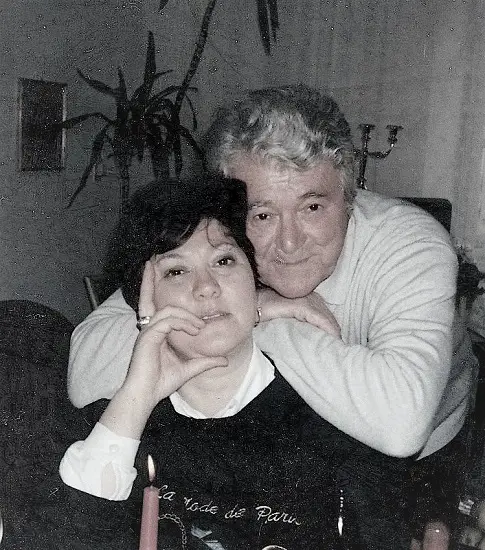
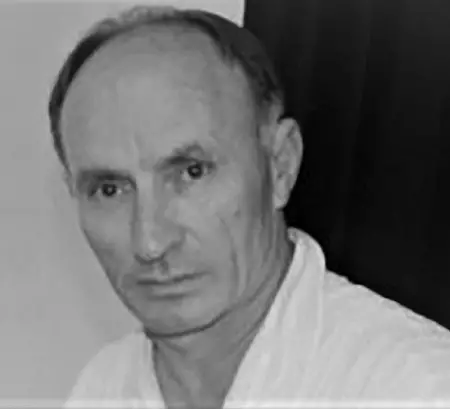
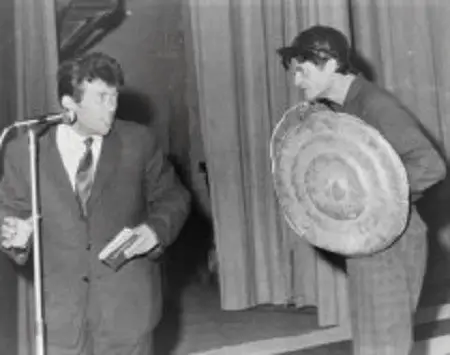
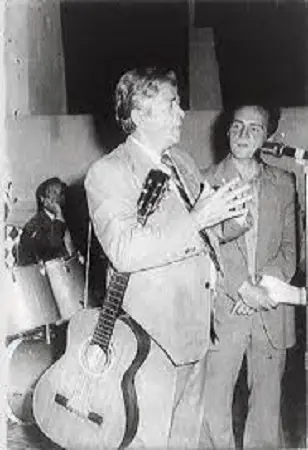
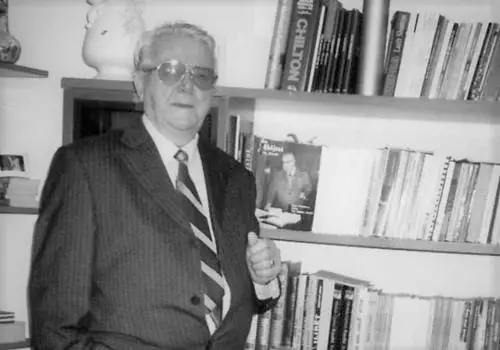
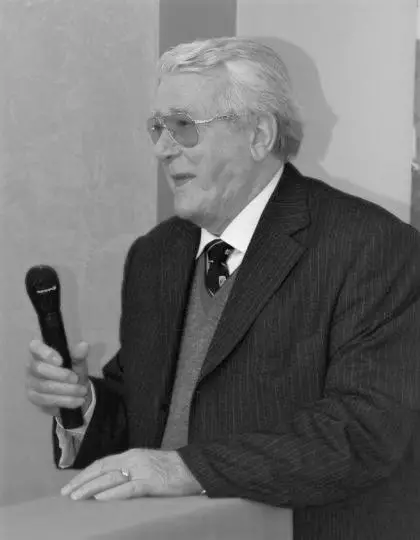
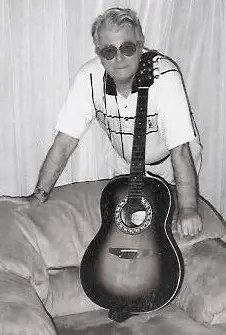
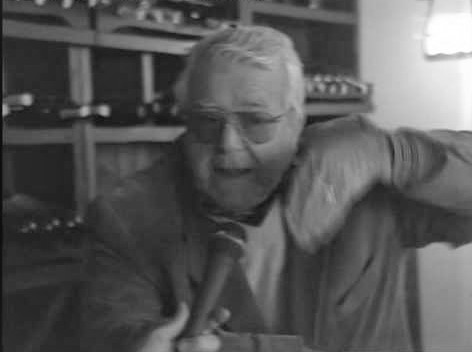
Memorie.al / For several years, the great Albanian humorist Gjosho Vasia rested in the city of Durrës, staying at the “Kështjella” hotel‑restaurant by the sea at Bërryl. Even though he carried over seven decades on his shoulders, Vasia, dressed in sportswear, together with his wife Blerina – with whom he had shared over 60 years of joy and suffering – was in quite good shape. In 1991, he immigrated clandestinely to Italy, but he wished to return in order to establish a humor group. Vasia said that he had bought an apartment in Durrës and that as soon as it was finished he would bid farewell to Trieste, the city where he had lived for 16 years. A stay by the sea to enjoy the view at “Kështjella” and the invitation of the establishment’s owner to have a coffee with the parodist who was “wounded and killed” by the communist regime gave impetus to our interview with him, also to bring back to the memory of art lovers – of whom he had many not only in the city of Shkodra but throughout Albania – a great actor of national stature.
Mr. Vasia, you started creating and playing the guitar early?
Internment taught me many things. My passion for the guitar has been my passion, my life, my suffering, and my joy. The guitar, humor, parody, sketches, various creations, stage acting, improvisations, and imitations have shaped my personality, given me the opportunity to express the desires of my people and to fight against the vices of society. Not to mention that humor interned me and “wounded” me, but also made me happy and joyful, as I met my love, with whom I have shared more than 60 years of happiness.
I was ready to die for the guitar. I took this instrument from a friend of mine and after learning six chords, I went to the “Piazza” of Shkodra, where a concert was being held, and I pleaded with the director Paulin Sekuj to give me the chance to perform. My persistence convinced him. I went out on the improvised stage in the square, in the middle of the “Piazza” – the place where the people of Shkodra still take their evening stroll, in their old and fanatically inherited ritual. Sekuj did not know me, but after seeing my persistence he agreed. I did not tell him my name, nor that was I the brother of Kolec Vasiaj, who had fled to Canada in 1948.
He was one of the students who took part in the funeral ceremony of Monsignor Gaspër Thaçi, in 1947 if I remember correctly. The police had placed a truck to block the road. The pupils and students of Shkodra lifted the truck and opened the way for the carriage carrying the body of the late Monsignor Thaçi. That is where the persecution began. Some of the participants in the funeral were killed by the State Security, while my brother fled first to Lusë in Kukës, and from there crossed the border, eventually ending up in Canada.
I had just returned from internment, and only a few peers in the neighborhood knew me, but I stayed away from them so as not to draw attention, lest someone later become interested in my biography. That is how I unexpectedly went up on stage. I performed a piece created by the great Pjetër Gjini. The “Piazza” erupted and demanded that I be brought back on stage to sing again. I did not know any other song and was forced to repeat the first two verses of the song I had sung. People learned my name and I began to be invited to evening gatherings and parties, while the State Security surveilled me.
How did your career as a musician continue?
Another night I was invited to the “Big Coffee”. The people of Shkodra know this place well, as do others who have visited the town where I was born. The waiter comes and asks me if I would like raki, vodka, Fernet, wine, or something else. I never drank alcohol. I told him to leave me alone, but my request was in vain. He told me there was also a ladies’ drink. It was called liqueur and was melon‑colored.
Like it or not, I accepted. After I drank it, people began to appear double and triple. My tongue also began to loosen. I was drunk on a 20‑gram glass. As soon as the evening started, I did not wait and began with the humor. I improvised jokes and melodies on the spot, played the guitar, and the laughter was endless – some fell off their chairs, others put their hands somewhere to hold on. With the guitar I was able to produce 12 voices.
Can you recall some episodes that left a mark on your conscience?
My real career began in prison in Durrës, where I was sentenced because I had been declared the winner of a National Spartakiad. I am perhaps the only person in the world to be condemned for being declared a national winner. I was a soldier in Durrës and there I registered for the high jump competitions. It was 1959, five years after I had returned from internment. My commander was a gentleman from Skrapar. I do not remember his name because I always called him “Commander”. He called me and with great trust told me that the State Security would not allow me to go to the national competition in Tirana.
My results were quite positive. I told the commander that I would find a way and I would go. And so I did. The Spartakiad lasted several days. I climbed onto a truck and as soon as I arrived near the Airport in Tirana, I jumped to the ground. I ran to the stadium and sneaked onto the track near the pit where the competition was about to start. A woman was registering the participants’ names. I approached and said: My name is Gjon Vërria.
The woman, who knew me because my results were well‑known, told me that my name was Gjosho Vasia, but I insisted on the first name. The competition started. I was declared the winner, and they began to take pictures of me. To avoid being recognized, I pulled the laurel wreath low over my head and twisted my face to distort my expression and my true appearance. The next day, the newspapers wrote: “Gjon Vërria from Durrës declared winner in high jump”.
In the newspaper I appeared with the laurel wreath lowered and my face distorted. But such a thing did not escape the State Security. A day later the name was corrected in the newspaper, while a Security agent summoned me. He took away my decorations and I was sentenced to 20 days in prison in my unit, because I had participated in the Spartakiad and been declared the winner!
And when did your career as a humorist begin?
My career as a humorist began here, in the Durrës Garrison, where I started to organize an Estrada [variety troupe] with those creations and orchestrations that I “cooked up” without anyone else’s help. Since the Estrada began to please my superiors, they decided to sentence me to a few more days to keep me for other numbers, but my commander intervened and asked me to return to my unit, from which I had set out for the Spartakiad. I have many memories, as I said – bitter and joyful.
After you were discharged from the army, you established and led many Estrada groups and influenced the development of many young artists. What do you recall from that period?
I returned to Shkodra and was assigned to work at the “Perlat Rexhepi” Farm, where I also set up an Estrada group. I found very rare talents such as Elez Kadria and Mërgim Muhja. We also took many others and won first place at the zonal competition in Shkodra. For the record, I always won first place in every competition. If you wish, write that fact once; if you wish, repeat it as many times as I assert my participation in competitions. (Laughs.) From there I went to the Cigarette Factory in Shkodra with other passionate names such as Muharrem Nurja, Tonin Tërshana, Fatmira Puka, Omer Osmani, etc. Our parodies, performances, imitations, libretto, direction, and everything else were liked by the juries, who always encouraged us with the first‑place trophy every year.
Why did you leave Shkodra, or did your biography become an issue?
In 1967, the “wild hunt” campaign had begun in our country, initially in art and culture. Later I understood that the Cultural Revolution had also begun in China. Feçor Shehu came to Shkodra and, on the road to “cleansing the stages” of “anti‑party” elements, before the artists and party members gathered especially for the meeting, he mentioned my name. Feçori reminded me, in front of others, that I had a brother who had fled. That is where my next ordeal began. I was transferred to the Vau i Dejës Hydroelectric Plant.
There was only one week left before the District Estrada Festival. I asked the director of the construction site to allow me to form an Estrada group. I was passionate about it and was not shaken either by Feçor Shehu’s words or by the transfer as a punishment. The director, a gentleman, gave me a car, and so I toured the site and gathered 15 young men and men, with whom I began rehearsals for long hours throughout the night. They were passionate and also had talent. Quickly, after one week, we went to Shkodra. Again I won first place and secured the right to compete in the National Festival in Tirana.
At Vau i Dejës, I also brought Zef Deda with me. I had seen him one day on the streets of Shkodra. He was around 16‑17 years old, and we knew each other’s families. He came from a very poor family. His father was an artist by nature, but died young, leaving young children. So Zef was forced to work. As soon as I saw him on the street, I asked him what had happened. He told me he had been fired because he had been caught sleeping on a shelf during the third shift. The director of the Vau i Dejës site, Napoleon Qendro, accepted my request and re‑enrolled him in a job. Zef became a true talent.
I had this confidence because he clearly displayed the elements of a true artist. He helped me tremendously, and this gave us the opportunity to win the “Gold Medal” in the competition we took part in. On the poster put up in Tirana for the Vau i Dejës Estrada, my name had been removed and the name Himni Ukaj had been written as director and group leader. At the end of the competition, our group received the “Gold Medal”. The then Minister of Education and Culture, Thoma Deljana, who had closely followed my persecution, called me, put his arm around me, and we walked together through the main streets of Tirana.
His aim was to rehabilitate me and to convince others of the abilities I had. But the satisfaction did not last long. In 1971, Fadil Paçrami brought me to Tirana to set up the Estrada at the “Stalin” Textile Combine, and in Tirana I also received an apartment. With the Fourth Plenum, only three years after I had been settled with an apartment in Tirana, the attacks against me began again. Many complaints had arrived from Shkodra because I had been transferred, while Paçrami, among other things, was punished for having supported me. So I returned to Shkodra, to the Cigarette Factory.
In 1991 you left Albania. What drove you to leave and make not a few sacrifices?
I left my country on 27 March 1991. I discussed it with my wife, Blerina, and we decided to sell the house to get the money needed for the journey. I was going to leave Albania, but where I would end up I did not know exactly. I left Shkodra and stayed a few days in Tirana. A relative told me that a girl who lived near the apartment where I was staying had a father who was a Security officer, and he could help me escape.
After some hesitation, out of fear of arrest, I agreed, but we had not met, as an intermediary handled it. He asked for dollars, and I agreed for two tickets from Rinas to Italy. The State Security officer took care of everything himself, from the passports to the boarding tickets at Rinas Airport. The day of departure came. When I entered Rinas, they pointed him out to me. I asked for his name, but he told me I did not need to know, and that he was the person I was looking for. He began to drive a hard bargain, asking for extra money.
First 100 dollars, then another 100, then 50 dollars. Then he told me that I would not be leaving that day. I jumped to my feet and insisted. Then he asked for another 100 dollars. I sat down at the end of the hall on a chair. To avoid being noticed, I took a newspaper and put it over my face so as not to be recognized, but to give the impression that I was reading. After 30 minutes I noticed that I was holding the newspaper upside down. What drove me to leave was the lack of freedom. I told this also to the Security officer when we said goodbye.
So, you were helped to escape by a State Security officer…?
He was interested in money, while Blerina and I were interested only in freedom. While I was going up the steps to the plane, I stopped halfway. I turned my head and saw the Security officer accompanied by the intermediary. There were many people at the airport who knew me, and when they asked, I told them I was seeing someone off and would return immediately. I was only three or four steps away from freedom, and I could not leave without thanking the one who helped me gain my freedom. As soon as I met his eyes, I approached and said with all my heart: “Thank you!”
On both sides of the steps there were soldiers, and our conversation had to remain unheard, otherwise I would end up behind bars. The Security officer immediately replied: “You paid for it.” I reacted and, under strong emotion, I answered back: “Freedom cannot be paid for!” That was it, and everything was closed for 15 years. I settled in Trieste, and I set foot in Albania last year. I live very well in Italy. My son Luciano has finished his studies and is employed at a research center in Canada, while my daughter Anxhela is in Trieste with her family.
Blerina and I will return to live in Durrës very soon. I aim to create an Estrada group, and I will succeed. I love art, the stage, the Estrada, and I cannot live without it. In Italy I have written many pieces. There are hundreds and thousands. I have also made a book of parodies titled “The Epic of the National Scum”, and I have written many comic and satirical pieces published in the foreign press, mainly American.
Meeting his wife during internment
Vasia: “On every anniversary of our meeting, I write a letter to my wife; so far there have been 55 such letters”!
A part of Gjosho Vasia’s life was spent in internment, partly in Tepelenë and partly in Skrapar. In fact, in Skrapar he also met his future wife. Today, after more than six decades, he not only remembers the first day they met, but he also commemorates it in his own – why not original – way…!
Regarding this, Gjosho recalls: “After my brother Kolec Vasia fled, the punishment was not long in coming. A year later, in 1949, we were interned in Tepelenë, which at that time was called the ‘Albanian Auschwitz’. It was a real torture to live there in those barbaric, enslaving conditions. We stayed until 1954, and I have many bitter memories. But I want to recall what gave me the pleasure to live and to be proud even today. After staying for several years in Tepelenë, we were transferred to Skrapar. It was 21 March 1952, a spring day.
I went out in Çorovodë, the district center. I was young and was watching the girls passing through the small town. My eyes fell upon the beautiful girl who later became my wife. Her name was Blerina. From her clothing, she seemed not to be from those parts. I approached her and without hesitation said: I am an internee, they call me Gjovalin Vasia. She too was an internee. Her father was Jonuz Kaceli, an intellectual condemned without trial and executed together with 21 other intellectuals in the case of the so‑called ‘Bomb at the Embassy of the former Soviet Union in Tirana’.
We fell in love and decided to unite. We devised our own code to avoid drawing attention. One day I crawled under the wire and, after passing unnoticed by the guards, I went to the spring where we met secretly. I left a letter on the anniversary of our meeting. I wrote that I had kissed her on the cheek, even though I had not yet kissed her. From then on, every year I write my wife a love letter. This year was the 55th letter, and Blerina keeps them all with devotion,” recalls Gjosho Vasia.
The 4th Plenum of the PPSH [Party of Labour of Albania], 27 June 1973: The “leadership” also deals with Gjosho Vasia…!
Muho Asllani: Gjosho Vasia, who was interned in Lushnjë, why was he supported?
Mehmet Shehu: This is Gjergj Gaberi, about whom I raised a warning over the phone. He is that saboteur who came from over there!
Mihallaq Ziçishti: Let Todi clarify these things for us, because he says: “I agree with everything that was said.” But let him clarify whether these were views or even factions.
Enver Hoxha: Now he will answer the questions.
Todi Lubonja: I think there are no factions here. My relations with Fadil Paçrami, despite the fact that a marriage alliance was formed between us – which did not depend on my will or desire – were not bound. The comrades can speak about that. Memorie.al