By Marsida T. Najdeni
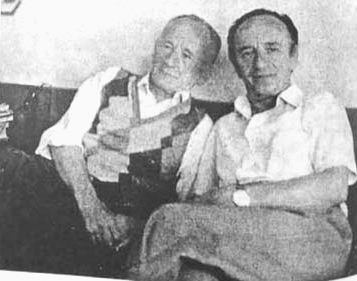
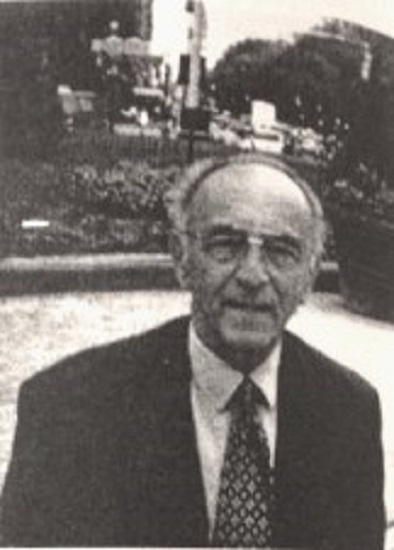
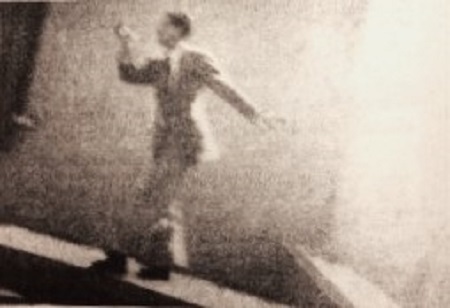
Memorie.al / Nuri are 88 years old, but his memory is as sharp as a young man’s. He can still feel his “tap-dance” steps under the rhythm of jazz music, as his once-elegant physique enlivened the hall of the famous “Nacional” Cinema-Theater in Tirana. Nuri may be among the first Albanians to perform this dance in Albania. Although “tap dance” has its roots in Ireland, it gained fame, spirit, and life in America, particularly during the first decades of the last century. It was popularized by New York’s Broadway shows and gained global recognition through Hollywood films featuring actors like Fred Astaire, Ginger Rogers, and Joan Fontaine. It is a rhythmic dance that reaches its peak through the skillful and melodic striking of feet against the floor.
One might rightly ask how this form of dance and music reached Nuri in the Tirana of the 1930s and 40s. The quickest answer would be: “Just look at Nuri’s surname.” But that would be too simple, and I would lose the opportunity to dedicate these lines to an artist we know very little about today.
The Beshiri Family
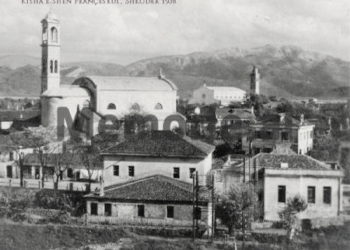
The history of the Beshiri family begins in the village of Besh in Tirana, where their surname originates. There, the family owned significant forested lands. Their arrival in the city occurred over three centuries ago, and their ancestors – as Nuri recounts – dealt in the trade and processing of timber for ships. The primary buyers were the Venetians of the time and the Austro-Hungarians, while Shkodra also remained a key recipient of the Beshiris’ processed wood.
The family wealth grew considerably during those three centuries, granting them an independence that allowed them never to hold official titles in Ottoman Albania. The traces left by this family are almost unbelievable – not only in the Tirana region, where they became one of the greatest houses, but undoubtedly throughout all of Albania.
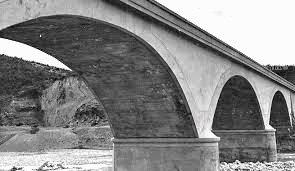
As custom dictated for wealthy families, they engaged in continuous acts of charity. The Beshiri family has hundreds of such acts to its name, but the one that has withstood collective amnesia is the “Beshiri Bridge” over the Erzen River. As we learn from the book “Old Tirana” by researcher Gazmend Bakiu, this bridge was first built around 1840 to facilitate the transport of goods westward and to prevent the drowning of villagers coming to Tirana to sell their produce.
The bridge was rebuilt several times because the Erzen River was very torrential; we learn this from the albanologist J.G. von Hahn, who visited the bridge in 1863, stating it was the third time it had been built by Ali Beshiri, at a cost exceeding 12,000 gold napoleons. Their charity extended as far as Dibra and Kosovo, driven by the plight of oppressed Albanians there. In Peshkopi, they are credited with building a large han (inn) for workers and travelers. In Kavaja, they built the “Teqe of Aleks” for Bektashi believers, named so because Emperor Alexander had passed through that road. This explanation is also provided by J.G. von Hahn, who attributes the construction of this religious temple to the Beshiris.
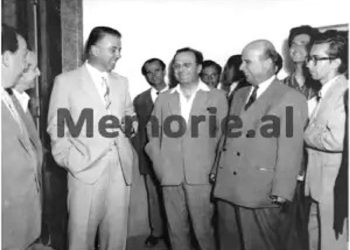
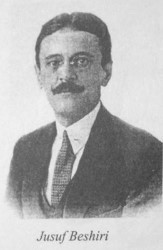
At the turn of the last century, a true patriot and intellectual was rising within the Beshiri family – Jusuf Beshiri, Nuri’s father. Born in 1887, Jusuf spent his childhood learning Albanian in secret at the Tirana primary school reopened by Filip Ashiku. In his written memoirs, Jusuf describes how he taught Albanian to his neighborhood friends after leaving Mr. Ashiku’s school. He further developed his patriotic spirit in Thessaloniki, where he attended the Lyceum under the influence of Albanian patriots known as the “Students of Thessaloniki.” In Thessaloniki, he paved the way for other Tirana locals like Jonuz Tafaj, Ali Fortuzi, and Bedri Toptani. Later, in Istanbul, where he graduated in Economic Sciences, he remained active in the circles of Renaissance patriots.
To understand Jusuf’s patriotic spirit and his activity in Tirana and beyond after returning from Istanbul in 1907, I am extracting a few lines from his diary, cited in Zenel Anxhaku’s book, “One Cinema, One Family, One City”: “With the fall of Sultan Hamit and the declaration of the Hürriyet (Liberty), I, along with Albanian patriots including a minority of intellectuals, formed a nationalist party named the ‘Albanian Party,’ whose objective was the liberation of the country from Turkish occupation. The Albanian Party, through its illegal activity and agitation, managed to increase its ranks, alarming the Turkish government, which urgently dispatched Turgut Pasha. In collaboration with the leadership of another anti-Albanian party, he made arrests among patriots and intellectuals. I was among those arrested.”
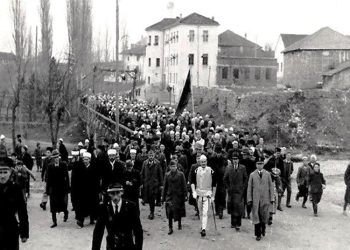
Indeed, this is what happened. We learn this from Kristo Frashëri’s “History of Tirana,” which sourced material from Ibrahim Dalliu’s “Patriotism in Tirana.” Both confirm that Jusuf Beshiri, along with other Tirana patriots like Ibrahim Dalliu, Beqir Luga, and Mustafa Mara, were dragged by horses from Tirana to Elbasan for an Ottoman trial; Jusuf and his father served 14 months in prison. This did not stop the Beshiris from joining the Toptanis on November 26, 1912, where, alongside other citizens led by Refik Toptani, they raised the red and black flag as a sign of independence from the Ottoman occupier.
Among the First Shareholders and the “Seventh Art”
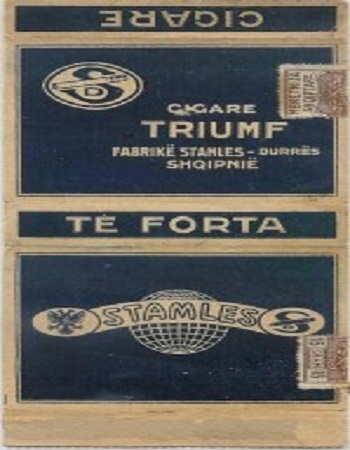
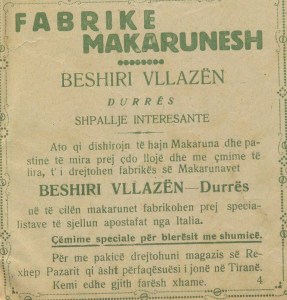
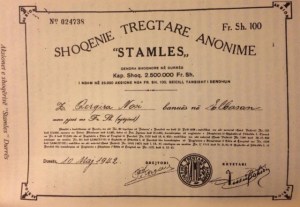
After the declaration of independence in 1912, Jusuf and his three brothers dedicated themselves to commerce in a way never before seen in Albania. Thanks to his economic knowledge and family tradition, the Beshiris opened a pasta factory in 1928, with branches later opened in Saranda and Vlora by Jusuf’s brother, Tahir. Prior to this, on February 21, 1922, the well-known “S.T.A.M.L.E.S” (Anonymous Trading Society for the Monopoly of Paper and Matches) was created for the production of cigarettes and matches, an initiative conceived by Jusuf Beshiri.
He gathered scions of wealthy families from Tirana and Durrës, assigning them specific shares. To understand the scale of this firm, one need only look at the figures: in 1942, its capital reached 2.5 million Albanian francs. By 1946, the number of shareholders reached 270; with a capital of 35,000 shares (one share equaled one hundred Albanian francs). Their Western-style economic progress was evident; S.T.A.M.L.E.S. workers received their wages every weekend at noon, and they were the first in Albania to provide a “13th-month salary” in December—a practice still common in many European countries.
The family’s patriotism is also reflected in the fact that all workers of the S.T.A.M.L.E.S society – those in tobacco, paper, and match processing – were kept on full pay throughout the entire Nazi-Fascist occupation.
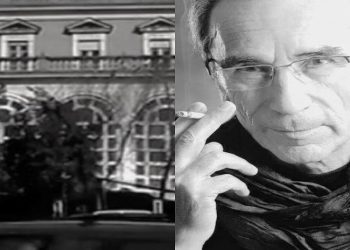
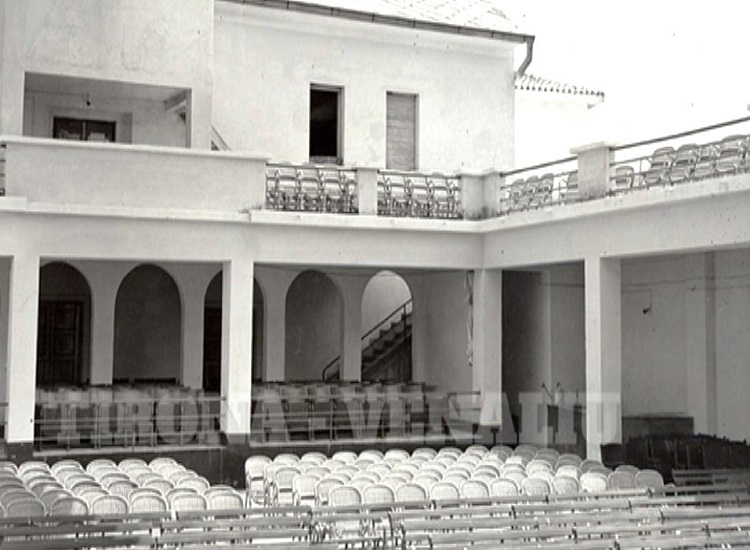
As journalist Fatmira Nikolli rightly wrote years ago: “The seventh art in Albania was brought and developed by Jusuf Beshiri from Tirana.” Indeed, fate decreed that Tirana should have a son as patriotic as he was artistic. It was Jusuf Beshiri who, on November 22, 1926, opened the “Nacional” Cinema-Theater in Tirana.
For the Albania of that time, where performances were rare occurrences in Shkodra or Korça, the creation of a cinema hall that also functioned as a theater was a major social achievement. The renowned publicist and educator Mati Logoreci dedicated endless writings and praise to Jusuf Beshiri’s initiative, especially as the latter opened similar halls in Shkodra, Durrës, Korça, Elbasan, and Berat.
Logoreci wrote: “Who does not know the Beshiri house of Tirana? One of the oldest families of this city always engaged in trade, spreading a clean and pure name in the commercial world within and outside Albania.” Indeed, Logoreci knew that the Beshiris’ trade crossed the Adriatic. Albert Getty and A. S. Marconi also wrote about their trading agency in Trieste. The “Nacional” Cinema-Theater thus became the first Western window for Albanians – another bridge the Beshiris gifted their compatriots toward the West.
Hollywood stars were presented there for the first time. To better perceive what the “Nacional” signified, we are aided by the memory of the world-renowned painter Ibrahim Kodra, who began his artistic journey working for the “Nacional,” creating the posters for film advertisements. “The ‘Nacional’ Cinema-Theater was a Temple of the Soul for Tirana,” Kodra said in an interview with Zenel Anxhaku. Thanks to the Beshiri family’s generosity, Ibrahim Kodra went to study in Europe, sponsored by them.
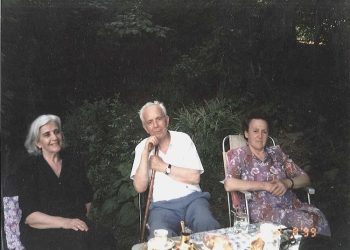
Nuri Beshiri was born in 1928; exactly two years after his father opened the “Nacional.” He grew up in an environment where figures like Ibrahim Kodra, Mati Logoreci, Mediha Frashëri, Eleni Qirici, and even the famous boxer from Turkey, Nasi Polena, were regular guests. His youthful imagination was fueled by Hollywood and Italian films. He spent hours studying every musical film that came to the “Nacional” and the “Rozafat” cinema (also opened by his father). Watching a ballet duel between Fred Astaire and Ginger Rogers was dreamlike for any boy in Albania at the time.
Nuri became proficient in several musical instruments thanks to private tutors hired by his father. While he learned the instruments to please his father, his mind was on that “strange dance” from American films. He and his sister spent long hours practicing tap dance. He never tired of jazz music, striking his feet on the floors of the “Nacional.” According to writer Dr. Lazër Radi in his book “Albania in the 1930s,” Tirana was buzzing with intellectualism during that decade – the artistic peak of Albania.
Few, however, knew how to appreciate Nuri’s “tap dance,” so his performances were often private or social. Using his father’s cinema hall, he performed for a select audience, becoming a source of joy for the capital’s youth. His generation would always remember him as the dancer of Tirana’s Golden Era. However, his art was cut short when the “Nacional” was seized by the communist state and renamed “17 Nëntori,” as if Tirana’s history began only with the arrival of the partisans.
Like many wealthy families of the time, the Beshiri family was swept into a vortex of confiscations, imprisonments, and a class struggle that lasted half a century. Nuri never danced tap again. He worked tirelessly as a typist for the state, while his transition years were spent over archives and files, trying to reclaim the property that rightfully belongs to him but is being exploited by the “thieves of the new millennium.” But Nuri finds personal happiness in his son, Jusuf, whom he purposefully named after his father. The elder Jusuf, Nuri, and the younger Jusuf are linked not only by genetics but by art – from cinema to dance and the piano.
The younger Jusuf Beshiri graduated from the Academy of Arts in Tirana in piano. Later, in Italy, he earned dual degrees from the famous Giuseppe Verdi Conservatory in Milan in Organ and Organ Composition, as well as Harpsichord and Baroque keyboard instruments. Thus, the younger Jusuf was the first to bring this musical spirit to Albania, where he now works as a professor at the Academy of Arts. Through countless concerts, he is widely recognized in the Albanian and European art worlds. May the history of this family be an inspiration for today’s Albanians? The example of this intellectual, patriotic, charitable, and art-loving family should inspire the “new wealthy” of today’s Albania to follow in the magnificent footsteps of the Beshiris for the common national good. / Memorie.al