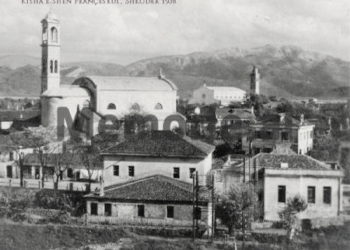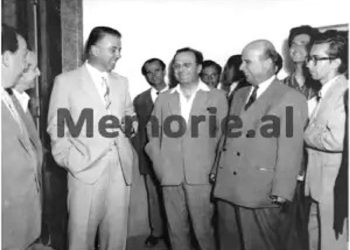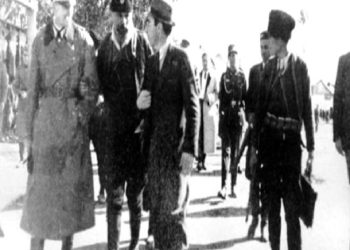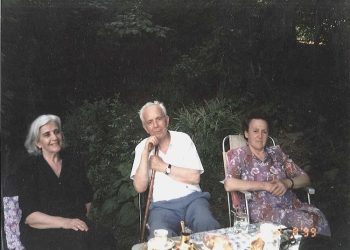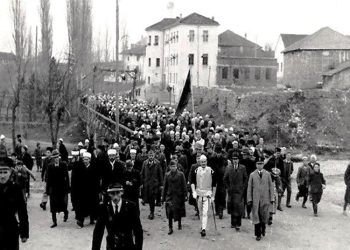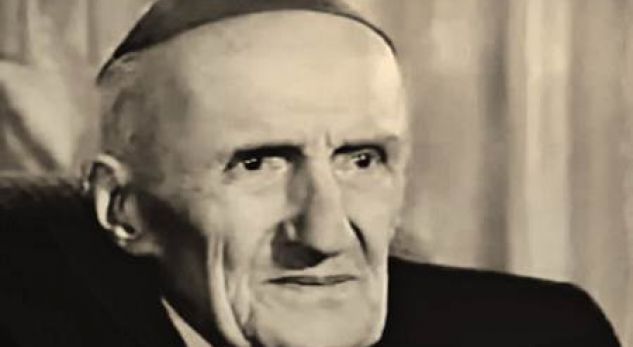
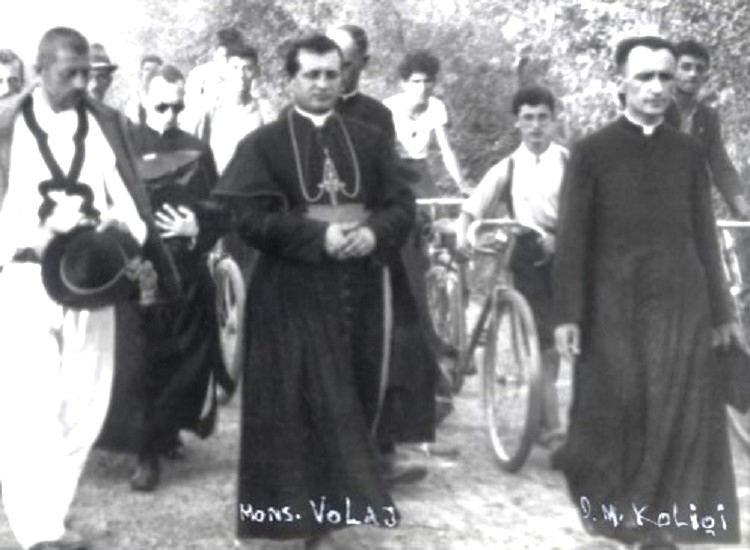
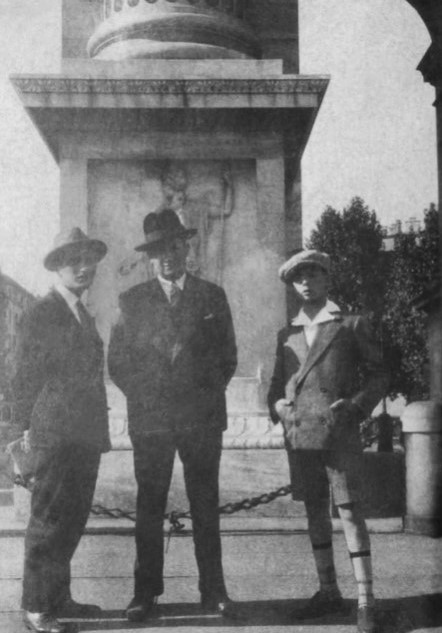
Memorie.al / Today we have dedicated a special portrait to the first Albanian Cardinal, Mikel Koliqi. This great man of the nation, he who became a living saint of Christianity and of his own country, so that Albania would reflect only peace, light, goodness, and culture, gave a great contribution not only to Christianity but also to art, in the field of music and Albanian culture. Mikel Koliqi was born in Shkodër on September 29, 1902, into a wealthy and respected family. His father, Marku, or Shani, as they called him, was a skilled trader and an influential man in Shkodër. Mikeli was the second child out of 8 children in this family (Ernesti was the first child and after Mikeli, Guljemi, Leci, Margarita, Antonieta, Viktori, Terezina. Today only Margarita in Shkodër and Terezina in Rome live).
In 1911, he enrolled in the Saverian College of the Jesuit fathers in Shkodër and in 1912, together with his brother Ernesti, they left for studies in Italy, near their uncle. In Italy, he successively completed the “Arecia” College for two years, the “Vilorez” College in Monza in the years 1919-1924, stayed in Brescia for one school year, obtained his high school diploma in Bari, one year in Florence, and then in Milan, where he studied for two years at the Polytechnic University, for engineering and then theology. During these years, Mikeli stood out for his broad culture and as passionate about music.
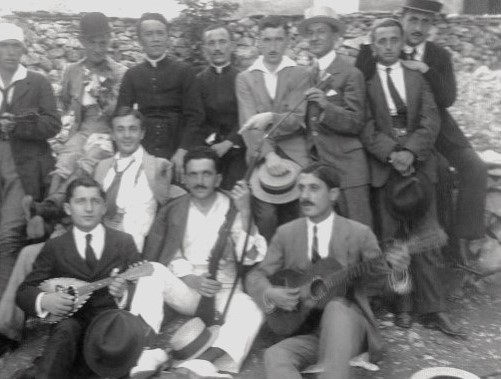
He played the piano from the age of 17 and harmony. He attended various performances in Italy, together with his friends and fellow students. One among them was the distinguished pianist Tonin Guraziu. In 1931, at the height of his studies, the grace of God called him to become a priest and to serve the people with heart. On May 30, 1931, he was ordained a priest by the distinguished Archbishop of Shkodër, Imzot Lazër Mjeda.
At that time, in the ’30s, Shkodër was in full artistic bloom. Respected names of the city had gathered the youth of Shkodër around them. It is said without fear that Shkodër was the capital of Albanian culture. Father Martin Gjoka, the first professional in Albanian music, had long created his artistic circle. The knowledge Mikeli had in music was self-taught, so he asked Monsignor Lugj Bumçi for a scholarship, or a music course.
Despite his efforts to find a scholarship in France, which was not achieved, Monsignor Bumçi managed to find a one-year specialization for Mikeli, near a famous Austrian choir, where he specialized as a choir conductor, which would later benefit him in his artistic creativity and in his work as a priest and later as a parish priest. In April 1936, he was appointed parish priest of Shkodër, having previously served also as deputy parish priest of the archdiocese of Shkodër. During this period, he also stood out as a musicologist. This is also the golden period of his musical creativity.
During his 10 years as a parish priest, alongside his work as a man of God, he played an important role in Albanian culture and music. In 1932, Mikel Koliqi created a choral group with the Latin name “Scuola Cantorum”, with high professional demands, even though it was only an amateur choir. With this choir, which also sang in the religious services of the Shkodër cathedral, Dom Mikel Koliqi became the initiator of revitalizing choral activities with works by known authors of world music, thus laying the foundations of cultivated Albanian music.
He founded the “Albanian Catholic Action”, and founded and directed the magazine “Kumona e së dielës” (Sunday Bell) (January 1, 1938 – November 1944), a cultural, religious magazine without forgetting social problems, dealing with the education of Shkodër’s youth in a way of moral and natural emancipation, based on the foundations of Christian doctrine. He created a studio where he also showed the films of the time, alongside his activity as a creator of church music. He created about 30-40 pieces for the Church choir. These pieces have now been lost, when his library was confiscated and everything of his disappeared.
The most important and culminating part of his artistic career is his creativity as a composer and precisely three of his melodramas. He laid the foundations of the Albanian melodrama.
Mikel Koliqi created three melodramas written by the well-known poet and dramatist Dom Ndre Zadeja. These were “Rozafa”, “The Siege of Shkodër”, “The Red Robe”, which have been transmitted to us as manuscripts. But even they have come to this day, thanks to a talented musician, one of his students, Tonin Harapi, who preserved these manuscripts for over 45 years in a row, a courageous act that expresses his high patriotic and cultural awareness.
(In November 1998, by the new choir raised under the name “Scuola Cantorum” which in 1991 by the composer Gjon Kapidani and which today is directed by the composer Zef Çoba, parts from his three melodramas were performed. These melodramas were studied and elaborated by his nephew, the esteemed composer who no longer lives today, Gjon Simoni)
“When I became a young priest, they knew I dealt with music, – Mikel Koliqi once said in an interview, before closing his eyes. – So I wrote some religious pieces. One day Dom Ndre Zadeja comes to the cell in the Parish House and throws on the table the literary piece ‘Rozafa’. Until that time, Albanian words were accompanied by foreign music. It didn’t seem pleasing to me that this old Albanian story should be accompanied by foreign music. So I started working in Albanian. I mean that the motifs of Rozafa are based on national pieces, so the other two melodramas also do not have a religious character.”
These works were the first starting point of our scenic music. Initially, this was to keep alive among the members of “Scuola Cantorum” the interest in attending the choir and simultaneously the entertainment of the people. The music of the first melodrama “Rozafa”, was set to music during the months of February – March 1936 and the show was given on April 26, 1936, at the Jesuit Theater. The show was directed by Dom Mikel Koliqi himself, who also played the piano. This show was also given on May 3 and 10 of that year. The melodrama consisted of three acts with eight musical numbers of various genres such as arias, duets, chorales, songs, and ensembles with soloists and choir. The show lasted about two hours, recitations plus music.
“To tell the truth, part of his memories, I made these pieces quickly, as I executed them myself on the piano and I didn’t have time to orchestrate them. The hall was completely full, mainly with young people,” Dom Mikeli recalled. In these melodramas performed Loro Bytyçi in the role of Rozafa, and later Nikollë Çuni, Tef Gjonej, Gjon Kujxhia, Joz Jakova, Pjetër Gjoka, Ndoc Jakova, Kolë Naraçi, Cin Lufi, Pac Luli, etc.
The melodrama “The Siege of Shkodër” was set to music on the drama with the same title by Dom Ndre Zadeja and was shown on April 26, 1937, one year after the first. This melodrama also consisted of three acts with six musical numbers and was performed by “Scuola Cantorum”. The melodrama “The Red Robe” was written and shown within the year 1937, on December 19. All three melodramas have a patriotic character and evoke the struggle of our people for independence.
During the fascist occupation, Dom Mikel Koliqi did not get involved with the war, nor with either side. He continued his work as a parish priest and simultaneously on his newspaper until 1944.
Meanwhile, we recall that his brother, Ernesti, had another intense literary and political activity. He was part of Shefqet Vërlaci’s cabinet as Minister of Education (April 1939 – December 1942). One of his greatest initiatives is the call he made to Albanian teachers to go as teachers in Kosovo, a call that many patriotic teachers responded to. In 1942, he goes as ambassador to Rome and never returns to Albania.
But Mikeli enjoyed great respect, an influential man in Shkodër, and this, as well as his brother, was one of the reasons that on February 2, 1945, he was imprisoned by the communist regime. Everything of his was confiscated, his library was destroyed, and his manuscripts disappeared. For Dom Mikel would begin the long road of Calvary, a frightening, very brutal road. In the years 1952-’53, he was released for a short time and then re-imprisoned again, to spend 38 years in communist prisons.
He served his sentence in all the prisons of the country and was treated specially, as not everyone could talk to him. He was constantly monitored. Hope in God kept him alive in that communist hell. Meanwhile, his brother Ernesti was an honored man, a personality in Albanian culture, founder of the chair of Albanian language and literature at the University of Rome. He maintained and nourished the Albanian language among the Arbëresh, and in his programs also included the names of writers who in Albania were slandered as “collaborators” of fascism.
One of the reasons Mikel was kept hostage in prison was also his brother, whom they constantly pressured by saying; “we executed him”, “we will execute him”, etc., so that he would not speak against the regime and would not develop political activity. Otherwise, they took care that Mikeli remained alive at all costs. With the death of his brother in 1975, his treatment also changed. In camps, he was isolated so he wouldn’t move. During all the years of prison, he came to Tirana only once, when he would be visited around the end of the ’70s and beginning of the ’80s. During the prison years, family members rarely went to him, as a harsher persecution awaited them. The one who visited him often was his niece!
With the death of the dictator Hoxha, the pressure on the power was great. How could an 84-year-old man be kept in prison?! The power released him in 1986. With both heart and fear, he was received at the house of his sister Margarita and his nephew Albert Kurti, son of the well-known musician Palokë Kurti, who took care of him until the last moments of his life, sacrificing and taking everything into consideration.
And Democracy came! The brutal communist night ended. Churches and mosques were opened. Dom Mikeli was on the verge of 90. Always with head bowed, light-hearted and smiling.
In November 1990, the courageous priest Dom Simon Jubani, publicly celebrated the first mass after 23 years in the chapel of the old cemetery of Shkodër. The Albanian government established relations with the Holy See and Dom Mikeli became the personification of the half-century persecutions that religion in general and especially the Catholic community he represented suffered during the dictatorship years. Although at the age of 91, Dom Mikeli exercised the duty of parish priest of Shkodër, which he had never abandoned but was relieved, at his request, from this duty due to age. In January 1992, the Holy Father, Pope Wojtyła, appointed him Bishop.
Dom Mikeli and Mother Teresa were two great figures of Christianity and simultaneously of the Albanian nation. They met in April 1993, in a dark room in Shkodër. Mother Teresa knelt before him, saying: “Give me your blessing because you are a martyr.” With modesty, Dom Mikeli tried to avoid this matter, but then blessed the hand with his own hand, the greatest Albanian of all times. The other meeting with the Pope occurred in April 1993, at the Archbishopric of Shkodër.
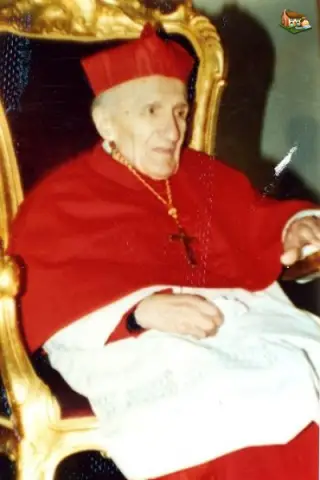
From the Holy See, he initially received the title “Monsignor”, while on November 28, 1994, Pope John Paul II ordained him Cardinal. In the hall full of light in the Vatican, with many people, when his name was called, he stood up. So tired, skin and bone, aged beyond measure, but with a noble face. Before various media, Cardinal Mikel Koliqi expressed himself with the greatest simplicity: “The Pope chose me as cardinal because I was the oldest and… Albania received the cardinal title.”
Thus, Dom Mikel Koliqi became the first Albanian cardinal. This marked the peak of his religious career. At the beginning of 1994, his brother Guljemi, nearly 90 years old, came from America. For a short time, the two brothers lived together until March 1996, when Guljemi died, leaving Cardinal Mikel alone again. In the autumn of 1995, he suffered an accident. They urgently sent him to Italy for treatment. Despite high care, the surgical intervention was not successful. Now he could no longer get out of bed.
On December 25, 1996, the President of the Republic went personally to his house to deliver the high decoration “Honor of the Nation”. It was the last honor paid to him. He died two months later in Shkodër on January 28, 1996, at the age of 94. He died surrounded by the high care of his sister Margarita, his nephew Albert, and his wife Xhina. His burial took place in his hometown on January 30, while the mass on this occasion was led by the envoy of Pope John Paul II, the Apostolic Nuncio in Albania, Ivan Dias.
Cardinal Mikel Koliqi was one of the special people who, thanks to broad culture and systematic work, manage to do great and important works for the nation. He was one of the clerics who quickly understood the time, reality, environment, and mentality surrounding them and naturally chose the style of work, the harmonization of religion with science, of eternity with death. “The life of Mikel Koliqi,” said Imzot Rrok Mirdita, “is a living symbol of faith in Albania. It appears in its natural development, even during the brutal ordeal, and in its resurrection.” / Memorie.al