
Memorie.al / The flash of a camera shutter records a historical document. The art of the darkroom recorded and documented many of the great historical events of our country. In this context, the photograph of the Vlora Government taken by Petro Dhimitri in November 1913 remains authentic and one of the only historical documents of the major event of the Albanian nation. This photograph was taken on the first anniversary of Independence. Thus, the path of research and illumination of the truth remains extremely long. This photograph has circulated in all publications. It has been thought to have been taken in the great historical autumn of 1912; in fact, the flash of light occurred one year later.
Under the rhythm of research to examine the history of a photo that circulated for 50 years in publications inside and outside Albania, presented as the photo of the day when national independence was declared, our historians told us nothing, while those who were conscious, instead of writing the date November 28, 1913, and fixing the location on the balcony of the house-museum of Independence, the seat of the Vlora government, they wrote: November 28, 1912.
We remain aware that the photograph did not depict the culminating moment of the last days of the third autumn of 1912. Although it remains rare and irreplaceable. Its flash is a story. Before history, we become speechless and surprised. We have an irreplaceable document.
The passage of years from November 1912 has limited our history, but not the truth. However, this photo from 1913 is significant and a historical reality. In the end, better than nothing, this photo, which depicts November 1913, one year after the raising of the flag, serves as a limit.
Its images bring forth those distinguished men of the nation who gave name to our national Independence. The perpetuation of history by the distinguished Albanian photographers of the time deserves great attention. If it weren’t for them, those days would remain incomplete for us. Therefore, this photo is of great importance. True, it was taken within the time frame of 365 days later, but it shows more; it brings views of the Vlora Government on the balcony of its seat in Skela, Vlora.
Ismail Qemali’s Cabinet, who took the photograph of 1913?
Photography researchers have identified the photograph that is preserved and testifies to our history of Independence. It concerns the photograph showing the Cabinet of Ismail Qemali’s Government in November 1913. What does the photograph show? The government cabinet has come out on the balcony of the seat of the Vlora government. The first row identifies Ismail Qemali and four members of the government and behind this row are the other members of the cabinet.
On the left side is a flag. The building as a seat served as shelter for the government, and it has two windows on the upper floor, where other people can also be distinguished. In front of it, citizens are visible with national flags in their hands.
How and who took the photograph?
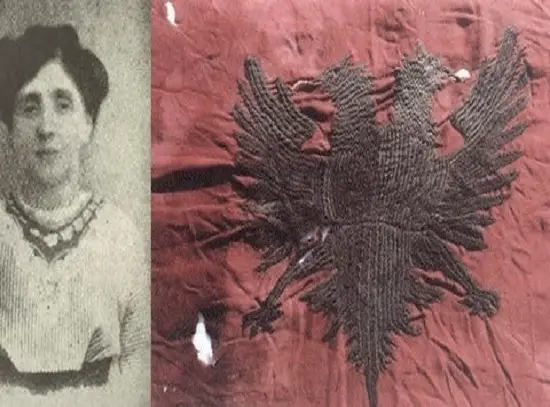
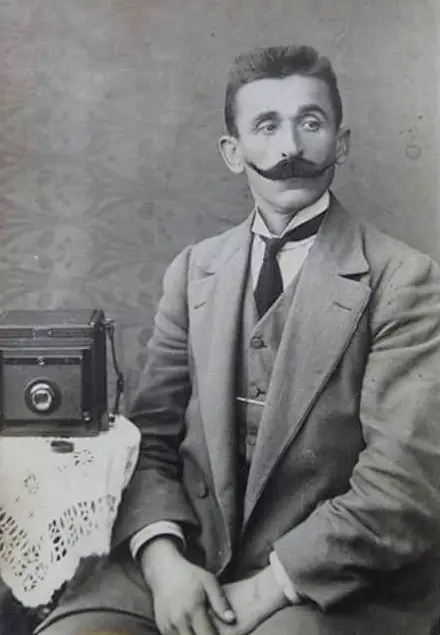
A chronicle about Petro Dhimitri, ‘The Photographer’ (1869-1946), published by Albania Site on Friday, September 18, 2009, states: “In 1912 in Vlora, Petro the Photographer carved the flag’s stamp [block] in wood, and together with Marigo Posio and Thanas Floqi, stamped thousands of flags and qylafs [fez caps] that adorned Vlora on November 28, 1912.” (“Zëri i Vlorës”. Vlora, October 12, 1972).
“That day in Vlora, thousands had come from all parts of Albania,” the writing continues. “They were men who had spent their entire lives in the mountains, fighting for this day. They were Albanian emigrants who had given their minds, wealth, and youth for the freedom of the homeland. They had descended from the mountains, from villages and cities, and all the men, women, young and old, were weeping tears of joy. The flag of Albania that day, more than ever, was a symbol of freedom, and the black double-headed eagle on a red field reminded the people of the great and long suffering they had passed through and the famous wars against five centuries of tyranny.”
Thanas Floqi in his memoirs would express himself thus: “But during those historical days, together with my brother’s sister-in-law, Marigo Posio, as well as with Petro the Photographer, we prepared and carved in wood the flag’s stamp [block] that was then used for the reproduction of hundreds and thousands of other flags that waved during the celebration throughout the historic city of Vlora.” (Memoirs of Thanas Floqi titled “My Life Story”, kept by his family.)
It is the merit of Master Petro that today; we see with admiration the photographs of the celebration of the first anniversary of the Declaration of Independence. The photograph of the delegates of the National Assembly of Vlora, as well as that of Ismail Qemali and others on the balcony, are immortal works of the Korça patriot, Mr. Petro.
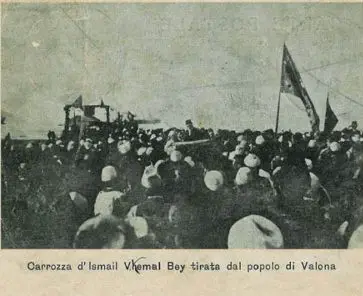
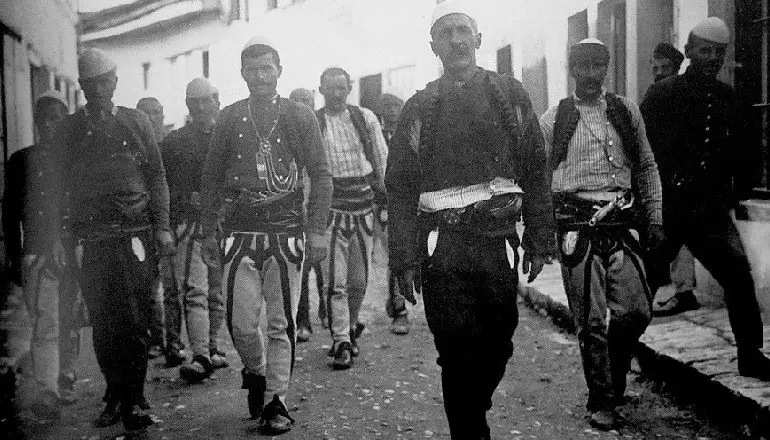
On the first anniversary of the declaration of independence, as the photographs show, he together with other patriots celebrated through the streets of the city of Vlora for this event, holding in their hands the portrait of the National Hero, Skanderbeg, and the red and black flag.
Researcher Qerim Vrioni, in the publication: “150 Years of Albanian Photography,” among other things, writes: “Petro Dhimitri (1861-1946). Petro Dhimitri was also a member of the guerilla bands of Çerçiz Topulli and Mihal Grameno and left several photos of the drama ‘Besa’ by Sami Frashëri, which was shown in Korça in 1908. Unique for their historical values are Petro Dhimitri’s photos in Vlora, on the occasion of the first anniversary of Independence (28.11.1913), especially the one depicting Ismail Qemali with the members of the cabinet on the balcony of the government building.”
The Residence of the Vlora Family
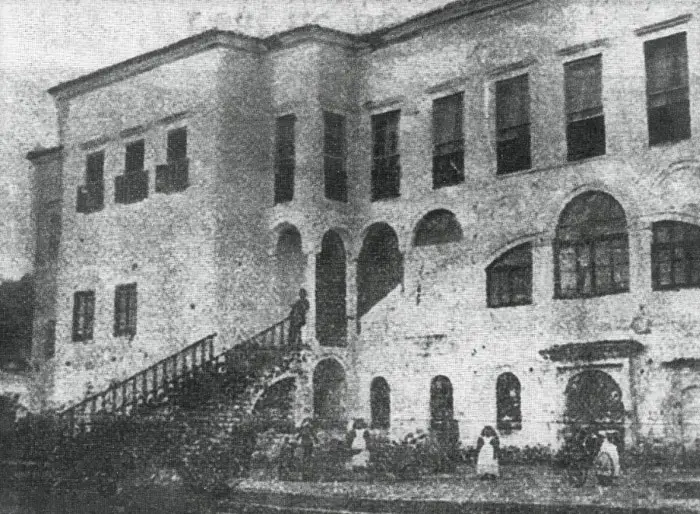
Eqerem Bey Vlora, in his memoirs, among other things, says: “Upon returning from Kuçi, I immediately went to the house of my cousin, Xhemil, to meet the head of the Provisional Government. The house was a reduced copy of the haremlik and had not four, but three floors. Through the connecting door, I entered the hall on the ground floor, where the large staircase was.” Further, he states: “On the upper floor, there was a large salon, furnished with beautiful Biedermeier style furniture…”!
It was built on the spot now occupied by the garden, in the city center, near “Flag Square”…! The building was demolished around 1925. It occupied an area of 4.53 hectares. On one of the middle balconies of this house, Ismail Qemali raised the Flag. The typical residence where the flag was raised belonged to Xhemil Bey and was located far from the first one, hundreds of meters away.
The photograph reflecting this moment showed a two-story building with a balcony, which was located by the seaside, while the house of the Vlora family, in the building called Selamllëk, on its second floor, hosted the Assembly of Vlora, which was located in the square where the monument and the “Sazani” hotel are today, presented a construction with a particular style of the time, three stories high and a number of windows, where the flag was raised at the spot which was also the entrance to the residence.
The Flag building was demolished, according to some data, in 1925 and turned into a garden. Qazim Kokoshi was at the head of the Municipality when the buildings were demolished. From that complex, the one that remains belongs to Eqrem Bey.
The Building, Seat of the Government in 1913
The history of this building recounts that until 1939, it continued to function as the Archaeological Museum, inaugurated on October 8, 1937. In 1939, the Italian occupiers burned the building where the Vlora government had resided. The building was rebuilt in 1962, with the same style and appearance it had before the burning, carried out by the Italian occupier in 1939.
After that year, the building functioned as the Museum of National Independence. Inside, photos, documents, weapons, works of art, relics of Albanian personalities from the period of the National Renaissance and Independence are arranged. In this building are the offices of Lef Nosi, Mehmet Dërhalla, Luigj Gurakuqi, the hall of the ministerial cabinet where the Vlora government met, etc./Memorie.al