
By Gjet Ndoj
Part Two
Memorie.al / Gjin Marku was born on June 2, 1918 (in documents, it is recorded two years later, in 1920), in the village of Baz, into a family with a reputation in that region. When Gjin’s father, Pjetër Marku, died, his friend Hysen Selmani, as well as his business partner Abaz Kupi, took nine-year-old Gjin and sent him to Tirana, to the “Orphanage.” Here, Gjin received his first primary and five-year education. In the years 1932-1936, Gjin Marku finished the “Harry Fultz” Technical High School in Tirana and later in Kavaja (only two months), in the Agriculture branch. After finishing school, he was appointed agronomist in the Korça district. In 1945, after the war, Gjini, like many other war leaders, was assigned to pursue studies in the military field in the Soviet Union. He was among the few students from Albania who attended the “Voroshilov” Academy in Moscow.
Continued from the previous issue…
Alarm in Tirana
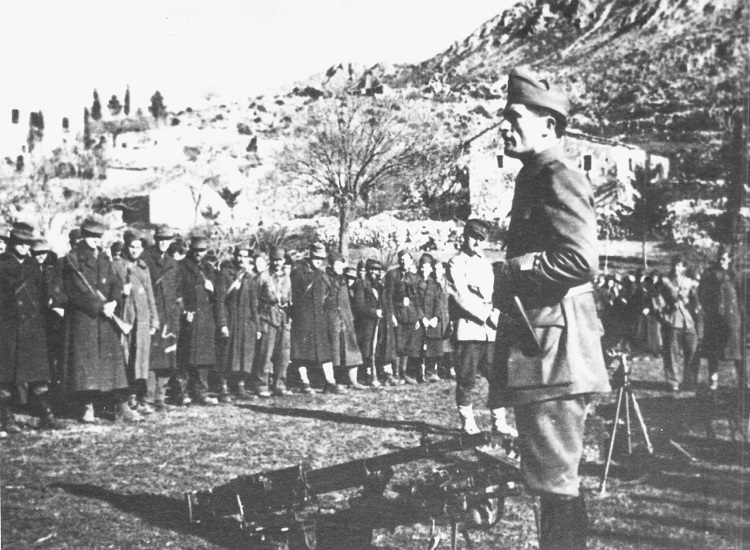
After this moment, the alarm in Tirana became even greater, because not only did they not disarm the guerrilla band, but they were disarmed by it. After this new situation, Gjini did not sit idle, but took measures by organizing the men from Skrapar and now attacking Çorovoda, the center of Skrapar. After several battles, the fascist authorities (the number of fascist forces exceeded 600), defeated, surrendered Çorovoda on September 5, 1942, thus marking an important event of our Anti-Fascist War, as the liberation of Skrapar also marked the first area liberated from fascism in Albania.
This was the biggest event of the war for the year 1942 in Albania. Even the fascist viceroy in Albania, Jacomoni, mentioned in his notes that; “Italy had the most difficult situation in Skrapar.” The same thing is said by the General Commander of the fascist Carabinieri in Albania, General Volante. The same thing is said by the Chief of the General Staff of Italy in Rome, General Cavallero. Referring to such data, in November 1942, Radio London also spoke, announcing that there were combat operations against the Italian fascist regime in Albania, etc.
Albania, an Ally against Fascism
In conclusion, we can say that the words of these exponents of fascism unintentionally popularized and made our war known outside Albania as well, a war which had now entered a new, more intensive, and more interesting phase. After the liberation of Çorovoda, the Skrapar guerrilla band became very active, operating now even outside Skrapar, such as in Berat, in Kolonja, where it destroyed the carabinieri post. Likewise, in Qesaraka and Barmash of Kolonja, in Frashër of Përmet, etc.
On November 28, 1942, about 100 partisans from Skrapar, inspired and led by Gjin Marku and with commander Xhelal Staravecka, who led another important band in Skrapar, attacked Përmet, one of the most important bases of fascism in Albania. The partisan incursion towards Përmet, despite not leading to its liberation, had repercussions abroad as well.
Thus, until the end of 1942, throughout the South, the famous commander was Mestan Ujaniku, while the commissar was Gjin Marku. “Some time would pass before other war leaders became known, such as Hysni Kapo, Mehmet Shehu, etc.,” recalls veteran Skënder Malindi. The events of 1942, especially the liberation of Skrapar and the partisan attack on Përmet, changed the opinion among the allies that Albania was not a country used by the fascists to attack its neighbors, but that Albanians had aligned themselves in the war against it.
For this reason, in December 1942, the British Foreign Minister Eden, the US Secretary of State Hill, and the Soviet Foreign Minister Molotov recognized the war being fought against fascism in Albania and projected the idea that after the war, Albania would be recognized by the allies. (These facts are also mentioned in the memoirs of the English officers who came later to the General Staff of the Anti-Fascist National Liberation War).
From a military strategic point of view, the greatest importance of the liberation of Skrapar was linked to the fact that a free territory was created, which would be the most important strategic base of the anti-fascist forces of Albania. From this free patriotic region, there would later be incursions by partisan forces towards Përmet, Korça, Berat, Mallakastra, Fier, Lushnja, etc.
The influence of the men from Skrapar and of Gjin Marku on the formation of the 1st Brigade, the 7th Brigade, and many other anti-fascist formations would be decisive. In this view, if we say that we had an Albanian Anti-Fascist War, we say without hesitation that the “cradle” where this movement was born is Skrapar. Naturally, later this liberation movement developed and took on proportions outside Skrapar as well, especially in 1943 and onwards.
Why was the Ballist-Partisan action for the liberation of Berat rejected?
In 1942, Skrapar became the place where the Ballist Movement was born and inspired. The inspirers of this movement were intellectuals from Skrapar such as Abaz Ermenji, Muharrem Kapllani, etc. “Although from Skrapar,” recounts Skënder Malindi, “they could never have the influence of Gjin Marku.” Perhaps this was also because ‘Balli’ was created when the mission that the men of Skrapar with Gjin Marku had for the freedom of the country in the war against fascism had started and it was impossible to stop halfway.
On the other hand, as contemporary war veterans affirm, it appears that one of Gjin Marku’s great merits is that he never exploited his power to burn or kills his Ballist opponents. This was precisely his strongest point, which made him the most influential man not only in Skrapar but also in Berat, Përmet, Gramsh, Mallakastra, Fier, Lushnja, etc.
The Proposal
In the spring of 1943, the Ballist leaders Abaz Ermenji and Muharrem Kapllani proposed to Gjini the organization of a joint Ballist-partisan action for the liberation of Berat. It was agreed, but at the moment when the Ballists insisted that in the leading staff of this operation there would be three Ballists and only one partisan, Gjin Marku rejected this project, which remained only on paper. The main reason was related to the fact that the balance of forces on the ground was completely different, incomparably in favor of the partisan forces led by Gjini.
Likewise, the opposition was also related to the other fact, that in case of victory, ‘Balli’ sought to benefit at the expense of the partisan forces, the credibility of leading the “War,” when they had few forces on the ground. However, the Ballists tried to launch an action, which failed almost before it started. Meanwhile, in the territories of Mallakastra, Fier, and Lushnja, a band of outlaws operated that called itself a Ballist band, but in fact it was more of a criminal gang and until that time was not influenced by the leaders of ‘Balli’. The command of this gang was held by Isa Toska, who was not only a tool and convinced collaborator of the fascists but had committed many crimes, killing, burning, and looting the innocent population.
Help for Mehmet Shehu
In mid-July 1943, Mehmet Shehu, who at this time was operating at the head of some partisan forces in Mallakastra, sent a letter to Gjin Marku, the main leader of the anti-fascist movement in the Berat district, which also included Mallakastra. This letter was a request for help with forces from Skrapar (which at this time had the most organized and battle-tested forces) in the war against the Italians and the forces of Isa Toska’s criminal gang. After this, Gjini sent about 100 partisans from Skrapar to help Mehmet Shehu’s forces.
After these coordinated combat actions up to this time, as well as with the instructions given by the General Staff, conditions were created for the formation of the First Assault Brigade, on August 15, 1943, in Vithkuq of Korça, the largest combat unit until that time. Mehmet Shehu was appointed commander, while Tuk Jakova was commissar. To this brigade, Gjin Marku sent forces from the Berat district that constituted the 2nd Battalion of the 1st Brigade, mostly from Skrapar and Mallakastra. With the other forces of the Berat district that were not incorporated into the 1st Brigade, Gjin Marku planned and carried out the encirclement of Berat, from the Pasvan Pass to Vodica.
At the same time, Isa Toska with his extremist forces, together with the Italian fascist forces, prepared the plan for the elimination, according to him, of the so-called “Rebel Republic of Skrapar.” In a conversation that Isa Toska had with the commander of the Berat Gendarmerie, he said that; “we will make Skrapar like Abyssinia and its leader like the Negus” (the former King of Abyssinia before the invasion by Mussolini in 1935). The anti-fascist forces and Gjin Marku got wind of this plan, being informed about the details of the plan, as well as the above statements.
“In this situation,” testifies veteran Skënder Malindi, “before Isa could get tired coming to us, we went to him. Our crushing battles against his gang took place in the village of Luar (near Roskovec).” In these battles, 5 partisans were killed. Here, veteran Skënder Malindi, one of Gjin Marku’s closest comrades-in-arms, was wounded for the second time. On the other side, Isa Toska’s forces were completely routed, with dozens of them killed, and the rest taken prisoner. Isa Toska himself and his brother escaped by fleeing without his outlaws (prisoners and dead).
This was the last event against the Italian fascist troops, as on September 8, 1943, Italy capitulated in World War II. In this situation, after the withdrawal of the Italian army, partisan forces entered Berat, led by Gjin Marku, and Ballist forces led by Ali Këlcyra and Abaz Ermenji. After the departure, the Italians left the depots filled with food, clothing, and weapons, most of which were taken by the partisans. In early October, the partisan forces drove the Ballist forces out of the Berat base.
This happened because of distrust towards Balli, a distrust that was not suspicion, but now a conviction for the partisan forces, but the main thing was related to the harsh opposition of the Communist Party after the Mukje Agreement. “I believe there’s not much need to tell you how necessary it is to resolve the Balli issue wherever you go. The Ballists and especially their leaders are playing many vile tricks. Gjini has made quite a few mistakes. Therefore, no mercy for the leaders and a little more mercy for their army of deceived villagers… Greetings to Shpat”.
Risk of Civil War
Until the summer of 1943, during the War, relations between partisans and other anti-fascist Albanians were not only not hostile, but often cooperative in the fight against fascism. This phenomenon was evident from the beginning in the relations between partisan forces and those of nationalists such as; Abaz Kupi, Muharrem Bajraktari, Myslym Peza, Dali Ndreu, Baba Faja Martaneshi, Haxhi Lleshi, Mestan Ujaniku, etc. The tactic of the Communist Party was to turn all the anti-fascist efforts of these nationalists and many others into a movement led by the CPA.
This process occurred from the end of 1941 until 1943, when territorial bands began to transform into partisan bands. So the bands, besides their commanders in the vast majority, also had commissars who were emissaries of the CPA and who took special care for the post-war victory of power by the CPA and only by it.
At the end of this process, the Communist Party achieved its goal, winning over in a very short time the commanders and their bands, such as: Myslym Peza in Tirana, Mestan Ujaniku in Skrapar, Haxhi Lleshi in Dibra, Baba Faja in Mat and Biza, etc., but it failed to subordinate the anti-fascist-patriotic bands of Abaz Kupi, Muharrem Bajraktari of Luma, Abaz Ermenji in Skrapar, etc.
Thus, by the autumn of 1943, the partisan forces constituted the main anti-fascist force in Albania, while the other anti-fascist forces remained only detached fragments destined to disappear completely by the liberation of Albania (November 29, 1944). This phenomenon is clearly reflected in historical documents, especially in the circulars and orders given by the Central Committee of the CPA and Enver Hoxha to partisan combat units. In a letter that Enver Hoxha sent to all district committees after the Mukje Agreement, his tendency to also come out against the CPA delegates who signed the Agreement unconditionally and with the tendency to bring everything under his control is clearly visible.
“Dear comrades, be informed that a treaty signed by the Committee for the Liberation of Albania has been sent from Tirana for distribution, which talks about the complete unification achieved between the National Liberation Council and the Balli Kombëtar. This treaty is in opposition to the National Liberation line and is not approved by the Central Committee of the CPA. Therefore, if you haven’t distributed it, tear it down and let it not be spoken about anymore…!
In case the treaty has been distributed, either by you or by Balli, then devalue it, say that the matter is to truly fight against the occupier and for a democratic Albania and not to sign papers that Balli has so far openly opposed with its deeds….! Insist to the people that Balli has sabotaged our war…. You must denounce Balli in order to detach it from the people, not with open war, but in the form of an appeal.
You must, comrades, understand that Balli is mobilizing for the armchair, to fight us – we must therefore be careful to strengthen our ranks and mobilize the people around us…! We must not let the reaction… take the reins from our hands…! Be careful to mobilize the councils and friends. Our agitation must cover that of Balli ten times over…! Be careful to organize educational groups…, strengthen the councils, strengthen the organization in the National Liberation Army (without the Party organization there is no band, there is no National Liberation War)… (08/08/1943). Fraternal greetings from the Central Committee of the Party ‘Shpati'”.
Enver Hoxha’s only preoccupation, therefore, was his victory for power through the CPA and not the war, since its fate was determined by the actions of the allies: in the East, the USSR, and in the West, the USA and England, etc. “Dear comrades… we are informing you of the situation and the measures you must take, especially regarding the internal situation. The great Soviet offensive carried out in a vast and new style and on a front of more than one thousand kilometers, is thus going liberating cities and wide regions.
Before the tanks, planes, and before the ingenious strategy of our great comrade Stalin, Hitler’s gang and his supposedly invincible German strategy suffered a shameful defeat and the glorious Red Army led by the Bolshevik Party is preparing the speedy liberation of the Soviet Union and other peoples…! The situation in Italy developed very rapidly after the opening of the Second Front in the West, in Southern Italy.
Italy surrendered unconditionally…”. Apparently, from this time, Enver Hoxha, separately from other leaders, was much more careful about the future of power than about the fate of the War, since after the strike against the Germans by the “Red Army” at Kursk, in fact, the “Decline” of Hitler’s Army and the certain victory of the “allies” are marked. / Memorie.al