By DASHNOR KALOÇI
Memorie.al / It was December 16, 1973, when the newspaper “Zëri i Popullit,” the organ of the Central Committee of the PLA (Party of Labour of Albania), published as its lead editorial a long article by the head of communist Albania, Enver Hoxha, regarding the armed conflict in the Middle East, which spoke in harsh tones against what he termed “savage and barbaric diplomacy.”
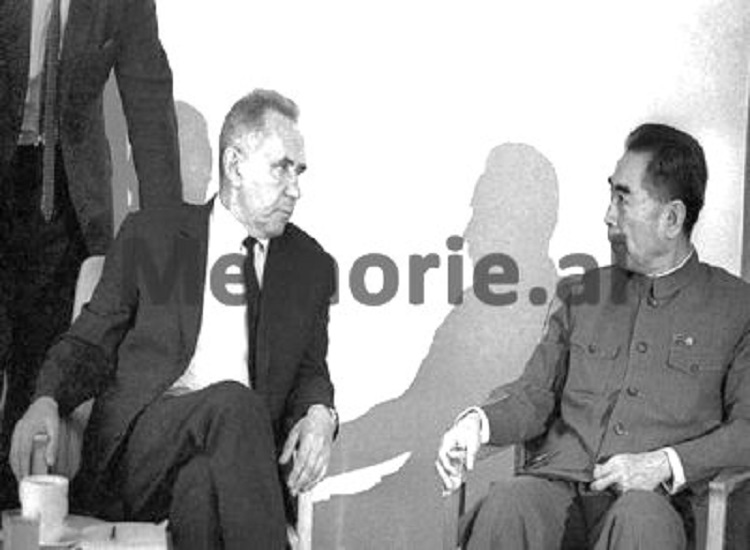
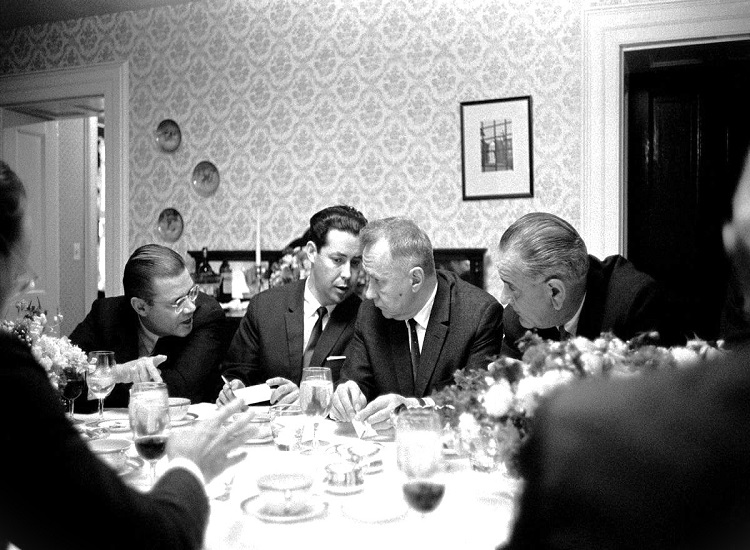
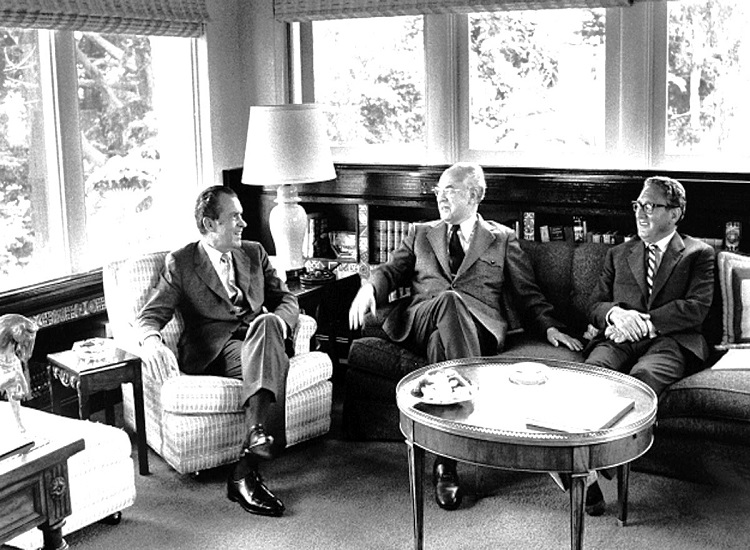
Through a “stinging analysis,” the article accused the foreign ministers of the USA and the Soviet Union – or the “two superpowers,” (as official Tirana commonly labeled them), Henry Kissinger and Alexei Nikolayevich Kosygin – asserting that the war in the Middle East was nothing more than a tool of pressure to strengthen the hegemony of the two superpowers. According to the primary leader of communist Albania, “this is not simply a newspaper article, but a severe indictment against ‘vault diplomacy’.”
According to Enver Hoxha, “at the height of the Cold War, Albania became the only voice that dared to say that atomic weapons and ultra-secret treaties were not for security, but for the plunder of the peoples’ interests.” Always according to the analysis of the main leader of communist Albania, “while Washington and Moscow advertised a new era of ‘eternal peace’,” official Tirana sounded the alarm about what it described as “secret diplomacy.”
The article published in December 1973 in the newspaper “Zëri i Popullit,” which Memorie.al brings in full in this writing, “unveils the dangerous backstages of the Brezhnev-Nixon meetings, from the oil crisis in the Middle East to the bargaining with the freedom of nations,” where Enver Hoxha, at the height of his grand delusions and mythomania, “as a leader of the world proletariat and a worthy successor to Marx, Engels, Lenin, and Stalin,” strove to show Albanians and the whole world how the Albania of that time openly challenged the two greatest empires on the globe, labeling their agreements as “a heavy debt that enslaved the peoples.”
Today, when the conflict in the Middle East (between Israel, the USA, and Iran) risks escalating further and the world is once again facing a reconfiguration of zones of interest, this historical document also serves as a rare testimony to the political line of the Albanian state at that time under the leadership of Enver Hoxha, who did not hesitate to denounce and raise his voice “against international dictate and the ‘diplomatic parasites’ that eroded the sovereignty of small countries.”
“THE SECRET DIPLOMACY OF THE TWO SUPERPOWERS – A GREAT DANGER TO THE FREEDOM AND INDEPENDENCE OF THE PEOPLES”
Article by Enver Hoxha, published in the newspaper “Zëri i Popullit”
December 16, 1973
To listen to the propaganda of the United States of America and the Soviet Union and the echo given to it by their satellites, it would seem as if the sole and primary preoccupation of Washington and Moscow is now the reduction of tension between states, the resolution of disputes between nations, the securing of peoples from every aggression and intervention, and the establishment of peace once and for all throughout the world. The newspapers and magazines, radio and television of the American imperialists and those of the Soviet revisionists, with thousands and tens of thousands of propagandists, priests, spies, and zealous town criers, are shouting in all directions that American and Soviet diplomacies are losing sleep to realize this “peace” and “eternal security,” the likes of which humanity has never known since its creation.
And the American and Soviet leaders have abandoned all their comforts to crisscross the capitals of the world in search of the “promised peace.” Behind them, ministers and ambassadors, emissaries and agents of all kinds, ranks, and categories are running from one country to another to find some path so that the “American-Soviet peace” can then pass without obstacles and pour over the entire world. But this is a demagogic fog with which the great masters of the United States of America and the Soviet Union want to cover the filthy back stages of their secret diplomacy. Since 1908, Lenin has unmasked the hypocrisy of this diplomacy.
And who can believe that Soviet and American heads meet head-to-head and in private for the purpose of casting away weapons, returning peace to Indochina and the Middle East, securing Europe and Asia, helping hungry Africa, saving people from environmental pollution, opening the ways of world trade, and guaranteeing the freedom of peoples? What did Kosygin seek in Cairo at the height of the war between the Arabs and Israel? It was said that he went to Egypt “to talk about peace,” “to save” the world from the danger of a general war, etc. But the facts proved that he went there to exert pressure on the Egyptians to give up the further continuation of the offensive and to stop the war.
The noise surrounding the danger of an American-Soviet complication due to the war in the Middle East, the alarm about undermining the trend of reducing international tension, were used as means of pressure on the Arabs to accept the ceasefire, while for public opinion, these “theories” were sold as arguments to prove that Arab sacrifices were worth saving world peace. The Soviet revisionists have not wanted and do not want in any way the victory of the Arabs. Kosygin, Kuznetsov, and others rushed to go to Arab countries to extinguish the armed liberation war as quickly as possible, because its successful development would also lead to the resolution of the Arab-Israeli conflict and would lead to the liquidation of the need for Soviet presence in this zone.
They absolutely needed a return to the state of “neither war, nor peace,” a state that creates a continuous instability upon which the hegemonism of both superpowers can stand and progress. No sooner had Kosygin left than Kissinger rushed to the Arab countries. The world was told that he had gone with a “peace plan,” even with “offers” and “proposals,” to finally resolve the twenty-five-year Middle East conflict. But Kissinger went to the Arab countries neither for peace nor to resolve the conflict. Nixon’s special advisor rushed to the Arab capitals because American imperialism was greatly frightened by the prospect of strengthening the unity of the Arab peoples, which manifested with a new force during the war.
The United States of America was especially frightened by the prospect of the revolutionization of the Arab liberation movement, which the continuation of the war made a natural process. The American bourgeoisie began to tremble at a development of the war which would not deal only with Israel but would also involve the issue of oil and the fabulous profits that Arab oil wells bring to American monopolies. As long as Israel wages a total war, the Arabs too would respond with such a war. These were the motives that forced Nixon and Kissinger to smile at the Arabs, not to spare them flattery, and to fill them with promises. Secret diplomacy is in the very nature of such blocs as NATO and the Warsaw Treaty, their councils, and their committees.
Behind tightly closed doors, foreign ministers and heads of state, chiefs of staff, and army commanders gather. All communiqués from these meetings speak of peace and defense, but all actions speak of pressure and blackmail against free and independent countries, speak of intervention and plots in underdeveloped countries, and speak of efforts to expand expansionism and neo-colonialism. They keep it secret, but everyone knows that in the staffs and councils of these aggressive blocs, atomic wars have been planned and are being planned, and projects of operations for armed invasions against these or those countries in this or that case have been and are being drafted.
The dance of secret diplomacy has also involved representatives of other countries. Thus, under the pretext of clarifying the situation in the Middle East, head-to-head talks with Soviet leaders are justified. But the peoples have the right and are interested to know: What happens in these meetings? Because regardless of whether someone may have illusions that the Moscow leaders have softened and no longer pose any danger, the peoples are convinced that the Soviet social-imperialists hatch plans against their freedom and independence, that they try to create conditions for new aggressions. There is someone who declares that he does not recognize zones of influence and is against those who fight for the extension of hegemony. This, as a statement, is a positive act.
But how are these statements reconciled with the approval, on the other hand, of Soviet policy in the Middle East? Does the Soviet Union follow the policy of zones of influence only for Bulgaria and Czechoslovakia, and not for the Middle East, the Mediterranean, the Adriatic, or other regions? In this time of intrigues and plots, the Soviets have a great need for advertisements and homages as defenders of the peace of the Arab peoples. They want this especially now after the meeting of the non-aligned in Algiers, where many countries criticized and unmasked the expansionist and neo-colonialist policy of the Kremlin leaders.
It is possible that, in such cases, one might think of profiting from the rivalry between the superpowers and exploit the moment to extract some favor. But history has proven the great danger posed by the policy of equilibrium. It has also proven that the great imperialist powers are not softened by prayers nor deceived by “cunning.” Nevertheless, one thing is well known: even if some favor is taken from them, the Soviet leaders, just like the American imperialists, give nothing without taking something. The credits or weapons given by them, to anyone who accepts them, represent a heavy debt that weighs upon the freedom and independence of the country; they are chains that bind you, even when you do not wish it, to the actions and the policy of adventures of Moscow and Washington.
Imperialism and social-imperialism continue to pump and use others or their emissaries as mediators to tie and untie intrigues at the expense of the peoples. The peoples do not trust such people, nor those diplomats and chancelleries that stumble upon them to supposedly arrange the work of one or the other. The United States of America, which finds itself in difficult positions to implement its hegemony in the world, has opened the bag of credits. Not only the Middle East, but almost most international events testify that the American imperialists and the Soviet social-imperialists raised secret diplomacy to the highest degree and made it the sole method of their agreements for the extension of zones of influence and the plunder of the interests of various peoples.
The Brezhnev-Nixon meetings have been the peaks of this savage and barbaric diplomacy. Here, intrigues and plots have been woven, the heads of which have not yet emerged. The speed with which the United States of America and the Soviet Union came out with a common position for the cessation of hostilities in the Middle East, which was expressed this time quite openly in the resolutions of the Security Council, shows that Washington and Moscow have drafted secret plans and have prepared ready-made solutions even for similar situations in other countries. No one knows what was said and decided in the ultra-secret Brezhnev-Nixon talks in San Clemente, what is transmitted and what is decided through the “red telephone.”
No one knows what was said and what was decided in the recent meetings in Moscow between Kissinger and the Soviet leaders regarding the Middle East and other regions of the world. But no one doubts that great bargaining and shady dealings were made between them. The American-Soviet treaty on atomic weapons, signed in Washington, along with the infamous Article 4, as well as other agreements kept in the vaults of both superpowers which have not yet entered into action, reserve for the peoples not only many unknowns and surprises, but also risks yet unthinkable and incalculable.
If the peoples of the world and, primarily, the proletariat of all countries were to be acquainted with the true content of such secret meetings and discussions, if they knew what is hidden behind the deceptive declarations issued on these occasions, they would see that they find themselves before aggressions, imperialist wars, and nuclear catastrophes, which cannot be stopped by any of the leaders of imperialism and social-imperialism, but only by the peoples and the world proletariat. The Albanian people think that the time has come, and is even passing, for everyone to rise up against this terrible plot and blackmail of the secret diplomacy of imperialist powers, which in the past caused world wars, later caused the war in Korea and Vietnam, and now in the Middle East, and which tomorrow will again set the whole world on fire.
The fear that has taken hold in Western European countries from the secret and unannounced agreements of the two superpowers shows that even the privileged allies of the USA have begun to feel the heavy weight of American-Soviet secret diplomacy. Western Europeans have now noticed that after the Brezhnev-Nixon meetings, pressures on their countries have become greater and more frequent. The “New Atlantic Charter,” proposed by the United States of America at a time when they are strengthening all-around relations with the Soviet Union, seeks to deny participants some of the inalienable attributes of national sovereignty and the rights to participate freely and in an independent and equal manner in international affairs.
The countries of Western Europe are dissatisfied that Nixon has taken it upon himself to discuss world issues, even those pertaining to the European continent, only with the Soviet Union, leaving out such large countries as France, England, Germany, etc. They are also noticing that after the Brezhnev-Nixon meetings, the efforts of both superpowers to make the Mediterranean a Soviet-American sea and to not ask or inform anyone about what they do in the Middle East have increased. The countries of Western Europe do not know at all what is discussed and decided in ‘SALT’ and are notified only then when they are required to approve the decisions taken in the super-secret talks of the two superpowers.
The American imperialists and Soviet social-imperialists brandish atomic weapons and threaten the world with them. But now England, France, and China also have these weapons. History has condemned and unmasked with all its force the secret diplomacy of the imperialists who, as Stalin said, “With noise and songs about peace, try to cover the preparations for war.” And, just as in the past, the goal of this diplomacy that the American imperialists and Soviet social-imperialists are implementing with such zeal and consequence is, behind the backs of the peoples and the eyes of public opinion, to prepare the division of the world between them, to sell and buy the interests of other countries, and to open the way for aggressions.
The more it is activated, the greater the risks to general peace and security. Therefore, as in the past and today, secret diplomacy must be fought just as it was fought in Lenin’s times, for the same causes and the same consequences. Its unmasking and destruction is a duty and obligation for all peace-loving peoples; it is a service rendered to liberation and anti-imperialist wars, to the efforts of all those who fight for the strengthening of national freedom and independence, against dictates, and for equality in international relations. The peoples have the right and must know what is done and what is decided in the high spheres of international politics, what is done in meetings and talks between Soviets and Americans, what is done in Washington, Moscow, etc., where secret diplomacy is practiced at the expense of the peoples.
The issues discussed there are not private matters, but problems dealing with the interests and fates of peoples, with the future of states and general peace and security. In the terrible fog created by secret diplomacy, all these diplomats are some parasitic dangerous worms that erode the lives of the peoples and cover themselves with false slogans. Can the proletariat and the peoples of the world accept this situation? If they were to accept it, they have accepted death. But the peoples and the world proletariat do not accept death without a fight; they know that only with a fight are these worms crushed.
The Albanian people, since the birth of the Party and their people’s power, have entered into polemics with such states and people, and will continue this fight with severity, without fear of blackmail, pressure, or armed intervention. All those who dare to take such steps or actions should be sure that they will have it bad with the Albanian people and will fail shamefully. We are not alone; for what we say, for what we think and fight for as Albanians; hundreds upon hundreds of millions of people in the world think and fight. / Memorie.al