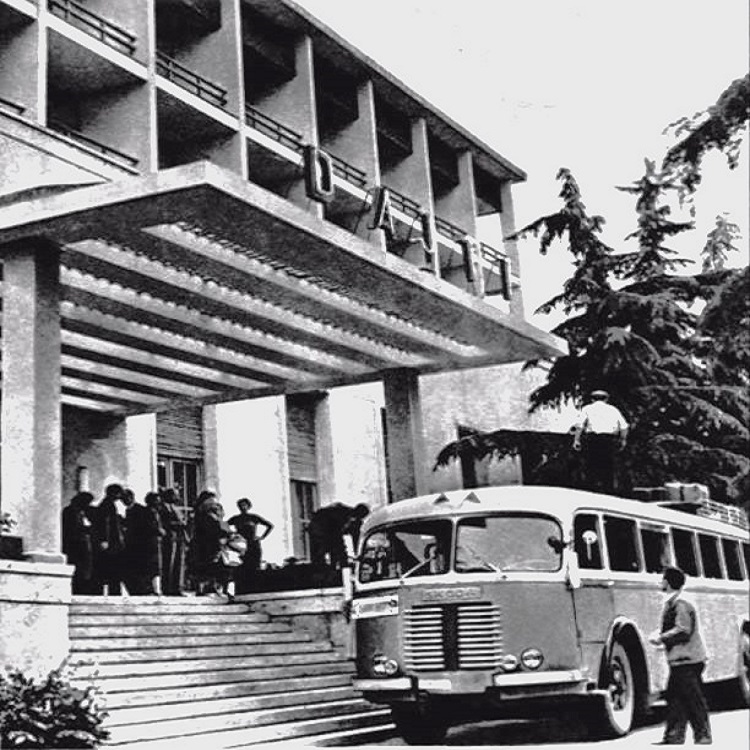
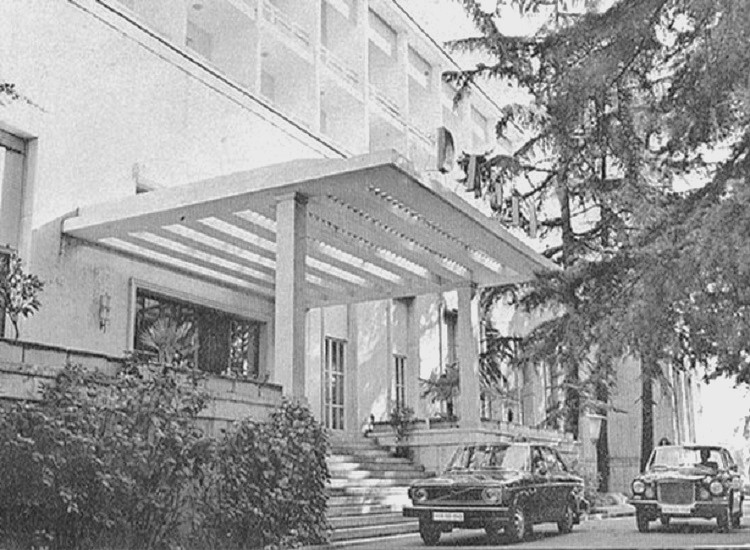


Memorie.al / Even if a photograph can say a thousand words; old photographs possess a much greater value. A historical photo can transport us back to another time or place, helping us relate to a specific moment that would otherwise be difficult to imagine. In this article, I have included several photos that I believe are worthwhile, as they tell a significant story that deserves to be written about. This is the story of the Hotel “Dajti” orchestra in Tirana. If you walk along the “Dëshmorët e Kombit” Boulevard in Tirana, you will encounter a building that, until the 1990s, bore the name Hotel “Dajti.”
Built according to an Italian project between 1939 and 1941, this hotel – like all Italian constructions of that era – was intended to bring about the “Rebirth of Albania,” as described in the book Albanien’s Wiedergeburt by Vilihard Kolleger (1910–1943). Within the framework of Italian architectural construction, this building was part of the configuration representing fascist imagery, shaped like a lictor’s axe.
Regardless of what fascism represents as an ideology, the years 1939–1940 constitute the brightest period for Tirana in terms of construction, as the building of a modern capital began there. It is well known that Tirana’s boulevard is linked to the great names of Italian, Albanian, and Austrian urban planning and architecture from the first half of the 20th century.
The European brilliance and majestic neoclassical style of the buildings were provided by the Italian architect, engineer, and urban planner Gherardo Bosio, who left his mark across the globe. He designed Hotel “Dajti,” one of the most modern hotels in the Balkans and one of the earliest luxury hotels in Tirana at the time. It was a symbol of Albanian tourism and the primary stop for foreigners visiting Albania – a landmark just as the Clock Tower was for the locals. Today, it serves as a building for the Bank of Albania, while preserving its architectural values.
Construction was completed and the inauguration took place at the end of 1942. With a total surface area of 8,760 square meters, 85 rooms, and conference facilities, it was surrounded by greenery composed by Pietro Porcinai, one of the best Italian and world landscape specialists of the time. Following his agronomy studies at “La Sapienza” University in Rome, his first task was the landscaping of the capital’s main road and the hotel grounds with unique trees suited to the city’s climate.
These seedlings were technically known as Cedrus libani (Lebanese Cedar). According to legend found in the Bible and Christian faith, as well as the Quran and Islamic faith, Solomon built the Temple of Jerusalem with this tree, which is considered a symbol of justice. In its L-shaped floor plan, the first floor was dominated by a large, beautiful lobby – bright, tall, and impressive, with majestic crystal chandeliers.
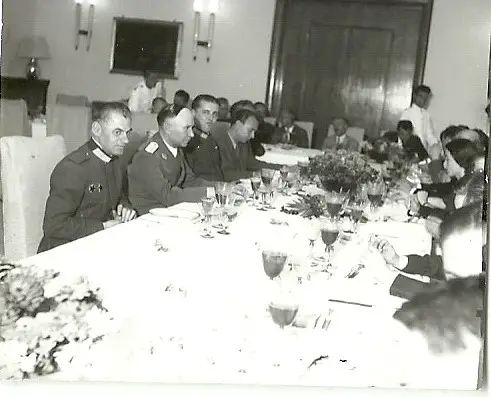
Next came the Bar-Café and two restaurant halls of varying capacities. This hotel, with its grand environment, luxury halls, modern salon-lobby, and high-quality cuisine, provided a significant venue for the presentation of the Albanian state. It hosted foreign and local dignitaries and served as a place of entertainment for intellectuals and others (until around 1965). During New Year’s Eve, it hosted over 250 people, and the venue was decorated with two tall trees – one in the main lobby and the other in the large hall where dancing took place.
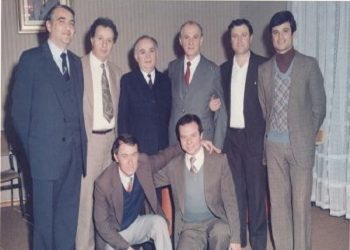
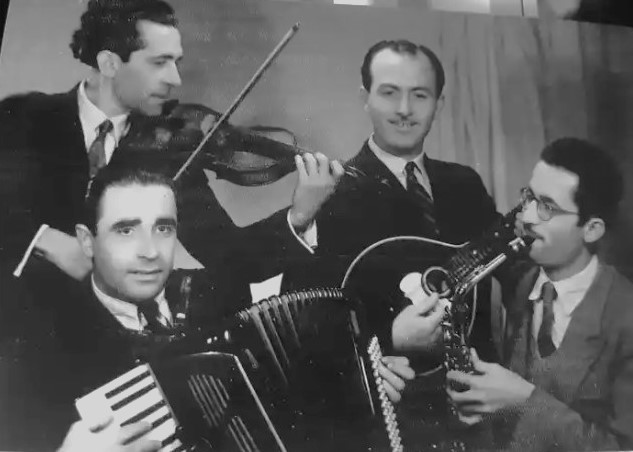
From the lobby, stairs led down to the Taverna. When Hotel “Dajti” initially opened after the war in 1946, the first Albanian saxophone players in Tirana – and indeed in Albania – were Zef Gruda, Muharrem Murthi (on tenor sax), and Sazan Selmani. The orchestra was later expanded with other instrumentalists, as evidenced by a 1946 photo showing (from left to right): Muharrem Tare (known as “Nella”) on violin, Skënder Reka on mandolin, Rrem Bilbili on sax, and Muharrem Murthi on accordion.
The formation later included Mustafa Zyberi on clarinet (father of singer Fatma Zyberi), Mehmet Ruri on drums, and Skënder Reka on accordion and piano (husband of the iconic Central Albanian folk singer, Fitnete Rexha).
Following the departure of accordionist and pianist Skënder Reka, the orchestra included pianist brothers Alqi and Aleko Kareco, Viktor Filja on accordion (son of Prof. Luigj Filaj, pianist and conductor of the “Streha Varfnore” Brass Band), and later the talented Shkodran pianist Nino Saraçi (seldom mentioned), Alfred Rrapushi on accordion, and Syrri Rroi on alto sax – who later became a professor and conductor of the Tirana City Band.
Mention must also be made of double bassist Tonin Shala, violinists Nazmi Maloku and Naxhi Berati, accordionist Serafin Prosi, and oboist Zef Gruda – a master of Albanian music who was labeled an anti-Stalinist in 1951 and sentenced to ten years in prison. After serving his sentence, through great effort and talent, he was appointed director of the Professional Variety Orchestra in the city of Kukës.
I want to dwell on the Shkodran pianist, Nino Saraçi, who worked evenings at Hotel “Dajti” and mornings at the Opera and Ballet Theater in Tirana, accompanying singers. Around 1973, the authorities removed him from Hotel “Dajti” due to his Western musical views. Members of the orchestra were often replaced due to their various commitments.
This orchestral ensemble – artistically led by saxophonist Muharrem Murthi, with violinist Muharrem Tare, Skënder Reka on mandolin, accordion, and piano, and saxophonist Sazan Selmani – initially worked at the “Parku Rinia” venue from 20:00 to 24:00, as it was a branch of Hotel “Dajti.” They would then work at the hotel from midnight until the early morning hours. Around 1960, the venue at Parku Rinia was named “Taiwan” and transferred to the NTSHUS (State Commercial Enterprise for Social Food).
It was in the Tavern – with its perfect acoustics and active nightlife – that the beautiful music of the orchestra was heard, led by Tirana saxophonist Muharrem Murthi (known as “Mario” in Italian musical circles or “Ustai” [The Master] in Albania, due to his gift for playing several instruments: tenor and alto sax, trumpet, accordion, piano, drums, clarinet, and oboe).
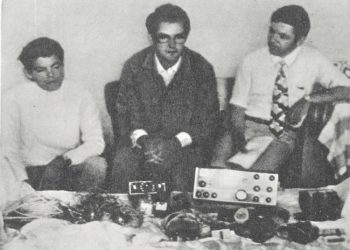
This professional musician, also employed as a recital saxophonist at the State Variety Theater, led an orchestra of excellently trained musicians with a repertoire of mostly foreign light music. They played from scores (as shown in photos), and people danced the twist until the early morning at Hotel “Dajti.”
From 1955, Lin Syla, a singer from Shkodra talented in Italian songs, and later the legendary Vaçe Zela with her resonant voice singing Italian or French tunes, captivated the audience. I would also mention Mrs. Carmont, wife of the former First Secretary of the French Embassy in Tirana, whose elegance in dance and modern attire gave the environment an even more attractive Western atmosphere.
This period coincided with major social changes reflected in the musical field (1960s–70s). This reality for the orchestra lasted until 1967–1969. Over the years, the composition changed. After the retirement of Muharrem Murthi, who dedicated his life to wind instruments and the institution of Hotel “Dajti,” he continued to mentor colleagues.
From 1965 to 1989, the orchestra was led by another very capable saxophonist and student of Murthi, Nazmi Keçi, who later married Murthi’s daughter, Suzana. The formation evolved to include Nazmi Keçi (tenor and alto sax), and Alfred Marenga on drums (husband of singer Vera Dervishi). After Marenga left for the State Variety Theater, his place was taken by Muharrem Dauti (known as “Jack”), with Bashkim Alimerko (known as “Bake”) on accordion.
We must also mention the renowned violin master Et’hem Lela, often present for his skill in interpreting Hungarian czardas. He was followed by today’s well-known master, Fatmir Lela, on guitar and mandolin. Both generations of the Hotel “Dajti” orchestra possessed excellent training and performance skills.
They played from sheet music and had a vast repertoire of foreign music – primarily Western Italian, French, Greek, and American, but also Eastern European music such as Russian, Polish, or Hungarian czardas – ensuring every foreigner was satisfied. But it wasn’t just foreigners; until the 1960s, the Hotel “Dajti” tavern was open to Albanians, frequented by intellectuals and music lovers.
It was a generation of artists who worked with passion; art was not for profit. They spent more hours at work than at home, considering the workplace their home. Every day at 10:00 AM, the orchestra rehearsed in the Tavern. Throughout its lifespan, the Hotel “Dajti” orchestra included unique musicians who have remained in artistic history.
Although the environment was under surveillance and the orchestra had to present its program of foreign pieces for approval, and despite the saying that “even the walls had ears,” there were still people of good sense. Tirana did not lack hotels or social venues – such as “Kursal,” “International,” “Vollga,” the League of Writers café, the café near the People’s Theater, the Officers’ House, “Kafe Flora,” or the “Ali Kelmendi” Palace of Culture – but the aura, name, and charm found at Hotel “Dajti” remain irreplaceable.
The refined atmosphere, highlighted by suggestive lighting, marble stairs, red carpets, parquet floors, and paintings by artists, provided a magical image. Enjoying a coffee or dining at this hotel was a unique impression and a privilege. It has been described as the historical memory of Tirana—and so it is, and must not be forgotten. / Memorie.al