
Memorie.al / Enver Hoxha was an unimaginable sadist, an unscrupulous vampire who mocked and amused himself with his subordinates, or the zealous “revolutionary” collaborators who worked with him to change the face of this country – that is, to make Albania a “true Paradise.” After a period of time, he would take the lives of these collaborators in the most shameful and inhuman ways! But the people were never made aware of his deeds or the humiliations he inflicted upon these leading collaborators. Through congresses, plenums, trials, the press, history, and even artistic literature, he treated their figures as he pleased. He presented them as cowards, ignoramuses, and immoral, labeling them with many other epithets as it suited his interests. In no case was the truth about them reflected; thus, the people never deciphered his tactics and never learned the truth.
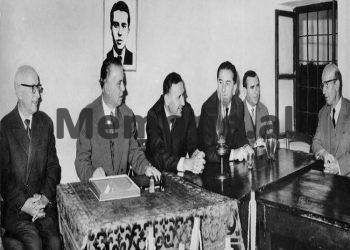
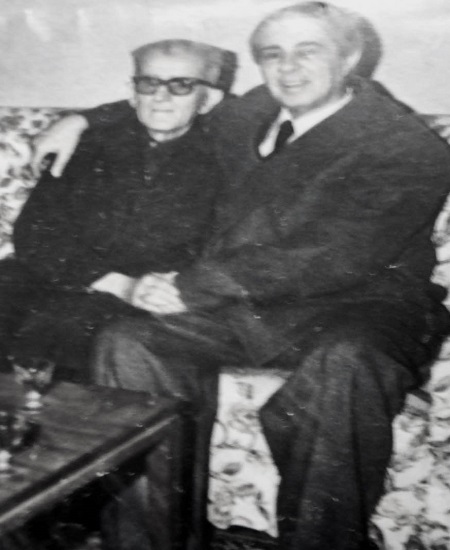
As I mentioned above, regarding these deeds of Enver Hoxha, I had confidential conversations with my uncle, Esat Dishnica, who had been connected with him since the Lyceum of Korça until the end of his life. Esat was his unique “best friend,” or better yet, “like twin brothers” – and I am not the only one who says this, nor just us as family members, but all those who were aware of their mutual relationship. They were never separated. This was a very peculiar wonder or, as my father used to say about this friendship: a “unique exception.”
To exclude and save Esat from the rule of planned and periodic annihilation – which did not spare any kind of comrade – Enver kept only Esat in “special” posts. Even during the “National Liberation” War, he served as a Member of the Presidency of the General National Liberation Council, or held relatively high positions in the General Staff, or was appointed organizer of the Dumrea unit, etc. After the “liberation” of the country, he made him a deputy of Korça in the People’s Assembly twice, and then kept him in the shadows, appointing him Director of Rest Homes in Pogradec and later Director of the Commissionary Society.
These were Esat’s duties as long as he lived. His economic treatment was privileged; he entered, exited, and dined at Enver’s without any need for an audience. They spent summer vacations together, especially in Pogradec. Ultimately, I can say he maintained their social intimacy until the end of his life. This was the most unique case in the history of the Albanian Communist Party and in the personal history of Enver Hoxha.
What my uncle Esat told me about Enver Hoxha
In the conversations we had, my uncle Esat said that historically everyone trembled before Enver Hoxha, or as they say in common Albanian, they were “shitting their pants.” Anyone who had a meeting with him would spend the whole night thinking about how to structure their discussion to be certain he would like it. This was the greatest preoccupation of these wretched leaders. In the entire history of Enver’s leadership, only two people opposed him face to face. This was a very special case, truly a wonder, especially for the “brave leaders.”
These two were Pilo Peristeri and Ramadan Çitaku. The latter (Çitaku) told Enver Hoxha verbatim: “Enough with your talk let us hear from the others too.” This happened when we broke ties with Yugoslavia, during a meeting of the Central Committee. Similarly, Pilo Peristeri spoke up when we broke ties with the Soviet Union: “Wait a minute, Enver, for those Russians were the ones who taught us what communism is!” In these two instances, Enver made two exceptions that were inexplicable for his nature.
For Ramadan Çitaku, no extreme measures were taken “as was the custom,” because Enver allegedly asked the Central Committee, if “it were possible,” not to pay mind to “Baca” (the Elder) because he was a good man but thick-headed – “a typical Kosovar.” Regarding Pilo Peristeri, he spoke similarly in the Central Committee, saying they shouldn’t mind him either, because these blunders or slips of the tongue were in Pilo’s nature; due to a lack of high political culture, he expressed himself in a “proletarian way,” as he himself said, but they should be sure he had no ill intent.
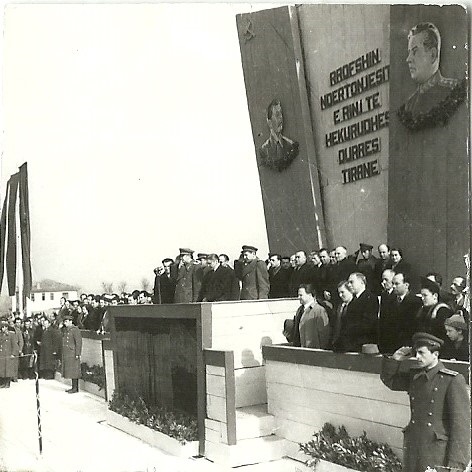
The Central Committee “took into account” Enver’s requests and took symbolic measures against both. “Baca” was sent to be the Central Director of Social Insurance, while Pilo was sent as Director of the Mechanical Plant in “Stalin City,” as it suited his background since he came from a family of blacksmiths. He forgave Pilo very quickly because he needed him; Pilo was his personal “cicerone” and served zealously to highlight Enver Hoxha’s revolutionary activity. Especially on October 16th of every year, he would send him to Radio, Television, various institutions, schools, and military units across the Republic to propagate Enver’s work, his sacrifice, and his “special” organizational, military, and political skills.
“Don’t speak if you dare!” Pilo placed Comrade Enver in the position of a man fallen from the sky, even beyond a prophet. He said that Comrade Enver was the true father and teacher of this people, who found Albania without any knowledge – not to say a completely ignorant people in politics, let alone philosophy – and without any revolutionary tradition. It was precisely his work, his teachings, and his most unimaginable sacrifices that brought us “to where we are today,” envied by the whole world.
Of course, Pilo’s “lectures” were pre-prepared in Nexhmije Hoxha’s “factory.” This “factory,” in official language, was called the Institute of Marxist-Leninist Studies.
Pilo Peristeri was considered among the oldest Albanian communists, along with Miha Lako – so “Zeus” had decreed. Therefore, Pilo was assigned this role of special importance since he also had his trust. As for all the other Albanian communists, including the highest leadership, they were “scared to death” of Enver – Esat would say. Take, for example, Mehmet Shehu, who is held as a great brave or War Hero by the entire Albanian people; he was “shitting his pants because of him.” He stood up in a Politburo meeting one day and, with the most nauseating and obvious servility to please the “commander,” proposed:
“Comrades, to increase security and protect the life of our teacher and commander, Comrade Enver Hoxha, so dear to us and to all of Albania and the world beyond, I propose that even we, the members of the Politburo, starting from me first, be searched down to our bodies and ‘everywhere’ before we enter Comrade Enver’s office for work, because the situation and the interest of the homeland demand it.”
Although this proposal seemed excessive even to Comrade Enver himself – not only did he not accept it, but he opposed it – Mehmet imposed it upon the Politburo. Thanks to the “internal democracy” in the Party and considering the extraordinary values of Comrade Enver, this measure for the preservation of his life was deemed small; consequently, by a majority of votes, the proposal of the “Hero” Mehmet Shehu was accepted.
Thus, from that day on, Sulo Gradeci’s men or members of the leadership protection sectors would manually search the entire bodies of even the Politburo members, along with the “legendary hero” Mehmet Shehu, whenever Comrade Enver called them to his office or home for work. But Mehmet made a second proposal, much more interesting than the first, and this was the peak of servility and fear towards Enver. Apparently, as the hardened professional criminal he was, he had begun to think his days were numbered and felt that the day the now-familiar “self-suicide” mechanism would act upon him was near.
To alleviate this distress or anxiety and to invest new signs of reliability in the Party, he stood up in a Politburo meeting and said: “Since Comrade Enver is very tired from many years of work of unimaginable intensity for the interests of the homeland, and furthermore, we have noticed that he tries to hide his fatigue when on duty or among us so as not to worry us – let alone the extraordinary cases where he might be absent from our meetings due to service outside Tirana – we must find new ways to ensure that our joint work never hinders the objectives Comrade Enver has set for himself.”
“But I want to emphasize something very important regarding this new and very complicated international situation. This situation has given rise to new problems that require solutions not only through standard technical, economic, political, and diplomatic means, but require more qualified treatments. Classical loyalty to Marxism-Leninism in a formulaic way is no longer enough; the basis of the solution must be much broader, supported unequivocally by the new thoughts that enrich Marxism-Leninism scientifically for today’s conditions, put forward by our Party with Comrade Enver at the head. I want to add one more thing:
We, the members of the Politburo, leave much to be desired. To reach this new level, we must work hard to assimilate these new directives. Therefore, I propose that in every Politburo meeting, Comrade Nexhmije Hoxha assist us, as she is naturally the best specialist for what I laid out above. Her presence and help will not only ensure we never err in the ‘line,’ but simultaneously create new opportunities and more extended time for Comrade Enver to work in his home studio for our cause. Meanwhile, we can be informed through Comrade Nexhmije about new requirements or instructions, thus sparing the commander the back-and-forth for us. Time is precious, after all!”
“I ask Comrade Nexhmije not to be misunderstood, for I know that everything I laid out will please Comrade Enver, regardless of the fact that he will be burdened with more work; but we know he is eager for work, and with these proposals, we will ease his unimportant movements. I also ask Comrade Nexhmije once more that for this help she will give us and the Party, we will be grateful; and so as not to violate the administrative rules of the Party, let us not protocol her presence in our meetings.”
Despite Comrade Nexhmije’s objection, the proposal was put to a vote and approved unanimously. As a result, Comrade Nexhmije participated in every Politburo meeting without ever being recorded in the official minutes. Even Sulo was pleased by the high level of consciousness of the “Biuro” comrades.
Mehmet, with these “brush-ups” or tall tales about Enver’s figure, thought he would gain something – at least to convince Nexhmije that he harbored love and respect for her. Enver had not been attending Politburo meetings for some time due to his known illnesses, such as high diabetes and severe heart disease; but the most significant issue was when he had to appear in contact with people, as he had suffered a galloping mental exhaustion in a very severe form, reaching a point where it hindered his fluency of speech, let alone his mental level.
But as it appeared later, these servile forms or behaviors Mehmet Shehu used gave him no benefit against the evil he feared would befall him according to history and the “self-suicide” rule that functioned normally in the Party. Time showed that his day of annihilation had also been precisely determined. This was, in fact, Enver’s worst health period, and it was clear to everyone that he was not recovering. Thus, the command of the Albanian State had effectively been taken over absolutely by the “Black Lady” Nexhmije Hoxha and Sulo Gradeci, her iron hand—both sadistic criminals beyond measure. Meanwhile, the horror and fear in Mehmet had reached their peak, as they had in me, Xhavit.
I remember a very shameful instance for the cowardly “hero” Mehmet Shehu. One day, he arrived with great majesty and authority at the Auto-Tractor Combine in his capacity as Prime Minister, for a work meeting at the base (as it was called then), on the occasion of the production of the first Albanian tractor. During his speech, which was permeated by great enthusiasm for the “successes” achieved by our working class under the leadership of the Party with Comrade Enver at the head, a comrade of ours, also a communist, Vesel Bano, overcome by “enthusiasm,” interrupted Mehmet and shouted in the hall: “Long live Comrade Mehmet Shehu!” Naturally, the whole hall cheered: “Hurrah! Hurrah!” frantically.
But surprisingly, Mehmet stood up, enraged to the core, and ordered with raised hands and voice: “Let the one who shouted that completely wrong slogan leave immediately!” After a moment, he continued shouting again: “Listen here, what I am? I am nothing but one of you and nothing more. We should shout – shout loudly indeed – but not ‘Long live Mehmet,’ but ‘Long live Comrade Enver Hoxha’ – the founder of our Party, because he raised us, educated us, and made us who we are today; he worked with all of us like a teacher with a student. Therefore, we all have the obligation to shout forcefully, and with great force: Long live our Party and its founder and teacher Comrade Enver Hoxha! Hurrah! Hurrah!” And so it happened at our Combine. Thus, from what I briefly described about Mehmet Shehu, it is quadruply proven that he was a true coward and a very ordinary butcher, like all his peers.
But we know both the history and the end of Mehmet Shehu, who went like “a goat” to the butcher when the planned moment for his annihilation, arrived, just like all the others. He was even so “conscientious” that he left a farewell letter for the Party that raised him, educated him, and in the end, naturally, annihilated him. Enver exploited Mehmet’s criminal side to the maximum, which was far higher than that of his comrades; we can say without fear that he was the champion of the other criminals, surpassed only by Enver Hoxha. Enver annihilated Mehmet when he wanted, just like a chicken, without any problem.
He never trusted him; he always suspected him, thinking he was ungrateful. In fact, Enver was surprised by Mehmet’s stance, wondering how he didn’t realize his time for sacrifice had long passed, like all the comrades before him. The misfortune for Mehmet, which “brought him to his knees,” was his belief that Enver could not do without him, while simultaneously believing Enver might die suddenly; thus, he thought that as things were going, he might make it through. But Enver also thought very carefully about how poorly Mehmet would treat his name and figure after death, let alone his family. Therefore, he deserved special treatment.
Gradually, he also eliminated his wife, Fiqirete Sanxhaktari. She, too, was a known criminal who had held high party functions; thus, she was in the nomenclature upon which the Party’s self-suicide mechanism had to act – a path she had personally designated for her own male and female comrades. Similarly, they eliminated his eldest son, Vladimir, through (self) murder. This was the reward that “Mother Party” gave to its sons and daughters for their “valuable” work over the years. Enver analyzed his close collaborators very carefully; if, for example, he noticed that nature had gifted them a little honor and a little bravery, he rejected them immediately and never wanted them near him.
He preferred people who, besides lacking honor and bravery, possibly had a questionable past. This interested him because it made it easier for him to do whatever he wanted with them. These “blind tools” passed check after check, and finally, he personally looked at these candidates again with great care – those offered to him as collaborators according to his taste by the organs designated for these problems. Above all, he checked whether they had high natural qualities to be processed according to his own desire; if he was personally convinced of these qualities, then they were considered indisputable for him.
Through accurate information, he learned the degree of their collaboration with previous governments; this information was an advantage for him because he knew they would be the most ready to get involved in any dirty work or crimes of any kind, just to cover up their compromised pasts. I am mentioning some of these low elements who worked with great devotion for that system, and in the end, many of whom were swallowed by the famous “self-suicide mechanism of their party”:
- Omer Nishani: a high representative of the Fascist Corporative Chamber and a member of the High State Council.
- Ramiz Alia: of Bosnian nationality, was a member of the Fascist Youth, wearing the black shirt. The Party possessed original photographs and fascist registers, some with his original signature.
- General Qazim Kondi: in September 1941, he was a fascist officer; for merits toward fascism, in January 1943, he was appointed Sub-Prefect of Kurvelesh.
- Gjon Banushi: a sergeant of the questura in Vlora and an employee of the “SIM” (British Secret Service) structures until early 1943.
Not to mention others like Spiro Moisiu, Shefqet Peçi, Bedri Spahiu, Et’hem Berhani, etc. I mentioned only some of these, from the highest to the lowest levels. He played with these types as he wished; therefore, he had achieved high results in crimes by using this kind of scum or element. One could talk about them forever, but unfortunately, within the State Security (Sigurimi) agencies, there were compromised individuals even from our own ranks.
This evil happened and became a fact also because there were those among us who could not resist terror and torture for long periods, which extended even to the family members of these unfortunate “wretches.” This was an unexpected and unimaginable fact; therefore, we must accept this shameful misfortune as the reality it was. Thus, the communist “hyenas,” by penetrating even among us, caused incalculable damage./Memorie.al