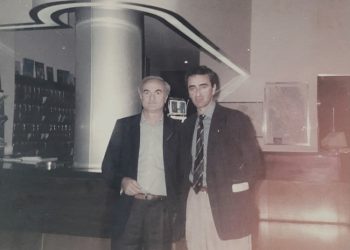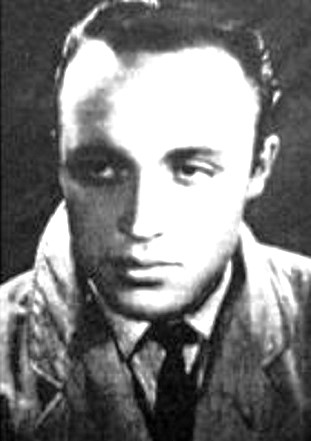
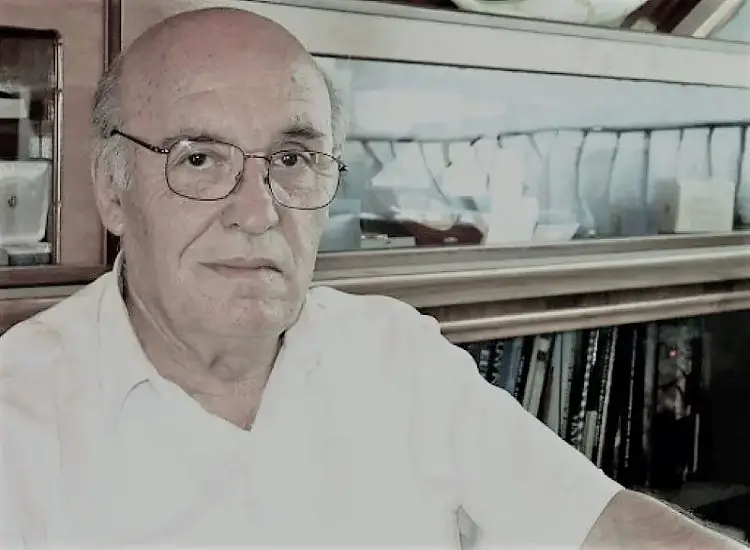
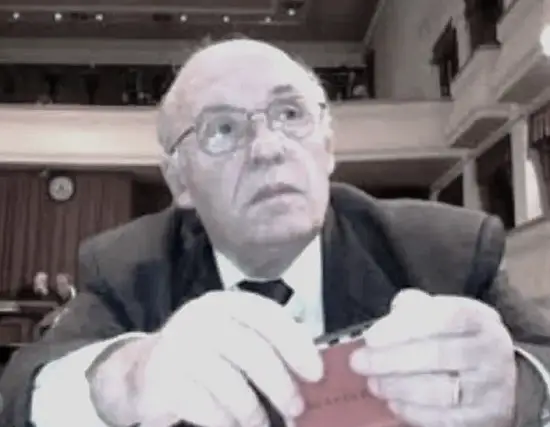
Memorie.al/ On July 8, 2006, Pjetër Arbnori, one of the opponents of the communist regimes of Enver Hoxha and his successor, Ramiz Alia, passed away in a hospital in Naples, Italy. He had spent nearly 28 years in political prison, so much so that after the ’90s, based on his time in camps and prisons, he was rightfully considered the “Mandela of Albania.” Starting in 1991, Pjetër Arbnori became involved in the anti-communist movement that led to the overthrow of the communist regime. In the first elections of March 1991, he was elected a member of the Albanian Parliament, representing the Democratic Party in one of the areas of the city of Shkodra. In the following years of pluralism and democracy, he was one of the most influential politicians, serving as a Member of Parliament for five legislatures of the Albanian Assembly.
Mr. Arbnori was also a founding member of the Democratic Party, the first opposition party after the establishment of the multi-party system in Albania in the early nineties. Shortly before he passed away, the well-known BBC journalist Aleksandër Furxhi spoke with Mr. Arbnori for the “Interview” section, which we are publishing below in this article.
The Unknown Interview of Pjetër Arbnori
BBC: Mr. Pjetër, can you tell me about your family, what family do you come from in Shkodra?
Pjetër Arbnori: The origin of my family is in Shirokë, which is a neighborhood of Shkodra, on the shore of Lake Shkodra with an extraordinarily beautiful view that has impressed me all my life. My father comes from a family of fishermen. Later, he attended school and was commissioned as an officer in the Zog Monarchy.
Later, like most officers, he also joined the Albanian Gendarmerie in the years 1939-1942. He was invited by the communists to join the communist gangs. He refused and was killed in a clash with them. I was orphaned at the age of seven and was an orphan with two sisters, nine and ten years old. My mother and sisters did needlework to keep me in school.
I went to school again with great luck, to do the third grade at the Jesuit school, where Albanian has been taught since 1864, and at the state gymnasium of Shkodra, which is the first state gymnasium in Albania. I received the gold medal, which they did not give me, even though I had all excellent grades. They did not give it to me for political reasons.
BBC: Mr. Pjetër, why were you arrested? It is said that you started a political activity when you were young. What was this political activity like, what were you doing?
Pjetër Arbnori: At the age of fourteen, I was part of groups that worked against the communist regime, which had no freedom. I can be proud to have been part of a group that distributed tracts, carried out various activities, and then when I moved to Durrës, because I was unemployed in Shkodra, I set up such a group and then joined the group led by Uran Kalakula, Tanush Kaso, Agim Musta, and other friends, which was called the “Social-Democratic Group,” because the goal was the creation of an illegal party, as we were for pluralism and against one-party rule.
I drafted the program of the new party. Through spies, we were discovered and arrested as groups in Tirana and Durrës, and so I spent about two years in a cell or in interrogation, with the aim of my connections being discovered.
BBC: What do you remember from that period, Mr. Pjetër? Do you remember when you were arrested?
Pjetër Arbnori: I had just finished typing the program, which was to be discussed at the joint meeting in Tirana. I left the house to go by train from Durrës to Tirana. The deputy head of the Internal Affairs Branch came, forcibly put his hand on my shoulder, grabbed me by the arms, and said; “You are under arrest!” From there, they took me to the Internal Affairs Branch, they threatened me, and they pressured me to reveal my friends. I told them I didn’t know anything, but they found a part of the manuscript copies of the program in my pocket.
BBC: And how old were you?
Pjetër Arbnori: I was 26 years old.
BBC: And your 28-year ordeal in prison begins. Without a doubt, it is a whole life, 28 years is a lot. What do you remember, or what has stuck in your mind the most from this whole life spent in prison?
Pjetër Arbnori: First, I will talk about the two years in the cell, the trial, my death sentence, and my stay in the cell. For about three months, they left me tied hand and foot, with irons and shackles and only with a blanket, which I grabbed with my teeth and turned to cover myself.
They tortured me with irons, with needles, piercing with needles, beatings, putting me in a coffin. They sent me as if to execute me. Even during the death sentence, they took me to the investigation, hoping that death would force me to speak.
In fact, there are many of my friends, living or dead, who had activity with me, but I did not tell, and they were not arrested. I will also say that even during the investigation and after the investigation, they tried to win me over, but I can say, not that I am brave, but I have never been a coward, and I will say that God saved me from being ashamed. I had the bad luck of being put in a cell every winter, but they did not hesitate to put me in there in the summer as well. Especially in winter it was difficult, because they would take away the fur coat, the pants, the socks, and you were forced to spend a whole month on the cement, in the dark. I also remember periods when not only the rooms but also the corridors, and the many cells of Burrel, there were 32 cells, all were occupied.
And, in a cell that was two meters by two and a half meters; seven people lived, together with the mattresses, together with the belongings, together with the clothes, together with the food. And these seven people slept like sardines, that is, three from the door, four from the opposite wall, and my feet would go into the other’s mouth and his feet would come into my mouth. It is understood that the food was either with squash, or with wormy rice, with wormy pasta, and with wormy beans…!
Wormy because they picked all the leftovers from the warehouses and brought them to the prison. Rice, pasta, or beans, but I’m telling you, not for one day, not for a week, not for a month, but for years, the pasta, rice, and beans were with worms or flies, and we would separate the worms or flies, or the worms that came out on top, and the rest we would eat because we had nothing else to do.
BBC: And, a good part of the time you spent in prison, you spent writing, didn’t you? Was it possible, how did you manage to write?
Pjetër Arbnori: In prison, especially in Burrel, but also in Tirana, there was a regulation that said you could keep a book, a notebook, and a pencil. We often told them; “We also need a dictionary” and the guard would say; “Good, study the dictionary first, and then get the book”!
BBC: So, they allowed you to keep books in foreign languages, didn’t they?
Pjetër Arbnori: When I went to Burrel, there in the past, there had been books in foreign languages, but they had collected most of them and kept them in a warehouse there and did not give them. The one who had saved the books in foreign languages had made such disguises, for example, by removing the cover of Marx’s book, Lenin’s book, removing the cover of Enver Hoxha’s books and wrapping the other books when he could, to disguise them.
Besides this, in prison, Enver Hoxha’s books in Italian, German, English, or French were also allowed, and the thing is that most people learned foreign languages with Enver Hoxha’s books. I will also tell you another method I followed to learn French. I had the book “War and Peace” by Tolstoy, there are many pages or half pages that are written in French describing the mundane life of the Russian aristocracy and below was also the translation.
I took all these French parts and the translated parts and put them in a notebook which I tried to memorize and then I also built a grammar, orthography, etc. notebook, where I wrote the different rules of spelling, grammar, etc. If I had this notebook now, it would look a little ridiculous, but it was a very laborious job by which I learned French.
BBC: And, after the prison ordeal, another life comes for Mr. Pjetër, and this country, these people, this nation, values you in the highest way and you served from 1992 to 1997, as the Speaker of the Parliament of Albania. What is this part for you? Did you feel, so to speak, rewarded for all that sacrifice, for all that life, for all those sufferings you went through?
Pjetër Arbnori: I do not consider this an honor for me, I consider it an honor and a duty that the people felt towards the former political prisoners, who suffered for forty-something years in communist prisons and who worked without reward, in swamps, in mines, in various construction sites, in various constructions, in different parts of Albania.
BBC: Mr. Pjetër, you are also considered a very special example of human vitality, who after a difficult life spent in prison, manages to find strength, manages to find energy, at an advanced age, to create a family. And you have a happy family today, as it seems. Can you tell us something about your family, about your children?
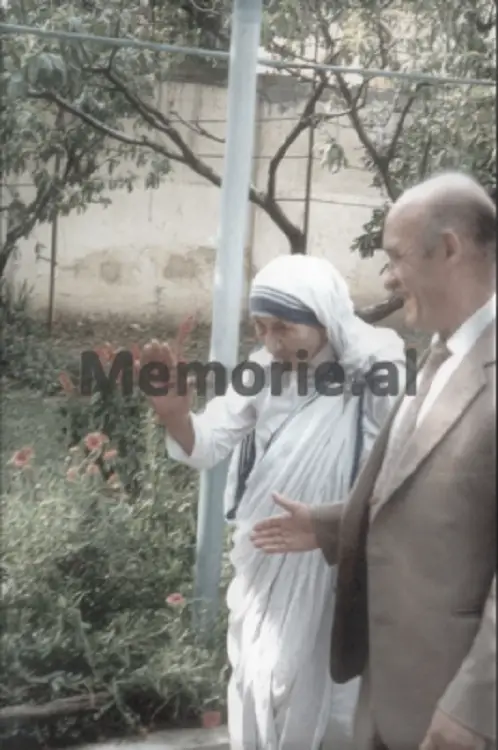
Pjetër Arbnori: I will say that this has been a happy day for me, a day when all my friends and companions sang and danced, and then fate willed that my wife would give birth to a daughter who is thirteen years old today and later, a son, who is eleven years old today and who, fortunately for me, have been blessed by Saint Mother Teresa and this is truly a pride for me, but also a responsibility for my duties. / Memorie.al