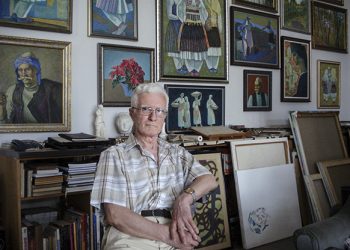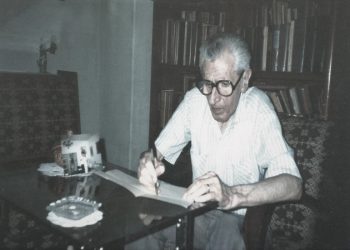

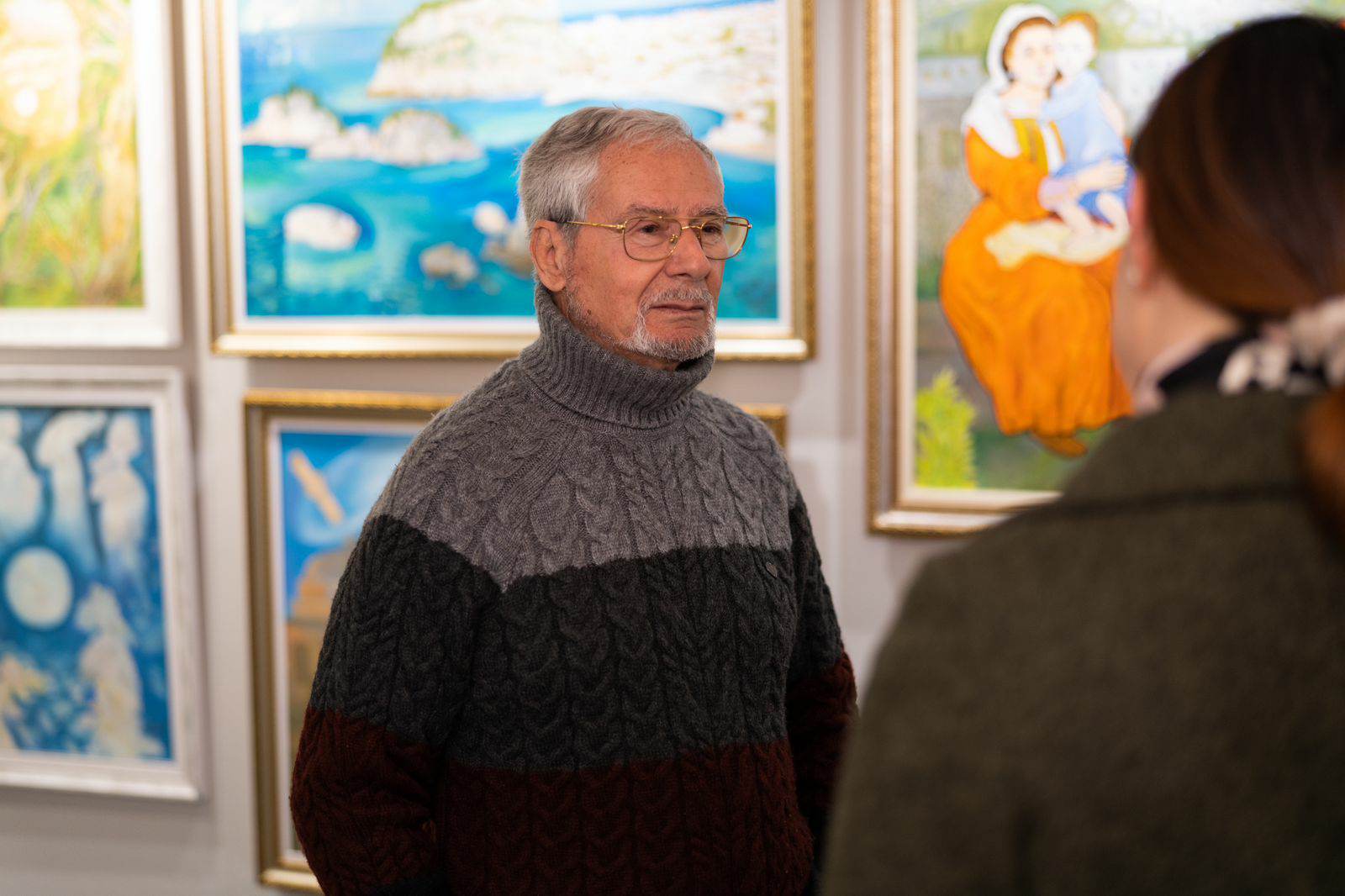
Memorie.al / The Sea are not just the balancing of internal relationships, as the Japanese writer Banana Yoshimoto says. It can transform your entire life. It was the sea that made Rakip Shabani a painter. Decades have passed, yet Shabani recounts his first relationship with the sea in the same way, with those same moist eyes of a child who once escaped punishments by diving into the water. These always sound like proud narratives and, in fact, all artists who were able to develop themselves through a relationship with nature – especially if their childhood window overlooked the sea – are privileged.
Perhaps a film would better convey the dreaminess of a boy who, to escape his father’s reprimands, plunged into the water, not as an escape toward adventures with peers. The child Shabani revealed himself only to the water; only the water saved him, and the sea helped him by giving him what he needed to become the artist he is today. Rakip Shabani spent solitary hours at the tunnel in Vlorë, with some pencils and papers in hand. His house was nearby, so fate had gifted him the solution.
He remembers his first watercolors from the fifth grade, never thinking that one day, painting would not just be the salvation of a teenager’s thoughtful hours, but of his entire life. Before a message I wanted to write some time ago to an important person in European culinary arts, I didn’t know what to write.
I consulted someone who knew him, and they told me: “Write to him quite simply, what you think, because he too is simple, as all great people are!” This came to mind from my conversation with Shabani, because perhaps when you have become the person you are today due to such great influences like nature, you always remain humble, as if before things for which you are eternally grateful. Because wisdom – a kind of wise withdrawal – and simplicity remain the elements missing from art and artists today.
The episode he told me about – how in a museum in Vienna, he had asked his daughter to take a photo of him in front of a world-class canvas, just to see and understand how “small” he was – should show the current era how many [unimportant] bubbles it is dispersing. The same dimension of thought is expressed in the simplicity of his watercolor.
The painter’s luck did not end with the gift nature gave him!
“When I was not yet able to appreciate or recognize it, the great painter Abdurrahim Buza came to Vlorë to look for talented students for the Artistic Liceu. Neither I nor my family had ever thought of this direction my life could take! I painted to dream, to get away, without being aware of what I was doing and how I was doing it. During one of those long hours at the tunnel, the professor approached me and asked what I was doing and why I hadn’t gone to the competition?”
This was the decisive event of Shabani’s life. Buza turned to the Executive Committee, giving them few alternatives: “If you don’t send me Shabani, don’t send me any other student.” The Committee representatives quickly reached an agreement with Shabani’s father, and immediately after, his professional relationship with art began.
“First, they registered me in Sculpture, where I studied for 5 years, although I never gave up watercolor because it seemed more practical to me. It was again Professor Buza who encouraged me to continue my studies in painting, but this did not happen immediately. First, I was appointed as a teacher, although I was younger than my students and didn’t know how to behave.”
Nature helped again. Rakip Shabani was appointed as a teacher in the village of Novoselë in Vlorë. The milkmaids he encountered there inspired him to dedicate himself to painting with such devotion that he produced enough work for an exhibition.
“My first exhibition was in a cow stable.” From there, from the “scent” of real life, Shabani’s career began. Although the first presentation of his works at the House of Culture was not successful, he managed to learn a lesson. When his father asked him what he gained from all that effort, he had the answer ready: “I gained insults, and from them, I learned.”
He learned so much that when Vilson Kilica went to his studio, he didn’t hesitate to take 35 works, which ended up at the League of Writers and from there, in an exhibition at the National Theater. Xhevahir Spahiu’s article in “Zëri i Popullit” was the voice needed to take the painter to the right circles. After this distance from the time of the Liceu, came the Academy of Arts. Rakip Shabani never escaped the sea; he was made of it, and his consciousness expressed it in all his works.
Even when a portrait at the Academy had a brown cloth for a background, Rakip the student painted it blue. Sali Shijaku did not miss this alteration of the composition. “Are you from Vlorë?” he asked.
From here began the long journey of the painter Rakip Shabani in all forms, because he was not growing in painting only through studies or experience. He worked and continues to work as he started: from nature. “I have walked across Albania three times! I have taken all kinds of motives from it. I have always thought that nature makes the artist. However, during my acquaintance with nature, I also learned folk poetry, legends, archaeology – all of these enriched the painting.” Another pleasure of meeting Shabani is the verses that slip from the years without any obstacle from his memory.
NUDES AND THE BUREAU
With no painter who studied and grew professionally during the past regime can you escape the topic of nudes, just as you cannot escape secret events, because nudes were exactly that.
“In the Academy, we worked with nudes, even with models, but of course they remained unexposed; it was like secret work that, nevertheless, was not treated as forbidden in school. I believe the Academy’s archive must still have them.” On the other hand, what was exhibited but worked on under the supervision of the party were the portraits of the Political Bureau.
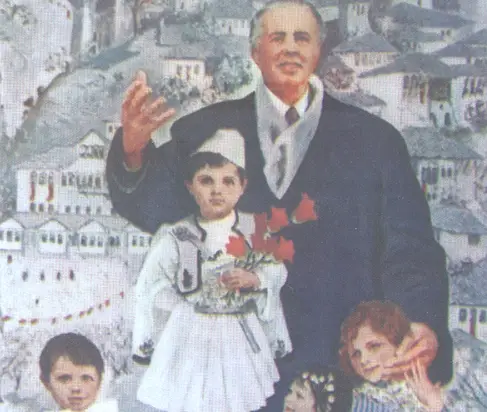
“After finishing the Academy of Arts, I worked on the portraits of the Bureau members. I had painted Enver’s portrait with longer hair than he had. That’s how it came to me, and that’s how I did it. Understandably, I was immediately called by the Party Committee to be identified as the painter who had made the leader look unshorn. I tried to give my artistic arguments, but your mouth was shut. However, I faced no penalties in my work.”
Because the focus of Shabani’s work was never politics. Penetrating the veins of the country’s history, touching it with his own hands, hearing it with his ears, and stepping on all sides, from south to north, enriched him in all aspects and gave his painting the grandeur of the human soul. Today, the world may have forgotten what Van Gogh said: “there is nothing more artistic than to love people, that love’s appearance may change, but not its essence,” but there are still painters like Rakip Shabani who have given form to all these feelings with brushes and colors. Yes, blue ones!
“GALLERY 43”
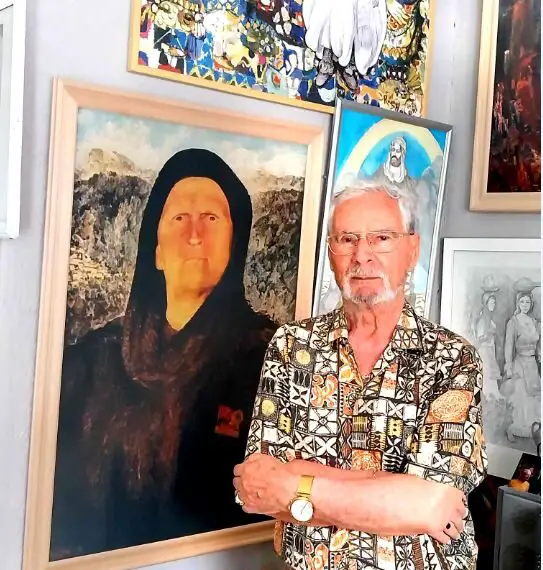
“Gallery 43” is the personal gallery of the painter Rakip Shabani. Displayed in it are about 100 works by the author, belonging to a period from 1969 to 2020. Besides the works displayed in this gallery, Rakip Shabani’s paintings are also exhibited in the National Gallery of Arts in Tirana and in Vlorë. Furthermore, his works have been exhibited in countries such as England, the USA, Argentina, Japan, Greece, Germany, Romania, Bulgaria, Italy, France, Brazil, etc. “Gallery 43” took this name because the painter himself was born in 1943.
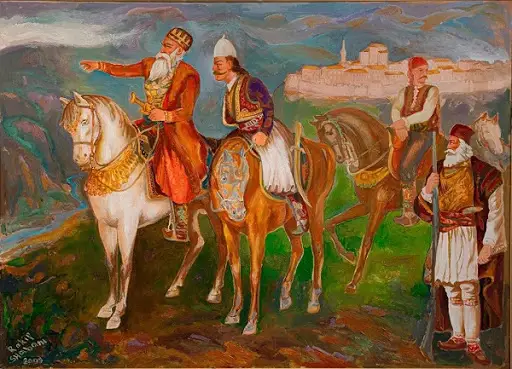
In this way, the naming is personalized and directly linked to his creativity. Shabani has been honored several times with national awards, one of which was for “Nëna Labe” (The Labëria Mother). The landscapes in the backgrounds of the compositions of the cycle on Ali Pashë Tepelena, “Who brought Doruntina,” and “Fairies bathing,” have always been valued as treasures, where the author masterfully gives not only the power and majesty of Ali Pasha but also conveys the full power of lyrical tones.
Using the legend “Who brought Doruntina,” where people leave and fly in the sky, taken by life or death, the author has built with fine taste the composition “Konstantin and Doruntina.” In addition to the sea, Vlorë, and motives of its surroundings, paintings of the capital are not lacking in the painter’s creativity. In them, numerous details of the Tanners’ Bridge (Ura e Tabakëve) and the Tanners’ neighborhood are noticed.
These paintings are expressed in black and white, but it must be emphasized that in none of the author’s paintings are there shadows, as the author has an organic connection with light and expresses it in every painting. “There is only color and light in my paintings; the shadow has been completely removed.” Besides the historical part, the author has also presented urban life with the cycle of street wanderers. In each of their portraits, the history of Tirana’s “barbons” (tramps), as the author calls them, is expressed./Memorie.al