By Besnik Dizdari
Part One
Memorie.al / As I wrote some time ago, I have been recently struck by the publication in Italy of a book about “Spartak” Moscow by the Italian author, Mario Alessandro Curletto. I got the book, read it, and was shaken to learn how the Stalinist regime had treated the protagonists of this football team that became legendary. Thus, I am moved to publish this series from the book, because many “Spartakist” events, directly or indirectly, also concern Albania. I contacted the author. I told him that Albania has played 11 matches with “Spartak” Moscow – perhaps a European record for the history of “Spartak” itself. The author of the book, with the sincerity of an honest and inquisitive historian, became very curious to know about these matches and the so unusual relationship between “Spartak” and Albania.
Although he had written this book more with the aim of showing his fellow Italians how far the Stalinist regime had gone and what happened to sports and football in communist countries. To remind Western citizens of what occurred. Not to forget. Even though it happened in another country.
So, we come to the book by author Mario Alessandro Curletto with the simple title: “Spartak Mosca,” which I believe presents a special interest for the sporting and non-sporting environment of Albania. Certainly, if today we all seek to always know the truth, only the truth – a good part of which among us continues to be hidden or “forgotten.”
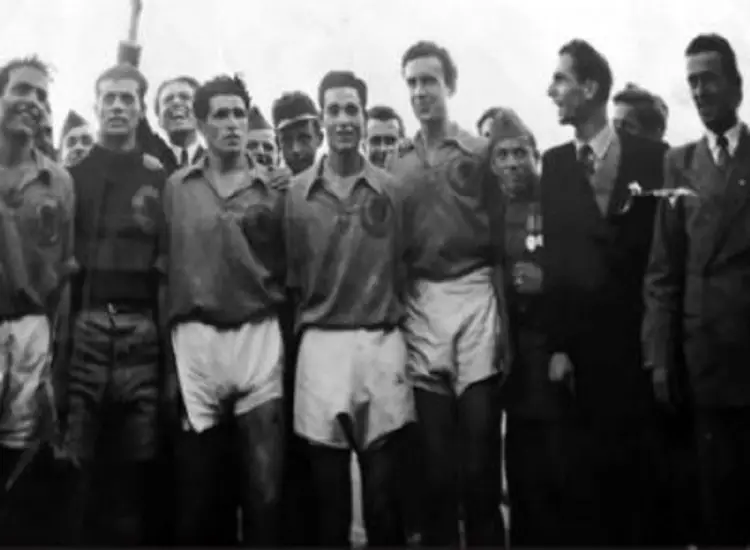
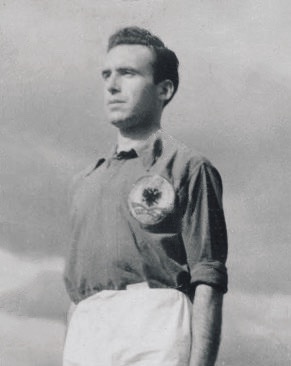
With “Spartak” Moscow, communist Albania had a truly strange connection. Or put differently, in the ’40s and ’50s, “Spartak” Moscow entered our history more strongly than anyone else. Above all, for the historical fact that the National Team of Albania played its first official international match precisely against “Spartak” Moscow. I have highlighted in published books that Adem Karapici is the man who first led this National Team onto the field against a foreign team, which by fate was a club: “Spartak” Moscow.
The Tirana propaganda, meanwhile, displayed irrepressible tones regarding “Spartak’s” arrival in Tirana in April 1946, even with “combative” and political tones, naturally. “Spartak” had much to do with the newly won war against Nazism. The goalkeeper Zmelkov, the best pre-war goalkeeper in the USSR, held six “Medals of Bravery” and was a heroic volunteer of World War II, following the front all the way to the capture of Berlin.
Likewise, the team’s coach, Albert Henrikovich Volerat, who was from Estonia, and the president of “Spartak,” Gennady Trofimovich, each also held two “Medals of Bravery” for the War. In their company on this journey to Tirana was the referee Nikolai Latyshev, among the greatest in Europe, who only a short time ago had officiated in London the biggest match of post-war geopolitics: the “Arsenal” – “Dinamo” Moscow match. Tones of party-political pathos did not cease in Albania during those days!
“Our national team,” wrote the Albanian press “plays its first match against the ‘Spartak’ team of Moscow, against one of the strongest teams of the heroic Youth of the Soviet Union, the standard-bearer of the common struggle against fascism, precisely on the day of May 1st, which is the greatest holiday of all workers of the freedom-loving world. Hundreds of athletes from the most diverse regions have come to the capital to enjoy our most prominent sporting event up close.”
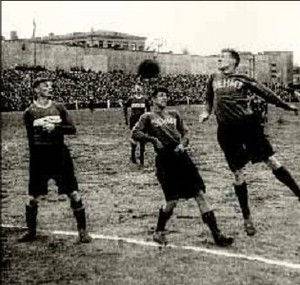
The first match of “Spartak” Moscow was against the team of the future of Albanian football, “Partizani” of the National Army, on April 21, 1946, in Tirana. It was a spectacular 5-2 for the famous Soviets, in the presence of all the authorities of the Albanian government. Only the two goals by the irrepressible Teliti shone, even before the distinguished Russians. It was grandeur not just in sports.
They were rare footballers, and facing their strength, the Albanian players felt in difficulty. In Shkodër, “Spartak” won 3-0 against a strange Albanian formation named the Representative of Northern Sports Clubs. Then 2-0 in Vlorë for “Spartak” against the Representative of Southern Sports Clubs.
But the big match was another: “Albania” – “Spartak” 1-2. This is the first international match of the National Team of Albania. It is May 1, 1946. The historical day of the National Team born exactly in 1936 – the same year when, thousands of miles away from Albania, “Spartak” Moscow in distant Russia would take its name and begin its march toward the apogee of success, as Curletto says in his book. Yet, this Albania was unable to play a single international match for ten years. By fate, even this first one after ten years was against a club, not a state representative.
And this match would be no exception to the first three for “Spartak,” as they scored the first goal in the 25th minute through Malinin, and before 60 seconds had passed, a second from Smyslov: 2-0, when the match had been almost balanced. After a disorientation that lasted about ten minutes, the Albanian National Team gradually began to recover and led the match for almost the entire second half.
Until the 74th minute arrived, with Teliti’s goal from an 11-meter penalty. 1-2 was a great success considering who “Spartak” Moscow was, even though in that year (1946) they had taken sixth place in the Soviet Union Championship among 12 teams.
The score-sheet of the historical match, recently clarified better than ever, representing the first official international match of the Albanian National Team, appeared as follows:
01.05.1946, Tirana, National Stadium “Qemal Stafa”:
ALBANIA – SPARTAK MOSCOW 1-2
- ALBANIA: Poselli, Llambi, F. Janku, Dibra, B. Fagu, Spahiu, Parapani, Teliti, Mirashi, Biçaku (Met Vasija), Begeja.
- COACH: Ludovik Jakova.
- SPARTAK MOSCOW: Zmelkov, Vik. Sokolov, Vas. Sokolov, Malinin, V. Guliaiev, N. Guliaiev, Smyslov, Klimov, Siemionov, Konov, Salnikov.
- COACH: Albert Volorat.
- GOALS: Malinin 25’ (p), Smyslov 26’, Teliti 74’ (p).
- REFEREES: Latyshev (USSR), A. Karapici, E. Hoxha (Albania).
- SPECTATORS: 25,000
And in total, the first four matches of “Spartak” Moscow with Albanian football are summarized as follows:
- 04.1946, Tirana: “PARTIZANI” – “SPARTAK” MOSCOW 2-5
- 04.1946, Shkodër: NORTHERN CLUBS REPRESENTATIVE – “SPARTAK” MOSCOW 0-3
- 04.1946, Vlorë: SOUTHERN CLUBS REPRESENTATIVE – “SPARTAK” MOSCOW 0-2
- 05.1946, Tirana: ALBANIA – “SPARTAK” MOSCOW 1-2
It is not easy, meanwhile, to imagine the Albanian sporting atmosphere for this “Spartak” tour, the journey of which to Tirana turned into the very inauguration of the Moscow–Tirana airline. And Albania, which had only 18 months prior established the foundations of one of the harshest regimes in post-WWII Europe.
From the sporting side, the important thing was that Albania had inaugurated its National Team worthily. It was a loss which, like the one against Bari in 1938, proved great growth, this time on different scales. “Spartak” suddenly encountered an obstacle it passed with great difficulty and was surprised. Eng. Granatkin, the leader of “Spartak,” stated: “Meetings in the past with Italian and Yugoslav teams have naturally influenced your teams. Our predictions were confirmed because we found in you serious athletes, and every member of the team is a good technician.”
This short statement from a representative of the Stalinist Soviet Union, such as the head of “Spartak,” Eng. Granatkin, is very interesting. He had received three “Medals of Bravery” for the defense of Moscow during WWII. Yet he “dares” to value the experience of Albanian-Italian matches, which the Albanian Communist Party did not even allow to be commented upon or mentioned.
However, Eng. Granatkin, more than a political head, was a true man of football. For over 25 years (1954–’79) he would be the vice-president of FIFA, and in his honor, since his passing in 1981, there is a tournament: the “Granatkin Tournament.”
We will begin with the chapter dealing with the demonstration match of “Spartak” in honor of Stalin in “Red Square,” at the foundations of the Kremlin. The only central square of a capital or even a city in human history that, for the sake of one of the most ruthless dictators, was transformed into a stadium for a single day, as it were, with the football field itself being carried in on shoulders!
Quite by chance, I happened to experience this old event with my own eyes during a television broadcast on the Russian channel “Planeta Sport.” The sensational scene for the very history of world football was filmed in that year, 1936. For history…!
It seems unbelievable, but it happened. Stalin and the entire Politburo of the Communist Party of the USSR stood frozen on the tribune of the “Lenin” Mausoleum before a football match, while the surprised leader leaned forward “smiling” with an astonished gaze over Red Square, which had been transformed into a stadium…! /Memorie.al