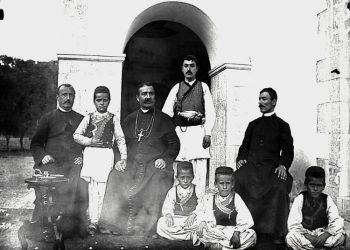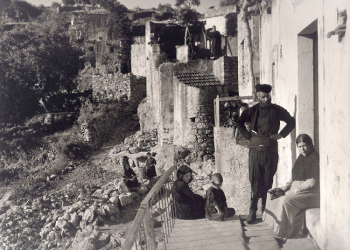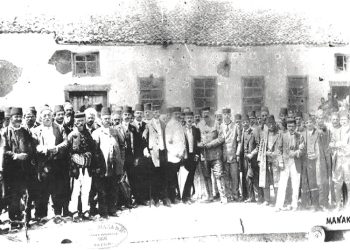
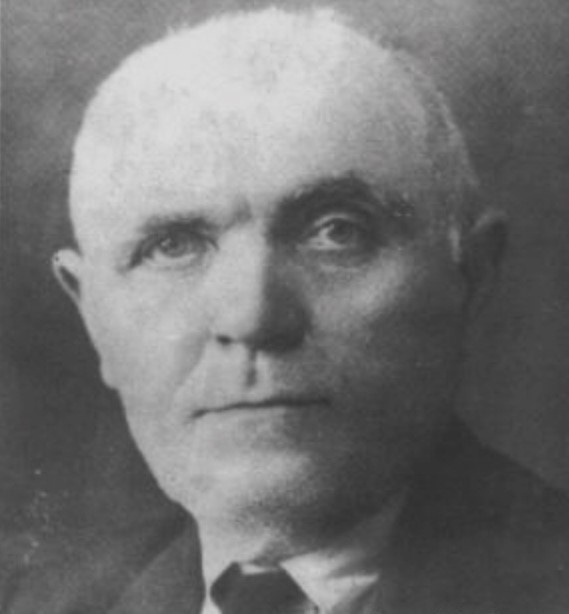
Memorie.al / If you go today to Sheper, where the well-known teacher and researcher, Ilia Dilo, was born and died – he to whom Sheper gave its name, Ilia Dilo Sheperi – you will find no relics, no trace. As the sole sign of remembrance, the cypress tree planted 73 years ago, on October 14, 1945, remains in the courtyard of Sheper’s church, where the earth was cast upon him. Afterwards, the grave was removed from there, and the remains were placed among the village cemeteries. “Place him among the people for whom he worked,” was the instruction, as ironic as it was bitter, from the high party leadership of that time!
Although he had a valuable contribution to Albanian national education and linguistic science, his name was removed from the history of the Albanian people, from the history of the Albanian language and literature, from the papers and lectures of scientific forums, right up to the Orthography Congress, where he had his scientific share, however modest that part may have been. His photographs with the most famous patriots and researchers of the time were retouched. Likewise, his name was not included as a separate entry in the Albanian Encyclopedic Dictionary of 1985.
A certain appreciation for him came late, after the ’90s, following the change of systems in Albania: he was awarded the title “Mësues i Popullit” (Teacher of the People) and later the high title, “Nderi i Kombit Shqiptar” (Honor of the Albanian Nation); a street in Tirana bears the name “Ilia Dilo Sheperi”; his name is mentioned in new scientific publications, while in the Albanian Encyclopedic Dictionary, the summarized entry with his name has the following content:
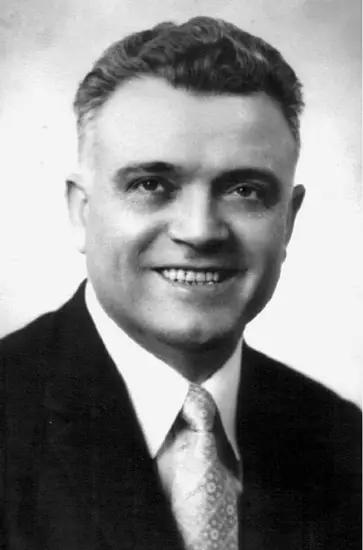
Ilia Dilo Sheperi (1872 – 1945). Activist of national education, linguist, “Teacher of the People.” He completed the “Zosimea” Gymnasium in Ioannina, worked for 15 years in Bënjë of Përmet. He participated in the patriotic movement and for the distribution of books in the Albanian language. For his activity in these fields, he was persecuted, expelled from his homeland, and sentenced to death by anti-Albanian political circles (1914). During the years of the First World War, he participated in activities for the protection of the country’s integrity. In the years 1918-1919, he converted the schools in the villages of Zagoria to the Albanian language. He was among the founders of the “Vllazëria të Gjirokastrës” society (1919).
He took part in the educational congress of Lushnjë in 1920 and that of Tirana in 1922. He contributed to the expansion of the school network and the preparation of educational programs. He worked as an Albanian language teacher in Vlorë, at the Gjirokastër Lyceum, and at the Girls’ Normal School in Korçë. In the field of Linguistics, he published the work Grammar and Syntax of the Albanian Language, especially Tosk for secondary schools (Vlorë 1927), one of the best grammars of the time, with many personal contributions, which presents the state of the Albanian language during those years. In its preface, he expresses valuable viewpoints and thoughts on various problems of grammar and the literary language. The work was re-published in Rome (1972) and in Tirana (2011).
Nevertheless, Albanian politics, which “pokes its nose everywhere” and “appropriates” everything, and the Albanian academic world, as it is and has remained, owe much to this man. What exactly, I do not know, as I am simply a citizen of this country, but at least, they should find his remains and place them where they belong, organize various scientific activities to restore his name, honor, and dignity as it truly was, without exaggerating anything; erect a memorial to him, if not elsewhere, at least in his birthplace, in Sheper; and include him in the nation’s memoirs, from which he was unjustly and violently removed.
Above, we presented a schematic account of the life of the renowned teacher and scientist, but his real life is a rushing river, because the time itself demanded heroes. Anyone who knows history even slightly will understand how dangerous it was in 1900 to speak Albanian, let alone open an Albanian school in your own home. The small room was indeed tiny, but it held the greatness and importance of a monument. The children there, prematurely aged by poverty and suffering under the brutal Turkish occupation, entered the illuminated room silently and learned to read and write. They learned Albanian.
When Ilia Dilo Sheperi was sentenced to death for the letter to the Patriarchate and the speech held before the people regarding the crime of Hormovë, his words were: “Even when you put the knife to my throat, you will see that the gurgling of my blood will pronounce A, B, C!”… The people’s protest caused the court to change its decision, and the death sentence was transformed into “Ezilim” (Exile). This was to throw dust in the eyes of the people, because they had decided to drown him in the boat that would take them to the ship. The boat was sabotaged (navagisi), and his comrade drowned, while Ilia survived, serving his sentence outside the country, in Italy. Later, he returned to his homeland, to his Sheper, intent on enriching and making his homeland as beautiful and independent as possible.
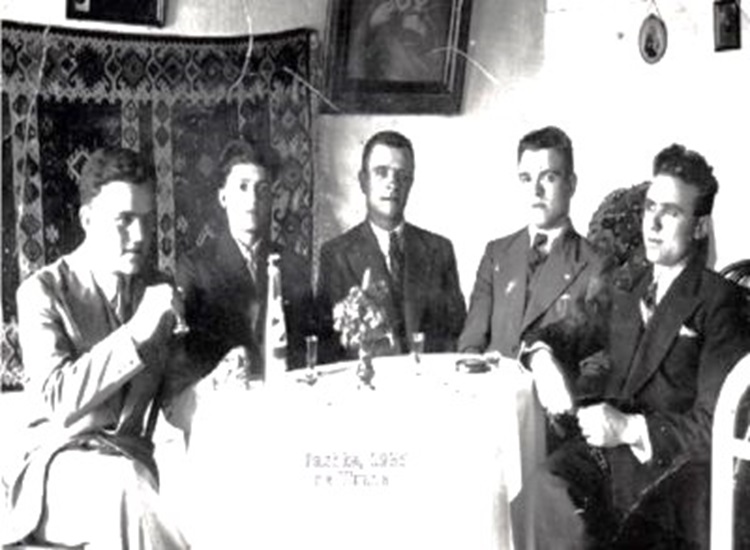
His house, especially his vast library, which occupied an entire floor of the two-story house, became a center for patriotic work for the entire South, where the issues of the time were discussed, and solutions and paths to salvation for Albania and Albanians were sought. The stairs of the house echoed with the heavy footsteps of Çerçiz Topulli, Aristidh Ruçi, Petro Harrito, Andon Zako Çajupi, Kostika, and many others… A warm hearth of patriotism, people who thought not about how to get rich and fatten themselves, but about how to enrich and beautify Albania.
As a scientist of class, Ilia Dilo maintained regular correspondence. Professor Doctor Norbert Jokli, with whom he was of the same mind and presented the same scientific arguments that Albanian was both older and richer than the three preceding languages and it was not just its richness and antiquity, but the generosity of this language to lend many word roots that are found in other languages, but originating from Albanian. Jokli adored and respected Ilia Dilo’s work. Expressing his regards to his Albanian colleagues more than once, he had said of him that “an ocean of knowledge was located amidst the harsh mountains of Zagoria.”
In the 1930s, even though he retired, he did not cease his scientific work. He spent all his time in his enormous library, which occupied an entire floor of the two-story house. When the house was burned by the Germans in June ’44, Ilia, knowing German culture, could never believe that they would burn his library, where 13 volumes of manuscripts were located, into which he had poured everything he had achieved with his studies throughout his life regarding the Albanian language and its antiquity. But, he did not foresee the betrayal. The house was burned first because the Germans had Albanian guides who directed the fire and the malice they had themselves or that others had advised them to have.
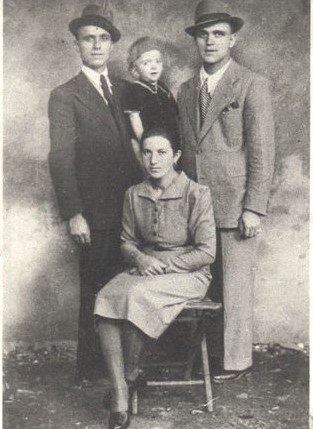
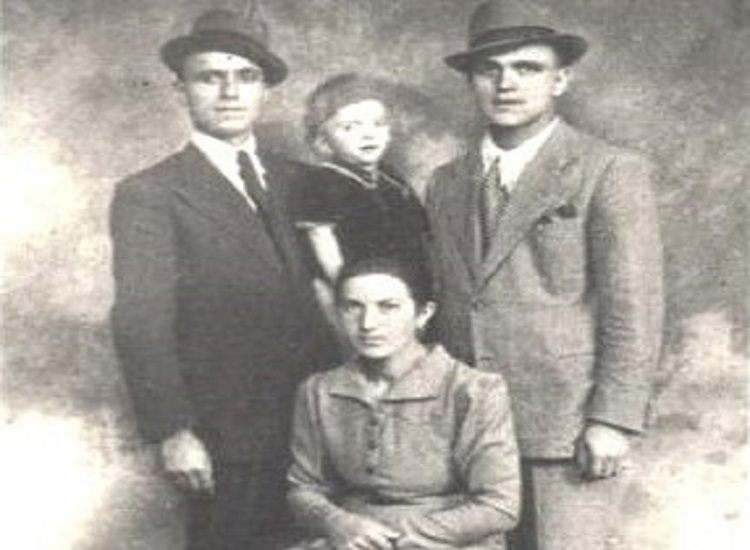
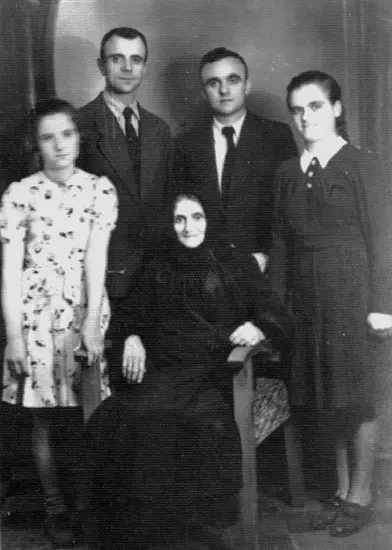
When Male Dilo, Ilia’s son, who understood from the position where they were that the house had been consumed by flames, asked his father what would distress him more: the burning of the house or the murder of his two sons. Ilia replied: – “What are you telling me, my son!? The boys would be a great sorrow of mine, but the library, all of Albania would feel and be condemned (by the loss)…” This was Ilia Dilo Sheperi. Like an ancient oak with deep roots, there, in Sheper, from the strong trunk, branches opened that were the faithful and unmistakable continuation of the healthy trunk. All ten of his descendants, seven sons and three daughters, justified themselves throughout their lives as his children.
The eldest son, Themua, supported the great household and helped until the other children started standing on their own feet. Assisting him, two years younger, born in 1902, was Qirjako, also a hard worker, gentle and well-mannered, but also an excellent scholar. At the age of 15, he opened the first Albanian school in Nivan on his own initiative and with his father’s help. He later became the director of the Poliçan School, where he also taught Albanian. However, his intellectual interests were broader; he worked as a journalist and later as an economist.
The third child of Ilia was Mihal Dilo; he studied veterinary medicine and worked with great love and passion in the field of agro-culture. Kokojka, the beautiful hill at the foot of Bisei, was transformed into a marvelous orchard with trees of all kinds. He got the tree saplings from Italy. Before he died, alone with his wife beside him, he told her: “Turn on the radio!” A Lab song flowed from the radio through his mind and soul.
He struggled to reach out to the shelf nearby. They were manuscripts containing the studies he had conducted during his marvelous work. Male’s son, Etieni, gave the manuscripts in 1996 with the good intention that they would be valuable to the university. But, they disappeared and cannot be found anywhere. Along with them was also a part of the memoirs of his close friend, Bilal Golemi. They, too, disappeared!
Margariti pursued higher education in Athens for mathematics. He was arrested and imprisoned by the dictatorship of the proletariat for no reason whatsoever, like many intellectuals of that time. He served his sentence in Maliq. He later married and had wonderful children who, through their behavior and work, uphold the family name. Another descendant of the Dilo family was Dr. Jani Dilo, serious and intelligent. After studies in Rome, he came to Albania, became involved in the war against the Italians and later the Germans, but could not reconcile himself with the political divisions and the theater of fighting that was taking place there.
He graduated brilliantly as a lawyer in Italy and in 1950 went to the United States, building an excellent professional career, first as a writer and journalist at the “Voice of America” and later taking on important duties. If Albanian academics had been a little more attentive, they would have given him his deserved place in the Albanian Encyclopedia. However, it is never too late for such essential historical corrections.
Oresti Dilo, Doctor of Medical Sciences, in one of the most civilized countries in the world, in New York. He had a great desire to serve his country, but it was impossible. Yearning and desperate, he sent his savings to people in Albania. He came to Albania in 1990 and, after the yearning meetings he held, learned about the unworthy attitude and treatment of his father’s figure. Horrified, he left the next day, only to enter a hospital, deeply shaken, where he also died.
Viktoria, the pride of Ilia Dilo Sheperi. She adored her father’s work, valued it, and practiced the teaching profession with immense zeal and love. All the events that took place caused her to suffer unprecedented shock, and thus, silent and in sorrow, she passed away at the age of 59. She was decorated “Mësuese e Merituar” (Meritorious Teacher) posthumously during the pluralist era.
Koço Dilo. Like all the Dilos, good, distinguished. At the age of 50, he was arrested and sentenced to 10 years in prison allegedly for attempted escape! The only witness who was supposed to testify for the charge against Koço was trembling like a leaf. Koço, right there in the hall, face-to-face, told the judge: “Mr. Judge, calm down the witness who is looking for a place to hide. Tell him that I am being judged, not him.” He served all 10 years in the terrible Spaç prison, where Krisua, Viktoria, Viktori (Xhamballo) Dilo, Ifi, Ylli, Bardhi, Edi, etc., often visited him. He was released from prison and died peacefully three years later in a hospital in Tirana.
Ilia’s other daughter was Thevronia. She was a good homemaker and wise woman. She raised good children and also suffered, like all the Dilos. This entire history of suffering and hardship, unfortunately, closes with another dark frame: Kaliopi Dilo, the wife of Male Dilo, the unbreakable pillar (kolonë e pathyeshme) of the Dilo house, was killed in 1991, at an advanced age, in the most macabre and yet most banal way imaginable – inside her home by robbers, who thought they would find the “gold of the Dilo emigrants (kurbetlinj)” there./Memorie.al