By Sven Aurén
Part Four
Përkthyer nga Adil N.Biçaku
The Orient of Europe
“Land of Albania! Let me bend mine eyes
On thee, thou rugged nurse of savage men.”
Lord Byron
In the book “The Orient of Europe,” the author is the Swede Sven Aurén. These are travel impressions from Albania in the mid-1930s – his direct experiences, entirely unretouched.
In a word, the translation of this book is intended to bring to the Albanian reader the original value of a history we have not known, or rather, a history we continue to perceive through distortions created by the interests of the moment.
Now, a few words about the person addressing these lines to you: My name is Adil Biçaku. I have lived and worked for over 50 years in Sweden, without for a single moment detaching my thoughts and feelings from our Albania.
I am now retired and living with my wife and children here in Stockholm. Having been away for a long time, and considering the natural evolution of the Albanian language over these decades, I am aware of the significant difficulties I will face in conveying the experiences of the original work to the Albanian reader.
Therefore, I would be very grateful if, together, we could find a practical way to collaborate in translating this multifaceted and valuable book. Morally, I would feel greatly relieved, as this would pay a part of the debt that all of us Albanians owe to our country, especially in these times that continue to be so turbulent.
With great respect,
Adil Biçaku
Continued from the previous issue…
By order of the Great Powers, a delegation of Albanian aristocrats traveled, led by Essad Pasha – himself an unofficial pretender to the throne – to Neuwied Palace on the Rhine. It was there that the crown of the new principality was officially bestowed upon Wilhelm. Simultaneously, the Prince was informed of the “joyous” situation: that amidst the furious enthusiasm of the Albanian people, he had been “elected” as the first King of Albania.
The moved Prince expressed his gratitude for the trust and honor shown by the Albanian people and accepted with great pleasure. He had, with considerable foresight, secured guarantees from the Great Powers for a pension of 200,000 francs, should future events make his stay in this new motherland untenable. The delegation pledged their loyalty, recommended them to him, and returned to Durrës. This took place around the turn of the years 1913–14.
Naturally, Wilhelm felt a great deal of trepidation when considering the life-threatening task he had agreed to undertake. By nature, he was far from a hero. Nor did the world press help him feel any more cheerful; newspapers across the globe were filled with prophecies of doom and greedy tales of horror regarding the ferocity and the Albanians’ perfect skill with firearms. Journalists took particular delight in making somber comparisons to the Mexican tragedy of Emperor Maximilian. Furthermore, the press emphasized other similarities between the Mexican imperial couple and the newly fashioned Albanian princely pair: in both cases, there was an ambitious, energetic wife who persuaded her husband to accept a high position that was as alluring as it was superficial.
While Prince Wilhelm stayed home in Neuwied, taking lessons in the Albanian language and studying the geography and social conditions of his principality, his wife went to Bucharest. There, she sought from the Queen of Romania, Elisabeth of Wied, a glimmer of information regarding Balkan folk culture. Indeed, Queen Elisabeth, publishing under the pseudonym “Carmen Sylva,” had released several heartfelt and interesting writings in this field. The two ladies conferred, and the Princess of Wied returned to Germany. A direct result of these important talks was an order placed in Berlin for “Albanian national costumes,” and to complete her equipment, the Princess secured a rich store of Albanian folk songs and musical instruments.
Simultaneously with these measures, a quantity of trunks was dispatched to Durrës, which was to become the residential city of the princely couple. The city’s inhabitants stood from morning until night at the harbor, where no fewer than 156 large crates of furniture, kitchen equipment, and other items were unloaded from a Trieste steamer. Sixteen saddle horses were sheltered under a tent for lack of a stable. Rigorous work was undertaken to transform a former Turkish Pasha’s residence into a “Palace.” For an unbelievable daily wage, Austrian carpenters and upholsterers struggled to prepare the rooms. The worst part was the rats. The master builder sent one desperate report after another to Neuwied. He had tried every extermination remedy, yet these foul creatures refused to vanish from the “throne room” and the reception hall.
There was also a host of other things to be prepared before the journey could finally begin. With great effort and care, Wilhelm prepared his own princely uniform. Had there been an Albanian tradition to lean on – namely, the beautiful garments of the highland chieftains – it would have been sensible to follow it, but in the eyes of the Prince, these were far too un-Western. Thus, he relied entirely on his own fantasy. It would be unfair not to praise the result: a light gray military coat with wide gold stripes around the sleeves and beautiful epaulettes; on his head, a white fur busby, like a Russian Grand Duke, and on the front of the busby, beneath the golden eagle of Skanderbeg, a thick golden cord with tassels.
But the most perfect feat of all was the idea for the plume. It was white, half a meter high, and stood as straight as a broom in a golden socket on the corner of the busby, as if the Prince were constantly carrying a miniature exploding bomb atop his head. Although this magnificent hat met the high aesthetic requirements, it later proved to have at least two serious drawbacks: it posed a risk of prestige-damaging incidents in low Albanian doorways and was somewhat cumbersome for the rather tropical conditions of the principality.
Another important measure achieved was the creation of an order, “The White Eagle of Skanderbeg,” as a token of princely gratitude to be awarded to individuals of particular merit. With this, the journey of Wilhelm and Sophie of Albania began from Neuwied toward their principality, acting as obedient tools of German-Austrian diplomacy to pave the way for an effective policy in the Balkans.
***
In Albania, the waves of joy were immense. Truly, over a million Albanians still lived under a foreign yoke; truly, this new sovereign was a foreigner and, moreover, a Christian (in a state where the vast majority of the population was Muslim). Yet, the ancient dream of freedom – though not entirely – had largely been realized. The goals of the “Great Policy” that the new principality would be forced to serve were absolutely unknown to the broad masses; even within intellectual circles, a strange optimism reigned regarding the “independence” of the new Albania. People believed what they wished to believe: that open sympathy for the Albanians’ four-hundred-year struggle for freedom was the cause for the nation’s birth.
They were proud that the Great Powers had recognized their own Mbret – a word in Albanian meaning ruler, which is a mangling of the Latin word imperator. King Wilhelm had fulfilled the great hopes of the Albanian people the moment he accepted the princely crown. Finally, the Albanian peasant would be master of his own land, for it was publicly rumored that a radical agrarian reform would be the first item on the new government’s agenda. The power of the Beys would be curtailed. There was talk of building magnificent roads, schools, industry, and everything else possible to help the Albanian people take the leap from the middle Ages into the modern era. The King had been appointed by Allah to pick up the fallen mantle of Skanderbeg and become a new Skanderbeg.
And while the Albanians celebrated their new-found freedom, their Prince, and the unheard-of kindness of Allah, Wilhelm-Skanderbeg stood with his plume and all his regalia on the deck of the ship Taurus, bound for Durrës, encouraging himself: Courage! Courage! Courage!
One who, on the contrary, was not so pleased with the turn of events was a man I have mentioned before: Essad Pasha. This strange character, a ruthless knight, would play such a decisive role in the five-month history of the Principality of Albania that he merits a more detailed introduction. As a member of the high aristocratic Toptani clan, he grew up in Central Albania, from where his parents sent him to Constantinople for advanced officer studies.
There, at a young age, he achieved great success, becoming one of Abdul Hamid’s favorites and amassing numerous commendations – which, in fact, did not stop him from conspiring against the Sultan. I have previously recounted how he, as a worthy member of the “Young Turks” society, presented Abdul Hamid with his deposition. For this bravery, he was held in special regard by the Young Turks and was sent to Albania at the head of Turkish troops to suppress the freedom movements in the northern part of the country. This he did so thoroughly and cruelly that he thereafter served as a merciless opponent of anything called Albanian freedom.
At the beginning of the Great Balkan War, he formed a small private army with which he marched toward Shkodra, where the Turkish governor was struggling to withstand the attacks of the Montenegrins. Thanks to Essad Pasha’s help, the situation improved. A few days after his arrival, he invited the Turkish governor to a small dinner at his residence, where he murdered him and took command of the city’s defense. It seemed as though luck would favor the Turks when, suddenly and unexpectedly, he surrendered the city to the Montenegrins, having secured safe passage for himself and his army.
The reason for the capitulation was incomprehensible, but Essad’s healthy account in Paris rose significantly due to the reward from the Montenegrins. With his private army, he then continued to fight on his own, whenever and however it pleased him. Those close to him died one after another under mysterious circumstances, and Essad inherited from them all. He grew wealthier with every passing day.
Then came the day when the Great Powers recognized Albania as a free nation. Essad, who had just cruelly and bloodily suppressed freedom movements in Northern Albania, was suddenly the most ardent friend of liberty in the whole country. Unfortunately, the Great Powers showed no interest in his discreet proposal for a King Essad I. To his chagrin, this zealous friend of freedom had to watch as the decision was made for Wilhelm of Wied, but he restrained himself and argued with Italy: this man will not last long on the throne.
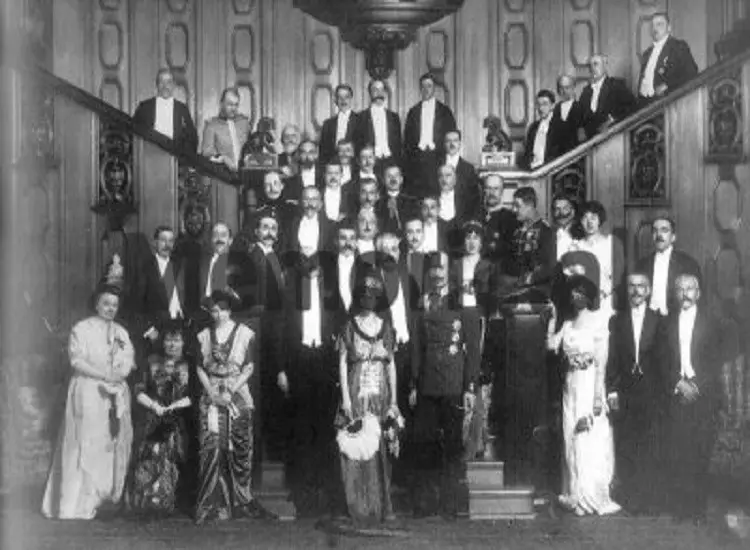
He changed completely and became the Prince’s most fervent supporter. When the delegation of Albanian aristocracy set out for Neuwied to offer the new Prince the crown, it was Essad who served as the head of the delegation. When the Taurus, on March 7, 1914, slid into the pier at Durrës, it was Essad who stood at the front of the gathering of Albanian aristocrats, waiting to welcome the princely couple to Albanian soil.
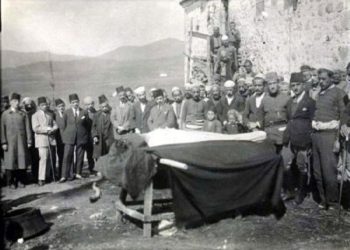
Behind this group, composed of Pashas and Beys in shining top hats and correct Western attire, the Albanian people waited impatiently. The piers and shores were packed. Special correspondents sent by the world press moved their pens across their notebooks. The scene teemed with beautiful costumes: women in veils (ferexhe) and Muslim bloomers (brekushe), shepherds in sheepskin furs, and highland chiefs in velvet coats embroidered with gold.
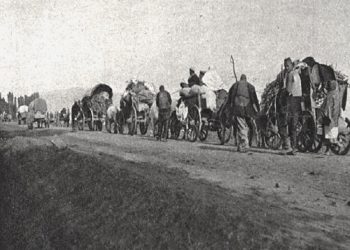
From the mountains of the north and south, from the valleys and high plateaus, Albanians had come to Durrës to see the King of Albania. They had traveled for days and weeks on donkeys and horses to participate in this historic landing. When the Taurus was first sighted on the horizon, unrestrained enthusiasm erupted. People shouted and cheered, laughed and cried. This was Albania’s great day.
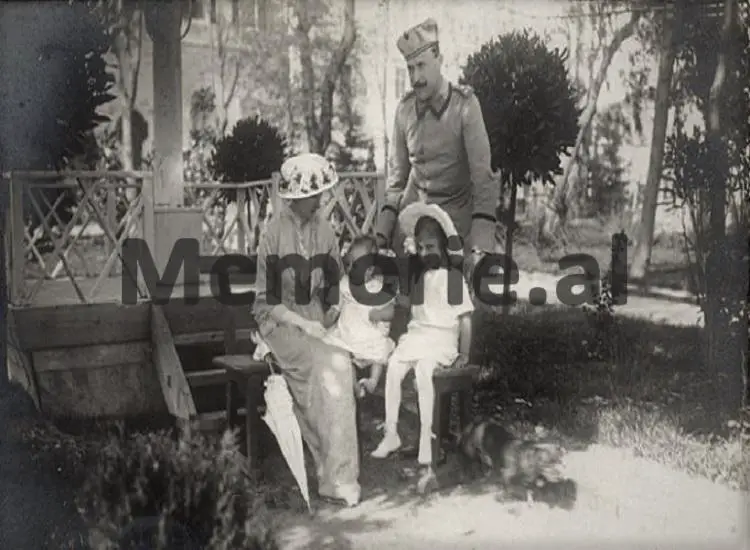
The Taurus and its escort of destroyers dropped anchor outside the pier. A boat went out to the arriving steamer, and a few minutes later, to the fanfare of military trumpets, the Prince and Princess of Albania stood for the first time on Albanian soil. Wilhelm, in his new uniform, looked magnificent with his straight posture and splendid figure. The beautiful Princess was dressed according to the latest Parisian fashion.
Then the cheering reached its peak. From the mass of people thundered the Albanian greeting, like a spellbinding wave for the princely couple:
– T’u njat jeta! T’u njat jeta! (Long life to you!)
But the Prince and Princess did not respond according to Albanian custom with the same words. T’u njat jeta! – May you live long! – was not part of the Prince’s vocabulary. Wilhelm raised his hand to his fur hat in salute and said:
–Danke schön. Danke vielmals…
And Sophie smiled a warm smile:
– Très bien! Merci beaucoup…
***
Unfortunately, we cannot know what Wilhelm was thinking as he looked out from the terrace of the Taurus and saw his future city before him: a cluster of ruined houses and filthy streets, a wretched port where steamers could not approach the pier but had to remain anchored offshore, and a “Palace” that in no way justified the name. He saw the shouting crowds of people in strange clothes and with wild appearances. Beyond the city, he saw parched fields, and beyond those, Barren Mountain ranges with terrifying clusters of clouds.
Perhaps his mind turned once more to Emperor Maximilian of Mexico. As he observed his subjects more closely, his thoughts surely drifted along the Mexican trail. In Berlin, Paris, London, and other capitals he knew, men usually carried walking sticks or umbrellas. Here, there was virtually not a single man who did not carry a long, menacing rifle on his back.
What the Albanians thought after their first encounter with the new ruler, on the other hand, was no secret. That very night, after the initial enthusiasm had cooled and people had generally composed themselves, they began to whisper over their cups of coffee. Was there not an unseemly symbol in the fact that the King had arrived on an Austrian yacht, escorted by Italian warships? Was it not a disturbing omen, given that foreign rule had only just ended in Albania?
And what of all those postcards of himself and his wife that the King had distributed throughout the country? How it was possible for a high lady to appear without a veil – and not only that, but in a deep décolletage – as if she openly wished to show her disregard for the Prophet’s command? And then, the new ministerial cabinet. The “evil spirit” of Albania was Essad Pasha.
His innumerable crimes, his legendary ruthlessness, his insatiable thirst for power – this was the very Essad the King had chosen as Minister of the Interior and of War. How could such a choice be explained? Was it because the King did not understand the Albanian situation, or was it sheer madness? Or was it simply out of fear of this powerful Pasha? Furthermore, the government in general inspired no confidence. How was it possible for the common Albanian to hope for agrarian reform when all the ministerial posts were held by land-owning Beys?
Nevertheless, it was not a state of revolt that dominated Durrës, but rather a persistent pessimism – a troubling premonition that was hard to shake off. Yet, the people actually tried, as much as they could, to help the King in his mission. To distract themselves, they went down to the pier and peered through the planks of the “Palace” fence. It looked magnificent, with all those officials in uniforms covered in medals, running back and forth between the still-unopened crates and boxes.
Even the guard looked impressive in an olive-green uniform with a rifle and fixed bayonet. But what made the greatest impression were the two servants. One wore highland dress, representing the North, and the other wore Tosk attire, representing the South. This was taken as a sign that Albania had finally become a homogenous state! The spectators could not have known that this was merely a simple imitation of the Austrian and Hungarian guards at the Vienna Hofburg./Memorie.al