Part twenty-three
Excerpts from the book by his children
A Few Words as an Introduction
Memorie.al/When we, Alizot’s children, would recount “Zotia’s” (Alizot’s) stories in joyful social settings, we were often asked: “Have you written them down? No! What a pity, they will be lost…! Who should do it?” And we felt increasingly guilty. If it had to be done, we were the ones to do it. But could we write them?! “Not everyone who knows how to read and write can write books,” Zotia used to say whenever he came across poor-quality books. When we discussed this “obligation” – the Book – among ourselves, we naturally felt inadequate. It wasn’t a task for us! By Zotia’s “yardstick,” we felt incapable of writing this book.
Continued from the previous issue…
Wit and Thorns in the Bookstore: Like a Zoo…!
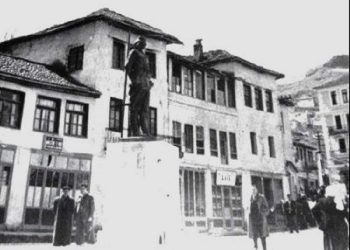
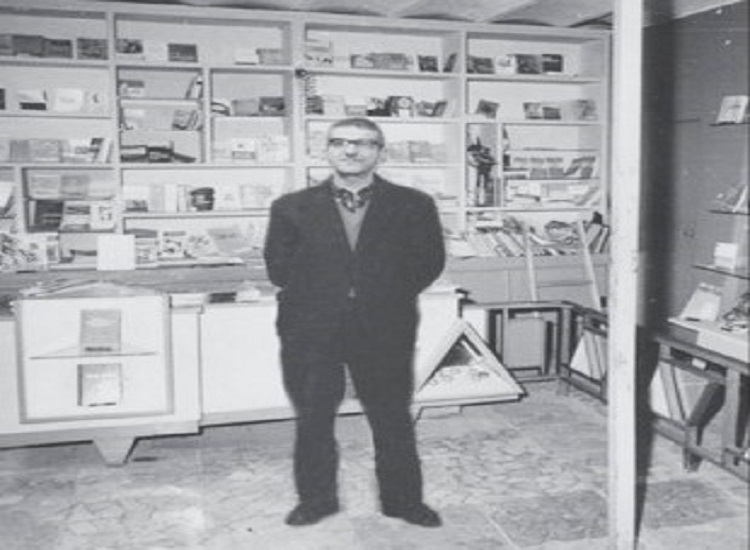
On the eve of the first National Folklore Festival in Gjirokastra, on October 16, 1968, a special investment was made to reconstruct the Bazaar and the Castle. Specialists, architects, and engineers were brought in from Tirana. In this context, a full interior renovation of the bookstore was carried out. The bookstore felt much lighter afterward. The tall, heavy, dark-brown counters that surrounded three sides of the shop were removed.
A light, partial counter was installed only where the bookseller stood, while the rest was replaced with decorative painted wooden railings. New light-colored shelves were built. The whole bookstore gleamed. Zotia was very pleased. He had collaborated with the interior architect on everything. He didn’t hide his joy and welcomed congratulations from everyone.
A few days after the reopened bookstore, a group of friends went to congratulate him. They were the usual company of humor and coffee: lawyers, doctors, passionate readers…! They entered, expressed amazement at the radical change, made comparisons to how it used to be, and praised Alizot. Zotia was immensely gratified, moving along the shelves behind the decorative railing that separated the seller from the buyers.
“There is only one flaw in this reconstruction!” one of the friends remarked.
Everyone froze at this bolt from the blue.
“What?” Zotia asked, surprised.
“With these railings surrounding the shop, it looks like you’ve been put in a cage, just like at the zoo!”
“Quite right, but with one small difference,” Zotia cut him off instantly, realizing where they were heading with all that praise.
“What difference?” they asked impatiently, glad they had finally “caught” him.
“The owner stays inside, and the animals stay outside!” Zotia clarified calmly.
The laughter wouldn’t stop. The visitors refused to leave, waiting for other acquaintances to arrive just so they could retell the story. Incoming guests would ask Zotia for confirmation.
“They are sincere, they don’t lie, that’s their one good quality!” Zotia replied laughing, having gracefully escaped the “siege.”
“I Want a Library”
A certain man had been put on a pedestal by his friends. He had just returned from several years of specialization abroad. He was envied by his colleagues, as was anyone returning from abroad at that time. However, it soon became clear that he lacked general culture; it was said he hadn’t read a single book in his life. This was discovered quickly, for in Gjirokastra, everyone is equipped with a “mind-probing apparatus.”
His friends advised him that he absolutely had to build a personal library. “But how do I do it?” he asked.
“Alizot can help you with that,” they guided him. So, one day he went to the shop:
“Alizot, I’ve come for you to help me make a library for my house!”
“You did well to come, but this is a bookstore and it only has books; the shelves are not for sale. For a library [the furniture], you should go to the carpenters, to Mane Xhaxhiu, at the top of ‘Varosh’.” Zotia had heard rumors about this person’s ignorance but pretended not to understand, not wanting to dig further.
His friends burst into laughter when he told them how Zotia had dismissed him. “Why, did you really try to take the bookstore’s own shelves from Alizot?!”
After a while, he returned with his friends. Everyone bought a book except him; he was the last. He didn’t know which one to pick and thought of a solution to save himself from his friends’ taunts:
“Alizot, I want you to choose my book for me!”
“With pleasure,” Alizot replied, ready as always. “But to hit the mark, tell me: what books have you read?”
“Of the ones you have here,” the man said, mobilizing his mental arsenal to hide the truth, “I don’t see any that I have read.”
“In that case,” Zotia explained with total seriousness, “we must start together from the muhalebi (sweet porridge)!”
“What is this muhalebi, Zote?” one of the friends asked.
“The ABC Primer!” Alizot replied, relieved to have found the book that suited a beginner reader.
A Night on “Broadway”
“May I help you?” Alizot addressed a client who, after much silent wandering around the shop as if searching for treasure, finally decided to buy a book.
“I want that book, ‘A Night in a Brothel’ (Një natë në Bordello)!” the client said, having waited for everyone to leave. In those times, it wasn’t considered moral to ask for such a book in public. Gjirokastra’s “wicked tongues” would have had a field day!
Alizot realized the client had confused the title with the book “A Night on Broadway”, but he didn’t rush to correct him, as this was another episode for his collection of humor. He smiled inwardly, not wanting to spoil the buyer’s thrill of “secretly” buying a forbidden book. He took the book from the shelf and handed it over, keeping the cover face down to “protect” the client from the evil eyes of the world. The client paid and left.
The next day, he returned with a friend. He approached Alizot with a shy yet smiling look and whispered:
“Listen, Alizot, how is it possible that the book ‘A Night in a Brothel’ had nothing in it? I leafed through it all night, didn’t miss a page, but the brothel was nowhere to be found. Is it possible they put an attractive title on the cover just to sell the book?”
“No, that’s not possible. Generally, the title represents the content. But I’m surprised, because the book you took is very well-liked. As I understand it, you’ve confused the title!”
Alizot placed another copy on the counter and said:
“I read the title differently than you do.”
The Nose as a Chimney
In the bookstore in Gjirokastra, people smoked, despite the “No Smoking” sign.
Alizot himself smoked. A lot. His fingertips were stained yellow-brown. He lit one cigarette with the end of another – two or three packs of “Partizani” a day. It damaged both his health and his modest family economy. He often ordered “Drishti” tobacco from Shkodra and rolled his own, saying he smoked less that way because the preparation took time.
The clients who stayed long also smoked. Most smoked out of “trouble,” like Zotia. But there were those, though rare, who smoked to look “manly.” They would inhale deeply and blow the smoke out through their noses while keeping their mouths shut. The smoke would blast out in two pressurized plumes. The smoker would act proud, thinking others were incapable of such a “feat.”
Zotia disliked arrogant people and didn’t spare them his wit. For this category, he used the expression:
“If God had known that men would use their noses as chimneys, He would have placed them on the top of their heads!” Everyone would laugh at the “smoking hero,” giving him a lesson in humility.
The North Pole
In the 1950s and 60s, information was limited. This lack of facts left room for fantasy and humor.
Kaman Çabej, having read an article in the magazine “L’Union Sovietique” about a Soviet icebreaker going to the North Pole, was telling Zotia that opening a path through the glaciers would link Russia and America by a short sea route.
“What are you blathering about, poor Kaman?!” Zotia interrupted. “Don’t you know what the North Pole is? The North Pole is an endless desert of ice and freezing gales, where if you were to pass gas—if you could at all—and turned your head, you’d see it frozen right there, like a bird’s egg!”
Kaman, a humorous actor from the Gjirokastra variety show, first listened with great attention, expecting a scientific fact. Then he burst into laughter.
“In other words, whoever intends to go to the North Pole better hold it in, so his trousers don’t crack?” Kaman concluded.
“Leave Me Your Shoes!”
Someone once asked Alizot for a loan when he still had his private shop. Alizot knew the man; in Gjirokastra, he wasn’t considered particularly trustworthy.
“Sure,” Alizot said, “I’ll give it to you, but on one condition!”
“Whatever you want, Alizot!” the borrower replied happily.
“You must leave your shoes here with me now.”
“Wha – ? How am I supposed to walk through the Bazaar barefoot? Besides, what do you want with my shoes?”
“Well,” Zotia replied seriously, “do you expect me to wear out my shoes trying to track you down to get my money back?!”
Falling in Front of the Bookstore
Sometimes, people walking toward the square would trip or fall on the stone slabs in front of the bookstore door. They would get up, dust themselves off, look back to see what they tripped on, and check if anyone was watching. They would get angry if they saw someone laughing and enter the shop looking pale, revolted, and huffing…!
Alizot, seeing the “accident” from inside, would greet them calmly:
“Are you badly hurt?”
“No, just a bit, but I don’t know how I tripped, what a mystery…!”
“It’s not your fault; you’re not the first to fall,” Alizot would console them.
The client would find comfort in the bookseller’s warm words. It wasn’t their fault; the fault lay elsewhere, as the owner himself explained:
“The fault lies with God for putting human eyes in the forehead. A big mistake! Had He placed them on the tips of the toes, surely no one would ever trip.”
The visitors would laugh, their tension dissolving, even though Alizot hadn’t entirely excused them.
The Camel Caravan
Groups of intellectuals often entered the shop together. At the door, a ceremony of mutual respect would take place. They would make way for one another, respecting age, education, and social standing. They entered in a self-determined order. Zotia would “read” this ranking for free. Usually, he agreed with it, but sometimes the order was based solely on state or Party rank.
From inside, Zotia would hear: “No, please, after you! Ooo, I insist, it is your right! Please, it’s too much…” Finally, the “leader” of the group would enter, looking quite pleased with him. Zotia would greet them with open arms and humor, often reciting:
“Even a camel caravan in the desert needs a donkey in front to show the way and keep the rhythm!”
Everyone would laugh, including the leader. They didn’t take it personally. On the contrary, it opened the door for the witty banter Gjirokastrians are famous for.
The Policeman’s Fine
A young policeman, new to Gjirokastra, entered the shop. He was checking a government decree against smoking in shops at risk of fire. He found Alizot with a cigarette in his mouth!
“Citizen, you are in violation of the fire safety law. Smoking is forbidden. I am issuing you a fine.”
Alizot looked at the fine and, “surprised,” asked:
“For what period have you issued this fine? I don’t see it written.”
Confused, the policeman explained: “Uncle, the fine is for now. If I find you smoking again, you’ll get another one!”
“Well, this fine is no good to me then,” Zotia said. “I want the period written on it, because I’m going to smoke again. I can’t do without it. Tell you what? So we are both settled, issue me a fine for the whole year. I’ll pay whatever it costs. Then you come back next year.”
“There are no fines like that, uncle,” said the policeman, who didn’t know Alizot.
“There are, there are,” Zotia insisted. “Ask your bosses, they know. They’ve fined me before.”
The policeman didn’t argue and left. His bosses, of course, knew exactly who Alizot was./Memorie.al