
By Sokol Parruca
Part Three
The rare testimonies of the renowned jurist Sokol Parruca on Shkodra’s football icons over the years, such as Halepiani, Hasa, Rragami, Rakiqi, Bizi, Dani, Zhega, etc.; artists like Vasija, Tërshana, Aliaj, Ljarja, etc.; as well as other emblematic characters of that city.
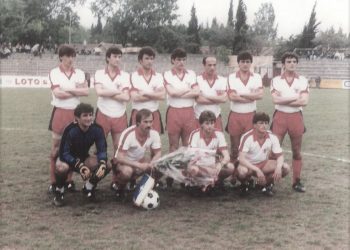
Memorie.al / It is difficult to write about the former players of the “Vllaznia” team of Shkodra over the years without being a researcher or a football specialist, but I am sharing my impressions of those I knew, touched, and saw – the youth coaches – without claiming to say everything they deserve. Undeniably, I believe it is impossible not to mention Ernest Halepiani. I was about 9 years old; I don’t remember which neighborhood friend I first went with to “Pioneers’ Park,” near the former “11 Janari” school, to begin football training. The children’s coach there was a short man with fine curly hair and a face that shone with kindness.
Continued from the previous issue…
GJOSHO VASIJA
Do you remember Corrado, the famous Sanremo presenter, who had that slightly raspy timbre that made him unique? To me, he resembled our Gjosho, except Gjosho’s voice was warmer and more melodious. As a teenager then, I not only dared to compare them, but my mind went further: Gjosho was greater. Later came Pippo Baudo, the magical man of the Italian stage; still, for me, Gjosho was incomparable.
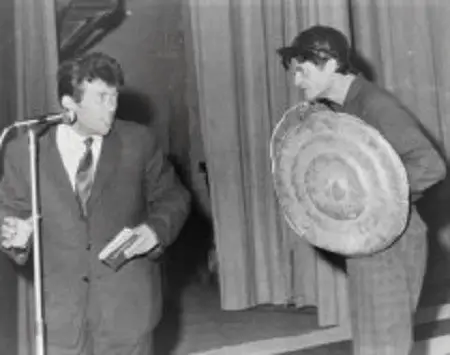
If Pippo was a brilliant, agile presenter, Gjosho was – besides a presenter – a humorist, musician, performer, and parodist; in short, a complete artist. The only difference was that while Corrado and Pippo played on grand stages, our Gjosho started and continued on the stages of enterprises, at the Vau Dejës Hydropower Plant, and occasionally at the “Migjeni” Theatre. Yet I say, talent does not ask permission; it bursts forth visibly, shining regardless of the stages or the luxury of great theaters. We had invited him to a dance party when we were in high school; at that age, our only thought was to dance and jump around.
But that night, no one wanted to dance. We gathered around Gjosho and followed his art, mesmerized. That night remains one of the most beautiful evenings of my life. Around 1972, I was living in Tirana, and his arrival was felt at the National Variety Theatre (Estrada e Shtetit). The people of Tirana excitedly exclaimed that Gjosho Vasija of Shkodra had arrived. The hall was packed, the applause was endless; they loved him, he had won them over, he delighted them, and thus he won their love.
But, tragically, the “shadow” that followed him everywhere – especially at the peaks of his success – penalized him. This is what happened during those heated days and nights in Tirana when they removed him, despite the regret left behind for the departure and loss of an irreplaceable super-talent and a good name that was never forgotten. He returned to Shkodra. He was used to dismissals and punishments, as he used to say with a laugh: “They kick me out through the door; I crawl back in through the window.”
I always wondered: where did he find this strength and courage even when they struck him at his strongest yet most vulnerable point – his art? They never managed to bring him down, to bend him, or to extinguish his smile. He was never defeated by despair, never surrendered to bitterness. He continued to play, no matter where… to laugh and rejoice in the moments. He smiled.
Ah, his smile was so magnificent! It wasn’t a forced smile, or a professional one…! No, his laughter bubbled up from his soul, for his soul was full of joy and mirth, because he was in love with every stone, every tree, every alleyway, and every house. He was born to be joyful. He was born to make us happy, too – we who loved him so dearly but could not protect him. Today, his body rests in a foreign land. One day Shkodra, the municipality with its own funds, will make it possible to return its son to the land of his birth, for Gjosho Vasija is a story of love and tragedy for his city.
RIN MONAJKA
Rini deserves much more than we, who knew him, can write. Elegant in appearance and extremely refined in thought, behavior, and stance. He was my sports comrade (we were both with the “Vllaznia” youth team) and we met almost every day. Quiet, very well-mannered, intelligent, cultured, and somewhat reserved as a type; nevertheless, it gave me pleasure to meet and talk with him.
It happened somewhere around the end of 1980 that he began to avoid me slightly. I felt it, though his gaze toward me had not lost the spark of friendship. At the time, I couldn’t understand the reason for this change. We had never given each other reason for such a cooling.
I learned much later, on the day he was arrested while I was working and living in Tirana, that he had openly come out against the system, being among the organizers of the toppling of Stalin’s bust in Shkodra. Only then did I understand that look of his, as if he wanted to tell me “don’t stay with me,” perhaps to avoid implicating me, or – more likely – he identified me as part of the system, which had naturally cooled our friendship.
Regardless, I never stopped asking about him. They had beaten, tortured, maimed, and disfigured him until he sustained the wounds that weighed on his health and took his life. And no one was punished. Rini left, he was forgotten, remembered only by his family, relatives, and friends. Although he acted bravely with conviction and determination against the system, today we see no plaque, no stone, no street or alley with his name, nor a bust to immortalize his act.
He gave his life for ideals and democracy. Although in life he was soft-spoken, modest, and hated boasting, he is a true hero of democracy. As such, he should enjoy all honors and respect. The wisdom and modesty that follow Rini even years after we lost him should be an invitation for attention to this man, who did not consider himself a hero, but to whom his friends and society gave the title.
Gratitude and honor to you, Rin. Rest in peace, friend!
ALDO PERIZI
Aldo, on your birthday, we – your friends and everyone who knew you – are with you today, and you are with us, even though physically you are somewhere above, greeting us from there with a smile. Ah, that very special smile of yours! In you, spiritual beauty and physical beauty became one. You were beautiful in soul, in mind, and in appearance.
Everyone has much to say about you. Each of us felt the warmth of your human soul. You taught me that one can become a close friend even through Facebook. Only a day before, we greeted each other. Ah, how I to know that was would be the last evening we communicated! Your heart stopped beating and you went up there where angels belong, for you were a beloved angel, friend.
You don’t know the grief you left us, how many friends you have impoverished, how many tears were shed for you. You were a simple Shkodra boy, yet you had the grandeur of a personality. Your heart suffered, it groaned, but it was so large it gave so much love and kindness that, burdened by illness; it could no longer hold the weight of your immeasurable love and care for people and your friends. We are all with you today, and we will be year after year, for you left us the beautiful memory of a model human being who cannot be forgotten. Rest in peace, dear friend!
RRIK ÇEFA
In the eternal flight toward the Infinite World. A wonderful Shkodran, a dear friend who will be missed…! Ah, how you saddened us with this sudden departure, dear Rrik…! We will remember you with longing and love, because your whole life was an unfinished melody…! Farewell, Rrik!
A FEW YEARS WITHOUT TONIN TËRSHANA…!
When I first met you, we were mere children; you lived in “Gjuhadol,” I in an alley a bit further down, near the cinema. Back then, we watched many films thanks to Ndoc of the cinema, who let us in without a ticket, sometimes to see the same film several times. The movie “Listen to My Song” stuck in my memory – the voice of that boy who sang so beautifully, Joselito.
After the cinema, when the film was showing inside, another boy sang outside – about 12 years old, in short pants, whose voice resembled the boy in the film. It was you, Tonin, and we liked both: Joselito in the film and you singing outside. Two wonderful voices. Both in short pants, both orphans – one searching for his mother, the other having lost his father when he was only five.
Both lives were difficult and grueling. Before turning 15, you were forced to leave Shkodra and come to Tirana to earn the bread you lacked. You sang in the park near “Bar-Sahati,” and late at night, having nowhere to sleep, you went near the Central Post Office. For a bed, you used some crates you gathered, for sheets, cardboard, and for a blanket, whatever plastic sheeting you could find.
You slept there peacefully, secure in your voice, until that moment that changed your life. While you were singing, you couldn’t help but impress a professional musician like Ferdinand Deda, who instinctively recognized your warm timbre. He brought you in, and then you took the path of the festivals. You were only 16 when you won first prize with “Të dua, o det” (I love you, oh sea).
You were born for music, and music became your life, your profession. There was no end to the applause, no end to the warm cheers, no counting the prizes you won. You were the singer they loved, the favorite of both composers and listeners.
Only once did you feel weak: in 1972, while singing in Pristina. The hall was full – silence and tears. Men and women, young and old were crying, and you were so close you could distinguish their silent sobbing. At the end of the song “Zambaku i Prizrenit” (The Lily of Prizren), a lump formed in your throat and you burst into tears; then they rushed to embrace you, to wipe your tears. Your tear in their eyes and their tears in yours. A union of tears. It was the first time you received not just applause, but the tears of the soul. You called that night in Pristina the success of your life.
One evening, as we sat together, a veil of melancholy mixed with longing could be read on your face. You missed Ndreka, your childhood and lifelong friend, with whom you had shared both suffering and joy. We set off and reached Shkodra around 11 PM, at Ndreka’s place, who was working as a guard at a site on the outskirts. You met and remained in each other’s arms for a long while; even though it was a moonless night, there was light and radiance in your faces and eyes from longing, love, and closeness. As I watched you leaning close, conversing with such delight, one could not distinguish who was the famous singer and who was the simple man-guard.
In your final years, you lived on the outskirts of Tirana, in a rented basement apartment. Oh, how many memories you left us in that room where, on cold winter nights, we warmed ourselves with your song, with your voice! How many nights we spent in that beloved room, where you and Justi (Justina Aliaj) would sing until sunrise! Oh Lord, what a pleasure! For me, that remains the music that made me happy: your voice, Tonin, and Justi’s voice, where besides musicality there was soul within – there was love, there was the scent of Shkodra.
A year ago today, in the afternoon, we were around you. You gave us all a look – Justi, Bruno, Tonja – and you told Meri: “Turn me a little and close my eyes.” Your pulse stopped, we froze, and we didn’t make a sound…! In silence and grief, we left you as you went peacefully to the eternal world, to rest in peace, dear friend, Tonin. Amen!
NDOC GACI
We, the boys of the neighborhood who hung around from the former “Republika” cinema to the former Internal Affairs Directorate (Dega e Brendshme), rejoiced in spring and summer because we all went together to swim at “Brryli” near the Kiri bridge, down below the Martyrs’ Cemetery. We were joined by the “Gjuhadolas,” the “Serreqas,” the boys of Arra e Madhe; others came too, but we were the regulars.
“Brryli” was a perfect place to dive; that concrete stretch several meters long, at a sufficient height, with deep water below that allowed you to dive and showcase all the styles of the time. We saw excellent divers there, but two remain in my memory:
NDOC GACI, a grown man then, in his early twenties, with a sturdy, muscular body, broad-shouldered, slightly taller than average, dark-haired with black eyes and thick, short-cut curly hair – features that gave him a certain handsomeness. Then there was his sun-bronzed, glowing skin and his bright red swim trunks, brought from abroad, which made him, stand out. When Ndoc dived, he joined his legs, spread his arms like a swallow, and hit the water hard with his chest, creating a sound so loud that even if you weren’t paying attention, you knew Ndoc had dived.
Meanwhile, Vil Tirana, a boy two or three years older than us but a friend of mine – elegant, slender, and very handsome – did a perfect tuck, and at the moment he hit the water, he extended his legs and pierced the surface without disturbing it. He dived like a true professional.
Ndoc Gaci had something else that drew us in. He had a fantastic sense of humor. Along with Pjetër and another friend whose name I forget but who had a clipped ear, they formed a humorous ensemble that even the great actors of Shkodra’s variety theatre would envy. Ndoc was the “first violin” in this orchestra of humor. Tossing jokes back and forth, they made staying there so joyful that we forgot to swim because we didn’t want to miss a single punchline.
Ndoc was a strong guy, known as such in Shkodra, but in his portrait and character, I saw nothing violent; on the contrary, he was always smiling, calm, sweet, and handsome – his entire being radiated kindness. We had heard that those at the Internal Affairs Directorate did not look upon him kindly, perhaps because of his boundless humor, or perhaps because of the jokes that circulated about him, attributing their authorship to Ndoc.
Two of them I still remember. Ndoc falls in love with a girl and, after getting her consent, goes to her father to ask for her hand, as was the custom. Dressed chic and with class – he always dressed that way – he meets the father. The father starts asking: “Have you ever been convicted? Do you have anyone in the family or kin who has been convicted? Any relatives who escaped abroad?” Ndoc answered reluctantly, and when he got fed up, he said: “Excuse me; I came to ask for your daughter’s hand in marriage, not to join the Party!”
The other story: they see Ndoc in the Kiri riverbed, among the “reeds” – usually the place where young people made love, creating comfortable hollows inside the reeds to maintain intimacy. There, Ndoc was digging a small hole with a trench shovel. Acquaintances saw him and asked: “What are you doing, Ndoc? Why are you digging that hole?” Ndoc replied on the spot: “I have a date with a hunchback.”
I don’t know how life turned out for Ndoc, but I hope it went well for him, for he truly was wonderful, and I cherish the beautiful memory of a man who gave us such special humor and pleasure! Memorie.al
To be continued in the next issue