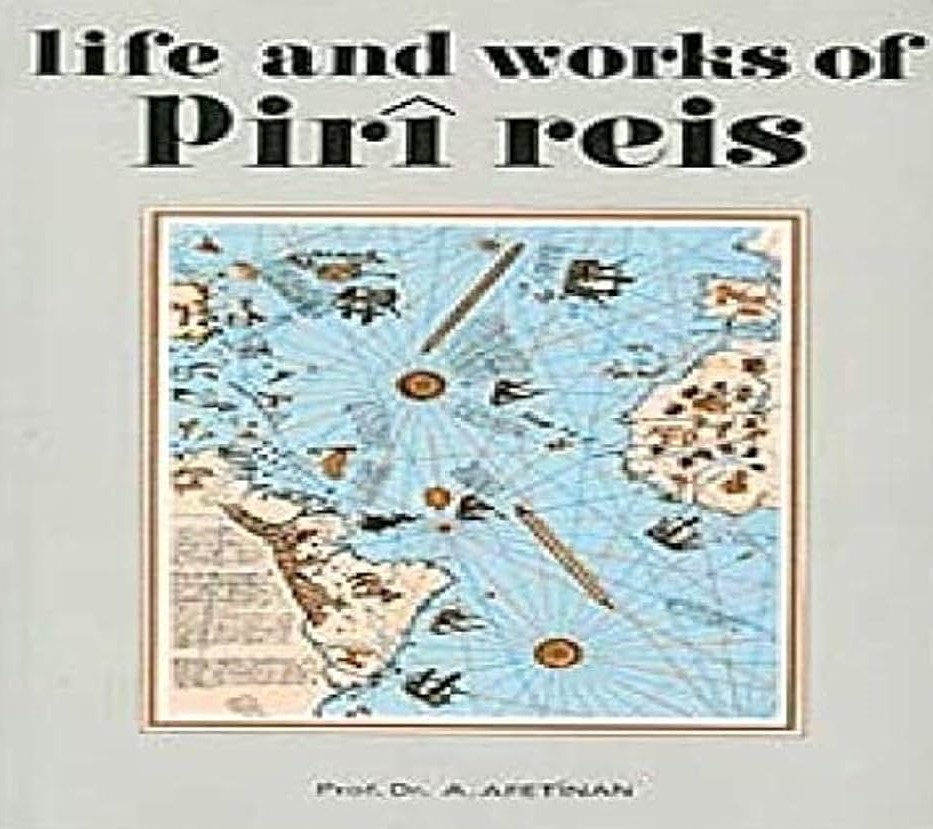
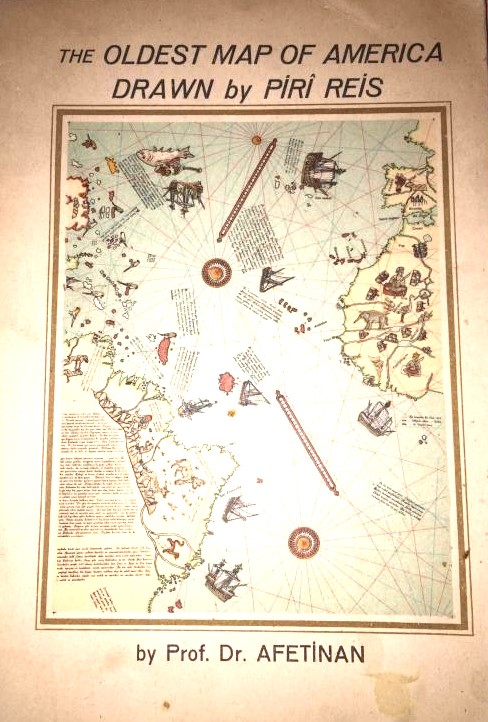
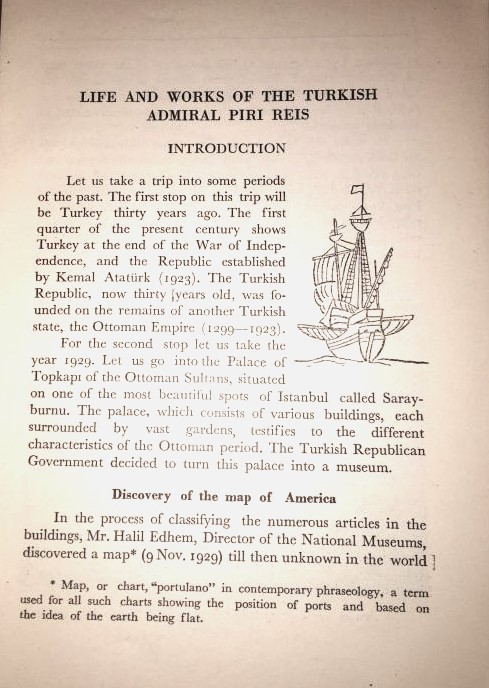
Memorie.al / In 1929, in the archives of the “Topkapi” Palace of Sultans in Istanbul, an ancient parchment was found, rolled up and completely covered in dust. The seals were removed from the parchment, and before the eyes of the historians, a strange document appeared: a complete and accurate map of Antarctica. The Turkish historian, Et’hem Halili, carefully studied the map and deciphered the seal and signature of the author of this document: the Admiral-in-Chief and Commander of the Ottoman Empire’s War Fleet, Pirro Rajs (Piri Reis), dated 1513 or 919 according to the Muslim calendar. A careful study of the map revealed that the admiral had utilized over 20 earlier source documents.
In one of the inscriptions, he confirmed that he had copied the map and that he knew very well that the Earth is round. The North-South axis of the Earth was shifted by 5 degrees from the time of the initial data, and the North and South Poles were in different positions from their current ones.
Science was only able to prove these details in the second half of the 20th century, but how could the Albanian Pirro Rajs formulate them in the 16th century – at a time when Galileo, Giordano Bruno, and Copernicus had not yet been born in Europe, and the Church did not even allow the idea that the Earth could be round?
Pirro Rajs (Rajca)
Pirro Rajs was an Albanian feudal lord who, at the end of the 15th century, entered the service of the Sultan as a cartographic researcher, where he excelled and was nicknamed “the Arnaut” (the Albanian). Due to his brilliant results in navigation, he quickly attained the rank of Admiral and was later appointed Commander-in-Chief of the Imperial War Fleet.
He led the Turkish fleet in many victorious battles in the Mediterranean, designed ships, and prepared atlases that were used for 200 years by Venetian and Norwegian sailors. In the 16th century, these were compiled into the major work “Kitab-ı Bahriye” (The Book of Navigation), which was used throughout Europe.
The discovery of the Pirro Rajs map plunged science into a difficult debate. The Albanian admiral’s map is much more accurate than 20th-century maps of Antarctica. On the map, boundaries, continents, mountains, passes, bays, rivers, and lagoons – which today are filled with ice – are precisely marked; the coasts of Southern Antarctica are described in detail.
Only through intensive studies in 1956 was it proven that in Antarctica, beneath the colossal layer of ice, rivers once flowed and green valleys existed. The full boundary of the continent was accurately determined after numerous studies (including satellite data) in 1998. Powerful American, French, German, and Belgian expeditions worked on this, equipped with geophysical instruments and the latest computer systems known to science.
The Conclusion:
The map of the Albanian admiral, signed in 1513, was absolutely accurate. How is this possible? British scientists called it “A dynamic Oriental rebus,” the French called it a “Mystification,” etc., but the fact remained unshakable. Through a minute study of the parchment’s origin and the writings on the map, its authenticity was proven. It was concluded that the map was originally large and that this is only a portion of it; the rest has been lost.
The geographic historian Charles Hapgood gave a copy of the map to US aerial reconnaissance specialists without telling them what it was. These experts worked responsibly and reached this conclusion: the map was prepared by specialists a long time ago using the methods of spherical geometry.
The map was prepared before the continent of Antarctica was covered by ice. The people who prepared this map (and certainly other maps of the globe that have been lost) must have had profound knowledge of geometry, mathematics, astronomy, and topography, and possessed the necessary tools to apply these sciences in practice. This must have happened 12,000 years ago. According to modern calculations, 15,000–20,000 years ago, the Earth’s poles were in a different position and Antarctica was a green continent, while other parts of the globe were covered by polar ice.
Human civilization was at a high level; it was known that the earth was round; they knew how to measure its diameter and perform calculations and equidistant projections. On the Pirro Rajs map, the South-North direction is drawn passing through Aswan – the Nile Delta and the Giza plateau – where the Egyptians later built the famous pyramids with astronomical precision.
The Albanian Pirro Rajs left his explanations on the poles of the map, noting that he had copied ancient documents from 1,500–2,500 years ago, inherited from the Library of Alexandria. These documents had been copied from even older documents, dating back as far as 12,000 years. With the destruction of the Library of Alexandria, many scientists managed to hide and preserve important maps and documents, leaving them as a legacy to their descendants.
Much later, a map of Northern Europe was found, dating back at least 9,000 years. Astronomical and climatic research, as well as legends circulating among the peoples of the Nile lagoons, the Judean plains, the Andes Mountains, etc., testify that in the 12th–11th millennium BCE, a global catastrophe occurred – the cataclysm known as Noah’s Flood. Due to significant climate changes, ice masses melted and the level of the oceans and seas rose so much that it flooded settlements in the lowlands.
Keeping this natural disaster in mind, the early ancestors of civilization took measures to preserve, among other things, scientific documents, which were copied and transmitted from generation to generation. Following the discovery of the Pirro Rajs map, research led to the discovery of two other similar maps. The second map, compiled by Oronce Finé, an Italo-French geographer and mathematician, dates to 1531 and shows Antarctica free of ice. According to analysis, this map is based on data even older than that of Pirro Rajs.
The third map, prepared by Academician Philippe Buache in the 18th century, is as accurate as the map prepared in 1956 by modern geophysicists and confirmed by satellite studies. These prove that the captains of the super-ancient civilization (12,000–15,000 years old) carried out discoveries as great and glorious as those of their modern-day descendants. They were equally skilled in understanding the world and utilizing the sciences, leaving a legacy of knowledge in navigation, astronomy, mathematics, construction, and cartography to succeeding civilizations (Egyptians, Sumerians, etc.). / Memorie.al