
Memorie.al / The establishment of the dictatorial regime in Albania was accompanied by violence and repression, not only against political opponents but also against their family members. If you spoke out against the regime, left the place where you were interned, or were wealthy or relatively wealthy, you were automatically categorized as an opponent of the regime. Family members of political emigrants were arrested and interned in the most infamous camps set up by communism, deprived of any kind of communication with their relatives. The issue raised for discussion relates to the repression against family members of political opponents and how legitimate their persecution was.
During the efforts to anathematize everything connected with the past, the regime ignored all the laws and agreements that had existed during the monarchy. This left a legal vacuum which necessarily had to be covered by new legislation, something the communist regime did not always accomplish in a timely and efficient manner.
The study “History of Internment in Albania 1944-1990” aims to shed light on an important and understudied part of the country’s history. Although this topic has aroused the interest of historians, no specific studies related to families interned during the dictatorship have been conducted before.
Based on Albanian archival documents as well as stories transmitted by witnesses of the time, historical facts about internment and expulsion as an administrative measure during the communist regime are analyzed.
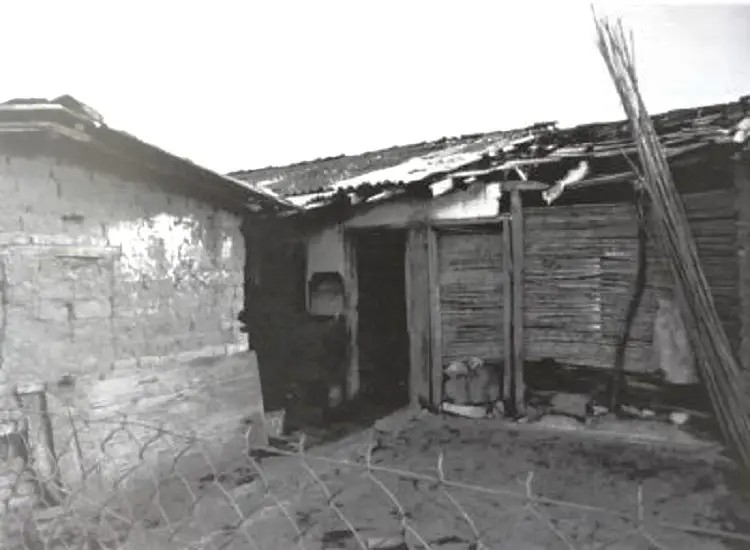
Besides the legal basis for internment, of particular importance in this study is the analysis of the conditions in which interned families lived during the period of serving their sentence. In this context, it is worth mentioning that living, medical, and hygienic conditions left much to be desired indeed were on the brink of destitution.
To make a more accurate synthesis of events, we rely not only on oral histories but also on archival documents of the time, which shed light on some specific aspects of the internment process.
To provide as complete an overview of the topic as possible, alongside the numerous difficulties in analyzing communist repression and the internment system, a summary of the hypotheses put forward has also been made, viewing events in the context of the time.
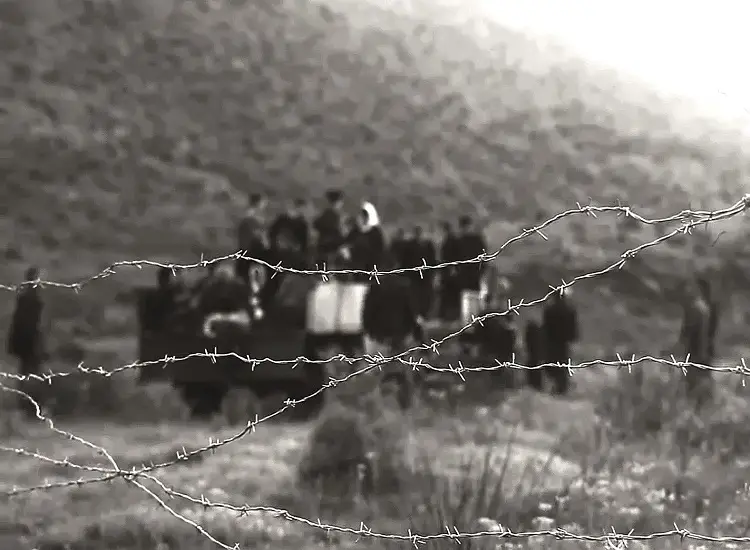
This study aims to analyze, argue, and conclude on several important hypotheses of the communist regime, in relation to the rights of those sentenced to internment and their persecution, answering the questions: How legal was it for these individuals to be interned in camps surrounded by barbed wire, or places of internment?
What were the rights and living conditions enjoyed by interned families in Albania, compared to other countries and those who did not have this status? What statistics can we bring regarding communist repression against internees during the 45-year period of their governance?
In this paper, I have tried to present in a detailed and comprehensive manner, as far as the sources we have on this topic allow, the daily life of interned families and their difficulties during communism.
A large number of documents are reflected in this study, on the legality of the internment process, living conditions in camps and internment locations, violation of individual rights, etc.
The main difficulties I encountered during the research and construction of the historical narrative relate mainly to the lack of archival documents on this topic. The archival documentation available to researchers is incomplete, and the numerous bureaucracies in accessing documentation have made this research even more difficult.
Information in local documentation, especially regarding internment camps, is lacking or not easily accessible, so I had to refer to foreign archival sources or to the testimonies of former internees.
These sources, although valuable, create analytical difficulties, mainly concerning the relativity of the recounted history. Bibliographic sources are also not numerous, and there is a lack of in-depth historical studies on this topic.
The collection of archival documents as well as the process of selecting source materials has been difficult due to the lack of declassified archival sources related to this issue. The archives do not provide rich, concrete source material on internment and the barbed wire camps. However, to have a broad base of primary sources, I have consulted the documentation of the Central State Archive.
The Archive of the Ministry for Europe and Foreign Affairs makes available documentary materials mainly concerning the stance of international organizations regarding the violation of individual rights in our country, which constitute an added value in this study. The documentary reports of the CIA and the US State Department on the situation in Albania are of particular importance in this study.
The CIA obtained most of its information from political emigrants, who reported not always accurate figures but provided very important information on living conditions, lack of food, and the violation of rights in the country. This detailed information today constitutes an important source in the historical study of the system of internment camps established in Albania.
I have also utilized a large number of files found in the Archive of the Ministry of Internal Affairs, as well as at the Authority for Information on Former State Security Files (AIDSSH), mainly referring to figures and decisions given for internment and expulsion as administrative measures. To more clearly analyze the internment system and the creation of internment camps in the country, previously published documentary publications have assisted me.
An important voice in this study comes from the testimonies of former internees, who share their experiences with us through interviews. Over the years, ISKK has turned these interviews into several volumes of memoir publications, under the title “Voices of Memory.”
The methodology used in this paper is the classic one, built and laid out on the analysis of internment, a historical phenomenon, generalizing and treating each case as unique, but also as part of an entire state structure that functioned on the ideological basis of class struggle.
The paper does not lack comparative observations of facts, brought by witnesses, in order to best highlight the historical truth based on the materials we have. The entire paper is constructed in chronological order, divided into chapters, each dealing with specific issues. The study’s content begins with the list of abbreviations, preface, introduction providing a history of the historical phenomenon and explanation of the terms internment and expulsion.
The study is divided into three chapters, each dealing with specific issues. The first chapter, titled: “A Brief History of the Internment Law,” deals with the history of the institution of internment-expulsion on a comparative level with previous periods, specifying legal aspects and problems arising from the application of laws for these administrative measures.
The second chapter focuses on the classification of labor and internment camps, categorizing them also with reference to examples taken from other countries. In this chapter, special place is given to aspects of life in barbed wire camps, as well as in internment villages, where archival sources shed light on the main problems internees encountered in daily life.
In the third chapter, statistical analyses are made referring to data provided by the archives of the time regarding this phenomenon. The study concludes with conclusions and the bibliography used for this paper. The appendix included in this study aims to provide a clearer picture of the internment camps established in the country.
Efforts to shed light on the history of internment and expulsion in communist Albania are to be appreciated, and I think this study will be important in this context. Through this study, I aim to highlight several issues that have not been adequately addressed in the past, bringing new facts that enrich the picture of communist repression. This study is the product of the collaboration I have had with the staff of ISKK, whom I have the pleasure to thank.
Special thanks are dedicated to the former Director of Studies at ISKK, Mrs. Luljeta Lleshanaku, without whose insistence and contribution this study would not be able to come in this form today.
I also owe deep gratitude to all former internees who share their experiences with the ISKK staff, making a great contribution to the future and the generations to come. / Memorie.al