
By Ali Buzra
Part Fourteen
– LIFE UNDER PRESSURE AND SUFFERING –
(ASSESSMENTS, COMMENTS, NARRATIVES)
Memorie.al / At the request and wish of the author, Ali Buzra, as his first editor and reader, I will briefly share with you what I experienced in this encounter with this book, which is his second (after the book “Gizaveshi in years”) and which naturally continues his writing style. The sincerity and frankness of the narrative, the simple and unmodified language, the accuracy and precision of the episodes, or the lack of a subsequent, intentional refining imagination, or its non-utilization, I think have served the author positively, who comes to the reader in his original form, inviting us to at least get to know unknown human fates and pains, whether by chance or not, leaving us to reflect as a starting point for raising awareness towards a catharsis so necessary for the Albanian conscience.
Bedri Kaza
Continued from the previous issue
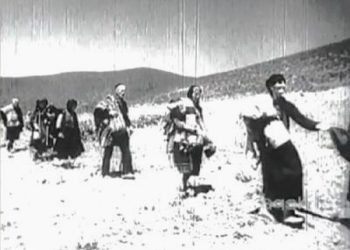
They cross the streams and mountain torrents with waist-deep water, and the poor boy accompanied his mother by the arm, who only moaned. He often went back to his father to help him cross the torrents with lots of water. At a place called “Qafa e Gajorit,” Tahiri remained behind; his foot hurt and he couldn’t walk. “Leave me here,” he addressed the police, but no one wanted to hear of it, or at least put him on a mule. After 3 hours of travel in difficult weather conditions, they arrived in Gurshpatë late at night. They were placed in a small room, 3 x 4 meters, near the offices of the cooperative sector.
There was an old tin stove there, but without a chimney pipe. Ramazan Tanushi, who was the brother of the livestock worker they had come with from Babja, arrives and brings them an armful of wood to light the fire. He was the sector’s cook. He told them to get food, but they didn’t take any. They wrung out their clothes, soaked from the rain, and put them back on. Destani covered the sick, moaning mother with the half-wet woolen blanket.
In the morning, the Tanushi brothers come again. Sami brings them bread and asks why they didn’t take food at dinner. “Take bread,” he tells them, “don’t stay hungry; we’ll wait for the money, if you don’t have it on you.” In fact, the truth was they had no money either. Destani overhears the brothers talking outside, where one of them expresses how these people must have spent the night, “well, you can’t force the soul out,” the other interrupts.
Now Destani begins to understand that the Tanushi brothers were good and generous men. So, now it is Destani, Tahir’s young son, who accompanies his elderly parents and will work there to support them. The eldest son, Samiu, who had been separated even before his father was released from prison, had a flock of children he could barely feed with dry bread and what could he do. The other son, Ismeti, was a shepherd in Mal i Letmit (Letëm Mountain).
He, although a master livestock keeper, was not sent to Mal i Zgoshtit with the other shepherds because it was near the border and they suspected he might escape. There, while guarding the flock, a villager passes by and tells him that his parents have been moved away from home. The young man sets off with anxiety in his heart to find out at home what had happened. When he enters, he finds his wife, with his brother Servet’s wife and the young children nearby, crying.
He asks where his parents are, while they, with pain in their souls, reply that they don’t know where they have been sent. “Destani has gone with them,” they tell him. And what could he do?! He stays a while and sets off again for the mountain with tears in his eyes and sorrow in his heart. He had to go; he had left the sheep unattended. The sector leaders had left him alone there. The other brother, Serveti, worked far away in Korçë, on high-tension power line pylons.
He knew nothing. After a few days, he comes home by chance. There he learns that his parents have been interned in Gurshpatë. He sets off immediately. He travels all night on foot and around 7 in the morning, he arrives there. He meets his parents and his brother Destani, and he cannot bear it but cries from despair when he sees them in that state. The mother cries with him too, while the father and Destani hold themselves together and try to ease their sadness and pain.
The crying in the room of the internees is heard by Jaho Kasa, chairman of the village People’s Council, who was nearby at the sector offices. The latter approaches and then enters. “What has happened, why you are crying?” he tells them with regret. Serveti tells him he had gone home to Letëm, didn’t find his parents there, and the family members were crying. Jaho tries to calm them and ease their pain. He tells them he has sent a statement to the Internal Affairs Branch in Librazhd, to see the possibility of their release.
Indeed, he had requested this and in the written letter insisted that at least the sick woman be released, for whom there weren’t even minimal conditions to stay there in Gurshpatë, guaranteeing that she would do nothing against the state. One of Tahir’s daughters, Trëndafilja, was married in Çermë of Lushnjë, to Rrahman Sina. The latter had a cousin who had married a wife from Letëm. When he goes there with his wife, he learns about Tahir’s internment and tells Rrahman about it.
“Prepare me some food,” he tells his wife, Trëndafile, “because I’m going to a military training exercise,” without telling his wife the truth about her parents. “Rrahman Sina came to Gurshpatë,” Destani recounts, “on November 27th, the first of his relatives, with about 30 kg of food.” All that winter, Destani slept on cement over a piece of plywood he laid on it, since the wooden plank bed had been left with the geology team in Babje. When he got the chance to go get it, he saw it had rotted outside from the rains. He placed his parents on a bed made of springs and rags. He put a piece of plywood in a corner of the room so his mother could change clothes.
When they went, the neighborhood brigade leader asked Destani what kind of work he could do. “Any kind of work you have,” he replied. Initially, he works in the brigade, in agriculture, and then mainly with livestock. He manages to achieve up to 900 workdays per year (A workday in the cooperative was equivalent to a daily norm). The work norms were high, but Destani was young and strong, and meanwhile he had both parents to support, not only with bread and food, but also with medicine, which he bought every month. Later, he also brought his own mule from home in Letëm, which he used there, achieving two or more norms per day.
“Gurshpatë respected us and supported us according to the means they had,” he recounts. In the first days of their stay there, people would pass by the offices and stop curiously to see the “dangerous criminals,” as they had been labeled by the authorities who brought them. “In fact, we went as ‘enemies’ and were treated as friends,” Destani recounts. Personally, I have accidentally contacted some people from Gurshpatë and, being in the process of working on the book, I asked them about Tahir Biçaku. Each one of them expresses that initially they didn’t know this newly arrived family.
The Sigurimi (State Security) employees said they were dangerous criminals. Later, it was seen that we were dealing with a serious and noble family. Old Tahir was a measured, fair, and proud man. Regardless of the sufferings he had gone through and was going through, whoever entered into conversation with him encountered a very cheerful and likeable man. His wife Hamide initially didn’t leave the door for many days, not only because she was sick, but also because she was ashamed that they were labeled “enemies of the people.”
Destani, a resourceful and lively hardworking boy, quickly gained the respect of the people he worked with. Destani speaks with great consideration for the residents of the village of Gurshpatë. – “As time passed, they respected us and did not despise us,” he expressed. Although under the conditions of the dictatorship, there were some among them who even reacted. Thus, one of the residents says to the powerful one, the area operative: “Is this your criminal, with a broken leg and a sick wife?!”
The chairman of the village council, Jaho Kasa, even writes to the District Party Committee that he is of the opinion that the internees should be released and go to their homes, but as it turned out, his statement was not taken into consideration. Hamide Zharri, who was a sector norm-setter, seeing their miserable condition, often went to the room of the sick Hamide, brought her wood, and in some cases lit her fire.
“Be careful,” they tell her, “or they might fire you.” – “Let them fire me,” she used to tell them, “I will help her, because she is sick”! After a few months passed, the internees bought a cow, which they grazed in the village neighborhood. Destani often helped the shepherds from Dumrea, who had their summer pastures on Mal i Polisit (Polis Mountain), by transporting materials with his mule. They would give him pieces of meadows which he would mow at night by moonlight and transport near the dwelling, securing food for the cow and mule throughout the winter.
During the five years of internment, their son Destani, who also left his high school studies (which he was continuing through the night system in Letëm), never left them for a moment. He was engaged to a girl from Serbisht. Her parents, as well as the girl herself, were several times pressured and threatened by the authorities to break off the engagement with the son of Tahir Biçaku, but this highland family with traditions stood by their given word, maintaining the friendship made with the aforementioned family, and the girl remained engaged for 5 years. On October 9, 1988, Destani gets married. The wedding was held in his village, Letëm.
A request was made to the Internal Affairs Branch, and it was made possible for his parents to be given permission to attend their son’s wedding. Many wedding guests from Gurshpatë also attended, who were invited by the Biçaku family. They secured and brought food for the wedding. At that time, food was a problem. Rural and urban families were supplied with sugar, rice, flour, coffee, etc., in a ration determined by the number of household members. In every food store, food supply was done according to lists compiled by the respective neighborhood and village councils.
In villages, meat supply was done 2-3 times a year on holidays, with 300 grams per person. For weddings and feasts, nothing was planned, but villagers helped each other, sacrificing their own rations for neighbors and relatives. Haki Tarillari, a serious and sensitive man, who at that time was the chairman of the Lunik agricultural cooperative (which included the village of Letëm), present in the sector that day, sees the residents of Polis-Gurshpatë arriving with food loaded on horses. He tells one of the administration employees that it’s not good for us that wedding food comes from Polis.
Thus, he orders them to call Ismet, Tahir’s son, who was a livestock keeper, telling him that whatever he lacked for the wedding, he could take from the sector. The latter, thanking him, tells them that everything has been brought from Gurshpatë. After the wedding finished, the parents went back to the place of internment, while Destani stayed at home for a week and then goes back to his parents. After completing the five years of internment, they returned to their home in Letëm. The health of mother Hamide, despite their constant care, did not improve.
She remained afflicted for many years of her life. For nearly 20 years, while her husband was in prison, she raised the children with great difficulty. During the five years of internment, they forced her, sick as she was, to stay away from her children, with a sorrowful heart for no reason. She lived with the joy of a mother only in the first two years of democracy. She passed away in June of the year 1993. Her husband Tahir Biçaku, from 1945 until 1962, remained a man suspected and surveilled by the State Security, as a scion of the Biçaku family in Letëm.
He worked with his brother, Shebrit, to build new houses, since the old ones had been burned down at the end of 1944. He spent nearly 20 years in the prisons of the dictatorship, and the other five years in internment, being labeled throughout this time as an enemy and criminal. Truly strange and completely paradoxical, when we remember how these epithets were attached to a person who had no connection whatsoever to what was being rumored and accused.
Although for over 40 years of his life he experienced the ferocity and violence of the communist state, he remained an invincible giant and a challenger of the dictatorship. Like many other persecuted people, he welcomed the overthrow of communism in Albania with pleasure. Tahir lived nearly 14 years of democracy, without arrogance, without boasting, welcoming and seeing off his friends and well-wishers from all over the region.
I wish to share with the reader my memories of two occasions when I met Tahir Biçaku during the democracy years. The first time I met him was in 1993. After we learned of his wife’s death, my father, who was unable to go, told me to go offer condolences. That day, 6-7 of us from Gizavesh got together, most were elderly, and we set off on foot for Letëm. After about an hour and a half of travel, we arrived there. In his two-story stone house, we entered the reception room, which was full of local men and visitors, smelling of tobacco smoke. Among the newcomers, I was the youngest. Along the way, I thought and wished to communicate with Tahir, whom I didn’t know, but as soon as we entered, I thought that in such an environment with many people and limited time, it would be impossible.
His sons and younger relatives stood, as per custom, which in a way is still maintained today in our villages, serving coffee, cigarettes, and cold water. I guessed which one Tahir was, now 72 years old, as he resembled his brother Shebrit, who was there. I followed him attentively. He greeted each one of us with great respect and kindness. I say this because, well, would all these people have come to his house for condolences a few years earlier!?
Everyone knew, and so did he, that in fact we would not have come. All the persons I went with, he met and greeted by name, because he knew them, while he met me saying: “How are you, my boy”? While we were drinking coffee, he got up from his place and sat cross-legged opposite me, shook my hand once more, and looking at me attentively, said: “I don’t know you! Who are you and whose son are you”? I told him my name, saying whose son I was. He smiled with satisfaction, took out cigarettes from his pack and asked me about my father, family, and where I worked. I told him I was a teacher in my village.
“I have been away for many years,” he told me, “and I don’t know the young generation.” – “Thank you,” I said. – “It’s my duty to be interested in who comes to my house and from where they come. During my prison years, I worked and lived with many educated people who were serving their sentence with me. I learned a lot from them. They were sentenced as intellectuals because they didn’t like communism,” he continued. He broke off from the conversation with me and went near the corner of the room, where he was cheerfully chatting with the newcomers, meanwhile watching the sons standing to see if they were serving the guests well.
Some of the newcomers left before us. Tahir, although elderly, did not accompany them inside. He would see them off outside in the yard, while his sons would go further. He did the same with us, who left at the same time. When I came home, I conveyed Tahir’s greetings to my father and explained to him the respect and attention he showed towards guests. My father told me that it is a noble household. They have been and are men who know how to recognize, value, and respect the guest. My father’s words silently also contained a certain reproach towards me.
Some years earlier, during conversations with him, we did not share the same stance, especially regarding the Zog period, and perhaps also regarding the history of the region’s noble families. During the time of the Albanian Kingdom, my father had been a student at the Tirana gymnasium. Boarding at the house of Ymer Koza, a friend of his father, a former gendarmerie officer of the time, he often spoke nostalgically about childhood memories in Tirana, about King Zog’s wedding, student demonstrations during holidays, etc.
In a way, like many of my peers, we were influenced by communist ideology. Regarding the Balli Kombëtar organization and its exponents, I held a negative stance. My father not only did not share the same stance as me, but in conversations we had without the presence of others, he was firm in his anti-communist positions. He expressed that the communist regime is not the best as propagated.
“Listen, son,” he told me, “this state does not allow you to stretch your legs on your own land, but just do your work and don’t get involved in politics, because the politics of these people will eat your head.” My father passed away in 1997. He lived the overthrow of the regime with great pleasure. In those 6-7 years after the fall of the dictatorship, our conversations, almost every night, were on historical themes, about events and episodes of the past, as well as the traditions of the area.
Around the year 1999, I meet Tahir Biçaku again in the center of the town of Librazhd. The former “enemy of the people” now freely entered government offices. He was dealing with the compensation documents for the prison years. What impressed me was that he did not vent with harshness and insults, despite all the suffering endured. It is a feature and characteristic of many former persecuted individuals who, with nobility and dignity, do not speak of revenge but demand that the crimes of communism not be covered up. Among other things, in general terms, he told me that we suffered not only ourselves, but also our children. These things must be known, mentioned, and written about, not for revenge, but so that those who come after you know what communism was. “I hope they will be written about,” I said, parting with him there for the last time.
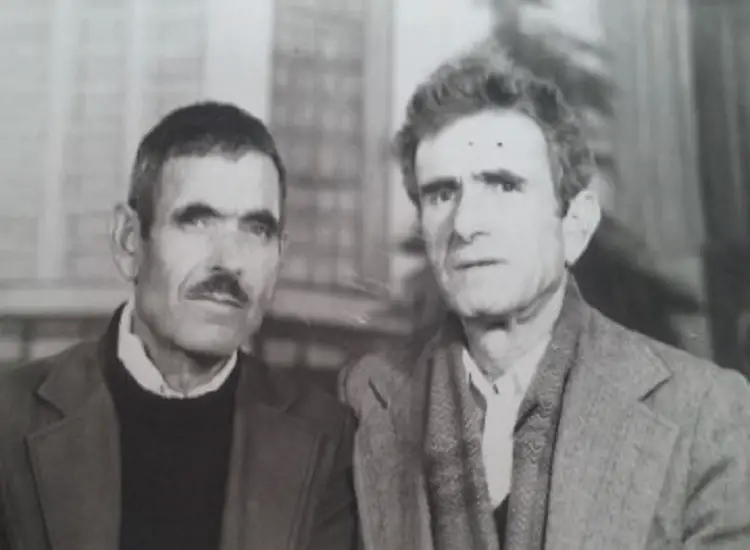
Tahir Biçaku passed away in 2004. Destani, the noble and courageous young man who sacrificed for his parents at a very young age, staying by their side during the internment years, and his faithful wife bore and raised 4 children; 3 sons and one daughter. The children were educated during the democracy years, and today they work inside and outside the country, in various sectors, while the parents continue to stay in the village, engaged in agricultural and livestock work. Samiu, Tahir’s eldest son, also lives there in Letëm, while his two sons are working in Germany. Ismeti resides in Fier, while Serveti in Elbasan. Shebriti, the man who sacrificed and supported the two Biçaku families with work and sacrifice, passed away in 1994. His sons have moved from Letëm and live in Durrës, Kavajë, and Elbasan, where through work and effort they have arranged their lives quite well. / Memorie.al
To be continued in the next issue