By MARVINE HOWE
Memorie.al / “An American organization for the Protection of Human Rights and Freedoms has accused the communist government of Albania of suppressing freedom of belief, expression and movement. Albania, a country with 3.2 million inhabitants, installed atheism in its Constitution, outlawing all faiths,” the organization’s draft report says. He says freedom of expression, movement and association have been drastically curtailed and dissent (opinion against) has been harshly punished with physical violence and long periods of imprisonment.
The Minnesota experts of the International Committee of Human Rights, an independent group of more than 800 lawyers, professors and judges, is issuing a report on Albania at the end of this month.
The committee has undertaken the project for Albania, as part of a series of studies on countries where human rights practices deviate more than international standards.
The committee asks the Albanian government to repeal the laws prohibiting religious beliefs and their exercise, ending torture and arbitrary arrests, guaranteeing freedom of expression, protecting minorities and guaranteeing their movement, inside and outside the country.
Some improvements compared to before
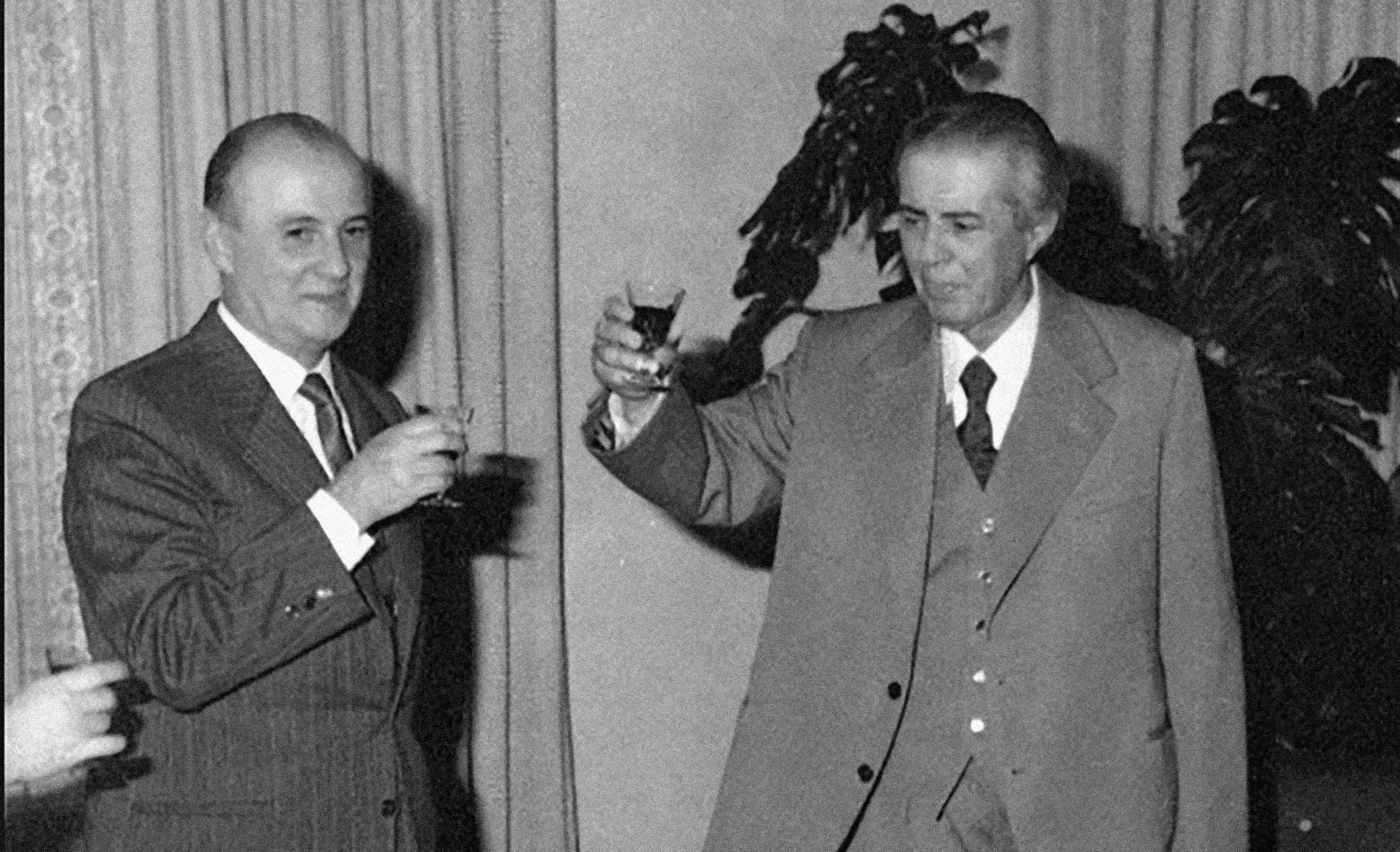
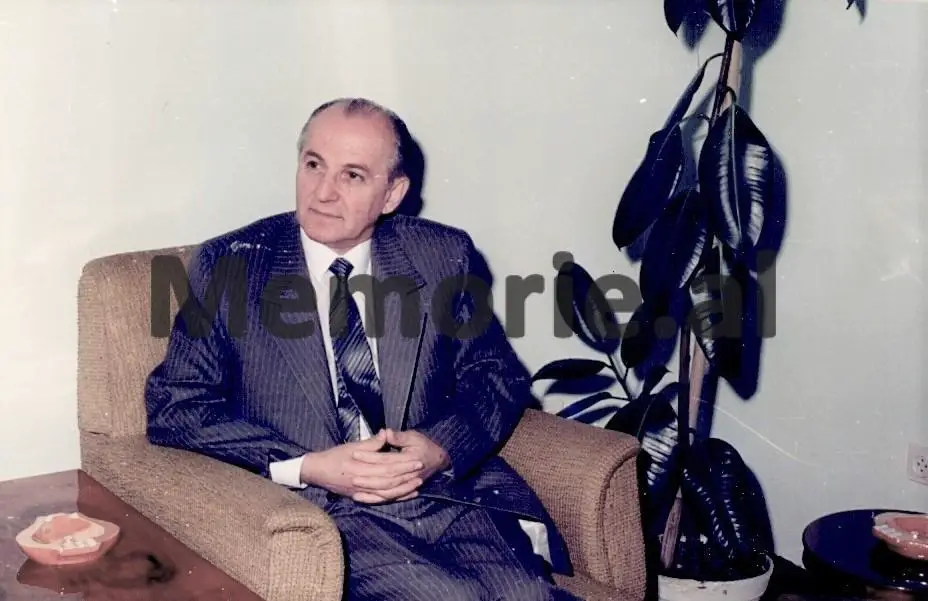
In reviewing the 40-year period of suppression of human rights, the Committee draws attention to some improvements since the death of the Stalinist leader, Enver Hoxha, in 1985; the symbolic changes are with Ramiz Ali, successor of Mr. Hoxha, whose government has banned the celebration of Stalin’s birthday.
“We emphasize the difficulties in the investigation in Albania, – say the official sources of the Committee, – after the negative response of the authorities in Tirana, the Albanian capital, regarding the request to allow the observation of the state of human rights”. Letters were sent to Mr. Alia and the Albanian Mission to the United Nations, asking for comments on the proposed report, as well as on outstanding issues.
In the absence of a field observation, the Committee was based on a 2-year study, made with interviews with Albanian immigrants living in the United States, Greece, Italy, Yugoslavia, who answered without identifying their name, because their relatives in Albania could have problems.
“There are also interviews with specialists, leaders in exile, academics, journalists, diplomats and other members of rights groups who had knowledge of Albania.
Albania was considered a bastion of internal oppression and self-isolation,” says former Vice President Walter F. Mondale, a member of the Committee, as he writes the introduction to the report and hopes that it can help by encouraging the Albanian government to change its practices. human rights and help the people who suffered for a long time in this Balkan country.
Torture is considered common
Noting that a number of political prisoners have not been identified, the report describes in detail the operation of a vast system of forced labor camps and prisons, where people were held because of their beliefs or dogmas. theirs.
Although a number of political convicts have believed that such a thing should end, the report says that there is a small sign of a decrease in the number of people, as there are violations of the procedures for taking evidence and testimonies, as well as torture in cells, which reportedly had become a common part of the justice system.
One witness, identified as J., was arrested in 1986 after refusing to vote for the local Communist Party candidate and was sentenced to up to 10 years in prison.
He was repeatedly beaten on the head, face and stomach with metal gloves and left in the cell so hard that he could not move his head for 6 months straight.
The documents show how V., a resident from the eastern part of the country, was banned from traveling within Albania and was arrested for 24 hours, where he was beaten with a rubber stick. Traveling between cities required prior permission and approval from the authorities in each city for any proposed travel.
According to this study, any person was considered dangerous to society and could be sentenced up to 5 years for transfer (exile-internment) within the country. He says that there was frequent mistreatment of family members who had people abroad, as was the case of V., whose parents were sent to exile after his escape in 1987.
Sanctions for escapes
Albanians are forbidden, with the exception of officially approved missions and under strict criminal rules, to go abroad. They were sentenced from 10 years in prison to death.
A.A., an immigrant who served as a border guard with Greece in the mid-1980s, says that a metal perimeter wire, electrified, was meant to stop anyone trying to escape the country, and as soon as someone touched it, he emitting an alarm and lights.
“The Communists, immediately after coming to power in 1944, organized activities against religious beliefs, executed and imprisoned priests and other clerics,” the report says. In the spring of 1966, Albania launched an “Ideological and Cultural Revolution” in support of its ally, the People’s Republic of China.
“In September 1967, all buildings, including 2,169 churches, mosques and monasteries, were closed. Some returned to residential areas, cultural centers, warehouses or cattle stables,” the report says.
Supporting atheism
Article 37 of the 1976 Constitution states that; “the state recognizes and supports anyone who supports atheistic propaganda for the purpose of inculcating the world view of scientific materialization in people.”
“All those who believed in religion were severely punished”, – says the interviewed person. An immigrant identified as I. says that a man in his hometown, who was a believer, was sentenced to 5 years in prison in 1988. Another immigrant, named L., said that he knows people who have been sentenced to up to 10 years in political prison, because they had the book of the Bible at home.
For the announcement that there could be an easing policy, the report quotes a letter from the representative of Albania to the UN, in May 1988, which says that “the issue of religious belief in Albania is already considered a right, a private matter that is in the conscience of every individual”.
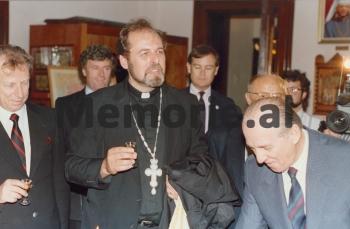
Also, the study underlines the importance of the visit of three Albanian clerics in 1988. Father Artur Liolin, senior leader of the Albanian Orthodox Diocese in the USA, Imam Vehbi Islami, director of the Albanian Islamic Center in Harper Woods, Michigan and the Jesuit priest, Ndoc Kelmendi .
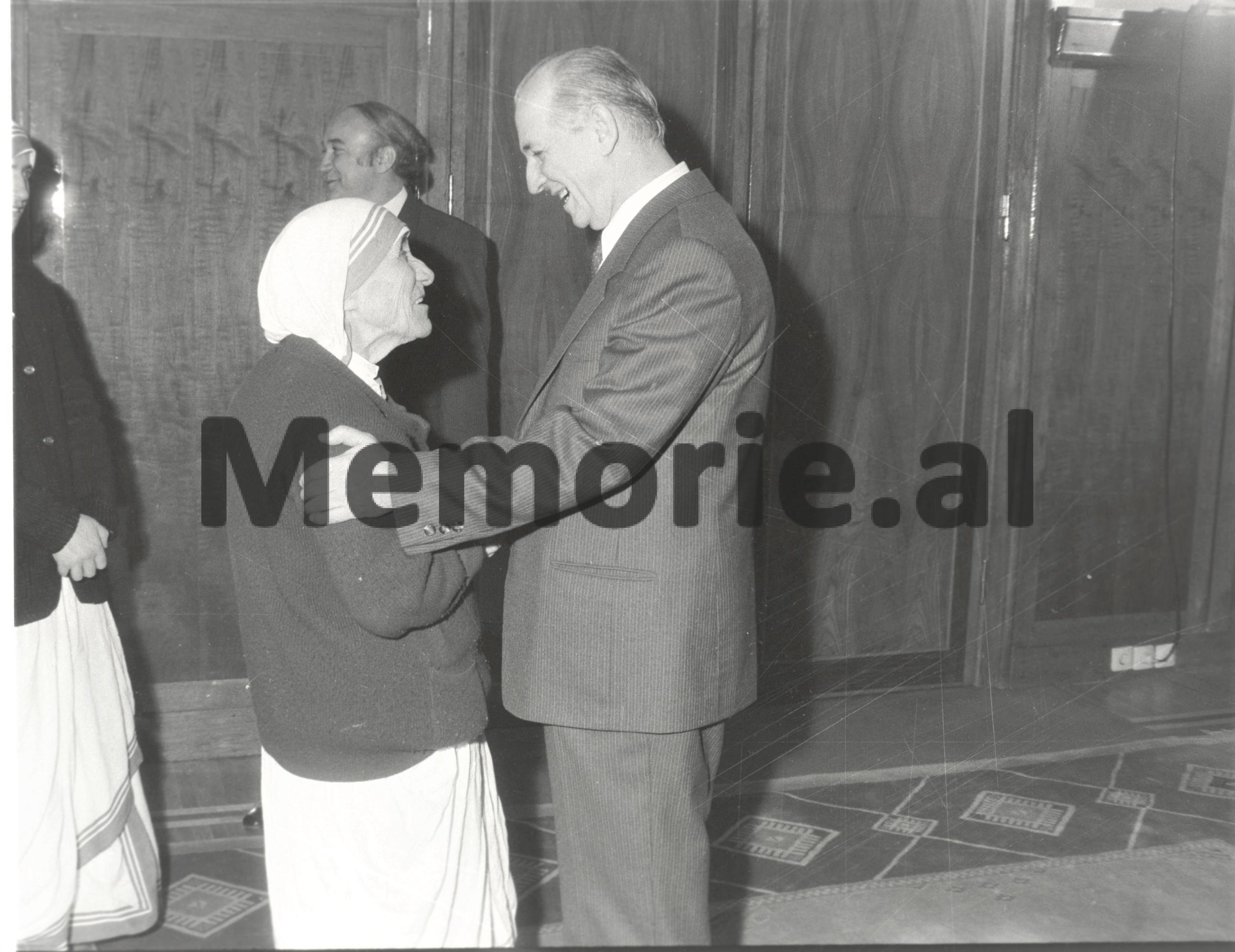
The change of attitude was also reflected for Mother Teresa, of Albanian origin, who was refused a visa, but who was allowed to return to Albania in August 1989, to visit the graves of her parents.
And Father Liolin, who was invited again for the second visit in November, to participate in the 45th anniversary of the liberation of the country from the Nazi occupation.
“We find that the policy of the ‘Alia’ government, for the exercise of beliefs, seems less rigid than that of its predecessor”, – warns the report, adding that “the expression of religious belief can only be conveyed in some limited ways and still constitutes a great individual and social risk”. Memorie.al
The article was published in the New York Times on January 21, 1990
The title is editorial
Prepared by Albert Gjoka