By Xhahid Bushati
-NOTES FOR THE BOOK “CITY OF SUFFERING”, BY AUTHOR MARK ZADEJA-
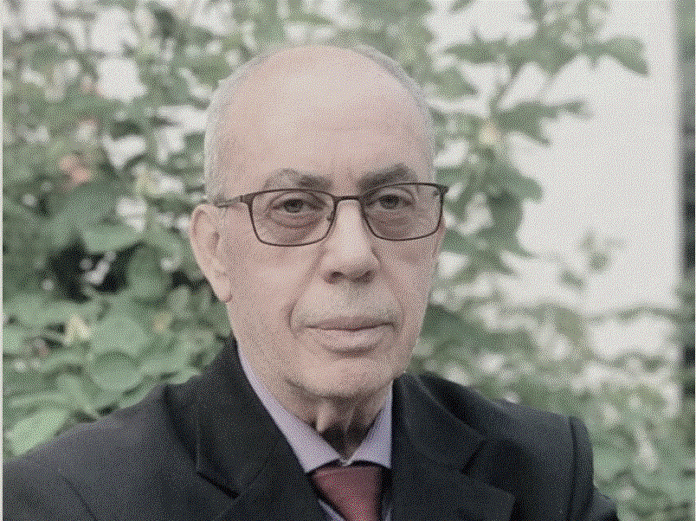
Memorie.al / Mark Zadeja were born in Shkodër, in a Shkodër citizen family. He completed his primary education at the “Vasil Shanto” school, while his high school at the “Ali Laçej” school, in 1965. He graduated from the University of Tirana, Faculty of Medicine, Department of Dentistry, in 1971. In the years 1971 – 1973, he worked as a dentist in the city of “Bajram Curri”. From 1973 to 1991, he worked in the Shkodër district. From 1992 to the present, he lives and works in Germany and is a German citizen. He successfully passed the exams in defense of the topic; “Protection against atomic rays”. He studied philosophy for years, privately. He has long been a lifelong member of the European Academy of Arts; an appraiser and specialist in old art. He is particularly a connoisseur and critic of contemporary art.
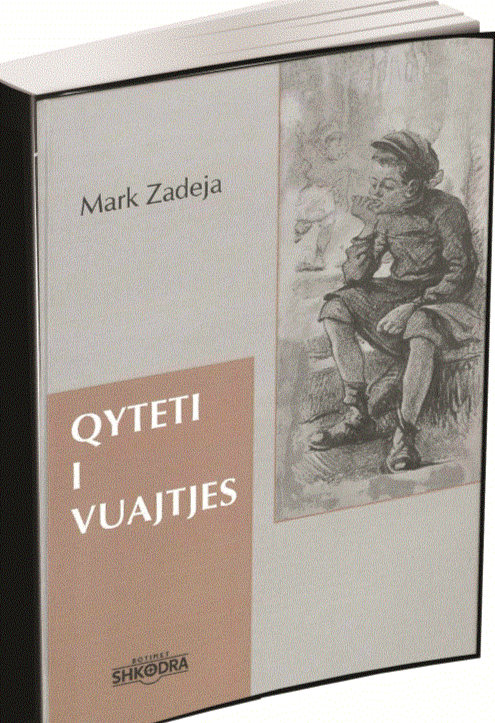
He is the author of the book “Forca e mendimit” (Botimet “Shkodra”, Shkodër, 2011), with which he passionately reveals human dignity in his original thoughts, the book “Kolë Idromeno (jeta dhe vepra. Shkodër, 2018), about this great patriotic, historical, art and cultural figure of the Albanian nation, the book “Vogëlushja” (Shkodër, 2019) as well as the book he is currently giving to readers, “Qyteti i vuqhejas”.
Since his early youth, he has been a philatelist and member of the Albanian Philately. He also deals with numismatics. He is a freelance author and has many works in manuscript, which will be published in the future.
By carefully following, with notes during reading and rereading, the rich literary, historical and philosophical creativity of the author Mark Zadeja, and I am talking about the artistic flow offered so far, it is impossible not to notice some characteristics that outline Mark’s profile on several levels, which are often intertwined, especially in the philosophical, historical and literary ones, where fact is the most irrefutable argument, where history and its time are present and true, where literature and art take on special values through a spectrum of colors, both heavenly and earthly.
When I talk about philosophy, it is revealed according to the author’s personal thoughts and concepts. When I talk about history, the author creates another reality, that of the tracer of tradition. Mark’s optics is such that this period of time, together with the main character, makes it livable. Its breath is current, as if to make it more lasting, it associates it as an identity with precious relics. When I speak of the literary notion, Mark’s artistic narrative is: real, credible, loving, heavenly and spiritual.
I found it appropriate to make this introduction, which was necessary, because, I think, there are the keys to deciphering the code of the book “City of Suffering”, recently released, it is a painful, real narrative, a memory that should not be forgotten and lost, but that should be remembered and recalled…! It is a narrative where wounds bleed, where graves speak and many graves have been lost. It is a narrative where human voices speak and speak, always about freedom.
It is a narrative that presents shocking and inhumane testimonies committed by the communist system. It is a shocking narrative, which seeks justice and forgives human peace. It is a laconic narrative, full of colors (and hope), which speaks in the name of dignity, morality and human personality. A narrative about the city of birth, about the author’s beloved Shkodra, but not only…!
History, in this narrative travels…, has its codes and signs, its drama, the unspoken that must be made said and known. A narrative that introduces the birthplace and its inalienable values, as if to tell us: “Throughout time, Shkodra has been and remains a European city”. On one of the pages of the book, and it is the introductory page, among others we read: “I have lived, experienced, and survived the time of the communist dictatorship.
This entire writing is dedicated to my city where I was born, Shkodra, the city of suffering. Essentially, the book contains the era of suffering under the dictatorial regime, but also after it, the “achievement”, and the manifestation of the suffering of the soul. The person who believes will find himself there. My family and I personally suffered the freedom of the soul together with my city. (p. 5).
Memories, facts undoubtedly bring attempts to refresh the events. It is very significant when memory stops at the moments when visiting the Catholic cemetery of Rrmaj. I have seen these graves since I was 6 years old. (p. 7) I was no more than 12 years old when I heard, I learned from my father, for the first time, that the back wall of the Catholic cemetery, he had baptized with the name “Wall of Blood”. (p. 9).
This is the formula, a formula of holiness of the narrative of the author Mark Zadeja, in his book “City of Suffering”. I repeat, to reiterate as a necessity, all the material is built on real events and, in a certain historical context. The narrated event is not only real but painful enough to tire the soul, touch the heart and bring tears to the eyes, where philosophy and memories are intertwined through convincing arguments and a clear and concise style, which constitute the authentic leaven of every page of the book.
I am going to focus on the author’s style. Regarding style as a notion, the writer Mario Vargas Llosa said: “Style is an essential element, although not the only one, of the form of narration”. So what do we notice as a phenomenon in the narrative style of the author Mark Zadeja?
It is an effective, beneficial style, which presupposes: that the stories and histories that Mark tells, contain for a long time the illusion of life, the true dream of real life, the true freedom long dreamed of, which became reality with the change of systems, but the freedom of democracy remained fragile, fragile as it is today. I am continuing the interpretation of the author’s style, expanding it with other elements, such as coherence and essentiality.
When we talk about coherence, we talk about credibility. Thanks to coherence, the style becomes effective. When we talk about essentiality, we talk about the quality of being as convincing as possible, that is, we see it as primary, we imagine it, we stage it, we live it, we keep it alive, we give it life, we give it hope, we give it dreams, memory and non-forgetfulness.
Because, the only way to tell a story, and, here, the author Zadeja has acted correctly, is to find a narrative, where the sentences with their textual constructions have color, internal rhythm, metaphors and symbolism, etc., that resonate with the soul, that is to say: with the spiritual.
As Gustave Flaubert said: “… in style, the right word must be found”. And we find this wisdom of Flaubert in Mark’s text. We find the right word as a limb in phrases or periods of sentences. By finding and marking the right word, the correct idea is revealed and emphasized.
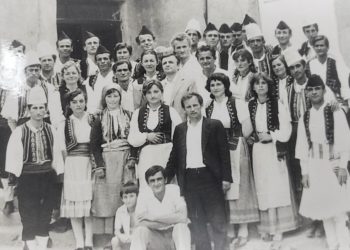
Marku, in addition to the narration that he uses in his text, has also materialized the refinement of ideas in his poems, which, due to the way they are structured, preserve and express reality, memory and non-forgetfulness, respect, pain and monumentality. History also speaks in these verses. History also speaks through the set of photographs, which are indicative of real truths. They are evidence of a wild time. They speak clearly.
In conclusion of my notes, this book, with its valuable content and an interesting and authentic narration, shows and teaches us that History should not be forgotten, especially when it is painful, full of tears and wounds. It also teaches us that that History and its segments should not be repeated; otherwise, Shkodra will again be the City of Suffering. This City, where the author Mark Zadeja expresses all his love, and where the narrations have precious values. Memorie.al