



From Dr. Qazim Namani
Part Two
Memorie.al / Pristina lies between the small streams of Prishtinë, Vellushë, and Matiçan, which flow from the mining hills on the western side of the Gollak highlands. On the southern and western sides, Pristina is bordered by the fertile lands of the Field of Kosovo. The altitude ranges from 585 m, 640 m, 670 m, and about 700 m in some neighborhoods of the city. Scientific studies on the etymology of the name Prishtina have not yet yielded a firm conclusion, but many researchers explain the name of Prishtina (Pristina castra) from ancient Indo-European languages, meaning ancient, of the initial phase, something old.
Continued from the previous issue
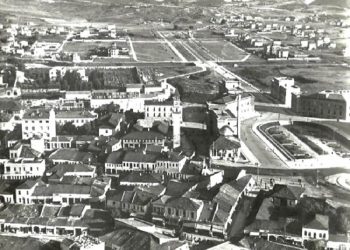
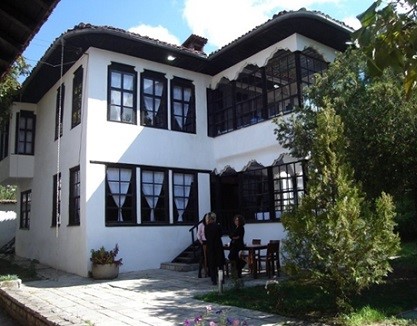
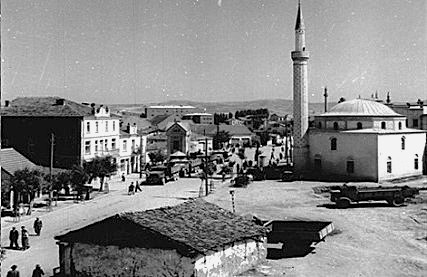
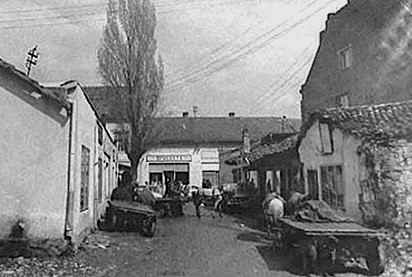
In this case, even religious objects were not spared, where the Catholic Church of the Stakaj family and the Llokaç Mosque, which was located in front of the entrance to the Bazaar, were demolished. This mosque was also known as the Bazaar Mosque (Xhamia e Çarshisë). Pristina also had an old covered bazaar. Among the public monuments in Pristina, the building that currently houses the Museum of Kosovo, the building where the Academy of Sciences and Arts of Kosovo is located, the Great Hamam, the Clock Tower, the Emin Gjiku Complex, etc., stand out. Among the sacred objects, the Bazaar Mosque, the Great Mosque, the Jashar Pasha Mosque, etc., stand out. The Tekke of Prishtina and the Evangelical Church exist in Pristina. On the outskirts of Pristina, in the village of Shkabaj, there is a small türbe (tomb), and in the village of Mazgit, there is the türbe of Sultan Murad. Pristina was heavily destroyed during the Balkan War when Serbian forces entered the city.
The Bazaar Mosque (Stone Mosque) in Pristina was built at the end of the 14th century and the beginning of the 15th century. This mosque was built by Sultan Bayezid as a sign of the victory of the Ottoman forces against the Balkan coalition in 1389. This building is one of the oldest cultural monuments. The mosque was located above the old covered bazaar of Pristina, which is why it was named “Bazaar Mosque.” Over the centuries, restorative interventions, works, and repairs were carried out on this mosque, which changed its original appearance. Characteristic of this mosque are the dome with a width of 10 m and the minaret built of stone, which survived for about 600 years. This mosque is also called “Tash Xhamia”, which in translation means “Stone Mosque”.
The Jashar Pasha Mosque in Pristina came under state protection as part of the Old Bazaar complex, which included: the Jashar Pasha Mosque, the old fountain (Shatërvani i vjetër), the Division Building, and the Clock Tower with registration number V. E. K. 02. 278/67. The Jashar Pasha Mosque is an object with achievements of Islamic architecture. We do not have accurate data on the time of its construction, however, the very style of its construction, the dome, the minaret, and the interior decorations suggest that the building was built in the 16th century, or even earlier.
The inscription of the name of Jashar Pasha on the portal of this mosque in 1835–1836 can be easily understood as a conservation or reconstruction during this time. Later interventions are observed in the dome, minaret, and walls. Conservation on a part of the minaret was done during the years 1976–1979. Jashar Mehmet Pasha was a wealthy feudal lord and governor of Skopje in 1842. The original gate of this mosque was destroyed to widen the road. The building is currently in poor condition and is threatened by cracks and humidity. Recently, the Stone Mosque entered its fourth year of renovation, where important historical layers have been damaged, while the Jashar Pasha Mosque began to be restored in 2014 with funding from the Turkish NGO Tika.
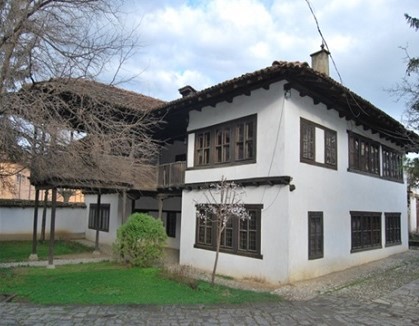
This türbe is known after Sheikh Mehmet Hafëz Efendia, the owner of the object. The türbe is a small object located next to the Clock Tower. Sheikh Mehmet, buried in this türbe, is known as a man of great authority in his hometown of Pristina. Sheikh Mehmet is the man who propagated on religious grounds for the city’s population not to relocate to Turkey. Sheikh Mehmet’s Tekke is said to have been built somewhere around the years 1925–1929, while the exact date of the türbe‘s construction is unknown. Sheikh Mehmet Hafëz Efendia’s tariqa was Qadiriyya; he died in 1947. In the Tekke building, there is also Sheikh Mehmet’s library with old books up to 700 years old, written in Arabic, Turkish, Persian, and French, as well as manuscripts that have not yet been studied.
Sheikh Mehmet’s family had an ancient Mulberry tree in the courtyard known as “Dud-shami” or “Sham–dudi,” brought from Syria about 200 years ago. From this Mulberry tree, known as “Dud-ilaçi” (“The Mulberry remedy”), a healing juice is prepared from its fruits, and it is said not to be found anywhere else on the Balkan Peninsula. The prepared juice was given free of charge to citizens who requested it for the healing of the mouth, throat, and stomach. Sylejman Kylçe writes that in the telegram of March 29, 1910, an uprising was organized by 2000 people from the population of the districts of Pristina and Vushtrri, and they occupied the roads of Llap and Gollak, inviting the population to join them. The uprising was made for the removal of the otrova tax (a tax in the Ottoman administration).
In the telegram dated April 19, 1910, it is reported that before the uprising of Llap and Gollak, Yahya Effendi from Pristina, in Rifat the Coffee Maker’s shop, hung a calendar sheet around the neck of a chicken that an Albanian was bringing to sell in the Pristina market, demanding a tax from him. Çallak Mahmut from the Ramazanije neighborhood of Pristina had one egg taken for the otrova tax out of 8 eggs, and that an Albanian was deceived into returning to the village, being told that 9 grosh and a half would be taken as a beard tax. This lie was thus spread among the people. After the news spread that a tax would be taken from chickens and for beards, the gathering of the villages in the valley of the village of Dyz, Llap and Kulin was organized, and the war with Shefki Pasha began.
On May 21, 1910, Mahmud Shefqet Pasha, the Minister of War of Turkey, arrived and began collecting weapons from the population. On May 30, 1910, after the control over the population of Vushtrri, Pristina, and Drenica was completed, a detachment consisting of 8 battalions was prepared by the command of the special army corps and began controlling the Llap and Gollak regions. Mahmud Shefqet Pasha announced on March 30, 1910, that the quantity of weapons collected had reached 8,000 and predicted that the quantity of weapons to be collected in the prefecture of Pristina would exceed 15,000 weapons. Pristina was occupied by the Serbs on October 12, 1912. On the way to Pristina, the Serbian army had killed and wounded 1,448 Albanians. A Danish journalist at that time reported from Skopje that 5,000 Albanians were also killed in Pristina after the occupation of the city.
After the occupation of Pristina by the Serbian army in 1913, Archbishop Mjeda complained that 1,200 of his believers had been forcibly converted to Orthodoxy. In May 1913, the Serbian commander of the Pristina area proudly informed Belgrade that 195 Muslim Albanians had been converted in Pristina. At the beginning of 1913, the population was registered, and no Albanians were registered in Pristina. In 1915, a Russian journalist reported that half of the population was Albanian. In 1916, according to the Bulgarian census, 11,486 Albanians were registered in Pristina. In February 1914, the Serbian Government issued a decree-law for the regulation of the newly liberated regions; thus, for the settlement of Serbian colonists, Nikola Pašić bought 3,000 hectares of land near Pristina.
Albanians were expelled from the colonized villages, and in addition to these, the Serbs also built new villages for Serbian colonists and named them according to Serbian mythology. Near Pristina, Çakllavica, Devet Jugoviqi, etc., were established. After the Second World War, there was no vigorous development between the two wars. Many colonists were settled in Pristina and its surroundings, all Orthodox religious objects were completely appropriated, and the emigration of the Albanian population to Turkey began. Buildings were constructed for Serbian rulers and their entertainment. Many Albanian town houses became the property of Serbian colonists. The current Union building was built in 1927, in the Western Baroque style, which was used as a hotel for the entertainment of officials from the SKS Kingdom’s military music guard.
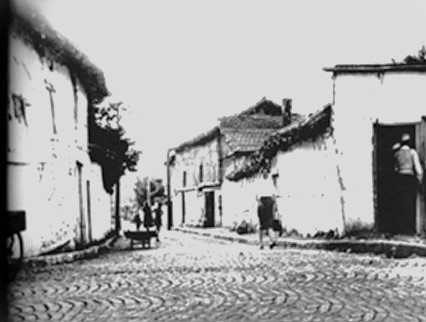
According to many citizens of Pristina who experienced the violence at that time, Albanians were tortured to death in the back part of this building. Pristina became the administrative center of Kosovo in 1947 and developed with rapid dynamics, failing to preserve the traditional objects of the Ottoman period. Today, Pristina as an urban city of this period has completely changed, with the exception of some narrow streets, where a few rare buildings of architectural value from the Ottoman period remain. Eduard Kardelj, accepting the manifestations of Serbian nationalism after the Second World War, said in the sixties: “Even our party comrades were involved in the chauvinistic persecutions against Albanians, their wives, and children.”
The hatred towards Albanians in Pristina reached such a point that in 1992, a despicable sign was hung in the Grand Hotel: “Entrance forbidden for Croats, Albanians, and dogs.”
In the urban tradition regarding art values and internal decorations in town houses, but also in the villages of the municipality of Pristina, Albanian masters were well-known, leaving behind valuable works of our popular tradition. In wood carvings, as well as in stone and fabric, the Albanian folk master managed to realize perfect works for the time. In the carvings, we mainly encounter astral symbols, which were used by ancient peoples since the early periods of history. Usually, the six-pointed star is carved, then the eight-pointed star, the moon, the sun, the snake, and decorations with plant motifs.
In Pristina, after the Second World War, the institutional and urban infrastructure began to be built, with the motto of building a city with an urban appearance. With the urban plan of the city of 1953, entire neighborhoods were demolished along with the old bazaar, destroying the Albanian folk architecture of the Turkish period. In this period, very few town houses managed to escape the deliberate urban plans drafted in Belgrade. With this plan, the Catholic church of Pristina, the Llokaç Mosque, the Jewish Synagogue, etc., were demolished. The Kosovo Theater was built in place of the mosque, according to Slavic-Russian architecture and model. After the Second World War, in 1945, the demolition of the old cemeteries of the city also began.
Two years after the war, the soil in the cemetery complex began to be dug up and sent by wagons to the Skopje tile factory. In 1947, a plan was drawn up to build the Pristina tile factory on this locality. Workers who worked at that time remember encountering graves during the excavation. The excavations also began under the cemetery complex near the current “Asim Vokshi” primary school in the city, beyond the stone bridge over the railway on the Pristina-Podujeva road. The phase of demolishing Albanian cemeteries in Pristina continued even in the seventies, when the city’s new tile factory was built. I remember that as a child, we saw bulldozers rolling several dozen old cemeteries with epitaphs written in the Ottoman language into the current courtyard of the tile factory.
There was also a very well-made grave with a heavy metal cover. Of these cemeteries, only one family managed to exhume their relatives at that time. The excavations were led by an Albanian student from Macedonia, who was studying at the Faculty of Machinery. Even during the nineties, nearly 100 Albanian graves from the complex of the current city cemeteries collapsed into the abyss of the excavations of this tile factory. According to Shaip Berila, the four neighborhoods of old Pristina also had their own cemeteries. The cemeteries were above the neighborhood (varosh), at the chimney of the tile factory, at the Llap Mosque, and… These cemeteries were razed, and these lands were given to the Serbs, but at that time no one dared even to ask why this was being done, say Berila.
Also, the current city park of Pristina was a complex of Albanian cemeteries, especially those who had emigrated from the Sanjak of Niš. Flat graves were also found at the “Field of Reconciliation,” near the hajrat well (public charity well).
There are two localities with Jewish cemeteries in Pristina, the old graves in Tauk Bahçe, covering 10 ares (1000 square meters), where 800 Jews have been buried since the 1850s. 200 Jews have been buried in the new cemeteries since 1922. The fate of the old cemeteries of Pristina was experienced by many localities and cities of Kosovo. Localities with non-Slavic material culture were colonized with settlers brought from Serbia, who built residential buildings over the cultures of civilization and earlier civilizations in these lands. After the occupation of Kosovo, colonists settled throughout its territory; in the district of Pristina, besides the city, colonists were also settled in Gračanica. Bërrnicë, Bardhosh, where cemeteries, properties, residential houses, and religious objects were appropriated.
In Bërrnicë, the early Albanian cemeteries were appropriated, which, according to the local population, belonged to Albanians, gravestones were taken, partially falsified, and with them the Serbs created the myth of the Nine Jugovićs. These stones are also published in the book by Dragan Cukić and Milan Ivanović, published by the Institute for the Protection of Cultural Monuments of the city of Pristina in 1996. The authors’ description is very doubtful, so this issue remains to be studied by eminent experts in this field. The indigenous Albanian population of the surrounding villages has preserved data that the raya (non-Muslim subjects) of Kolovicë and Bërrnicë, who had lived in these villages during the Ottoman rule, are Albanian, of the Krasniqe tribe and brotherhood with the Albanians of the village of Makoc and Llukar. After the Second World War, Pristina acquired the function of an important economic and administrative-political city, which created a solid material base. The size of the city was measured by the degree of involvement, the number of cadres, specialists, scientists, politicians, and liberal intellectual professions./Memorie.al