




Memorie.al / 100 years ago, from a small balcony in the former Skela of Vlora, an elderly man with a great heart would declare: “Let us enjoy an independent and free Albania!” This national figure, Ismail Bej Vlora, thus announced to the entire world the birth of the “state of the Albanians.” A “source of light” was thus created for the Albanians, whose ray has “traveled” for 100 years through swells, sunny and calm times, through storms and tempests, sometimes seized by paralysis and other times sawn, disappointed, or exhausted. And so, 100 years passed. Several generations replaced one another, but all had one goal: to climb as high as possible on the “ladder of hope”!
When we speak today of this “source of light,” we cannot fail to mention those who brought this source, our great patriots, especially all those who worked and gave the Albanian the “Alphabet of the Albanian Language,” but who closed their eyes before “freedom arrived.”
Nevertheless, they hoped that “the sons would remember them when this freedom was resurrected.” Indeed, “the sons remember them,” especially on anniversaries, but not only on anniversaries.
Remembrances on anniversaries are undoubtedly received and observed with respect, but also with pain and responsibility.
Respect is linked to what has been created in this country, to the name that has been left behind, and to the opportunities created “to climb the ladders of hope,” just like all other nations. Joy and pain are two sides of the same coin, as we celebrate, but we also grieve for the passing of the lives of those who brought the joy and the essence of these anniversaries. But the greatest pain is when people speak ill and think ill at the time when we should be rejoicing – when people speak ill of what is known and what is unknown, when “staying on damp ground” is called a virtue.
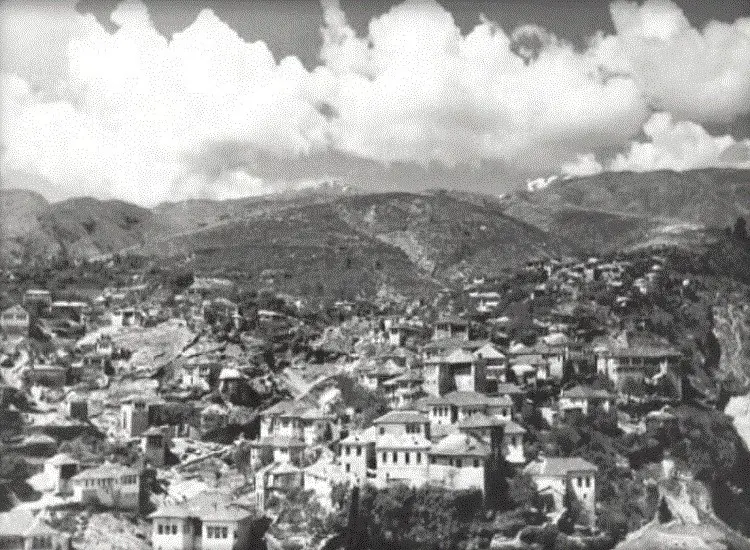
It has been observed that not only on clear days but even in the biting cold of winter, the light in Lunxhëri is somewhat different: somewhat more brilliant, purer, and stronger. It is fantastic to think that this “light” has also participated in forming the consciousness of the Lunxhiot; it has influenced the formation of his character to be an oak and not a willow, just as it has influenced the formation of his free thought and philosophy, to take up the “ink and pen,” which encouraged him to always look far ahead.
If light is the first element in forming the character of the Lunxhiot, we can say that the mountain, the forest, and the water are the accompanying elements in the processing of human morphology: people with great, clear souls, with a fine aristocratic refinement, but also brave and loyal, which has made and makes us proud to be Lunxhiots. Not a few such people have come from this region. The first among the first was the “nightingale with many tongues,” Koto Hoxhi from Qestorat, who chose his collaborators from Frashër who emerged, as Basho Koto himself writes: “Like Alexander with a roar, over Toskëria and Gegëria.”
Such were Pandeli and Koto Sotiri from Selcka, who left high ranks in the court of the Habsburg Monarchy and gathered around Basho Koto in Istanbul, in the “Society for the Printing of Albanian Letters.” One must not forget Nane Petri from Saraqinishta and Nikolla Stavro Vaso Qestoriti, who were among the 27 signatories of the founding of the Istanbul Society. Furthermore, we could continue with Urani Rumbo from Stegopul, Janko Minxha from Krina, Aristotel Lafe from Saraqinishta, the prominent jurist and drafter of the first legal codes of the Albanian state, the minister of the first state, as well as the first publisher of the magazine “Drita,” Petro Poga from Erind.
All these national figures, giants of Albanianism, strived to “sing the songs of the motherland” when many others made it suffer. For this devotion, these martyrs were beaten at the “Shpella e Çarë” (Split Cave), exiled to the deserts of Anatolia, and imprisoned in the underground cells of the Gjirokastra Castle or in Yedikule in Istanbul, where the candle light ruined their eyes.
We must remember these patriots who had the sweetness of the melodies of the motherland in their hearts, souls, and mouths. They constantly sang these melodies, but it is their testament that we, their descendants, should also sing “our songs” and care for them. We must not allow our “songs to be decomposed with scribbles.” Likewise, we must not allow emigration to “force” us to forget them. Simultaneously, we must encourage the coming generations to “orchestrate” more pleasant and harmonized melodies, but to learn to preserve and pass on the entire heritage of “our songs” with care.
We must all know that every one of the “songs” that has been inherited was made with blood. If the blood of heritage is cast aside, then the generations to come will not be able to “climb the ladders of hope.” We must also know that heritage is pride. It honors the creator, but at the same time, it honors and elevates the cultivators just as much – those who preserve and pass the heritage to the generations. To pass on heritage means to leave descendants!
We should always be proud that our region has taken a place of honor on the High Altar of Albanianism, with its brilliant representatives, with tribunes, with giants, among who stands the radiant-faced “Warrior of Hell,” Koto Hoxhi. But who was this giant? History and great men of every nation have not taken long to be raised to the “Altar.” This is what happened with the “Warrior of Hell”; it did not take long for his figure to be mentioned in anniversaries.
An activist of the National Awakening, of Albanian education and culture, Koto Hoxhi was deservedly commemorated in the Albanian press of the 1920s and 30s by renowned names in the Albanian culture of the time. The first to commemorate Koto Hoxhi is Nuçi Naçi, one of the last Renaissance figures who gave his life for the national cause, especially in the field of national education. In his writing published in the newspaper “Rilindja Shqiptare,” Tirana, 28.9.1925, based on data he received from Koto’s son, Janko in Korçë, he writes: “Koto, according to the official school program, taught Greek in the school of his birthplace in Qestorat (Gjirokastra), but simultaneously also Albanian, in the dangerous secrecy of the time.”
Naçi also tells us that “Koto went to Istanbul, where he worked as a merchant and built a good fortune, which would have allowed him to live peacefully in his village, had he not become involved in the national movement that began in Istanbul in 1879. There, he developed an active political activity for the implementation of the program of the Istanbul Society, specifically for the issue of determining the alphabet of the Albanian language, as well as for the drafting and publication of the Istanbul Alphabet in 1879.”
Further, Naçi gives us concrete data on his activity in the field of Albanian education and his creativity. He mentions him as one of the founders of the Albanian theater with the theatrical play “Lunxhiot Wedding (1874).”
The second to remember the Renaissance figure is the publicist and writer Xhevat Kallajxhi, who at that time directed and published the newspaper “Demokratia,” which was issued in Gjirokastra. In his writing dated May 28, 1932, he takes occasion from the pilgrimage to the grave of Koto Hoxhi in Qestorat on May 21, 1932—St. Constantine’s Day, Koto Hoxhi’s name day – undertaken by members of the “Teachers’ Club,” led by Safet Butka, the director of the Normal School of Gjirokastra.
In the article, Kallajxhiu tells us that: “The seventeen teachers of Gjirokastra (which included him as well as the well-known intellectual Vangjel Koça), were received by a group of men, women, and school students to participate in the memorial service that would be held in memory of Koto Hoxhi.” “We also went to the church,” Kallajxhiu adds, “welcomed by Mrs. Zografo, Koto Hoxhi’s niece, and her son, Mr. Kristaq.
At the front of the church, a large and beautiful wreath was placed, sent by the ‘Koto Hoxhi’ girls’ school of Gjirokastra and another from the ‘Normal’ School of Gjirokastra. The student Sofokli Papavasili, a bright boy who shows hope for the future, declaimed the poem ‘Independence’ with a clear and touching voice. The aforementioned speeches moved everyone. From the church, we went for a visit to the Zografo house, invited by the owners. We were treated to sweets (gliko), Turkish delights, rakia, and coffee.
This house is one of the first in Qestorat, and the Zografos family is a noble and well-known lineage. Koto Hoxhi’s niece, the honorable Mrs. Zogë, wife of Dr. Vito Zografos, sang for us a number of poems by the old patriot. On this occasion, with the initiative of the Teachers’ Club, the grave was cleared of thorns and wild weeds that had covered it over the years due to neglect, and a carved stone were soon placed at the head of the grave: Koto Hoxhi (1824-1895).”
Another important signature we encounter in the pages of the press of the time is that of the future writer Sterjo Spasse (at that time a teacher in Dropull), published in the magazine “Normalisti 1934,” titled: “Koto Hoxhi, one of the warriors of hell.” He comments with pleasure that Koto Hoxhi wanted “the nation to be resurrected not with noise, not with killing and opposition, but with skill – that is, with ability, reason, and wisdom. He wanted all wealth to be dissolved for education, but the education had to be purely Albanian.
But that was not enough: education had to be for both males and females because that is how the generation Koto’s great heart dreamed of would emerge. All his life he worked for the opening of Albanian schools. His compatriots mocked him for this dream, as they wanted to catch the prey without hunting; however, Koto, always inspired by the ideal of nationalism, with a smile on his lips would tell them: ‘I am not sowing salt, but I am sowing seed.’ And fate seemed to smile on him elsewhere.
In Janina, he was preparing for the opening of an Albanian school. He had taken all measures, he had obtained the permit, but ah, this life! He died unexpectedly in his native village in Qestorat, where he had gone to pick up a friend of his whom he had appointed as a teacher in the new Albanian school in Janina.”
Another distinguished worker of our culture of the time was Ismet Toto, who wrote an important commemorative piece in the magazine “Yllyria” no. 42, 1936 (Tirana), on the occasion of the anniversary of the Albanian School (Mësonjëtorja) of Korçë. Toto writes: “Koto Hoxhi would take the students of the Normal School with him and gather them in the village square on Sundays, repeating Albanian poems without fear or fatigue. Many teachers emerged from the Normal School of Qestorat. Teachers of the Greek language, groups quite well prepared for the villages of Epirus and Macedonia. Most of them were ardent Greek nationalists…!
But here and there, from that nest, some types inspired by the ideas of Koto Hoxhi emerged. They were nationalists too, just like the majority. But with the difference that they were more fanatical, because they were fighting for an idea that no one yet believed in. Thus, from the Greek ‘Normal’ of Qestorat emerged a Pandeli Sotiri, from Selca of Lunxhëri, the first director of the first Albanian school in Korçë in 1887, and a Petro Luarasi from Luaras of Kolonja, who continued the work of the former with unspoken momentum and courage.”
Finally, we want to mention another distinguished worker of our culture, the writer and publicist Milto Sotir Gurra, who wrote about Koto Hoxhi in the newspaper “Bashkimi i Kombit” in January 1944 (Tirana). He takes occasion from what Safet Butka had done when he was Inspector of Education in Tirana (1935-1937) and had equipped the capital’s schools for the first time with photos of several Renaissance patriots. It was there he had seen and discovered Koto Hoxhi.
“You are most interested in a portrait,” Gurra says in this writing, “and it draws your attention persistently: This is an old man with a sweet and smooth face in every point, with a broad forehead, with a nose that ends like a bird’s beak, with small, deep-set eyes full of stories and brilliance, with a stiff collar and a black tie, and you ask: Who is this apostle whose portrait you have placed here in this small gallery of the workers of Albanianism?
But even before the answer reaches your ear, your eye goes to the bottom of the portrait frame and reads: Koto Hoxhi.” Milto Gurra calls his writing a sketch and promises that once he has gathered the necessary material, he will have the obligation to conduct a full study on Koto Hoxhi./Memorie.al
![“Count Durazzo and Mozart discussed this piece, as a few years prior he had attempted to stage it in the Theaters of Vienna; he even [discussed it] with Rousseau…” / The unknown history of the famous Durazzo family.](https://memorie.al/wp-content/uploads/2026/02/collagemozart_Durazzo-2-75x75.jpg)
