– ALBANIA, A LIFE BETWEEN CHARM AND WONDERS –
Memorie.al / To tear down the statues of Albania’s true “devil,” Enver Hoxha, was easy. But to erase his name from the mountains is not at all so. The despotic and cracked leader who ruled this country for more than four decades insistently demanded that his name be written on the mountain face near the city of Berat with acid, in enormous letters. It will remain there for a long time. This is the kind of monumental oddity for which this misunderstood country of Europe is known everywhere. It is, without a doubt, a strange country, but also the most enticing, the least globalized, and not by accident, the most budget-friendly destination for any foreign tourist.
I experienced all the oddities of Albania, as well as its special charm, in the city of Berat, when a bear that was placed in a restaurant cage turned my arm back. The newest hotel in town had acquired it for entertainment, which after a week in Tirana, no longer seemed so strange to me.
I made a mistake by approaching the cage too closely, and it immediately stretched out its mouth and bit my arm. “Bruno” is an orphaned bear, after Roma killed his mother.
It is typical of Albania: at first it seems a bit frightening and strange, but then it becomes pleasant and makes sense. “Bruno” gave another color to my stay in Berat. Like all of Albania, Berat is located at the “crossroads” between Greek, Ottoman, and Western culture.
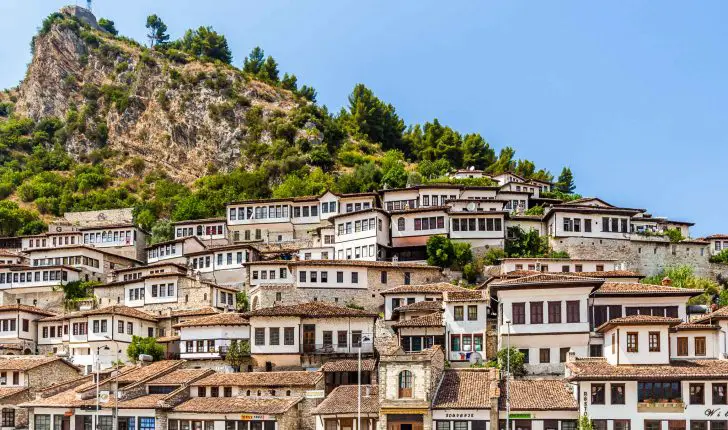
Known as the “city of a thousand and one windows,” for its houses stacked one above the other, it offers an excellent view of Albania’s past, present, and future.
The city’s past quickly appears during a visit to the medieval castle. A quick climb up the cobbled streets and beyond the castle walls reveals the first surprises: here people still live in this 13th-century complex – 150 families scattered across the buildings of this area.
Elderly women sit on stones, waiting to sell lace to random tourists. The museum with 16th-century icons in the Orthodox Church is full, even though the guide recounts that 70 percent of the icons in Tirana’s National Museum were taken from Berat.
Every corner of the castle complex hides a new surprise. I nearly stepped on the train of a bride’s dress as she struggled up the hill to reach the church where her wedding would be celebrated. Behind the church, a rooster strutted on the stones as if all of this were his domain.
Among the stone houses, I had a quick vision of a macabre fairy tale: a beggar who seemed to suffer from gigantism sat in the middle of the road, with deformed legs and a head that immediately turned toward me, giving me the first sensation of pain.
Behind the houses, a red mosque rises with great pride, as a symbol of Albanian religious tolerance. Many Albanian cities still have mosques, Catholic and Orthodox churches in all their neighborhoods. Many citizens say that above all they are Albanian, while religious faith is secondary.
But not all of Albania’s past is so harmonious. From the top of the walls of Berat Castle, far from the city’s historical area, one can see the apartment complexes of the Stalinist era.
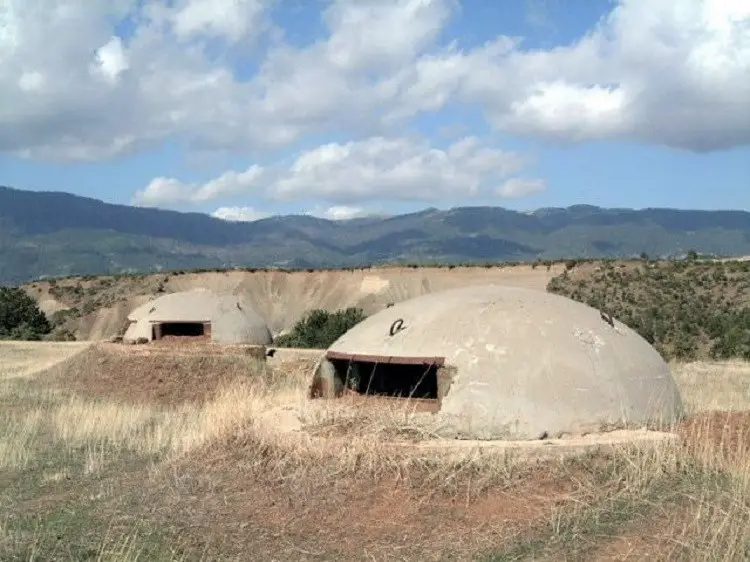
From 1945 to 1985, Albania experienced one of the harshest repressive regimes, led by Enver Hoxha, a paranoid tyrant who closed the borders, deprived his citizens of all rights, banned private cars, and built thousands of bunkers across the country to protect it from imaginary invaders.
Behind the mosque, I see workers restoring a church whose frescoes had been painted over with white paint during Hoxha’s regime, which banned the practice of religion in the country. Hoxha’s officials executed priests and turned churches and mosques into theaters and basketball courts, or simply destroyed them.
Berat benefited because it was declared a museum city, but nonetheless it was subjected to the campaign of erasing religious symbols.
In search of comfort in present-day Albania, I stopped at many Eastern-style cafes in the city, with a typical male clientele that chats during their midday free time while smoking cigarettes and sipping Turkish coffee.
To eat, I could choose Greek salad, German schnitzel, or Eastern kebabs. Near the coast, Italian pizza is added to the menu – another ingredient in Albania’s cultural mixture. The Ottoman occupation has left its mark on this country, and this is visible not only in the cafes and Turkish kebabs, but also in the architecture and lifestyle.
A visit to the Ethnological Museum of Berat is another glimpse into the past. The 19th-century wooden house has its walls covered with handmade lace, like that sold by the elderly women in Berat Castle.
The rough leather garments and heavy work tools in the museum speak of a difficult life for the area’s peasants. This visit also brings to mind the blood feuds for which Albania is known throughout the world.
In a Balkan version of the Hatfields versus the McCoys, families in blood feuds tried to wipe each other out for generations, because of the slightest offense to honor or pride.
Outside, children play in the streets, while adults talk about the “derby” in football – the great rival, Greece, which qualified for the European football championship.
A group of men with tough-looking faces stand on the street corner, listening to music blasting from the latest BMW, with thick gold chains around their necks – a symbol of the river of money that has recently arrived in this country.
Like other cities, Berat has a Western Union office, where residents receive money sent by relatives living abroad.
Entertainment at night in Berat also comes from abroad: a pop singer from Bulgaria, portly, with a mustache and that rooster-like appearance, which from posters around town looks like an “overweight” version of Borat.
Instead of this entertainment, I decided to set off on a trip into the nearby mountains. Berat also represents Albania’s future: eco-tourism. Various companies have started offering expeditions to the high peaks and distant fields of central Albania.
My trip included boat rides, river swimming, and a long walk among the mountains. Along the way deep into the mountainous area, we passed a number of car washes in the middle of the road, which perhaps show the late Albanian pride in owning and driving a car.
Speaking of which, there are also many memorial plaques on the country’s roads, in memory of those who have lost their lives in fatal car accidents.
Deep in the mountains, the “Mercedes” and “Audis” of the capital give way to donkey carts and old cars that seem to have come out of the sets of “Mad Max” or “The Grapes of Wrath.”
We passed a road that was once blocked by the regime because it leads to military garrisons and a factory that once produced AK-47 automatic rifles, or so it is said around there. After passing this grim “town,” I was surprised to see with my own eyes a doll crucified on a concrete pillar.
The adjacent building, also unfinished, had a stuffed elephant on top of its concrete pillar, while the view continued with a massacre of giant bears, dolls, and turtles, all offered as a sacrifice for the new constructions. I was told it was for good luck, but I never understood why.
We passed several small agricultural villages, where women and men wandered through the fields tending to crops, just like their ancestors 100 years ago. I think they saw our Land Rover with its bright orange color as just another fantasy, like the factories, castles, communism, capitalism, and all these religions competing for a little more attention. Our passing did not change the rhythm of work in the field at all.
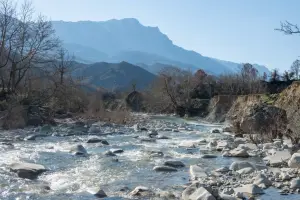
Meanwhile, we had arrived at the virgin riverbanks. We started a boat ride, but saw no one around. We passed small waterfalls, untouched shores, hidden caves, and a few small fishing spots. It felt like discovering the Grand Canyon 100 years ago, before anyone had thought of turning it into a tourist destination.
Only when our trip ended did we see a group of children jumping from rocks into the water, escaping the intense heat.
On the way back to Berat, I saw other residents cooling off in their usual way, with an evening stroll through the city. Young and old couples walked arm in arm along the Osum River, crossing the bridge that hangs over it, or the old stone one.
Like the peasants, they also see the change, but they consciously continue to respect old customs. At the hotel, we watched a video about river walks on the giant screen in the garden.
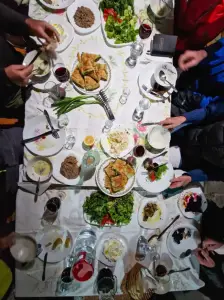
Then we “dove” into a mix of meats, salads, and pastries – typical Albanian dishes. The last surprise of the day in Berat was “Bruno,” still squirming in his cage in front of our restaurant.
FIVE STRANGE FACTS ABOUT ALBANIA!
Bunkers, bunkers, bunkers: Albania has tens of thousands of concrete bunkers, scattered like mushrooms all over the country, memories of the communist regime. Some have been painted, some even turned into bars.
God Bless America: Because of American support for neighboring Kosovo, Albanians has a deep gratitude for America.
“No” means, if it doesn’t mean “Yes”: Traditionally, Albanians shake their heads from side to side, and that means they agree. The foreigners’ “yes” here is “no”and“no” is “yes.”
Dr. Devil’s Beaches: The beaches of Durrës and Saranda are overcrowded during weekends, so much so that you cannot find a place to stay.
King Zog: He is strange even for his name. He is Ahmet Zogu, and he was the first of a clan in Albania to proclaim himself King of the country in 1928. / Memorie.al
Taken from the “San Francisco Chronicle”