
BY DASHNOR KALOÇI
Part Two
Memorie.al / Around the middle of October 1982, just a few days after the arrest of the Minister of People’s Defense, Kadri Hazbiu (former Minister of Internal Affairs in the years 1954-1979) and the Minister of Internal Affairs, Feçor Shehu (arrested on March 22, 1982), upon the directive of Enver Hoxha and the order of the Minister of Internal Affairs Hekuran Isai, the Special Operations Group was established. This group was headed by the Deputy Minister of Internal Affairs and simultaneously Director of State Security, Zylyftar Ramizi, with Enver Zeneli and Hasan Ulqinaku as his assistants. The main task of this group was: “The discovery and investigation of the activity of the hostile group,” led by Kadri Hazbiu, which also included Feçor Shehu, Llambi Ziçishti, Nesti Nase, Mihallaq Ziçishti, Llambi Peçini, Fiqret Shehu (with her two sons, Skënder and Bashkim), etc., as well as the connections they had with the former Prime Minister Mehmet Shehu.
In addition to other tasks, such as the review, study, and analysis of a large number of files and archival documents covering a long period (1945-1982), the “Special Operations Group” summoned several former high-ranking officials of the Party of Labour of Albania (PPSH) leadership and former senior cadres of the Ministry of Internal Affairs, State Security officers, etc., to provide written accounts of what they knew or suspected regarding the “hostile activity” of Kadri Hazbiu, Feçor Shehu, and their collaborators. By order of Minister Hekuran Isai, three groups of experts were also created with corresponding specialists from the Ministry of People’s Defense, the Ministry of Internal Affairs, and the Ministry of Health.
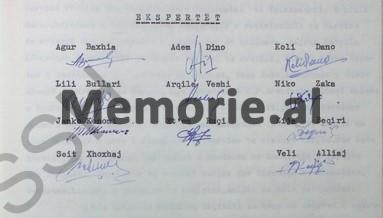
These three groups of experts, after studying and analyzing the “hostile activity” of the three main former heads of these ministries (Kadri Hazbiu, Feçor Shehu, and Llambi Ziçishti, respectively), would compile a detailed report, which would be submitted to the Special Operations Group, headed by Zylyftar Ramizi. Likewise, alongside these three groups of experts, two other groups were created from the districts of Durrës and Korçë (composed of high-ranking officials of the Party Committees and Executive Committees), who would study and analyze the “hostile activity” of Mihallaq Ziçishti for the period when he served as the First Secretary of the Party Committee in those two large districts of the country. Within this framework, the group of experts selected from the Ministry of People’s Defense included: Agur Baxhia, Adem Dino, Koli Dano, Lili Bullari, Arqile Veshi, Niko Zako, Janko Konomi, Et’hem Ruçi, Zija Beqiri, Seit Xhoxhaj, and Veli Alliaj, who would provide their report, including the aspect of fortifications.
Meanwhile, the group of experts selected from the Ministry of Internal Affairs, who would also provide their report on the aspect of fortifications, included: Vasil Kola, Baudin Kazani, Dhimitër Lazri, Veip Proda, Llazi Cici, Tomor Lapardhaja, and Qëndro Koçi. Both of these expert groups, upon completion of their work, drafted a report-information of hundreds of pages, which was submitted to the Special Operations Group. After “studying and analyzing” it, again with other experts attached to that group, the main documents were handed over to the group of investigators appointed for the investigative process of the so-called “Hostile Group of Mehmet Shehu” (led by Kadri Hazbiu, Feçor Shehu, Llambi Ziçishti, Nesti Nase, Mihallaq Ziçishti, Llambi Peçini, Fiqret Shehu, etc.), which would constitute the basis for the indictment against them.
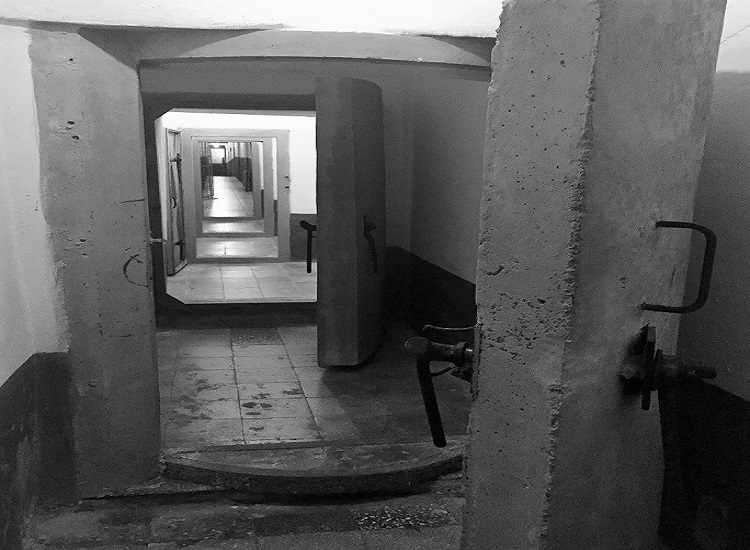
In the report-information of the expert groups from the Ministry of People’s Defense and the Ministry of Internal Affairs, a central place was occupied by Kadri Hazbiu’s “sabotage” in the field of fortifications, both during the period when he led the Ministry of Internal Affairs (1954-1979) and the Ministry of People’s Defense (from the beginning of 1980 until the day he was arrested on October 15, 1982). That part of the report-information also discusses two of the most critical underground facilities of the Ministry of Defense and the Ministry of Internal Affairs, such as the “General Command Post” (an object that has been known for several years as the museum “Bunk-Art 1”) , where the General Staff and the Defense Council, headed by Enver Hoxha, would take shelter in case of war, and from where the war was presumed to be directed in the event of a military invasion or aggression against the People’s Socialist Republic of Albania.
And the other underground facility located beneath the courtyard of the Ministry of Internal Affairs (Museum “Bunk-Art 2”), where the leading team of that ministry would also be sheltered in case of war. These archival documents, extracted from the Archive of the Ministry of Internal Affairs (which for years has been part of the fund of the Authority for Information on Documents of the former State Security) and are published for the first time by Memorie.al with the respective facsimiles, inform us about these and other details from the report-information of the respective expert groups of the two ministries regarding “Bunk-Art 1” and “Bunk-Art 2,” which have been a subject of visits for years even for foreign tourists who continue to have great curiosity and interest in knowing Communist Albania.
(The report-information of the expert group for the Ministry of Internal Affairs has 75 pages, but here in this article, we are publishing only the part that talks about the two main command posts, those now known as: “Bunk-Art 1” Museum and “Bunk-Art 2” Museum).
ARCHIVAL DOCUMENT WITH THE DECISION OF THE MINISTER OF INTERNAL AFFAIRS HEKURAN ISAI, FOR THE ESTABLISHMENT OF THE GROUP OF EXPERTS WHO WOULD GIVE OPINIONS ON THE HOSTILE ACTIVITY OF KADRI HAZBIU, MIHALLAQ ZIÇISHTI, AND FEÇOR SHEHU, IN THE MINISTRY OF INTERNAL AFFAIRS
PEOPLE’S SOCIALIST REPUBLIC OF ALBANIA SECRET
MINISTRY OF INTERNAL AFFAIRS Specimen No. 1
No. 92/15 Prot. Tirana, 10.6.1983
EXPERT OPINION ACT
ON THE HOSTILE ACTIVITY OF KADRI HAZBIU, MIHALLAQ ZIÇISHTI, AND FEÇOR SHEHU, IN THE MINISTRY OF INTERNAL AFFAIRS
Tirana, 1983
By decision dated 25.4.1983, of the head of the Investigation Group, C. Hekuran Isai, we, Vasil Kola, Deputy Secretary of the Party Committee of the Ministry of Internal Affairs; Baudin Kazani and Dhimitër Lazri, Counter-Intelligence Officers, Vehip Proda, Intelligence Officer; Llazi Cici, Jurist; Tomorr Lapardhaja, Cadre Instructor, and Qendro Koçi, Civil Engineer, have been appointed as experts to give opinions on the hostile activity of Kadri Hazbiu, Mihallaq Ziçishti, and Feçor Shehu, in the Ministry of Internal Affairs.
For this purpose, we have been requested to clarify these questions:
THE SECRET REPORT WITH THE EXPERT OPINION ACT OF THE EXPERT GROUP OF THE MINISTRY OF PEOPLE’S DEFENSE, REGARDING KADRI HAZBIU’S “HOSTILE SABOTAGE WORK” IN FORTIFICATIONS
PEOPLE’S SOCIALIST REPUBLIC OF ALBANIA SECRET
MINISTRY OF INTERNAL AFFAIRS No. 12791-A
Directorate of Investigation
INVESTIGATION FILE
No. 14
EXPERT ACTS
Hostile activity in the field of country fortification
In the field of fortification, the enemies Mehmet Shehu and Kadri Hazbiu have caused great damage to defense and the economy, as they carried out actions contrary to the decisions of the Defense Council, laws, etc.
Thus, acts of sabotage were carried out in the great work of fortification, fortification objects, etc. In Order No. 19, dated 25.3.1981, “On some rules for carrying out fortification works,” Point No. 1 states: “The fortification of defense regions from bottom-up is strictly forbidden. The fortification of regions shall be carried out only from top-down, seizing first the key and dominant places of the defense region.
No firing position shall be placed in the field without the complete fortification from top-down being finished. Any construction of an object that contradicts this approval is strictly forbidden. Any violation of the requirements of this order, as well as the criteria given for the fortification of defense, shall be severely punished up to criminal prosecution.”
This order was given with a hostile purpose, as it contradicts the requirements of the Military Art on People’s War, which requires that fortification begin from the first line deep into the territory and from the simple to the complicated. This order, with a hostile purpose, demands that the field be left without fortification and the mountain be fortified, an action that compromises the defense of the homeland.
From some information provided to the enemy Kadri Hazbiu by the Ministry of Internal Affairs regarding the measures to be taken for the state of works in the objects of the Party leadership, such as Information No. 13, dated 5.2.1982, which presented the situation and requested measures to fix the situation, the enemy Kadri Hazbiu took no action.
In this information, the enemy Kadri Hazbiu made a note: “The matter requires study, for resolution by Veliu, Mendui, Alfredi, and me.” In fact, no measures were taken and no study was done, deliberately hindering the progress of work in these very important objects.
The enemy Kadri Hazbiu did not take measures to implement Order No. 2282, dated 6.9.1980, which stated that prefabricated elements should be collected throughout the country by 30.10.1980.
In fact, the collection of the remaining elements was deliberately not done; the implementation of the order was not demanded, in order to harm not only the country’s defense but also the economy as a whole, as this quantity of remaining elements was produced again, re-spending significant monetary and material values.
In the country’s fortification by the enemies Mehmet Shehu and Kadri Hazbiu, priority was given to the construction of firing positions, underestimating the construction of field works and command objects such as command posts and control points.
This was done with a hostile purpose to create the harmful concept that one can only fight in concrete, to weaken the defensive capability, to leave army units without command in case of war, thereby violating the military line of the Party.
Kadri Hazbiu sabotaged the implementation of the Defense Council decision, such as Decision No. 4, dated 15.5.1975, for the completion of several important objects such as the military bases in Himarë, Shëngjin, the Poliçan Factory, etc.
With a hostile purpose, these objects were delayed in order to leave our ships unsheltered, severely compromising the defense of our coastline and the commissioning of the Poliçan Factory.
In the ultra-secret information dated 5.1.1982 sent to comrade Enver Hoxha by the enemy Kadri Hazbiu, there are deceptions with hostile intentions regarding three issues:
a) It was stated that “In the Poliçan facility, the works of the first phase will be completed in the first quarter of 1982, while the construction works in the entire facility will be completed by the end of 1982.” This is not true, as the works have not been completed even today, and there are still many work volumes to be carried out in the future.
b) “At the Palermo base, where the works on the main facility will be completed by the end of 1982, while the submarine brigade is to be relocated to this base during 1983.” This is not true, as the works at this base were not completed by the end of 1982, and work will continue on this object throughout 1983 and into the future.
c) Further in the information it is stated: “The Radio-Television facilities and the Command Post of the Defense Council will be placed on alert.” These facilities were not placed on alert during 1982.
These deceptions by the enemy Kadri Hazbiu were made with the intention of misinforming the Party leadership and compromising the combat readiness of these very important objects for defense. The enemy Kadri Hazbiu did not take measures for the implementation of Council of Ministers decisions No. 2191, dated 28.6.1977, and No. 114, dated 30.5.1978, for the construction of the Radio-Television facilities within the set deadlines, which should have been completed in 1981.
The enemies Mehmet Shehu and Kadri Hazbiu, knowing the importance of these objects, hostilely delayed their completion, severely damaging the country’s defensive capability.
Several command posts and operational control points for units and detachments, as well as many tunnel-type ammunition depots, did not have maintenance personnel, and as a result, they were damaged along with the ammunition. The commands of the units raised these problems.
But the enemies Mehmet Shehu and Kadri Hazbiu refused to appoint workers for the maintenance of these objects, with the aim of damaging the ammunition and the construction objects, so that the army would be without ammunition and without command in case of war.
The enemies, in contradiction with Ordinance No. 8, did not allow the introduction of control-revision in defense works, with the aim of damaging the country’s economy and leaving the fortification unchecked. / Memorie.al
EXPERTS
Agur Baxhia Adem Dino Koli Dano Lili Bullari
Arqile Veshi Niko Zako Janko Konomi Ethem Ruçi
Zija Beqiri Seit Xhoxhaj Veli Alliaj