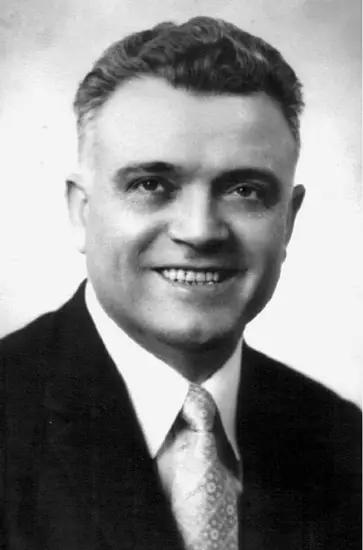
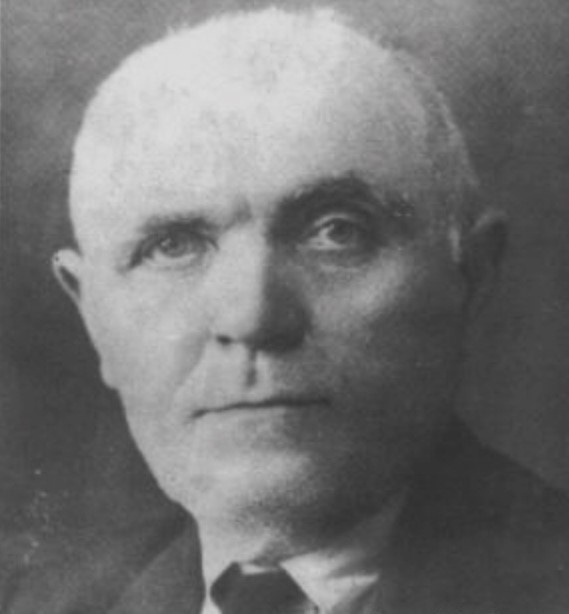
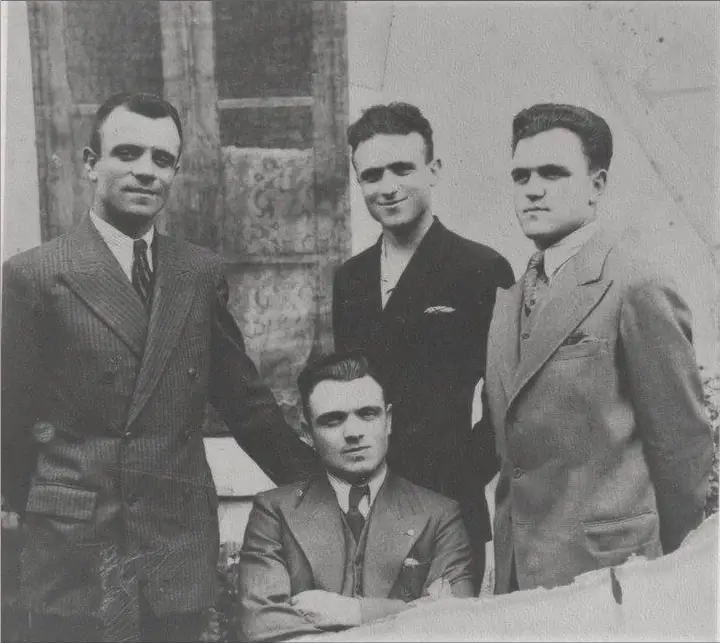

Memorie.al / Late September night, 1996, Tirana. After a meeting with some friends, I was returning to my sister’s house, where I usually stayed during my days in the capital. By chance, I met my friend Eden Babani, editor-in-chief of the newspaper “Liria A”. “I understand why I’m out, but what about you, why so late?” I asked. “I was at the printing house,” he replied. “The new issue comes out tomorrow. Buy it, because it contains a very interesting article about a well-known nationalist family.” The next day, as soon as I went out, I bought the newspaper and began looking for the article. I found it on the third page, accompanied by a photograph of a handsome man who, smiling seemed to be reciting the following aphorism:
“Cultivate faith and love for one another, not with blind obedience (peqe and lepe), but with logical and mature reasoning. There are no rules that define the rights and duties of a human being within the family and society, except for the rules of reason.” (Etien Dilo, A World That Is Born and Cannot Quite Be Born, page 215)
I started reading. It was a wonderful piece written with a confident style and language by a man of letters, Etien Dilo. It primarily spoke of a prominent figure from the great nationalist clan of the Dilos of Sheper, Zagoria: Jani Dilo. I had heard of this patriotic tribe, of the distinguished men who had rendered a precious contribution to the long road of freedom and democracy. That article stuck in my mind.
I had also heard of Sheper, the village of the great Çajupi. But what remained more vividly in my memory was a scene from my childhood. It was 1950. I had just returned from school. My father sat there, deeply saddened. I asked my mother why. She told me that a distinguished friend of his had died. My father overheard and said:
“Listen, my son, today the heart of a man who dedicated his life to the fatherland ceased to beat, but people abandoned him and left him to die in misery. For him, no bell tolled, just as it once was for Papa Kristo Negovani.”
He was speaking of the great man from Sheper, Aristidh Ruci. A member of the “Labëria” Club. A member of the organizing commission for the Assembly of Drashovica in support of the Memorandum of Gërçë. A participant in the proclamation of national independence. A member of the organization of the demonstration against Italian occupiers on November 28, 1919; a member of the “Vatra” federation and the “Bashkimi” society in the years 1920-1924. He was interned in Italy by the fascists. A member of the “Balli Kombëtar” Organization. A political prisoner during the communist regime.
Years passed. It was no longer the time when only a few printing houses or publishing houses existed in our country. Now we live in the world of the internet, where one can connect at any time with friends living far away. This is how it happened to me. I enjoy writing, and I send these writings to electronic media. Often, I receive messages from those who read them. Through them, I struck up friendships with several people I have yet to meet. Among them were Ksenofon and Eduard Dilo in the United States, and Ylli Dilo in Greece.
One day, while working in our association’s office, an honorable lady arrived.
“Excuse me,” she said. “I am Antigoni Dilo, the cousin of your internet friends. I have come to gift you these two books sent by Ksenofon.”
I took them.
I read the author: Etien Dilo. The titles: On a Journey: Indisputable Personalities When the Nation’s Fate Was at Stake and In a World That Cannot Be Born: A Voice Where There Was No Longer a Voice.
Two intriguing titles. I looked at the back cover. A brief biography: Born on September 19, 1938, in Sheper, Zagoria. He completed secondary school at the “Asim Zeneli” gymnasium, Pedagogical branch, in Gjirokastër (1951-1955). Higher studies at the University of Tirana, Faculty of Language and Literature (1960-1964). He served as a teacher in the Fier district and the Ballsh gymnasium. After the establishment of political pluralism, he was awarded the title “Merited Teacher.” Books and articles: The Daughter of Sheper, a Name That Lives Among Us (monograph), Ilia Dilo Sheperi, Bone of the Motherland’s Bone, In a World That Is Born and Cannot Quite Be Born. He republished Ilia Dilo Sheperi’s “Grammar” with necessary additions and notes. He left two other books in manuscript. He passed away accidentally on July 6, 2008.
I was deeply shaken. How is it possible for God to take such people to Himself?! I sat down and began to read. An entire gallery of characters, each greater than the last. A whole pleiad placed at the service of the fatherland. An entire family closely bound to the fates of the nation. Their history begins early, when the country was still under Ottoman rule, continues through the declaration of independence, World War II, the War of Vlora, the Albanian Republic and Monarchy, the occupation of Albania, the establishment of the communist totalitarian regime, and the period of democratic transition.
Meditations swirl in my conscience!
The first of them: Ilia Dilo Sheperi. Linked since youth to the movement for freedom and independence. During WWII, he was interned in Italy by the Italian occupiers. After a year, he managed to return to Durrës, but the authorities did not allow him to disembark. He was sent back to Italy. In 1917, he opened the first Albanian school in Sheper. On that occasion, Ilia Dilo Sheperi said: “The school is the foundation of nationality and progress. Whoever spared effort and expense for this matter could not advance the Albanian cause.”
In 1927, he published “The Grammar” in Vlorë, a book of great value for the schools of that time. He retired in 1934 but never stopped working for Albania. He opposed the occupation by fascist and Nazi invaders, but also opposed the start of fratricide by the communists. He connected with the British missions led by Major Tilman, Major Bill McLean, and Lieutenant Colonel Smiley, to whom he made clear the true anti-Albanian stance of the communists. He closed his eyes on October 14, 1945. The lament of the women of Sheper echoed in those hills:
“The snow-capped mountain has broken / The silver crown has split / O father, famous father / You left and turned your back / You left, the place is desolate / There will be no more Ilia / O Ilia, good Ilia / A tear-soaked handkerchief for the poor / When you spoke of Albania / The land shone like lightning.”
But the communists could not reconcile with his merits. By party order, they exhumed his remains and threw them elsewhere. A truly barbaric act. Ilia Dilo Sheperi left seven sons and three daughters, who had the misfortune of suffering all the evils of the communist totalitarian regime.
Ilia’s son, Mihal Dilo, a zootechnician and colleague of Bilal Golemi, was accused and denounced for alleged sabotage in the field of livestock. Pressure was put on him to collaborate with the State Security (Sigurimi). His character could not accept such a thing. His son, Foni, had managed to join the Variety Theater of Gjirokastër, but one evening, while performing, he noticed the performers were wearing his grandmother’s costumes, which had been previously confiscated. He could not bear it and left in protest.
But the greatest disaster struck just as the light of democracy was beginning to dawn. It was January 25, 1991. A group of bandits, incited by the masters of crime enraged by the loss of power, barbarically massacred Mihal’s wife, the late and honorable Mrs. Kaliopi Dilo, on her own doorstep. A repulsive crime. The criminals were leaving the power they had gained through blood in the same way – with blood. The greatest irony of this macabre crime is that, like many others, it remained unpunished despite the establishment of the democratic system.
The former political prisoner and poet Pirro Kuqi dedicated the following poem to this tragic event:
“They, the terrible ones / Emerged from the night / Like wolves from a cave / Dark as a storm / With the devil deep in their souls / They massacred you / Oh, in your clear eyes / And the horror made us shrink / As if it tore our ribs / And our faces withered / And our hair turned gray / Those who for fifty years / Were never sated with crime / But where are the killers? / No one answers us, this slaughter / Like lightning over the shores / When we ask about the crime / All paths are closed to us / They emerged from the night / Like wolves from a den / The storm fell upon us / They still wander around / Vampires among the people!”
Another son, Qirjako Dilo. At the age of 16, he opened the first Albanian school in Nivan, Zagoria. He pursued higher studies in land registry in Bari, Italy. He contemptuously refused the position of Minister of Finance during the fascist occupation. Author of several studies on prominent nationalist figures such as Mihal and Petro Harito, Aristidh Ruci, Jorgji Çako, Ilia Dilo Sheperi, and others. He certainly could not reconcile with the fratricidal policy followed by the communists. For this, the State Security set a trap for him similar to the one against the Catholic Clergy in Shkodër. They secretly hid several rifles and cartridges in his shed, and for this, he was arrested and sentenced. At the moment of his death, he told his wife: “In the courtyard, you poor soul, there is the grave!” He was carried to Sheper on the shoulders of only a handful of men, his closest kin. Albania was living through the period of the great divide.
Margariti, a student of the Fultz Technical School. Arrested for alleged espionage in favor of the Anglo-Americans and the Greeks. Could Sheper, a purely Albanian village that has always produced men in service of the fatherland, have produced an anti-Albanian? In no way. But communist malice was capable of inventing anything! Thus, terrible tortures continued. And here, his brother Mihal appears before our eyes, which, hearing his groans from the torture forced his way inside and shouted:
“Do you want to kill him? Kill him, no one can stop you, but what is this horrifying death?!”
Finding himself cornered, Margariti was forced to drink poison (DDT) to escape the torture. After serving two years in prison, he was released for health reasons. He returned to his family shattered. It was not long before he closed his eyes. Upon his grave, these words were written despite the opposition of communist fanatics: “My true faith is not to live and let others live, but to live and help others live.”
Jani Dilo. Here is how the newspaper “Liria” began its piece in November 1996: “Jani Dilo entered and remained in the ranks of the Revivalists with the same ideal, ‘For free Albanians, in a free Albania,’ one of the sons of our people who fought against the occupiers and for the salvation of Albania from communism…”
Etien Dilo continues: “He was in Albania when he needed to be; he left when he had to leave—not to save his skin, for they had done nothing but fight for Albania; not to protect lands or estates, but to fight for the salvation of the homeland, so that the paths of democracy would open and the national question would find a resolution.” Jani Dilo was born in 1911. After primary school, he attended the lyceums of Gjirokastër and Korçë. He then went to Rome as a student at the Military Academy, which he completed successfully. During the war, he joined the ranks of “Balli Kombëtar.” His comrades called him “The Strategist of the Balli War.” By chance, he met his former academy professor, who had come as a general of the occupying armies. The professor wanted to embrace him, but Jani replied: “I loved and respected you as a professor, but not as a general of an occupying army. A grown man should not deal with an infant.” This resulted in his internment in Italy. After returning to the homeland, he continued the struggle alongside “Balli Kombëtar.” In November 1944, he was forced into exile. Initially in Italy, where in 1947 he earned the title “Doctor of International Law” with the thesis “The Problem of the State.”
In 1950, he settled in the USA. In October 1956, the representation of “Balli Kombëtar” in America sent him as its representative to the International Agrarian Bureau Congress in Paris. He closed his eyes on January 14, 1984. He was a scholar and literary critic. Among his works are studies on Migjeni, linguistic problems, and the characteristics of Skanderbeg. He wrote: To Know Our Martyrs, portraits of fellow travelers like Zef Pali, Nexhat Peshkëpia, and Father Gjergj Fishta; How Communism Was Born and Grew in Albania; The Civil War in Albania; and writings in English: “How the Communists Took Over in Albania”, “Russia’s Dream of Conquest Doomed to Failure”, “Titoism on the March”.
This was Jani Dilo, about whom Etien wrote the article in the newspaper “Liria A” – the article I mentioned at the beginning of this writing. But such a thing did not sound good in the ears of the vampires who wandered free in the streets of our cities. One of them, one of those who in the past spent their lives writing anonymous letters and who lacked the courage to show his name but used the pseudonym “Jorgji Dëllënja.” The wretch, who seemed to have lost his name on his way through the trash, published a rebuttal in the communist rag “Kushtrim brezash.” The poor soul thought the time of the satraps still continued. He forgot that those times had set, never to return.
Orest Dilo. Like all the other brothers, he could not reconcile with the fascist occupation. For this, he was imprisoned in Turin, where he had gone for studies. When he returned to Albania, he entered the trade business. He was a hasty type. For this, his brother Jani Dilo cautioned him, and this became a lesson for him. In 1944, he immigrated to the USA, a few months before his brother. He graduated from medical school in Pediatrics. He settled in Easton, where he married Vasilia Milides.
Koço Dilo, the youngest of the Dilo sons. He lived in the village. His only income was from collecting medicinal plants in the mountains. He was arrested and accused of “high treason against the fatherland,” allegedly for having thought of escaping – something that had never even crossed his mind. He was sentenced to 10 years in prison.
“Hold on, there is a God!” his brother Qirjako told him when they met after the sentencing. Further confiscations began, even down to the sisters’ clothes. They even snatched the rich library of Ilia Dilo Sheperi. He served his sentence in the terrible Spaç. He swallowed a handful of tobacco to end his life. He fell ill with cancer and heart disease. He was hospitalized in Tirana. Today he is no longer with us.
The other brother, Themo, as well as the three sisters, also went through the calvary of persecution. Viktoria, the daughter and worthy successor of her father, a dedicated teacher, had to wander through the villages of Fier, like many of her persecuted colleagues throughout Albania. On October 6, 1982, her great heart suddenly stopped beating. In Fier, she was accompanied by the tears of almost all the neighborhood residents and her former students; however, in Sheper, only family members were present. The party organization did not allow the villagers to see off the daughter of “the great Dilo.” A woman from Zagoria addressed the participants with these words: “Honor is greater when the world gives it to you; the shame remains for your own.” Of the other two sisters, one was married in the village and, although her family was members of the cooperative, she never went to work; the other married in Përmet and later settled in Tirana.
These were my meditations while reading the two books by Etien Dilo. I had heard of many tragic cases of persecution during the period of the communist dictatorship, but I had never encountered such a tragedy as that of this martyr family. The democratic changes that occurred in our country awakened hope in the grandchildren and nieces of this noble tribe. But those hopes were quickly extinguished. Disappointment took the place of hope. This led many of them, though at an advanced age, to take the paths of emigration. Today, like many other Albanians, they are scattered to all four corners of the globe.
Nevertheless, one thing is true. The voice of the Dilos was not lost in vain. This voice, spoken at a time when there was no voice – as Etien Dilo calls it in his book – is a clarion call for a truly democratic Albania, for a truly free Albania. Finally, allow me to close this piece with a quote taken from the unforgettable speech of Ilia Dilo Sheperi at the people’s rally in Gjirokastër on November 28, 1920:
“Rejoice, O Albanians scattered in every corner of the world! Sing, you beautiful birds that fly in the sky of Albania! Bloom, you fields! Thunder, you mountains! Roar, you rivers and seas of Albania! Bless us, O holy martyrs of the fatherland! Courage, patience, and hope, you, O irredentist Albania!”/Memorie.al