Part One
Memorie.al / To someone, it may perhaps seem surprising: a martyr who is also the first sports record-holder of a nation! In truth, in this title of this article or in these eight words of it, everything is as natural as it is true. Although it is only now being proven through this first-time story of this year 2018. It is strange how it has been possible that until today, in 2018 thus, this truth has remained unknown, unlearned, unrecorded. And yet, we should not be surprised. History in Albania, that of sports in particular, still moves far too slowly, like something of secondary importance, with endless untruths, with naive tales, with the distribution of affirmations, even unmerited ones. To the point where an honest professional historian must do nothing but constantly correct the brutal behaviors of unscrupulous writers, who surprisingly continue to fill the pages of newspapers.
I also feel somewhat guilty that only today, in 2018, it is discovered that a martyr is also the first record-holder of Albanian sport. In truth, he is the first record-holder of only one sport, Albanian light athletics. However, this is simultaneously the first documented record that we have for all types of our sports. His name is Pjetër Guraziu.
A distinguished intellectual of Albania, executed without any guilt by the communist regime along with 21 other martyrs, because of the so-called assassination attempt via a bomb thrown at the Embassy of the Soviet Union in Tirana, in 1951. An event well-known to the Albanian people, which professional historians have scrutinized in detail.
Pjetër Guraziu is one of these martyrs. He is the father of an early friend of mine, from the beginning of our generation at the Shkodra gymnasium, Filip Guraziu – also one of the greatest athletes of Albania. He bears the name of Pjetër Guraziu’s father, thus his grandfather, Filip Guraziu, whom we are calling the first. And if today’s Filip is named Filip Pjetër Guraziu and his father is named Pjetër Filip Guraziu, this is a noble hereditary commemorative community of family names – which civic Shkodra had as a style of memory of a certain nobility.
And, naturally, it seems to me that, so to speak, even in genetic content, this father-son duo has a kind of entirely original closeness. The other closeness then is that my friend, Filip Guraziu, also has an entirely unusual life. Besides his university profession as a mathematics teacher, thanks to his prominent talent as a basketball player, through turmoil and heavy punishments – which he knew how to face with his stoicism – he managed to survive. To rise, even, as if in a reversal of history, to the position of Mayor of Shkodra…!
Last year, I missed several major anniversaries of Albanian sport. I missed the 50th anniversary of winning the first title of Champion of Albania (1967-2017) of “Vllaznia” of Shkodra. It was not a simple event of that sort. It was an entirely extraordinary event, among the rarest in the history of Albanian sport. Finally, after over a rare decade, with “titles” of the Cup and as runner-up of Albania, Shkodra’s basketball managed in 1967, through its “Vllaznia”, to win its first Champion title.
Surprisingly, one of the greatest: Those who made the history of Albanian sport, the Martyr PJETËR GURAZIU – The first Record-holder of Albania, a title won, so to speak, “in nature,” outdoors, at the so-called “Spartak” Sports Corner of Shkodra, which held in its fragile stands and in the rows behind the metal boundary, up to 4,000 spectators! One of the most prominent protagonists of this event is named Filip Guraziu.
It was a rare decade (1957-1967), from which the author here, as a student of the Shkodra gymnasium (1956-’60), whose building constituted the high boundary of the western part of the “Spartak” corner, remembers with nostalgia indelible sporting events. It cannot be described today what the Sundays of the “Spartak” corner were like, there, right in the middle of Shkodra. A Shkodra deeply exhausted, tired, neglected, but being that it was only a few years from pre-war Shkodra, it still preserved its civility and the “xhiro” (promenade) of the Piazza could not be stopped.
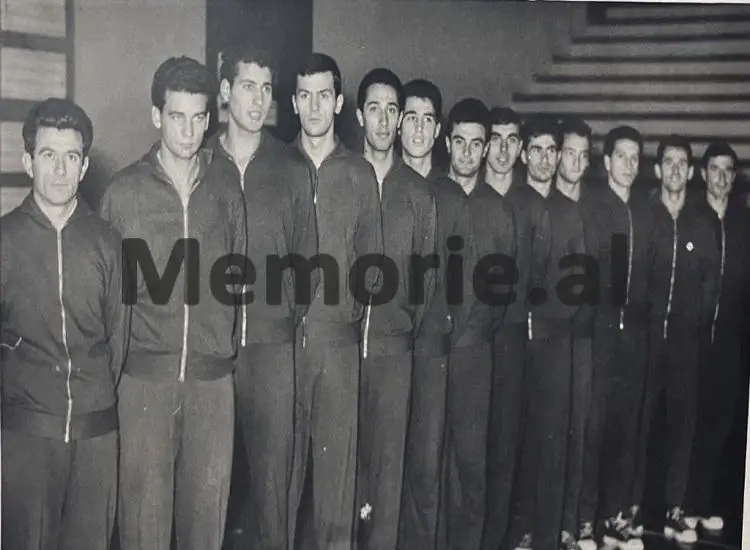
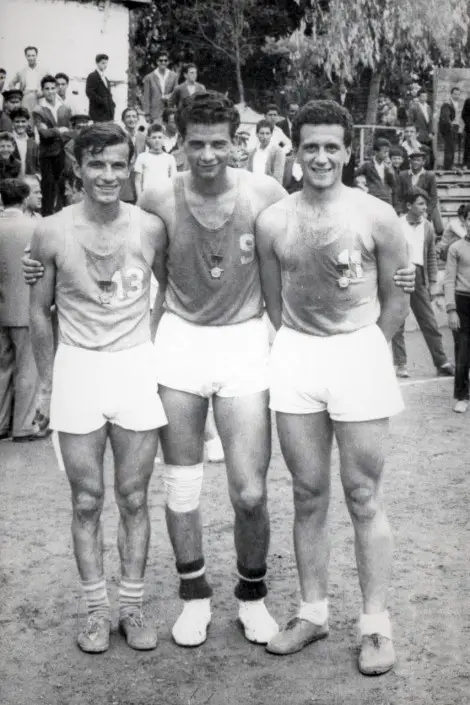
The great trio of 17 Nëntori of Tirana and of Albanian basketball, from the left: Bujar Shehu, Vaso Shaka, Filip Guraziu.
And likewise, the 4,000 spectators at the “Spartak” corner could not be stopped either. It was a rare, indescribable relaxation. An oblivion of the great troubles of a city, as well as of an entire people. It seemed that poverty and isolation were transformed into wealth and freedom only during those three hours at the “Spartak” corner. Because three hours they were. First, the match of the female basketball players, then that of the men. Recently, the Albanian Basketball Federation has published a wonderful album dedicated to basketball, which is an example to be followed and congratulated. Especially its president, Avni Ponari, but also its general secretary, Korab Llazani.
In it, a historical photo is found. It is the basketball starting five of “Vllaznia” of the 1950s: Esat Haxhi, Muhamet Sokoli, Vehbi Ademi, Luan Shatku, Skënder Osmani. I say that the history of Albanian basketball has not had a five more monolithic, more unchangeable, more harmonized than this. Of course, after it came much better fives, especially those of “Partizani” and “17 Nëntori” (today’s Sport-Klub “Tirana”), but also within “Vllaznia” itself later on. And yet, the uniqueness of these five great athletes of Albania, all five in the national team as players and coaches, deserves the pedestal.
Especially regarding the originality of the game of a compactness that deserves to be studied even today. It is enough to mention only one phenomenon, which might even be a world case: it happened that for 40 minutes of play, they would win a match without being substituted almost even once! Moreover, they were loudly applauded even by their good “bench” teammates, such as: Ali Quku and Beqir Sekuj, Sandër Laca, Malo Zhabjaku, and Ndrekë Gjini, as the talent of Valter Kalaja was arriving. With one exemplary absence: the close associate of the first five, Qemal Tafilica, who had fled with his brave escape across the borders of Albania.
At their head was our gymnasium teacher, captain-coach Esat Haxhi. Then the national team player of fine technique, Muhamet Sokoli, a “doc” Shkodran, as the Latins say, but who came from the colors of “Puna” (“17 Nëntori”) of Tirana and “Partizani”. When I then reach the other national team player Vehbi Ademi, I find the elegant universal – a rare volleyball and basketball player.
And I close with the duo of the youngest, in fact two colossi, because being 1.88 or 1.90 meters tall, as they were, at that time they were called colossi. I am talking about the great Luan Shatku – perhaps the first model of a basketball center in Albania, and Skënder Osmani – the entirely original tall scorer and always a unique blocker of the best opposing player. These two greats are the founders of the game with two centers in basketball in Albania, which disarmed and surprised all the teams of that time.
There is no doubt that the end of the 1950s sanctioned the modern foundations of Albanian basketball, however modest it may have been. The names across the main cities are unforgettable. And our story, thus, a bit slowly, is moving to reach Filip Guraziu, in truth Pjetër Guraziu, whom I cannot separate in any way. Father and son, who naturally belong to entirely different eras…
For the title of Shkodra’s basketball – Champion of Albania, we would have to wait for the year 1967…! It is a story as beautiful as it is “capricious.” And in the case of Filip Guraziu, it goes beyond the dramatic!… The “Vllaznia” of basketball 1967 would be a Shkodran champion, which unlike any other sport, would arrive in Shkodra from the capital’s basketball. All this, we can say, is the first and only sporting seizure by Shkodra from Tirana, at a time when our capital “mercilessly” seized Shkodra’s talents every year, in almost all types of sports.
This basketball history is a history that has a prologue. The five mythical to us, mentioned above, in the early 1960s would be on their way out. But its influence had nurtured the next generation. The names that come are also almost all national team players of Albania. Valter Kalaja – the first who descended thanks to that five. He would be linked with my childhood friend, from gymnasium and beyond, Petrit Osmani thus, who would become the most winning coach of “Vllaznia” – brother of the great Skënder. And in turn: Zyhdi Çoba, Asllan Gjyrezi, Angjelin Shiroka, Nikolin Pali, Nikolin Kovaçi…!
They would be a guaranteed future. They were our friends, of my generation – for whom we constituted the most loyal “fans.” And I, who had already left Shkodra, naturally like so many others, in the Tirana of the big-named “Studenti” Stadium, would be delighted with my fellow citizens, Renato Radoja, Bujar Golemi, Filip Guraziu, or also with Vladimir Gjurba, whom “17 Nëntori” of Tirana had “bought,” established by the master of masters Feti Borova. It seemed that Albanian basketball had two Shkodras: one in Shkodra and one in Tirana.
Unique for the history of Albanian basketball, a basketball that in its modern form started with a Fatmir Meka – the most modern of them all, and which would reach as far as a Vaso Shaka, a Bujar Shehu, and a Kosta Papa, led by the last of the “Mohicans,” the unforgettable captain Dhimitër Papa – also a great friend of mine. To this extraordinary basketball capital, a bit later, the greatest of the greats, named Agim Fagu, would set the seal. But we are in the year 1967, and the powerful subsequent years of an extraordinary generation had not yet arrived.
The 1960s were taking off vigorously, however. When suddenly, again the capital – a school in itself of Albanian basketball – was not satisfied with just that. As much in football, so too in basketball. Here too the “brutality” of “Partizani,” which “seizes” Luan Shatku and Petrit Osmani, with whom in 1964 it is declared champion of Albania. When “Dinamo” also takes a whim to do basketball, having as part of it the other Shkodran of great experience from “Vllaznia,” Skënder Osmani, now a veteran, and who gives this new “Dinamo” what it lacked: maturity. Suddenly, Shkodra also demands its own.
Eng. Bujar Golemi of “17 Nëntori” returns, who besides being a player, would be the historical coach of “Vllaznia.” And the “king” of basketball, Renato Radoja, would be “re-seized” from “Partizani,” but also the surprise of surprises: our protagonist, Filip Guraziu. The return of this trio of “Nëntori” champions: Golemi – Radoja – Guraziu, to Shkodra, is one of the most unique and surprising wonders in Albanian sport even. Thus, when no one thought it, “Vllaznia” was turning from “the seized” into “the seizer.” On March 7, 1965, in Tirana, it seems the most alarming match ever is played: Vllaznia wins 79-75 against Partizani. Look at who the fives are:
“PARTIZANI”: M. Përmeti, L. Shatku, P. Osmani, K. Papa, J. Baho.
VLLAZNIA: B. Golemi, R. Radoja, F. Guraziu, A. Gjyrezi, N. Pali.
Out of 10 players, a full 7 are Shkodrans, because two of those from “Partizani” are also such: the “soldiers of the people” Luan Shatku and Petrit Osmani. And “Vllaznia” has the team for the title closer than ever. Although it lacks its two “Partizani” players, Shatku and P. Osmani. And even without them, the title is very close. The drama of the championship reaches its peak with “17 Nëntori” leading. However, on June 6, “Vllaznia” wins against the leader in Shkodra, 58-56. The fives are these:
“VLLAZNIA”: Radoja, Pali, Gjurba, Guraziu, Gjyrezi.
“17 NENTORI”: Shaka, Bumçi, Shehu, Kasmi, Topalli.
“Vllaznia” 33 points, “17 Nëntori” 33, “Partizani” 31, “Dinamo” 30. It had been years since such a balance had been seen in Albanian basketball. The teams of Shkodra and Tirana are tied at 33 points each, with “Vllaznia” leading thanks to a better point average. The Albanian Basketball Federation has no other way. And it decides: a third match for the title. Unfortunately, with an unseen bias. In 1957, “Vllaznia” and “17 Nëntori” had finished the same way, with equal points, but the title match had been held in a neutral city, in Durrës, at the “Nako Spiru” Sports Park.
“17 Nëntori” had won. But now, the Federation commits one of the greatest injustices known to Albanian sports: it decides unilaterally that the final would be held in Tirana. The event takes place on June 13, 1965, and 17 Nëntori, which as was known, had a very worthy team, on its own court, before its own public, does not find it difficult to win the match 74-63 and the title of Champion of Albania. The Shkodran title would still be delayed…!
The adventure of this title would start only after a year, in 1966. Meanwhile, Shatku and P. Osmani of “Partizani” are expected to return. And with them, Çoba of the “University.” Everything begins on September 25, 1966. Shkodran victories do not stop: “Vllaznia” – “Luftëtari” 84-42, “Dajti” – “Vllaznia” 47-106, “Vllaznia” – “Universiteti” 67-57, “Dinamo” – “Vllaznia” 61-64, “Labinoti” – “Vllaznia” 41-64. Above all, “Vllaznia” – “17 Nëntori” 76-59!
The Shkodran five is rare: Radoja, Shatku, Lahi, P. Osmani, Guraziu. All Shkodrans, but with one difference: Three of them, all three of the National Team of Albania, Renato Radoja, Agim Lahi, and Filip Guraziu, had grown up, been formed, and had long ago become Champions of Albania under the jersey of “17 Nëntori.”/ Memorie.al