By Mr. Sc. Nikollë Loka
Part Two
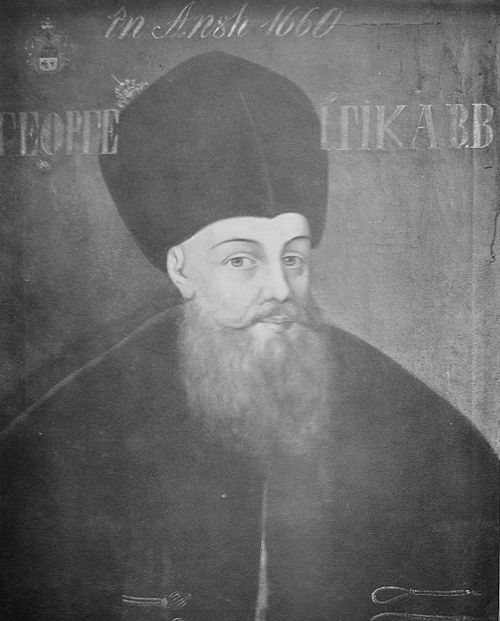
Memorie.al / The ancestors of the Gjika family left Zërec of Përmet and settled in Constantinople in search of a better life. They engaged in trade and managed to enter the “Phanar” district, where the wealthy Christians of the Empire resided. They continued the profession of merchant; even Gjergj Gjika, the founder of the dynasty, practiced this trade when he met the Grand Vizier of Albanian origin, Mehmet Pashë Qypriliu, who helped him climb the social ranks and opened the doors to power. The Gjika family, likely during Gjergj’s time, moved from Constantinople and settled in the Romanian territories, which benefited from the status of “Dar al-sulh” – the land of conciliation. This status allowed these territories to have their own political, administrative, and military structures, effectively possessing full internal self-governance, while their foreign policy was obliged to be harmonized with the Ottoman state, according to the principle that the Danubian principalities would be the “friend of the friend and the enemy of the enemy” of the Ottoman Empire.
Continued from the previous issue
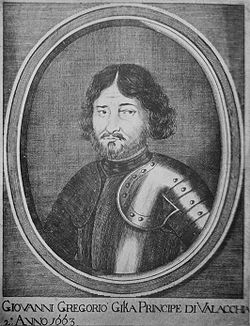
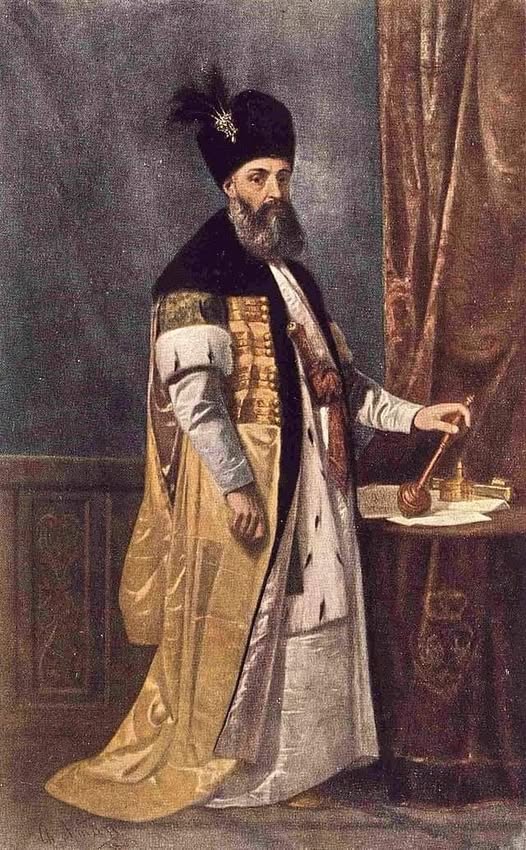
Grigor Aleksandër Gjika (Grigore V Ghica) was born in 1803. He was the grandson of Prince Grigore IV Ghica. He married Helena, the daughter of Prince Ioan Sturza, who had been the Prince of Moldavia from 1822 to 1828 and hailed from a prominent Romanian noble family. Grigore was educated in France and later in Germany. Upon returning to his homeland, he connected with the nationalist and liberal opposition that opposed Prince Mihail Sturza and the regime of the Règlement Organique. After the Revolution of 1848 and Sturza’s departure from power, despite his political choices, with the approval of Russia and the Ottoman Empire, the Divan of Moldavia appointed Grigore as Prince for a seven-year mandate, according to the Convention of Balta Liman.
After ascending the throne, Grigore undertook several modernizing reforms. On his initiative, for the first time in the history of the Romanian principalities, a gendarmerie was created to maintain order, a period recognized as the founding era of the modern Romanian gendarmerie. Gjika revised the agrarian system; encouraged public entrepreneurship and organized the educational system.
In 1851, he appointed the Transylvanian intellectual August Treboniu Laurian, a supporter of Romanian nationalism, as the inspector of Moldavian schools. Likewise, during his reign, censorship was eased, and literary activities increased. The program of Grigor Aleksandër Gjika’s first reign ended with the Crimean War, when Russian troops occupied the Danubian principalities to use them during their attack on the Ottoman Empire.
Removed from power in June 1853, he went into exile in Vienna in October of that year. When the occupying troops withdrew the following year, Grigore resumed the leadership of Moldavia. During his second reign, Prince Grigor Gjika abolished Roma slavery. This was the end of a gradual process, as Mihail Sturza had freed the state-owned Roma slaves in 1844, but Roma slavery in the private ownership of the wealthy still remained.
Gjika is also noted for his support of the nationalist program for the union of Moldavia and Wallachia, and he backed the activities of the Nationalist Party, provoking the anger of Austria and the Ottoman Empire. In the final years of his reign, Grigore appointed several representatives of the Nationalist Party to government positions. In 1856, Grigore ended censorship in Moldavia and proclaimed freedom of the press.
The Second Reign
After the conclusion of his reign, Grigor Aleksandër Gjika left the country and went to Paris. In his place, after a short period, the Sublime Porte appointed Teodor Balș with the title of Kaymakam. As a staunch opponent of the union, Balș sought to gain the support that would make him the titular prince. Retired to his estates in Le Mée-sur-Seine, Grigore continued to support the union, which became more feasible with the Treaty of Paris. He also supported the holding of free elections in Moldavia and demanded the annulment of the elections conducted by Nicolae Vogoride, who had replaced Balș.
This led the opponents of the union to spread rumors against him. Gjika was deeply affected by the insults and by Emperor Napoleon III’s refusal to grant him an audience. Under these conditions, Grigor Gjika committed suicide on August 24, 1857. “I am a victim of the great bitterness caused by slanders, though I am completely innocent. The day will come when the truth will emerge, therefore I await my enemies before God’s judgment,” he wrote in his final letter.
Two days after Grigore’s suicide, Ottoman authorities decided not to recognize the elections held by Vogoride. Gjika’s achievements laid the foundation for the new Romanian state when the Moldo-Wallachian union was realized. Gjika’s laws on censorship served as a model for new legislation and were generalized for all of Romania. In gratitude for his role in creating the gendarmerie, the officers’ school in Drăgășani was named after Grigor V Gjika.
Ion Gjika (Ion Ghica)
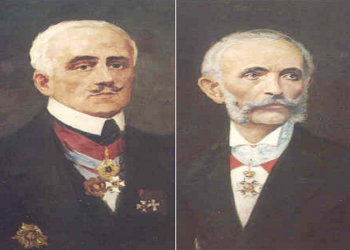
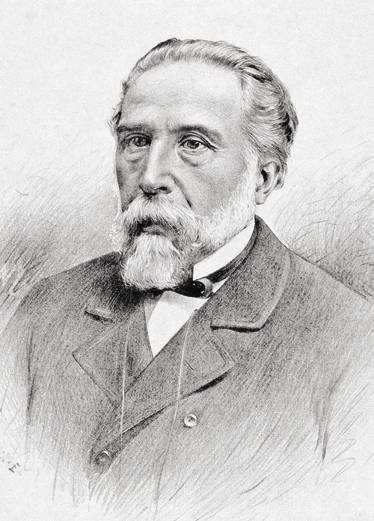
Ion Ghica was born on August 12, 1816. He is a prominent figure of the 19th century: writer, politician, academic, diplomat, mathematician, and professor. He served as Prime Minister of Romania twice (from July 16, 1866, to March 13, 1867, and from November 28, 1868, to February 14, 1870). He was the President of the Romanian Academy four times (1876–1882, 1884–1887, 1890–1893, and 1894–1895), as well as the head of the Romanian Writers’ League in 1848.
In his youth, Ion Gjika completed his studies in Bucharest and then in France, where he studied engineering and mathematics from 1837 to 1840. After completing his studies in Paris, he went to Moldavia, where he became involved in the secret organization “Frăția” (The Brotherhood), which aimed for the union of Moldavia and Wallachia. At that time, he also taught at the Mihăileană Academy in Iași. He spent several years in Italy, France, and England.
In 1847, he married Alexandrina Mavrocordatos, the daughter of the Greek Prime Minister, Alexander Mavrocordatos. He returned to his homeland and joined the Wallachian revolutionary camp. On behalf of the Provisional Government established in Bucharest at the time, he went to Istanbul to approach the Sublime Porte. Ion Gjika also participated in mediating talks between the Romanian leader of Transylvania, Avram Iancu, and the Hungarian Revolutionary Government of Lajos Kossuth.
After the failure of the 1848 revolution, he went into exile for ten consecutive years. During that period, he was tasked by the Sublime Porte with the duty of Governor of the island of Samos (1854–1858). There, he distinguished himself by fighting piracy. Upon successfully completing this duty, Sultan Abdulmejid I decorated him with the title “Prince of Samos.” Before returning to Romania, Ion stayed briefly in Austria.
Return to Romania
In 1859, after the union of Moldavia and Wallachia was achieved, Prince Alexander Ioan Cuza called Ion Gjika to return to Romania. Although he was a confidant of Cuza, he participated in the secret group that prepared his removal from power. Meanwhile, Ion Gjika became a leader of the Liberal Party and was elected as the first Prime Minister under Prince Carol of Hohenzollern. He held the post of Prime Minister of Romania in 1866–1867 and 1870–1871.
Ion Gjika is considered one of the most prominent figures among Romania’s liberals and one of the most distinguished leaders of the Liberal Party. In 1881, he was appointed Romania’s ambassador to London, where he remained for ten years. Besides his political and scientific activities, Ion Gjika was also engaged in literary work, gaining popularity with his letters sent to Vasile Alecsandri, his lifelong friend. Written during his stay in London, they provide a mirror of Romanian society of the time.
He is the author of “Collections from Exile,” written in 1848, and “Conversations on Economy,” where he presented his ideas on economic development. He was the first to advocate for the support of local initiatives and the introduction of foreign investment in industry and trade. In 1891, he retired from active political life and went to the family farm in Ghergani, where he spent the last days of his life. He died in Ghergani in 1897.
Dhimitër Gjika (Dimitrie Ghica)
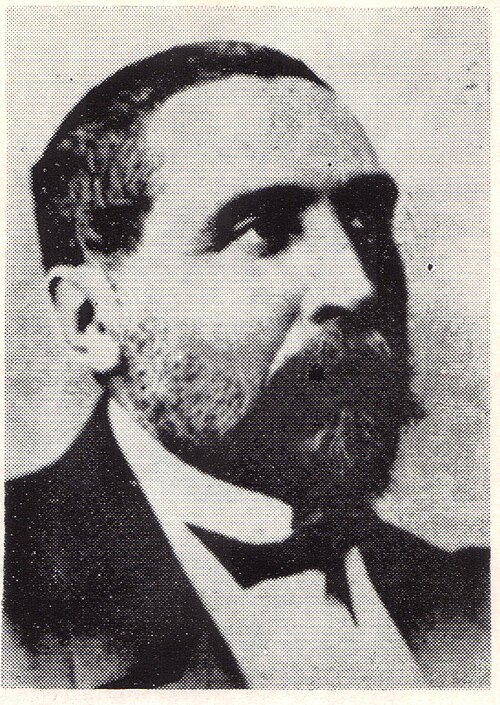
Dhimitër Gjika was born in 1816. He was the son of Prince Grigore IV Ghica and his first wife, Maria Hangerly. Dhimitër married Charlotte Duprond, with whom he had two daughters: Maria and Iza. He engaged in politics early on within the ranks of the Conservative Party, becoming one of its primary leaders. He served as Prime Minister of Romania from November 28, 1868, to February 14, 1870. On May 10, 1886, he was designated to announce to the Romanian people the country’s transition from a republic to a monarchy. He died at an advanced age, but still active in politics, in 1897, while serving as the President of the Romanian Senate. /Memorie.al