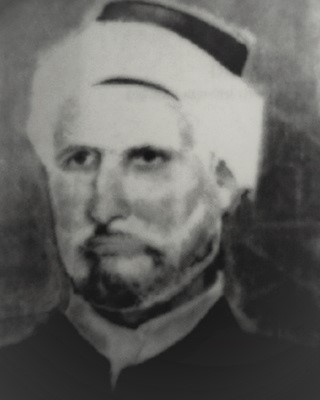
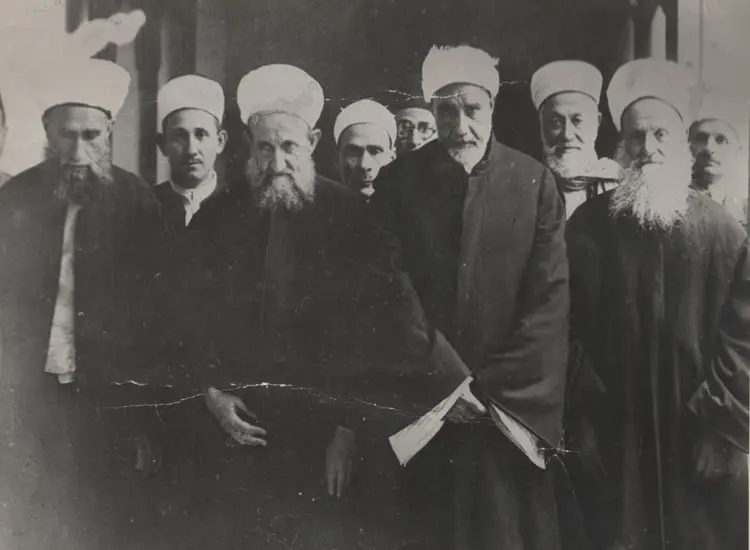
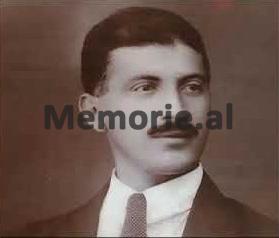
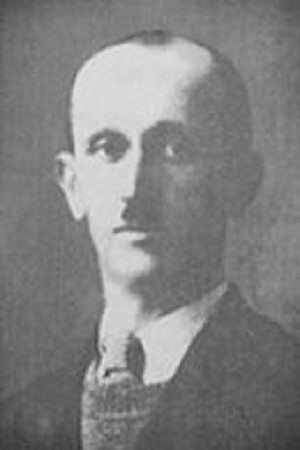
Memorie.al / Daut efendi Boriçi was not only a distinguished Islamic scholar but also one of the most prominent patriots of the National Renaissance. He led the Inter-Regional Committee of the League of Prizren with patriotism, as well as the League’s Branch for Shkodër. Daut Boriçi is noted for his dedication in the field of education. According to his autobiography, Daut Boriçi was born in Shkodër on December 20, 1825. He himself notes that his first mejtep (elementary school) teacher was Molla Ferhati, who lived during the period 1772-1844. This elementary school was located in the Old Bazaar, and eight-year-old Dauti attended it along with his brother, Salihu. A verse with realistic notes by Hoxha Ferhati, dedicated to the two Boriçi brothers, Dauti and Salihi, is found in the Boriçi family diaries.
Who was Daut Boriçi?
According to his father’s notes, Dauti spent his childhood near the family after finishing elementary school. In his autobiography, Dauti notes that as early as 1839, he had begun learning Arabic and taking theology lessons from the renowned myderriz (professors) of the Qafë Madrasah, an institution founded by Mehmet Pashë Plaku (Bushatliu).
A contingent of clerics was prepared by the hands of respected teachers such as Salih Efendi i Madh, Molla Ahmet Hadri, and Molla Sylo Fakja, as well as distinguished foreign myderriz, who later became affirmed, honoring themselves, the institution, and the country: Jusuf Tabaku, Mulla Ahmet Kalaja, Hasan efendi Podgorica, etc., as well as Dauti himself.
We find him at this madrasah even in 1845; after completing it, he was appointed imam of the Draçin mosque and was called Molla Dauti at that time. After two years of service, in 1850, he set off for Istanbul and on October 21, he registered at the Çifte-Bash Kurshun Madrasah, one of the madrasahs of Sultan Mehmed II. During his studies, he had numerous meetings with compatriots and carried out orders to secure various books from the Ottoman capital for his hometown. He himself gives such a testimony when he recalls meeting Mustafa Pasha three times in June 1851, who was in Istanbul.
In this young student, the former ruler of Shkodër, at an advanced age and with great life experience, as well as with a serious cultural background, found a conversationalist so interesting and prepared that he proposed to Dauti to give private lessons in language and faith to his son, Riza Bey, at a time when there was no lack of distinguished educators in the Ottoman capital.
Thanks to the consideration he gained in the Bushatliu family, when Dauti wished to return to Shkodër, Riza Bey entrusted him with supervising the wealth inherited from his father in Shkodër, with a salary of five liras per month, which was a good economic aid for his large family.
Hoxha and Teacher
After finishing his studies and returning to his homeland, he began his teaching career at the “Rushdije” school in the Old Bazaar, opened in 1858. The “Rushdije” school corresponds to today’s 9-year school, which for the time was the most advanced type of school, attended by many children of the city’s families, mainly Muslims, without excluding Christian families.
The first certificates where he signed as head teacher belong to 1863; one such was issued to his nephew, Musa Boriçi. The signatures of the professors on this certificate testify that names such as: Sali Efendi i Madh, Ahmet Efendi Kalaja, Ahmet Efendi Basha, three of the country’s affirmed myderriz, taught at this school (this commission also examined candidates for teachers who underwent a competition).
Within a short time, he managed to make a name for his professional preparation and the results in the progress of the students, so much so that with a document dated October 14, 1863, he received praise from the Ministry of Education. He was also noted for his ability in leadership and organization, so we see him in the role of Deputy Director of Education as early as 1858, when in this capacity, on April 7, he delivered the occasional speech on behalf of the authorities when the foundations of the Great Cathedral in Shkodër were laid, which was also an expression of solidarity and tolerance of all Muslim citizens towards their Catholic fellow citizens.
According to a note in the newspaper “Takvimi Vekajim” (printed in Istanbul on September 25, 1867), Molla Dauti continued to be the head teacher, and his name was already listed among the best teachers of various prefectures of the state who had won honorary titles. His school correspondence shows that in 1870 he was the inspector of primary education for the prefecture of Shkodër, a duty he had started in 1869. He devoted himself to this duty with high conscience, with the good desire that the light of education would spread even to the most distant corners of the country.
This is confirmed by the proposal he submitted to the relevant ministry for the opening of new schools in the sub-prefectures of Peqin, Kavajë, Durrës, Krujë, Ulqin, with the sense of a competent person and a good connoisseur of the problem, although it concerned an area almost half the size of today’s Albania; he also accompanied the proposal with suggestions on the way to secure funds, as well as the necessity for the premises to be structured according to contemporary conditions for educational institutions.
Thanks to the high degree of professional credibility, the ministry approved his proposal and suggested he determine the number of new premises, the repairable ones, and the necessary expenses; he was even asked what he predicted for teachers’ salaries and the method of preparing new cadres. It was quite normal when the vilayet administration recognized his merits through a letter dated 8.3.1874, according to which the virtuous Mulla Daut was ordered to be given all the necessary facilities.
In a telegram sent to him by the Ministry of Education on December 4, 1879, it announced that he had been assigned to go to inspect some primary schools in the districts of Istanbul and to report on the needs for their reform. This was a reason for him to be kept away from the political activity of his engagements in the League of Prizren.
Recognizing his preparations and abilities, the Ottoman administration initially appointed him to direct a girls’ school in Istanbul and then as a school inspector in Anatolia. Away from his family and homeland, after the death of his wife and the drafting of a petition by a representation from Shkodër, he returned to his hometown, continuing his career in education. A document shows that in 1888, he was listed as the director of education. In 1892, he submitted documents to retire, but this request was only realized in 1894.
Daut Boriçi as a Politician and Diplomat
In Albanian publications of a historical nature, the opinion has been accepted that Daut Boriçi began his political activity simultaneously with the events of the League of Prizren, but the researcher Hamdi Bushati presents arguments that Dauti began to be active in political problems as early as 1869. On June 15, 1878, two days after the opening of the Congress of Berlin, a powerful demonstration took place in the Old Bazaar, in the courtyard of the library, near the Madrasah, and amidst a nationwide enthusiasm, the petition sent to the Congress of Berlin as a sign of protest was read.
Certainly, Daut Boriçi was among the initiators of this telegram, whose signature is among the first of the 380 signatories of this memorandum, which was sent to the Congress on June 16, not only on behalf of Shkodër but also of the regions and cities of Northern and Central Albania. Among other things, it emphasized: “…The Albanian nation, whether Muslim or Catholic, completely different in race and religion from those of the Slavs, is determined to defend the homeland against any territorial dismemberment…” and further; “…we pray that you protect our national and territorial integrity and spare us the destructive conflicts that will break out…”
Daut Boriçi, although a high-ranking official in the local Ottoman administration, not only resisted all pressure but also led others by placing himself at the service of the national cause. On July 11, 1878, the Shkodër Branch of the League of Prizren was created, also called the Inter-Regional Committee, consisting of 20 people led by Daut Boriçi. The newly created Branch moved from words to deeds, from political solidarity with the League’s decisions to the rapid organization of armed volunteer units. The Branch notified the center that it was ready to send 6,000 volunteers to cut off Tivar and then Podgorica from the hands of the Montenegrins, but this was not realized.
The creation of the contingent of “Branch gendarmes” to maintain order increased its authority and prepared the atmosphere for even more radical actions. Events rolled against the wishes of the Albanians, as both Tivar and Podgorica, Žabljak, and Shpuza passed under Montenegrin rule. Shkodër had to cope with the large influx of immigrants from these areas, and it was up to the League Committee to organize the work by activating its commissions.
Despite the fact that new socio-economic problems were created for the city, they were faced thanks to the generosity and solidarity of all citizens, as well as the dedication of the League’s activists, collaborators of Daut Boriçi, Jusuf Tabaku, Jusuf Sokoli, Selim Çoba, the Dragusha brothers, etc. Meanwhile, the Committee was clear that the fight should be waged not only with the language of arms but also with that of diplomacy, so it was decided to send a memorandum to the foreign consuls located in the city on May 18, 1879.
As in all documents issued by the Inter-Regional Committee, Daut Boriçi signed first this time as well, and inevitably, his mature intellectual thought, his sharp diplomatic judgment, and his ardent patriotic feeling flashed between those lines. Two years after retiring, specifically on November 2, 1896, Daut Boriçi passed away and was buried in the cemetery of the Luguçesme mosque.
Daut Boriçi, Linguist and Author of Texts
A third profile of Daut Boriçi, no less important, is that of the linguist and creator of school texts. His contribution in the field of education was not reduced only to the framework of legal activity in that sector. As stated in the History of Albania, “…the patriotic Muslim cleric, Daut Boriçi, published an Albanian primer in Istanbul in 1869, which, using the Arabic alphabet, sought to win over wide strata of the Muslim population for the national cause, without drawing the attention of censorship.” Precisely Daut Boriçi published the Turkish-Albanian primer based on an alphabet drafted by him with Arabic letters.
As far as is known, the first information about Daut Boriçi’s creativity comes from the magazine “Diturija” by “Lumo Skendo” (years 1927 and 1928) through the rubrics “Albanian Bibliography,” “Letters from readers,” based on the information of two Shkodër teachers, Sheuqet Muka and Hamdi Bushati.
Regarding the publications of the primer, as well as other works, Prof. Dr. Jup Kastrati gave a wider information in the “Bulletin for the exchange of experience,” in 1954, presenting it fully in his work “Bright Figures of the National Renaissance,” where he explains the publication of the primer in 1869 and several other reprints in 1869 and 1881, the drafting of an “Albanian Grammar,” general knowledge about the noun, number, gender, etc. The work is incomplete and manuscript.
He also compiled the Turkish-Albanian dictionary, the manuscript of which is preserved in the State Archive. In addition to these, he left a manuscript autobiography and two diaries, one from 1884-1850, the other from 1893-1895. In addition to the works of other authors, the linguistic contribution of this personality was also treated by researchers Shefik Osmani, Njazi Kazazi, Tomor Osmani, at the scientific symposium on the occasion of the 100th anniversary of Daut Boriçi’s death (Shkodër, November 1996)./Memorie.al