
By Petrit Velaj
Part Seven
Memorie.al / During the years of the Second World War, as if without realizing it, we were swept away by the waves of the Anti-Fascist War. We were schoolmates, city boys – me, Bajram Tushi, Hajredin Bylyshi, Hiqmet Buzi, Mumin Selami (Kallarati). Amidst dreams, desires, and the romanticism of literature. I am bound by many memories to these friends of mine. Our parents, our mothers, were honest and generous people. A patriotic mother, Mama Tina, the mother of Tol Arapi, the well-known patriot, would gather us around her like a hen with her chicks. She was the mother of my youth companion, whom we called the “flower of Vlora youth,” Vllas Arapi. It seems to me that Mumin Kallarati gave Vllas this epithet. I associated with every friend and companion who was honest and sincere. This united us in our social circle with peers like Hazis Sharra, Qemal Xhyheri, Xhemil Beqo, and others. Even though our opinions differed, we went together on picnics, games, and to the cinema. One meeting at Lef Sallata’s house: suddenly, politicized thoughts exploded in our social circle. The debate ignited with the young revolutionary, Kastriot Muço. He was an honest man. After four or five days, Kastriot said to me: “Petrit, when will you hold the youth meeting in the Çerekçie neighborhood? In the city’s active committee, you have been elected as the head of the neighborhood youth group.” After a few days, we organized the youth meeting in the “Çerekçie” neighborhood.
Continues from the previous issue
They threw us into dungeons, and some were beaten and mutilated. November 1952. I remembered a folk song about the flag and Ismail Qemali: “In Vlora the prefect spoke, oh Vlora of Kanina / Ismail is coming from the sea / Is he alive or is he ill / His hands are filled with flags!”
In prison, I had also learned a beautiful poem by Father Pjetër Meshkalla. I recited it one day in the room among my fellow prisoners: “I am Albanian! / Do you recognize the flag / This holy flag / That appears before us in red and black? / These beautiful colors let the Arber people know / That my ancestors died in Freedom. / Upon the mountain crags – in field and meadow / An Albanian I am – and an Albanian I wish to be!”
After three months, the Ministry of Internal Affairs called us again to the prison courtyard. This time, our lineup was for labor camps. 1953… 1956 construction… canals, Tirana… New Tirana … Tërbufi??? In 1957, they transferred me to the Vlora prison. Not two or three weeks passed before, together with some comrades, we beat up several spies who were prisoners with us, but who had long been placed in the service of the State Security (Sigurimi).
We had such troubles since the Burrel prison. We were fed up to our noses with them. The conversations we had in our free time, they transmitted through their channels. Because of their beating, the organizers – me and Ceno Çaushi from Hekal – were transferred back to the Burrel Prison, into isolation.
Isolation was done to each of us in separate cells. We were also forbidden meetings and food from home. One day in the cell, “a beast with a human face” came to us. His name was Luftar Jaho Bolena. I remembered that his brother, Faslli Jaho, who was my friend, had been executed by Luftar’s comrades in 1945. He called us and threatened us: “We will grind even your bones if you discredit our informative elements.” God willed that after six months of isolation, Ceno Çaushi and I came out alive, reduced to skin and bones from the mistreatment.
According to prison rules in such cases, we went for a medical examination with the civilian doctor for Burrel prison, Mr. Qazim Bakalli. Whenever the need for such visits arose, he was called by the prison command. I was happy when I saw him, because I was a friend and fellow sufferer of his brother, Emin Bakalli, a former student of Harry Fultz’s Technical School. The noble and generous doctor, when he saw me and Ceno Çaushi, felt very sorry. With an internal nervousness, he noted on the medical chart: “To be exempted from labor camps.”
Whenever the conversation turned to Doctor Qazim Bakalli, many prisoners praised his humanism and generosity. He served at the civil hospital of Burrel and often saved medicines from that hospital, or bought them himself in the pharmacies of Burrel and Tirana, solely to help the sick of the Burrel prison. One could easily distinguish his opposition to the Prison Command when he recommended the transfer of prisoners to the Tirana hospital.
Father Meshkalla said it well: “The Great God has brought us this man to help the prisoners in their troubles!” Many of us, who were in serious health conditions, were kept in this life only by Doctor Qazim. I remember one day: he called me to the infirmary and while examining me, Doctor Qazim said in a low voice: “Despite the great suffering you are enduring, you have no major disease in your body. However, I am marking a diagnosis here to prevent you from heavy labor in the camps!” He did the same with other prisoners. New contingents of prisoners were constantly arriving at the Burrel prison.
New contingents of prisoners constantly arrived at Burrel prison from other prisons in the country: Vlora, Berat, Shkodra, Tirana, as well as concentration camps: Varibobë, Thumanë, Zadrimë, Shtyllas, Maliq, Spaç, Bulqizë, Tepelenë…! Among those contingents, I recall the dark-skinned youth Musa Sina, from Peshkopi of Dibra, whose father had been killed and who had been sentenced to 25 years in Burrel prison. Dilaver Premti, the son of the patriot Rrapo Meto – Premti, from Vranisht of Vlora, also filled me with humor.
I had known Uncle Rrapo closely. The communists killed him in 1943 because he was the most influential man in the Vlora River area. During the years of the Second World War, I had heard many stories about Rrapo Meto’s bravery in the Mesaplik and Lower Kurvelesh regions. His son, Dilaver, was also sentenced to ten years in prison. He was only 15 years old when they imprisoned him. There they were sentenced again, allegedly for organizing a group within the prison against the people’s power, together with Maliq Koshena, Bego Gjonzeneli, Hamdi Gjoni, Pirro Xhezo, Dervish Hodo, Petref Agaj, who were sentenced to death by firing squad.
Since Dilaver was young, he was sentenced to only ten years. Dilaver maintained a manly stance in prisons and camps. No one helped him, because as he told me, in the village he had only his old mother who was raising his two younger brothers. In our company was also the young man from Smokthina, Myfit Malaj, brave and unyielding against the communist dictatorship. He told me that Gani Vajza’s militiamen had surrounded him while he was a fugitive, along with Sali Azemi. Sali was executed, while Myfit, since he was young, was sentenced to 25 years.
His brother, Eqerem Malaj, was also in prison. Among the other prisoners, I befriended the 14-year-old boy Selman Pazo from Vranisht of Vlora. He was a mere child. I asked him one day what he had done. He told me: “I was a goat shepherd in the mountains of Vranisht. They accused me that, while looking across the sea where the islands of Greece were visible, I was allegedly going to escape to Greece. To tell you the truth, brother, when they arrested me, I saw my beloved Vlora for the first time, about which my father and grandfather had spoken with such fire. I saw Vlora with my hands tied as they brought me down from Vranisht.”
Such accounts made your skin crawl. I cannot get the stories of my friend from Verzhezha of Skrapar, Jaçe Kapllani, out of my mind. His family had great patriotic traditions in that region for generations. They had executed two of his brothers. Following the principle of class struggle – of this communist plague – he told me: “They even exterminated the dogs and cats of my tribe. I’m not joking. When I return from prison, I don’t know where to go…”!
This had also happened to my childhood friend and companion, Burim Kokoshi. When he was re-sentenced, all the prisoners said he was sentenced for his great honesty. In the indictment, it was written: “As a scion of the Kokoshaj tribe, your place is among handcuffs.” The gentle, stoic, and studious Burim Kokoshi endured Burrel prison with honesty. He told me he was in a dire economic situation because the confiscation of the house had included even the cat he loved very much. “The State Security officer liked it. He put it in a bag and left…”!
As a member of an old Vlora family, I can say that Vlora cannot be understood without the Kokoshajs, and the Kokoshajs cannot be remembered without Vlora. An indigenous tribe with a patriotic stance for at least these last 2-3 centuries. From the heart of this tribe came great patriots and intellectuals. This family alone passed through a true calvary of the communist hell: Abdi Kokoshi, the well-known jurist of the country, was executed; they killed Meto Kokoshi; they sentenced Kudret Kokoshi and Engjell Kokoshi to death; and the well-known Vlora patriot Qazim Kokoshi to long imprisonment…!
And now in prison were also Burim Kokoshi and the jurist Fatosh Kokoshi. Along with the Kokoshaj tribe, Vlora is also proud of its twin tribe: the Sharrajs. They suffered the same fate. Ceno Sharra watered the streets of Durrës with blood against Haxhi Qamili’s rebels. The hand of criminals also struck Azis Sharra, who was killed by them in the streets of Vlora. Muharrem Sharra was executed in 1945, while the engineer Abdyl Sharra, even with the rope around his neck, shouted: “Long live Albanianism,” three times.
Abdurrahman Kreshta and I dedicated ourselves to him for a year. He groaned and suffered for a long time. After 7-8 months, he died. He had left a dying wish for his sister, that when we were released from prison, she should come and thank us for the service we had rendered him. In the hell of Burrel, I have known many others, among whom I cannot leave out of my memories the sons of the patriot and legislator Hasan Dosti. As soon as Hasan’s son, Viktor Dosti, was released from prison, the State Security immediately arrested and imprisoned the two brothers: Tomorr Dosti and Leka Dosti. I knew them closely in Burrel prison and the labor camps.
They were two young men sentenced under the charge of “attempted escape.” Opposite temperaments, but with a common character. Tomorr was impulsive and sanguine, while Leka was very phlegmatic and gentle. From the first meeting, they expressed their great humanity and the patriotic culture they carried. It struck me how much they suffered economically. They had no people to look after them. They would not accept economic help from anyone, even from their close friends. They had only completed high school. During their time in prison, they learned foreign languages and ceaselessly read European literature authors.
Like a beautiful vision of prison life, the portraits of religious clerics appear to me. In Burrel prison, I knew Afiz Ali Kraja of the Islamic clergy, as well as Baba Barjam of the Bektashi sect. From the Orthodox Clergy, among the many priests, the great figures of patriotism and the Albanian Orthodox Clergy shine through, His Grace, Monsignor Vissarion Xhuvani. I knew him in the harsh conditions of isolation in Burrel prison. A man of universal culture.
He kept me close and in our free time, he told me much about his life, about the defense of the Albanian Autocephalous Church, about Monsignor Noli, Luigj Gurakuqi, Lef Nosi, and other patriots. I remember this story with his friend Luigj Gurakuqi.
In 1924, His Grace Vissarion Xhuvani was the Speaker of the Albanian Parliament headed by Fan Noli. One day, during his speech, Luigj gets angry and goes a bit too far, deviating from the topic. Vissarion Xhuvani, in his capacity as Speaker, addresses Gurakuqi with these words: “…Quiet, you cucumber, enough with those debates of yours!” After the usual break, the deputies return to the hall. Some ask His Grace to apologize to Luigj Gurakuqi for the insults he had made.
And His Grace stands up and, addressing the hall, says to them: “Mr. Luigj Gurakuqi, I ask your forgiveness and the insults I made, I take them back.” At this moment Luigj stands up and says: “You’re Grace, thank you for the correction you made to your conscience by saying that you ‘took back the insults.’ But what about the ‘cucumber’ you accused me of?”… His Grace, cutting the conversation short, answers: “I take back the cucumber too!” And continued to give the floor to someone else. The whole hall had laughed. Then His Grace had realized the slip of the tongue…!
For a long time in Burrel prison, I was in a room with him. From time to time, moments of humor were created. When His Grace Vissarion Xhuvani was leaving the prison because he had served his sentence, he said goodbye to all of us. The last to embrace him was Professor Mihal Zallari. They had been family friends. While saying goodbye, he stayed longer with him, focusing his eyes better on him. He turned to us and said: “Stay in health. May we meet safely in a free life…”!
And as he was leaving, he burst into tears. However, at this time, Xhevdet Kapshtica, who took opportunities to make humor, addresses Professor Zallari: “Professor, why when His Grace left did he fix his eyes on you so long and burst into tears?” Zallari replied: “Xhevdet, His Grace was terribly in love with my grandmother. Since I resemble her, he saw a vision of my grandmother and burst into tears…”! We all laughed with all our hearts. In Burrel prison, I also became acquainted and befriended the coryphaeus of the Catholic Clergy, Father Pjetër Meshkalla.
A slender man, with protruding jaws, small forehead, and piercing eyes. His speech was slow, as if coming from the depths of the years. In addition to theology and philosophy, he also had a traditional European culture. This clerical figure stood by us like a saint who had descended into Burrel prison to give a little light to our souls torn by torture. Father Pjetër Meshkalla was a man who knew why he suffered, but for his religious devotion, he also knew how to die. Around 1948, Bedri Spahiu came to us in prison. They gathered us in the courtyard and as soon as he started, someone interrupted him: “Shame on you, you Slav cub, speaking like that about our wives and sisters and yours. God willing, may what you say grow at your door for suffering, and not for shame…”.
And indeed, after a while, when Bedri Spahiu was put in prison as an “enemy of the Party and the people,” his wife was sweeping the streets of Elbasan. “I quarreled with Haxhi Lleshi and Beqir Balluku because I opposed them for the poverty the Albanian people were experiencing,” Bedri told us. Father Meshkalla did everything possible to help me with some item through the slot of the dungeon door. One day, from his ration, he brought me a piece of bread. The guard caught him. The prison command sentenced him to one month of isolation, just as they did me. I was sentenced to one month of isolation.
Father Meshkalla was very generous. The food and clothing sent to him by Catholic followers from the cities and villages of the country, he distributed among the other prisoners. I remember one day, it was snowing. Those were cold days. We had gone out in the morning into the courtyard. Seeing me among the other prisoners, he calls me and says: “Petrit, the cold and the evil have caught us, they have joined together. The Great God will help us to come out of here alive and in safety…”!
In the afternoon, the cold had increased even more. He waved at me and called me aside. He says: “Here, take this wool flannel. There are also wool long johns there. Put them on now. Thus has the Great God ordered…! I want to see you wearing them, for thus I am at peace…”! In Burrel prison, I also befriended many collaborators of Father Meshkalla, especially Dom Shtjefën Kurti and Dom Gjergj Bici. Dom Shtjefën Kurti was a sturdy, handsome, and noble man. The words that came from his mouth reminded me of the beautiful songs of the Albanian lutes, which speak of legends of fratricide, blood-feuds…! His whole life he worked for Catholicism and Albanianism. I felt sorry when I learned he was executed in 1969, with the “Gurrëzi group,” on the Mat Riverbank.
Dom Gjergj Bici and Father Aleks Baqli were also people with a broad clerical-lay culture. Father Aleks would say to me: “Petrit, you who are younger, tell people, my son, of these crimes of the red devils.” Among other religious figures in prison life, I also knew: Ndoc Vata, Bernandin Shllaku, etc. In Burrel prison, in the room, for a long time I also had my two close friends: Xhevit Mehilli and Pelivan Azisi. Professor Xhevit Mehilli was the maternal brother of the nationalist lawyer, Skënder Muço.
Pelivan Azisi was the brother of Azis Sako Azisi, the commander of the guerrilla unit against the occupiers of the country during the Anti-Fascist War. Xheviti was beside me with a mattress. An honest, gentle man, with culture and a firm stance. Pelivan, a lover of education, phlegmatic, clear in thoughts. As I saw him sitting in the prison courtyard, always following Mr. Arqile Tasi, talking and benefiting from his cultural baggage and European education, I rejoiced with all my soul. Both, professor and student seemed to me like the great Greek philosopher Socrates with his student, Alcibiades.
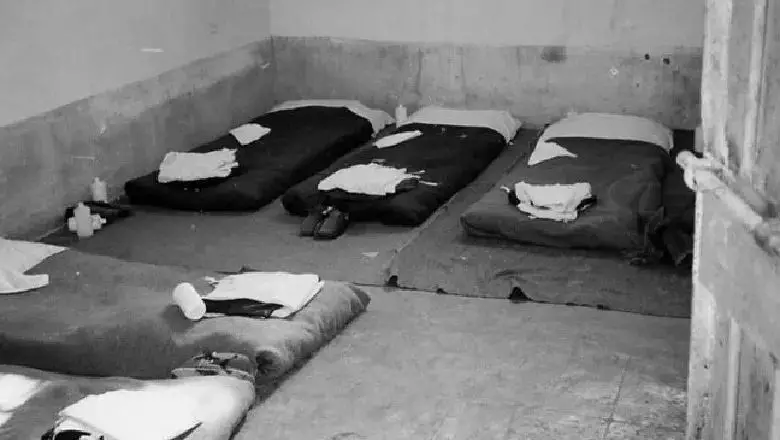
The wise and clever words that Arqile Tasi spoke were a maxim for Pelivan. Pelivan liked Henley’s verses very much, in the poem “Invictus,” which he often cited to us. It happened that I took upon myself the blame for a mistake made by another prisoner who was very ill. The prison guard sentenced me to one month of isolation, without a jacket or trousers in the dungeon. It was the custom that after a week in isolation, they would bring a blanket. The guard went and took the blanket from my mattress. Instead of the blanket, he brought me a cull (rug) made of goat hair. He asked me: “Is this rug yours?” I replied: yes.
I recognized it; it was Pelivan’s rug. As it seems, I thought, Pelivan seeing my thin covers, replaced them with the rug, which was warmer for the dungeon. Not even 3-4 days passed, and someone informed that the rug belonged to Pelivan. The command began an investigation on both sides. But when they saw our firm stance, they did not prolong it. In the 1960s, when the dictator Enver Hoxha broke with his Russian patrons, a certain softening in behavior toward prisoners began in the camps and prisons. Memorie.al