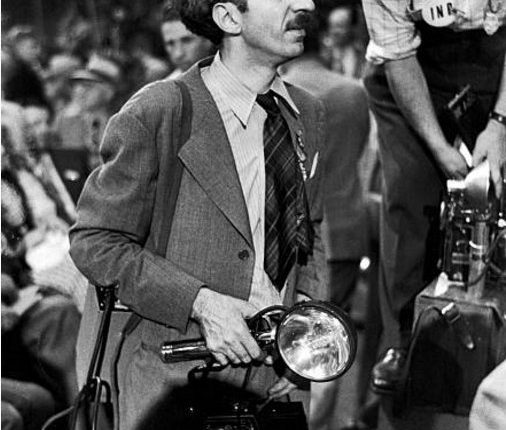
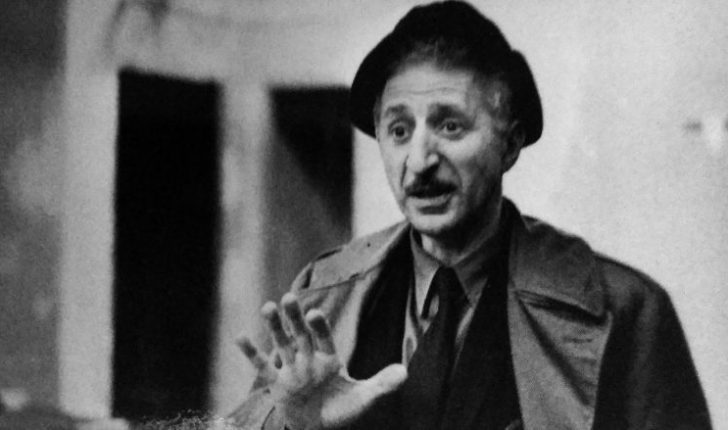
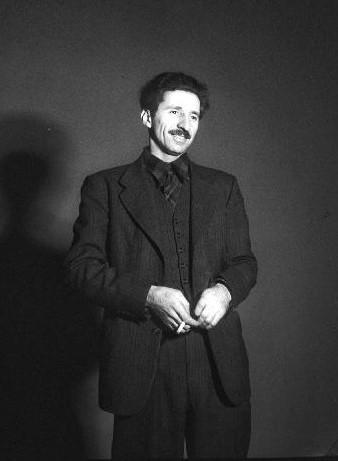
Memorie.al/ Gjon Mili is considered the most successful Albanian photographer in the world over the last 100 years. The publication of his “Picasso” photograph in the 2000 album The Photo Book by the prestigious London publishing house “Phaidon” serves as a further argument for this conclusion. A specialized commission selected and presented 500 photographers from 59 countries in this album, featuring creations from the beginnings of this art form (about 150 years ago) until the end of the last century.
But who is Gjon Mili, this world-renowned photographer who, until 10–12 years ago, was – through no fault of his own – unknown and unwanted in the Albania of that time? He hailed from a family from Korça and was born there in 1904. At the age of five, he immigrated with his family to Romania, where he lived until he finished high school. Later, in 1923, he went to the USA. There, he quickly took up the art of photography with the enthusiasm of a young artist with a rich imagination, becoming a specialist in the field of new photographic techniques.
After graduating from the Massachusetts Institute of Technology (MIT) as a lighting engineer, he distinguished himself through his work at “Westinghouse,” a company that manufactured electrical equipment. In 1937, he attained the title of professor and used for the first time the “Electronic Flash” and “Stroboscopic Light” invented by Professor Harold Edgerton, with whom he collaborated.
The name of Gjon Mili, the “genial Albanian” according to playwright Sean O’Casey (Mili – Photographs and Recollections, Boston, 1990), is mentioned in many serious global publications on the art of photography – be it through reproductions of his photos, discussions, commentaries, or even as examples to illustrate academic conclusions (Feininger, Gautrand, Kismaric, etc.). Our well-known graphic arts researcher and photographer, Piro Naçe, writes of him: “He was serious to the point of strictness regarding the science of lighting and photographic research” (Skena dhe Ekrani magazine, 3/1988).
Mili worked as a journalist and photojournalist, particularly for the famous Life magazine; this work led him to visit various countries and photograph renowned figures within them. In 1934, he opened his first solo exhibition, while his last was in 1980 in New York, on the occasion of his 75th birthday, where 140 photographs from across his entire career were presented. The “New York Graphic Society” published the album Mili – Photographs and Recollections in his honor.
He successfully mastered many genres of photography, such as portraiture, landscape, advertising, documentary, political, and arts photography (theater, cinema, concerts, dance, and sports), etc. In Susan Kismaric’s book American Politicians: Photographs from 1843 to 1993, published by the Museum of Modern Art (MoMA), New York, 1994, two of Mili’s politically themed creations are found among many others.
The photograph “The Famous Picasso Drawing with Light,” as Michel Frizot calls it in his book New History of Photography (Paris, 1998), was taken at Mili’s suggestion in 1949 at the “Villa Vallauris” in Southern France. The great painter lived and worked there. Mili executed the photograph using two light speeds.
The painter drew a centaur in the air with a small light bulb; this action was performed in total darkness with the shutter of the stroboscopic camera open for the necessary duration. Then, without moving the camera or advancing the film reel, the shutter was closed, the environment was lit (opening the window to the right of the figure), and with a dizzyingly short duration (a few thousandths of a second), the impression of the person and the environment was captured on the same frame. The final photograph resulted from this combination.
The prominent German photographer and researcher Andreas Feininger remarked that the photograph, “despite the perfect focus, gives the idea of movement” (La nuova tecnica della fotografia, Rome, 1991). Even the painter’s posture in a fleeting position emphasizes this sense of motion. The painter’s right eye, although not on the optical axis of the photograph, constitutes its compositional center of gravity, where the viewer’s gaze “gets stuck” from the first seconds of observation.
This is not the calm gaze with “piercing eyes that seem to puncture the paper they are printed on” (G. Clavenzi, Specchio, June 24, 2000), seen in the portrait of Picasso by the famous American photographer Arnold Newman. In Mili’s case, we have the painter’s right eye fixed in an explosive state, in full resonance with the environment and especially with the figure of the centaur.
The photograph of Picasso painting the centaur – which in ancient Greek mythology was a half-man, half-horse monster symbolizing wild and unbridled passions – was taken at roughly the same time that a white dove painted by him had become the “Dove of Peace,” a symbol of the anti-war propaganda conducted by left-wing forces in Europe, led by the Soviet Union with its traditional demagoguery.
Indeed, Picasso’s figure increases the “magnetic field” of this photograph, but it should not go unmentioned that Gjon Mili photographed other outstanding personalities of world art and culture, such as director Hitchcock, actress Helene Weigel (Brecht’s wife), painter Matisse, playwright Sean O’Casey, philosopher De Chirico, conductor and composer Pablo Casals, singer Paul Robeson, actress Sophia Loren, etc.
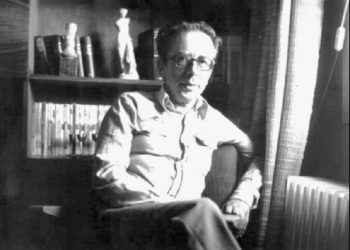
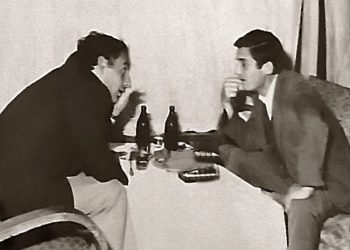
Mili was also photographed by the distinguished French master of photography, Henri Cartier-Bresson, during a conversation that reflects his vitality.
The dimensions of Gjon Mili’s personality grow when we consider certain patriotic facts, such as not changing his name or nationality, and his use of the “Albanian language, which he spoke and wrote so beautifully,” as Piro Naçe emphasizes. The appreciation that the world of photographic art has shown for the photographer of Albanian origin, Gjon Mili, fills us with a natural pride for our compatriot. It encourages us to make this prominent figure widely known in our country so that lovers of this art can benefit from his artistic and scientific creativity. / Memorie.al