
From Mërgim Korça
Part Two
– “I Killed, According to the Kanun of the Mountains” – An Analytical View –
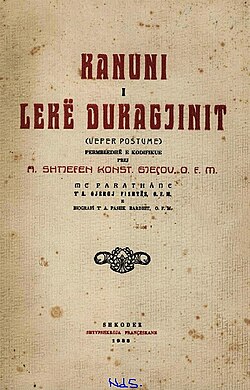
Memorie.al – Given that during the dictatorship the “Kanun of Our Mountains” was much talked about and attacked, and, moreover, had mud slung at it, I decided to set myself the task of an analytical analysis of it (the “Kanun”). My aim is to analyze it while avoiding, as much as I can, extremes—that is, not merely following the example of scholars from the communist dictatorship era and taking the diametrically opposite direction, but attempting to analyze the positions of the “Kanun” with as much balance as I am capable of. In the following, attention will be paid, and it will later become clear why, although I am the son of a man from Korça and a woman from Gjirokastra, I feel the need, when addressing a topic that essentially concerns how the norms of ethics and morality were regulated among the highlanders of the Northern territories, to address readers in the Gheg dialect!
Continued from the previous issue
Captain Ndue Gjonmarkaj, educated at a secondary school bearing one of the most famous names in Europe, the Theresianum in Vienna. He studied Law in Florence. Despite his 90 years, anyone who knows him and meets him will notice that he maintains a mental clarity that any young person would envy. So, here lies the crossroads: by not using the opportunity he had, when he was ambassador in Washington, to listen to Captain Ndue Gjomarkaj’s “message” regarding the interpretation of the ‘Kanun,’ should Mr. Tarifa’s lack be considered a missed chance, or a lack of desire to confront facts and interpretations that would have ruffled the path he had predetermined for himself to follow? For my part, I see the non-encounter of scholar Fatos Tarifa with Captain Ndue Gjomarkaj as an unfortunate missed opportunity, for the scholar himself—without wanting to push my assumptions further.
Nevertheless, may God grant Captain Ndue a long life, in full health as he is, and may God grant the scholar in question balance and wisdom, so that future generations may judge his future research activities concerning the ‘Kanun’ as positive. Having clarified and placed, I believe, at the center of the audience’s attention the criteria upon which I see the scientific evaluation of the values and eventual shortcomings of the ‘Kanun of the Mountains’ as grounded, I will begin discussing some of its sections.
Since ancient times, when humanity began to develop, undoubtedly the need arose to determine fair punishments for the unjust actions of individuals. Only by grounding one on these foundations was tranquility born, as the source of humanity’s happiness—this being the main objective of every social organization of human society. In short, the precise determination of one’s rights and the guarantee of exercising those rights are the foundations of the organization of human society, upon the pillars of justice. At the time when the ‘Kanun of the Mountains’ was in effect, there could be no question of written laws, for we did not have a state of our own.
Therefore, the ‘Kanun’ acquires great value because it laid out for the inhabitants of the regions where it applied both rights and obligations. It determined rights, this is more than true, but on the other hand, it also underlined prohibited actions such as crimes, and likewise indicated the obligations that everyone needed to know. Thus, in general terms, I feel the need to pose a fundamental issue: with the communists’ seizure of power, the general trend was to strike out all the achievements of the past and to start showing that Albania began its history from scratch, with the establishment of People’s Power.
In this way, our national history was reduced to the maximum, meaning to the minimum of its values! And so, the ‘Kanun’ too was condemned to its own ostracism (ostracism was a legal institution of democracy in ancient Athens, by which those who endangered the city were expelled from it for 10 years. According to Aristotle, ostracism was conceived by Cleisthenes in 510 BC). This stance held against the ‘Kanun’ at a time when it was noted—not only by Father Shtjefën Gjeçovi, but also by other scholars—that it has great commonalities with both the ‘Kanun’ and the famous Code of Manu of India (1280–880 BC).
Whereas from the end of 1944 until 1990, the ‘Kanun’ was identified solely with blood feuding, and the evil is that even to this day, more or less, they continue playing the same old flute, which all anti-Albanians have exploited so badly! The ‘Kanun of the Mountains,’ which was published in 1934, five years after Father Gjeçov’s assassination (according to his notes), consists of 12 so-called books. Each book is then divided into chapters, these into sections, and each section into paragraphs. To address the problem we have set for ourselves, undoubtedly the scientific criterion requires that the analysis of the statistical relationships that the chapters, sections, and paragraphs under discussion constitute be taken into account.
Thus, in total, the ‘Kanun of the Mountains’ has its 12 books divided into 24 chapters (it is a coincidence that the number of chapters is double the number of books), 159 sections, and 1263 paragraphs. All this diversity of 1263 paragraphs embodies that which for centuries was the Civil Code and the Penal Code of the highlanders of Northern Albania and Kosovo. Examining now these constituent elements of the ‘Kanun’ related to blood feud, which is treated in Chapter XXII, consisting of its 23 sections divided into 168 paragraphs, they constitute exactly: in terms of number of sections, 14.6% of the ‘Kanun’s’ total sections, and in terms of paragraphs, we are dealing with 13.3% of the total.
I now pose a question that is not at all rhetorical but very fundamental: is it logical for the entire ‘Kanun of the Mountains’ to be identified entirely with one of its components, which is only one seventh of it, even if that component were the most diabolical among them all? I believe that no balanced and undoctrinated person would say “Yes!”
Considering that after half a century of confrontation and slander against the ‘Kanun,’ it is only natural that there are entire generations who, in the best-case scenario… do not know the ‘Kanun’ at all. Not to push further and delve into how the propaganda against the ‘Kanun’ led even those who had heard one word here and another there, completely irresponsibly and only to serve the dictator, to write works that distorted the canonical truth; add to this the fact that even if they had the ‘Kanun’ in hand and read it… they were incapable of understanding its Gheg language.
This situation now paves the way for me and makes it much easier to address what they have presented as the worst of the worst, the treatment of blood feud, namely Chapter XXII. Of the 168 paragraphs of Chapter XXII, I will focus on what I consider the most important and fundamental, because time does not allow me to deal with each one.
Chapter Twenty-two: Murder
Section One Hundred Eighteen: The Ambush § 822. The ambush is a behavior by which the mountains and fields of Albania are used to place blood-feud pursuers, or anyone who has the intention to kill, in an ambush. (To lie in ambush; to wait in ambush, to set an ambush, to fall into an ambush).
Anyone who reads, with great care, the very wording of the first paragraph of the Murder chapter, understands perfectly how just and honorable the conception of this very paragraph has been: the ambush is the definition of a highly positive and commendable action—to capture in order to judge according to the ‘Kanun,’ or, if the criminal did not surrender, to eliminate him after the deed, and likewise to stop the potential criminal from committing a crime.
I believe that anyone who now reads this original concept according to the ‘Kanun’ says to themselves… we thought that ambushes are set by people who want to commit a crime. This view is also reflected in the Orthographic Dictionary of the Contemporary Albanian Language, where the word “PRITË” (ambush) is explained as: the group of people who spy from a hiding place to attack someone by surprise. Partisan ambush.
Naturally, the question arises: which definition is more accurate and 100% positive? Undoubtedly, the ‘Kanun’s’! In the ‘Kanun,’ the term “ambush” denotes a legal action for the good of the region where it operates and has jurisdiction (a definition determined centuries and centuries ago). Whereas the definition according to the normative Albanian language of 1980 has a bifurcated meaning: without taking political interpretation into account at all (whether the partisan ambush was positive or negative), it implies that an ambush can be set by criminals, or by people who commit a crime believing they have the right to do so.
I am not blaming this definition at all; on the contrary, I emphasize that this definition has come to be bifurcated over the centuries because both the ethics and the morality of society have changed. Whereas § 822, which was not merely descriptive like a dictionary, but regulated the very life of our Highlanders when there was no talk of an Albanian State, let alone justice institutions, was a determinant that on one hand punished the murderer and on the other hand prevented the spread of crime!
I now pose the matter in this way: this paragraph, which is also the first and the foundation of the chapter regulating murder, does not in any way incite killing; on the contrary, it calls for the punishment of committed crimes and the prevention of future crimes. But on the other hand, I note and emphasize that if we judge this paragraph according to the 1948 UN Charter “On Human Rights,” and also compare it with the norm that one can only be called accused until guilt is proven, or go even further and judge it according to criteria aimed at removing the death penalty from the penal code, no matter the guilt committed by the accused, then we would be judging the ‘Kanun of the Mountains’ as if we wanted to ask Alexander the Great how much he would set as the selling price for a ‘Mercedes Benz’ car! (???)
Whereas I, if we are to judge our ‘Kanun of the Mountains’ fairly and without prejudice, invite scholars to make comparisons, whether with the Code of Urukagina (2360 BC), which consisted of legal provisions from ancient Mesopotamia, or with the Code of Ur-Nammu (2050 BC), which provided for a body of judges and sworn witnesses, or with the Code of Manu (1280–880 BC), which classified people according to social rank and imposed harsher punishments the more privileged the offender was in terms of the class from which he came, or even with the Draconian Code (621 BC), the severity of whose articles is proverbial.
In this context, the ‘Kanun’ should be judged, to see what a pearl of justice it has been! Judged according to this perspective, grounded on scientific and not at all voluntarist criteria, nothing else would happen but that it would be highlighted what great values have been denied to our Nation by policies—be they those that also directed historical science!
Next, so as not to bore the reader who is honoring me with their patience, it is clear that I will not present paragraph after paragraph with lengthy analyses of them, but neither to vulgarize and simplify the issues to the point that scholars feel left out; I will continue, as if in flight, intending to brush off the dust that has settled on some of the main paragraphs of the chapter named MURDER, without making any comments or analyses, but highlighting them as they have been, not as they have been presented through their reflection in distorting mirrors.
- The ambush shoots the gun at men, not at women, children, at houses, or at livestock.
- If the ambush fires a gun at women, children, houses, or livestock, it acts against the ‘Kanun,’ and if the Banner of the ambushers does not take care of this violence by punishing them according to the ‘Kanun,’ then the gun will go from house to house, then clan to clan, village to village, and finally Banner to Banner.
I have nothing to comment on these paragraphs that honor the ‘Kanun’ as a regulator and maintainer of order, where there was no state or laws.
- The house of the murdered man, if it has given a pledge of besa to the perpetrator, he (the perpetrator), even if he killed him, must go to the wake and the mourning to accompany the murdered man to the burial and stay for lunch. This besa lasts 24 hours. This paragraph is the third of section one hundred twenty-two. For illustration, I want to recall a past experience that my late friend, composer Tish Daija, told me about some ten years ago, when he came to visit us in America. Tish had gone there around 1949 or 1950 to Shllak, to collect musical folklore. Night had caught him at a house. They were sitting by the fire with the host, talking, when they heard two gunshots, Tish told me. The host just said, “That’s an evil gun,” and they continued their conversation. A short time passed when someone outside called out and asked for besa.
“Come in, you’re welcome,” the host replied.
In came a man with disheveled hair, pale as wax, young, who started telling the host that he had quarreled with an unknown man, and one thing led to another… he had killed him. The host placed a glass of raki before him and continued the conversation. Not half an hour passed when someone called out from outside again. It was the chairman and secretary of the village council. After they sat down, they greeted everyone and threw tobacco pouches to each other and to the host, and the chairman began to speak, explaining how a murder had occurred in the village. The perpetrator was unknown, no one knew where he had gone, but the murdered man was … the very son of that host!
As Tish told me about that incident thirty-odd years later, his voice trembled. The old man of the house didn’t flinch. He didn’t even twitch his mustache, he only said, addressing the late Tish… “Didn’t I tell you that were an evil gun that fired?” Shortly after, the door opened and several men brought in, supported under the armpits, the falcon-like son of that house! The night had passed watching over the deceased. At the head of the son’s bier, the old man, with Tish on one side, and the perpetrator on the other! When the crowd gathered the next day to bury the dead, the perpetrator wanted to slip away and leave. But the old man, with a sharp eye, stopped him and told him that he was obliged to go and lay his son into the earth.
After the burial, he told the stranger (whom no one there, except Tish, knew among all the people gathered at the mourning) that he owed him to sit at the lunch table for his murdered son. And when that ceremony also ended, the old man told those present to excuse them, as he had to accompany that foreign guest to the village boundary. Then they understood what was happening. As soon as the old man left with the guest under besa, they told Tish that he, according to the Kanun, had to escort him to the boundary of the besa, give him provisions for the journey, and then part from him. And that is exactly what happened, because Tish did not leave the house before he heard from the old man’s own mouth about those actions that Tish hadn’t had the chance to witness!
The only comment I cannot refrain from is the question: how can the ‘Kanun’ be called bloodthirsty, that ‘Kanun’ which has a fundamental paragraph under the section “Besa,” in the chapter “Murder,” such as paragraph 856? I continue with a paragraph that, in matters of blood, establishes an equality that amazes.
- The price of one man’s life is the same, for the good as for the evil.
890.If the path of settling blood feuds had been left aside, the evil-doer, for wealth and nobility, the “firuk” (impoverished, low-born), they would have been killed even without cause; murders would have increased as if no one had come out to demand reasons for killing the evil-doer and the firuk.
- Whoever kills a person, be it man or woman, boy or girl, even an infant in the cradle, good or ill-favored in appearance, blind, old or very old, rich or poor, noble or firuk, the punishment is the same: for killing a male, 6 sacks (of grain), 100 rams, and half an ox as fine.
I think it would not be without interest to also address, along this vein, the issue treated by section one hundred twenty-nine, which concerns “Blood for Evil Deeds.”
- Those who are both strong and violent, if they are both killed while doing evil, the blood is considered lost (i.e., no blood feud follows).
- The parents of the mentally impaired cannot claim blood, but they will give the perpetrator a broken gun with: “Bless your hand.” Regarding this aspect of the treatment of moral norms, I will describe a scene I experienced myself. If I’m not mistaken, it was the summer of 1950. With a close friend of mine, Bardh Shiroka, we were in front of Pharmacy no. 1 in Shkodër, in Fushë Çelë. It was around sunset, many people were strolling there. We heard two gunshots. We turned our heads and saw on the opposite sidewalk a highlander with a revolver in his hand, and at his feet a body sprawled on the ground.
At that moment, the highlander ran towards a shop and there fired his gun again at someone. Then they caught and tied him up. The story: a migrant laborer working in Shllak had seduced a young bride, and she had left the village to come and walk hand-in-hand with her admirer in Fushë Çelë, Shkodër. Her husband did not forgive and pursued the couple. He killed them. The perpetrator’s name was Pal Mhilli. In the act, one bullet fired by him also mistakenly wounded an army officer who, when Pal’s trial took place, appeared as a witness, forgiving Pal for his wound and asking the court to also spare his life. But the court sentenced Pal to death by firing squad for the murders he committed, and they executed him according to the law.
However, the folk rhapsodist did not let the case pass unnoticed and sang to the çifteli: “When the lead bullets crossed / An officer there fell / At the trial when he appeared / He helped Pal with words / ‘For Pal I ask forgiveness / For this fellow was a good man / Whoever fights for honor and faith / Is a patriot for the Fatherland / For Albania he did not fail, he gave’!” / Memorie.al
To be continued in the next issue