
By Prenjo Imeraj
Part Two
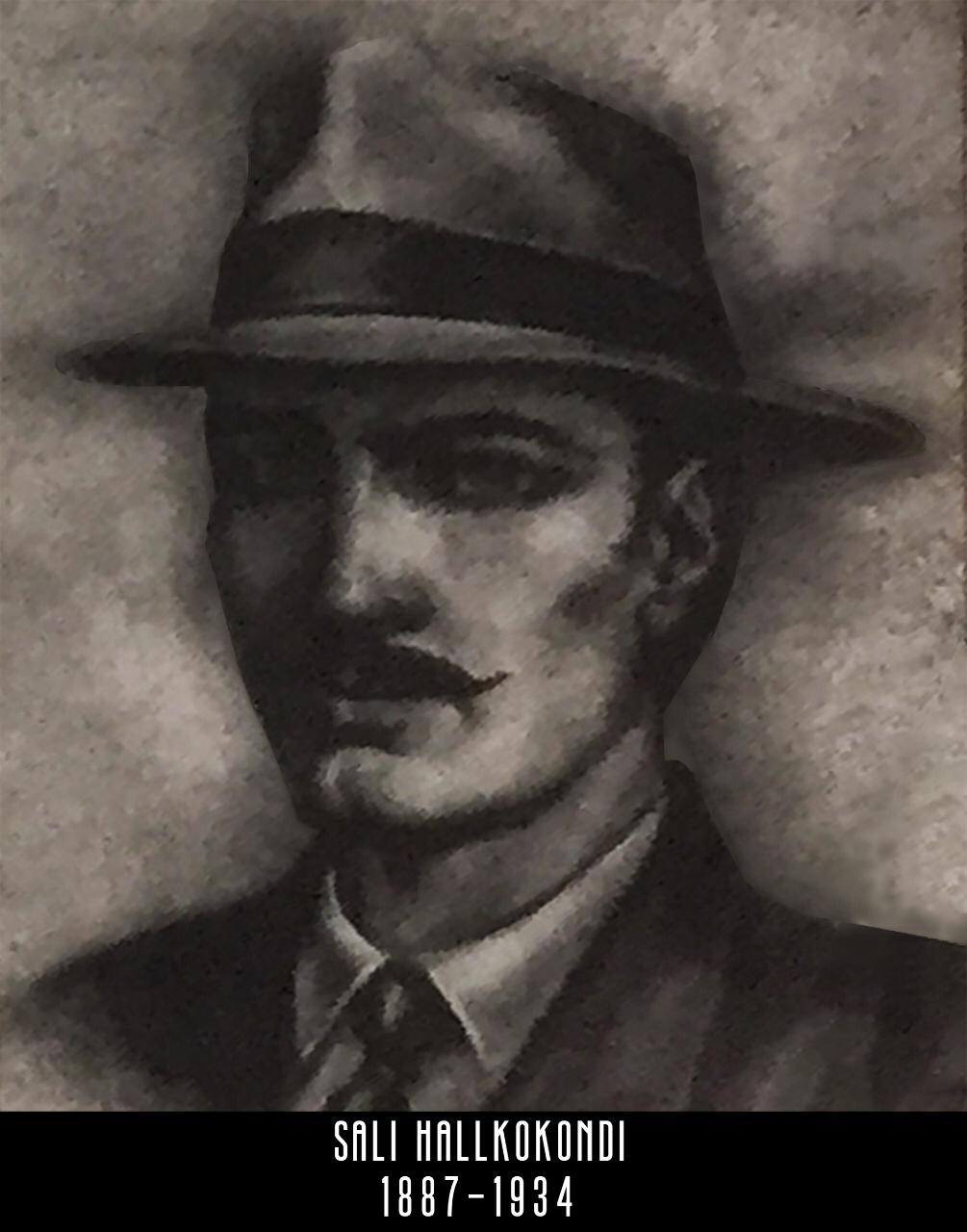
Memorie.al / Two major things stand out immediately when reading Bardhosh Gaçe’s interesting monograph dedicated to this figure of historical proportions: 1. how is it possible that such a great encyclopedic figure like Sali Hallkokondi has been left in oblivion for so long? 2. His premature death, through a macabre murder at the height of his life, for his intellectual and patriotic activities (he lived only 49 years)!… The well-known journalist and publicist Bardhosh Gaçe has proven to be very courageous and persistent in researching the life and activity of Sali Hallkokondi, at a time when nothing had been written about this prominent intellectual and ardent patriot – not during the era of King Zog, who is suspected of having buried the legacy of Hallkokondi himself, nor during the communist regime, or even in the early days of democracy in Albania.
Continued from the previous issue
At the same time, Sali Hallkokondi and his associates did everything in their power to implement the instruction of Ismail Qemali: to keep the National Flag rose in Vlora and not the Turkish flag carried by the rebels. And so it happened: the national flag waved over the heads of the rebels, and Vlora was not destroyed by the bands. Toward the end of November 1914, Sali Hallkokondi and several other patriots, to escape the reprisals of Mustafa Ndroqi’s army, left for Italy for a few days. They returned from there in mid-December.
When Italy landed its forces in Skelë on December 25, 1914, Sali Hallkokondi would declare: “Public opinion is deeply distressed because the people have understood very well the intentions of Italian politicians, who in verbal assemblies spoke of a policy beneficial to national rights, but on the other hand, their actions, works, and revealed goals ensured a policy for grabbers and occupiers, entirely to the detriment of the primary interest of the Albanian nation…”!
Between 1916 and 1921, Sali Hallkokondi – like many intellectual patriots educated in Istanbul, Cairo, Vienna, and elsewhere – was involved in several cultural and patriotic societies that played a unique role in raising national consciousness in the city of Vlora and its surrounding regions. Meanwhile, in the autumn of 1916, French forces of the Army of the East entered Korça, while the Italian army extended its rule over the Gjirokastra region, removing the Greek occupiers from there. In the first months of 1917, it also expanded into Saranda and Erseka, where the border with the French army was established at Qafa e Qarrit.
In February 1918, on the initiative of Halim Xhelo, Sali Hallkokondi, Zaçe Xhelo, and Laze Malo, the “Opinga” society was created. Its regulations were drafted by Sali himself, and its purpose was to organize the struggle against the Italian occupation. The scope of this society extended to Dukat, Kurvelesh, Topallti, and as far as the Kudhës region, with a tendency to expand further into Sevaster, Nivica, and beyond.
In July 1918, Sali Hallkokondi, together with his brother Bajram Hallko – a skilled military man – and other patriots, including Avni Rustemi (who was a teacher in Vlora at the time), founded the patriotic society “Djalëria e Vlorës” (The Youth of Vlora). It aimed to increase the anti-imperialist spirit against the Italian occupiers. This society quickly caught the eye of the “Political Office for Civil Affairs.” Its head, Ugo Capialbi, summoned Avni Rustemi and Sali Hallkokondi, among others, warning them… “to maintain tranquility in the cities and villages.” Nevertheless, November 28, 1918, marking the 6th anniversary of the flag-raising in Vlora by Ismail Qemali, was celebrated with a large demonstration, initially led by school students and followed by hundreds of other citizens, headed by the leaders of “Djalëria e Vlorës.”
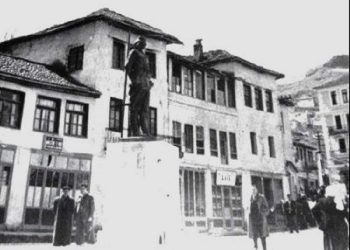
With the National Flag at the front, they marched through the streets, stopping for several moments in the square in front of the prefecture, where Bajram Hallkokondi was among the speakers. In the historic Flag Square, the demonstration continued with the singing of patriotic songs and speeches by Halim Xhelo, Avni Rustemi, Jani Minga, etc. In that same square, Bajram Hallkokondi would declare with sorrow: “It brings me great bitterness that today, in this sacred celebration around the national flag, there are more Italians than Albanians… but the Albanian is never intimidated by the discipline of the Italian soldiers surrounding us! The blessed land of Vlora and all of Albania is ours, where we must live free, and no power can stop us from this goal…”!
After the Congress of Lushnja, from February to May 1920, Sali Hallkokondi left deep traces with his activity across regions, villages, and the city of Vlora. Together with other patriots, old and young contemporaries, they began to think and act on organizing resistance against the Italian occupiers and the dangers threatening Albanian territories.
In all the meetings organized for this purpose in Dukat, Tragjas, Kanina, Brataj, Mesaplik, and Vranisht, etc., Sali Hallkokondi was found alongside Halim Xhelo, Osman Haxhiu, Alem Memeti, Hamit Selmani, Hamza Isai, and others. Among his peers, Sali Hallkokondi became a fiery orator in support of the Congress of Lushnja and especially the call directed by Prime Minister Sulejman Delvina, which demanded: “A general pledge (besa) for the defense of Albanian lands.”
Following the meetings held at the homes of Abaz Mezini and Osman Haxhiu in March 1920, and the creation of the organization “Mbrojtja Kombëtare” (National Defense) to prepare for the armed uprising, Sali Hallkokondi, like other patriots of Vlora, left the city and went to his birthplace, primarily in the Mesaplik region, to organize the people of that area.
Sali Hallkokondi was one of the organizers of the Assembly of Barçalla, where he declared: “These rifles that will crack under the command of Osman Haxhiu will shake Europe and will write a new page in the history of Albania!”
At this same time, several pseudo-Albanians, incited by Vorio-Epirote sillogos in Corfu and Athens, demanded the administrative separation of the Himara region from the motherland. Sali Hallkokondi, as the envoy of the “National Defense” Committee, convinced those people to leave this matter to be resolved after the Vlora War.
At the Meeting of Beun, Sali Hallkokondi was appointed to the military commission, which played a major role in organizing the guerrilla units (çeta) on the combat front. Until the creation of the Prefecture of Drashovica, S. Hallkokondi was one of the primary advisors to the general commander of the war, Ahmet Lepenica. With the establishment of the administrative center in Drashovica under Prefect Qazim Kokoshi, Sali Hallkokondi was entrusted with the duty of Vice-Prefect. Halim Xhelo was appointed as its Secretary.
With the victory of the Vlora War in 1920, Sali Hallkokondi settled again in the city of Vlora as a jurist in the court. During this time, he met Father Shtjefën Gjeçovi, who was the parish priest at the Catholic Church of Vlora, alongside Dom Mark Vasa, both of whom were members of the commission for the victory manifestations of the Vlora War. This acquaintance turned into a mutual friendship that lasted long after.
When Avni Rustemi was imprisoned in Paris following the famous assassination of the traitor Essad Pasha, Sali Hallkokondi was among the most active Vlora patriots in organizing popular protests and drafting memorandums and telegrams addressed to the French court and the Ministry of Justice of France for the release of that distinguished son of the Albanian Nation. After Avni’s release from the French prison as innocent, a magnificent reception was organized in Vlora by the “National Defense” society, where the two brothers, Sali and Bajram Hallkokondi, were not only present but delivered fiery speeches…!
In drafting the letters of gratitude sent on behalf of the people of Vlora to the judicial body in the French court and to Avni Rustemi’s defense lawyer, a council of five people was chosen, including Sali Hallkokondi.
On April 21, 1921, on the initiative of Avni Rustemi, the congress for the union of Albanian societies into the “Atdheu” (Fatherland) federation was held in Vlora. As Sali Hallkokondi stated, it was based on three principles: social morality, national consciousness, and the education of society through European civilization.
In June of that same year, the barbarities of Greek chauvinist circles began in the region of Chameria. Sali Hallkokondi, who had been in Chameria between 1904 and 1911, harbored a burning love for the patriots of this heated national territory. He and his associates requested that the Albanian government intervene through diplomatic channels to stop the violence and massacres against the Cham population and ensure aid for those who had arrived in Vlora and Saranda.
In the autumn of 1921, a battalion of 400 fighters was mobilized from the city and outskirts of Vlora to confront the Yugoslav army, which had invaded Dibra and Mirdita. Avni Rustemi, Sali Hallkokondi, Agjah Libohova, Omer Radhima, etc., joined this battalion. From the war front, Sali Hallkokondi wrote several articles for the press of the time, titled: “Vlora Volunteer Fighters” and “Intellectual Volunteers of Vlora.”
Sali and Bajram Hallkokondi, in terms of general political thought, were inclined toward the views and actions of Avni Rustemi and Halim Xhelo, alongside other progressive forces who were against the feudal lords and large landowners who had displayed anti-national actions detrimental to the interests of the homeland. In this regard, the “Atdheu” Federation played a special role, with Sali Hallkokondi as a key figure. He demanded that women play a major role in Albanian life for the emancipation of all social life. In this context, he became a supporter of the women’s organization in Vlora led by Mrs. Marigo Posio, helping her daughter, Fereniqi Posio, with the publication of the newspaper “Shpresa Kombëtare” (National Hope) in the city.
In September 1921, in the Mesaplik region with its epicenter in Vranisht, blood feuds erupted regarding property ownership. Concerned by this grave event, Halim Xhelo and Sali Hallkokondi organized an assembly with participants from all the villages in the area, where it was decided to forgive the blood feuds of that region.
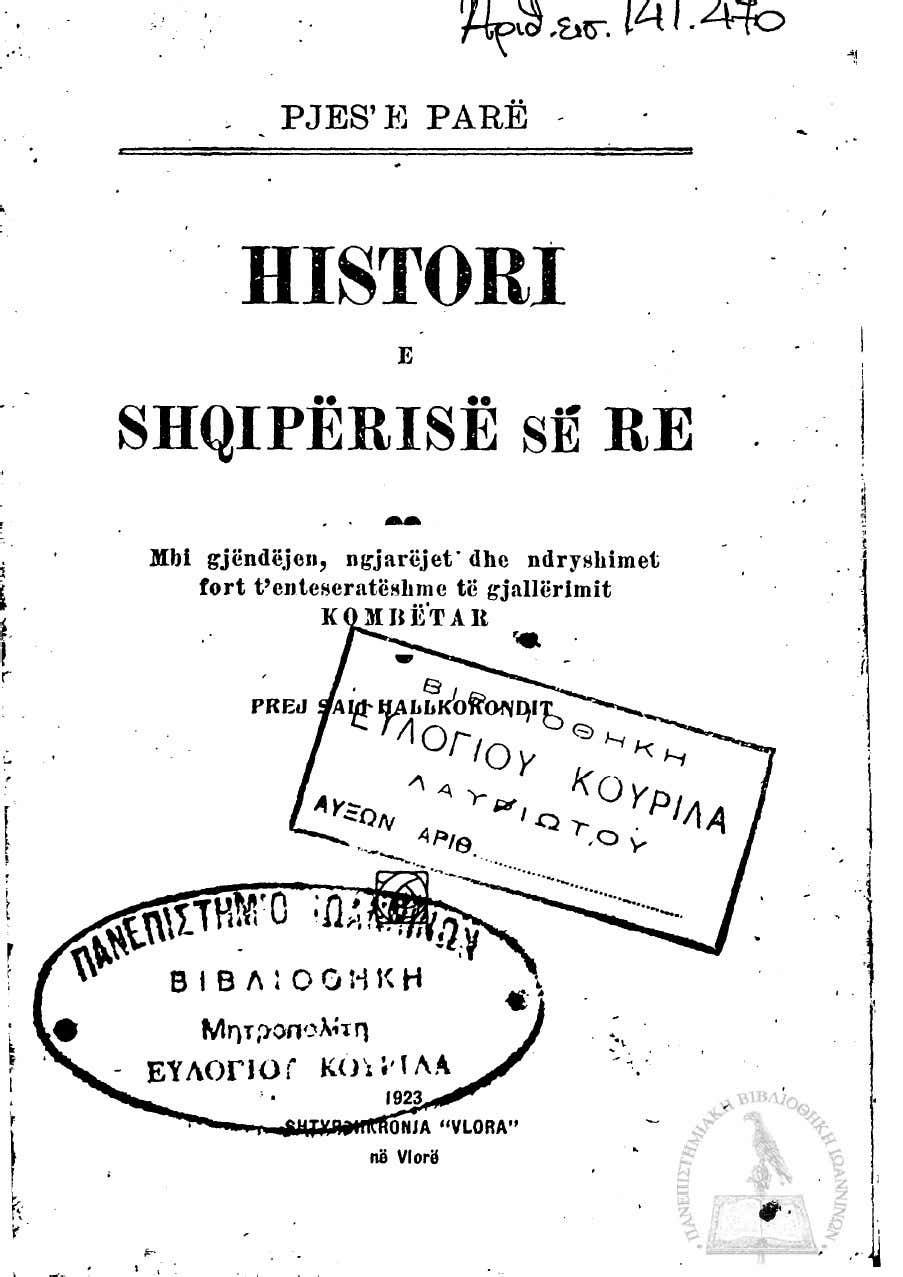
On October 17, 1922, the “Bashkimi” (Union) society was founded with Avni Rustemi as chairman. Sali Hallkokondi viewed its program as a guide toward destroying feudal remnants and opening the path for the development of capitalist relations for the progress and civilization of Albania. During that time, he contacted many intellectuals from various regions of Labëria to write his book “History of New Albania,” which was published in June 1923, drawing the attention of public opinion and the press.
The assassination of Avni Rustemi in Tirana on April 20, 1924, was a heavy blow to the democratic movement of the time. Sali Hallkokondi and other leading members of the “Bashkimi” society worked tirelessly to organize Avni’s funeral ceremony, housing guests from all over Albania and dressing the city in mourning. At the same time, they sent a telegram to Avni’s parents in Libohova with these words: “Your misfortune and ours has embraced the hero on the high altar beside Kastrioti and Qemali. Together with you, the youth of Vlora loses and mourns the valuable son of the Homeland…”!
Following this magnificent ceremony, Sali and other members of “Bashkimi” went to Tirana, experiencing the creation of Fan Noli’s Government, with the hope of building a democratic and constitutional government. Until the end of 1924, Sali Hallkokondi worked in the Ministry of Justice of that government. Memorie.al