
-FIRST POLITICAL COURT AFTER THE LIBERATION OF ALBANIA-
In Albania, immediately after the war, Enver Hoxha strengthened his authoritarian power and continued the terror to show and prove the strength of fear and danger to the life of anyone who would raise his voice and oppose or take any action against his will, to masked by the power of the people.
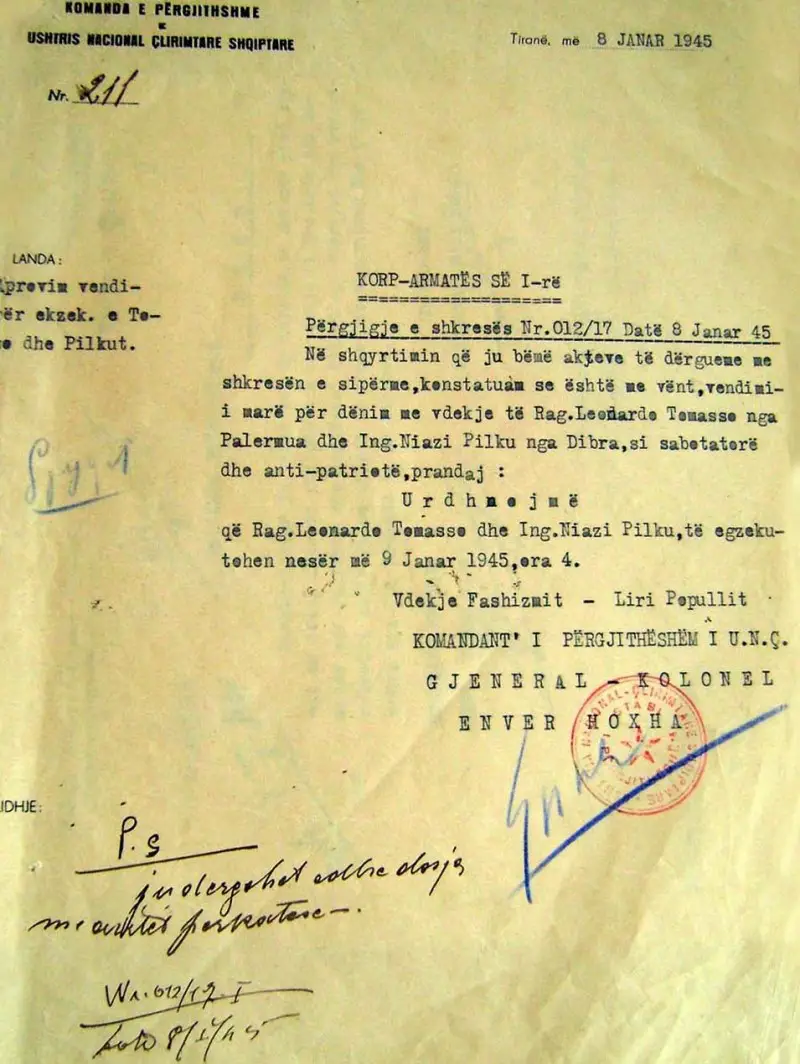
On January 9, 1945, the trial took place for several hours and the first immediate execution with death, for political reasons, with a decision of the Military Court, against an Albanian engineer and an Italian.
The convicted and shot persons were:
– Ing. Niazi Mehmet Pilku, born in 1900, in Debar.
– Leonardo Tomasso, born in 1900, in Palermo, administrator of the firm “Ital-strada”.
The court documentation does not create conviction about their dangerousness and shooting. From a letter dated 25.11.1944, it is understood that ing. Pilku was the director of rehabilitation works on the roads of Albania, which were carried out by Italian companies. He directed the works on the roads Durrës-Kavaja-Rrogozhinë and Vora-Milot, which were carried out by the company “Ital-strada” and “Marinucci”. Pilku and Tomasso, were reported by the Minister of World Affairs, Spiro Koleka.
At the heart of the sentence was the incorrect reporting of the Italian firm “Ital-strada”, for the vehicles and the workers, which even if it were so, did not constitute a reason for the death penalty! Both were accused of being “saboteurs and anti-patriots”. The record of the interrogation, on 1.1.1945, of the entrepreneur is irregular. The Italian who came to Albania in 1939, did not accept the accusation. Even in the statement made before the court by ing. Pilkut, dated 31.12.1944, has no admission of charges.
The court consisted of military men without the necessary education and without professional legal skills: Colonel Hysni Kapo (chairman), Lieutenant Colonel Beqir Balluku (vice-chairman), partisan Sotir Spiro (member) and the secretary, Major Haki Toska. The prosecutor was Major Bako Dervishi, but his name was not written in the main minutes.
By decision no. 1, dated 8.1.1945, the Military Court of the Military Province of the First Corps, imposed the death sentence, without relying on any criminal legal and procedural basis. The record of the trial is a proof of the illegality of the partisan trials, held in a few minutes or at most in half or an hour, without any rules of a criminal legal procedure, written in incomprehensible formulations, without rules of spelling. Judgment is made almost as in the extraordinary situations of War on the front, when the commander judges and immediately decides the death sentence of the deserter, or of one who does not follow the order for combat.
The decision was upheld by the Supreme Military Court at the General Staff of the National Liberation Army, which was subordinated to the government, by decision no. 1, dated 8.1.1945. This decision was taken several hours before the trial, to artificially create a legal basis and justify the arbitrariness of the trial and the death penalty, in conditions of peace where it is necessary for the state and justice to act in accordance with the Constitution and laws.
The court consisted of Gaqo Floqi, Frederik Nosi and Veledin Zeneli. The prosecutor was Myftar Tare. In this decision, article no.29 of the Regulation on the Functioning of Military Courts, dated 20.12.1944, was added as a legal basis. Whereas in the communiqué of the prosecutor, the law no.
Enver Hoxha approved and ordered the immediate implementation of the decision with the death penalty, by shooting. Both convicts were executed in Tirana. (Source: Albanian State Archive)
With this trial, with this decision, with this approval of leaving the decision in force and with these two victims, begins the political violence of the new popular power, known as the bloody year 1945, with the first shootings on the river bank of the capital.
The trial and punishment as well as the immediate execution were openly illegal because they had no constitutional and legal basis, as well as the basic norms of protection of rights and freedoms were not respected by the political and justice leaders, who claimed to create of a new state in defense of the people.
This decision is considered illegal even according to the general internationally recognized principles of protection of human rights and freedoms. He referred to a military regulation approved by the General Staff of the National Liberation Army. Trials and death sentences according to the rules of war, partisan trial procedures and prejudiced by the Commander-in-Chief, have continued irresponsibly and with the logic of eliminating by any means political opponents even in the first days after liberation, when it had not yet been established. state, the Constitution and the main laws for state and justice institutions had not been adopted.
The establishment of the new Albanian state was defended by the high state institutions representing the will of the people, as well as in the legal literature of the socialist period, with the decisions taken by the Command of the General Staff of the National Liberation Army, at the Meeting of The Antifascist National Liberation Council, on May 24, 1944, also propagated as a congress, as well as with the establishment of the Provisional Government, in Berat. These military and political instruments have really been given the constitutional and legal power to justify the construction and functioning of the state and military justice, and then civilian justice.
Based on the theoretical principles and practice of the rule of law, it is appropriate to emphasize that the military and political structures of the War cannot be equated with the institutions of a state that is built and functions according to the constitutional principles. From the analysis of the political and legal relations of that time, some conclusions emerge that are important for the history of the state and law:
- Albania was declared independent and sovereign, on November 28, 1912. The modern Albanian state was founded by the decisions of the Provisional Government of Ismail Qemali, the Congress of Lushnja, etc.
- The laws of that time had the force of action during and after the War.
- The constitution and laws could be repealed or abrogated by structures created during and after the war, which did not have the necessary constitutional source and power.
- The non-recognition of the Constitution, the Criminal Code, the Civil Code, the criminal and civil procedural codes, approved by King Zog, as well as all the laws and agreements of the time, were required to be made by laws and decisions approved by institutions representing the will of the people, the Assembly and the Government, to emerge from free and internationally recognized elections.
Elections were held on December 2, 1945, and the Constitution was adopted on January 11, 1946.
With this political and legal analysis, I think we understand more correctly the illegality and state violence legislated by justice, as well as the absolute power of Enver Hoxha, who achieved the propaganda dictatorship imposed by the political system of the state of the ‘Dictatorship of the Proletariat’, in The Constitution of 1976. Memorie.al