“I drank cognac with the Prime Minister’s son, while back where I came from, every bow-legged mining brigadier could scream at me and tell me whenever his f***ing heart desired: ‘I will rot you alive in the mine, Sadik Bejko’!”
Memorie.al / 1. I will not take the position of a critic to write an introduction to Bashkim Shehu’s stories. I would have to employ a different kind of knowledge for that. But not only for that reason. It would feel like a dodge, like throwing a cold sheet over them. To put it plainly: I cannot be cold and detached while I begin to write about them. Bashkim Shehu – from his emergence as a writer in the short story collection “Another Time,” and later with the screenplay for the film “Hell ‘43” – had understood that the written word can speak of one thing while reminding you of another. He had acquired, or perhaps was born with, the apparatus of writing in the absence of freedom – the freedom of speech.
All of us, who come from those dismal times, as soon as we scratch the ground where we walk, pit open up. Not the kind of pits left by shoes on loose soil. Not those. Pits that descend deeper than the human mind can conceive. Pits that open suddenly, and our feet echo as they walk upon another reality. The reality of a not-so-distant yesterday, but for us, the living who emerged from it, that reality is more alive than we are, even more than our lives in today’s existence. Perhaps it is tragic that a generation lives like this, in two realities simultaneously.
But we are not skilled enough to take a stone sharp as a knife’s edge and sever the umbilical cord that binds us to our yesterday. No matter how fate threw us mercilessly from one time to another – across people, generations, customs, laws, states, and into different structures and waters of life – we still breathe with double lungs. We breathe through two sets of pipes, of time and of life. Two gullets, two sets of tracheae. One set tucked away in the shade, huddled beneath the other – beneath those of the present, through which we draw the living breath of daily life.
Whether we like it or not, we will remain this way, doubled – if not to say that our layers, like those of all other people, sometimes go even further than ourselves. We can even breathe with the lungs of our grandfathers and great-grandfathers. We are human. Even with our temporal mutilations, or those others we assume are not so. We cannot split times in two, three, or four as if we were chopping logs – the way a sawyer divides trunks to make them easier to carry or to fit into a furnace, a fireplace, or a stove.
They forget that physically, this might be achievable. But they forget that spiritually, there is something that neither time, nor space, nor politics, nor ideologies, nor winters, nor droughts can cut. And yet, we live and act in the present, in the everyday. We are living human beings. On the deepest level, we are beings that breathe universally.
What I have said so far are the impressions left by reading the stories in this book. Here, I will open a couple of parentheses. In what follows, it will become clear how they relate to what I am writing.
- February 25, 1974
I was carrying my ten-day-old son in my arms. From Tirana to Gjirokastra. By train to Fier. I had made my arms a cradle for my infant. In Fier, a friend of my wife’s family, Abdi, a driver of a “Skoda” tanker truck, met us, and all four of us squeezed into his cabin. My wife, still recovering from childbirth, collapsed; she was motion-sick. My mother-in-law, who suffered from a middle-ear condition, collapsed even worse than her daughter. Both were as if fainted. Uncle Abdi at the wheel. Me, with my arms as a cradle. Thus, from Tirana, I had to bring my newborn to Gjirokastra. Along the way, Abdi tried to keep a conversation going, and in my distress, I replied as best as I could.
The two women (mother and daughter) were more dead than alive. But the journey had to be completed. My arms and muscles ached more than they had a month earlier (January 20), during my first week starting work as a miner. In those days, having been a man who held a pencil or a pen, I tried to strain myself to push a ton of iron – which is the weight of a mine wagon itself – plus a ton of coal loaded on top of it. But this weight of the infant, this stiffening of the arms on a road that then took 12 hours, turned out to be far more fragile and far heavier than that of the iron and the mineral loaded in the metal bowl above it. This is our life. Perhaps heavier and stronger than iron.
This “favor” of being banished from Tirana to the mine, as it was said, was being done to me by the Prime Minister. “He is a sword, my dear; he is the sword of the revolution. But he is as just as he is good. If he only knew who you truly are, he would weep, my dear.” That’s what a poet and former fighter, L.Q., told me. But who I “truly” was neither the Prime Minister nor anyone else ever found out. And here it was: a ten-day-old baby, two broken women, a father who had only his arms to hold his son, in a dilapidated tanker truck, on a road of gravel and pits. Where were we going? Ahead of us lay insults, rejection, violation, exclusion, and being trampled upon.
- Summer 1978
My friends R.M. and A.I., poets and admirers of my only book of poetry “Roots,” told me to meet Bashkim Shehu. We have spoken to him about you, they said, and he can meet you. Share your troubles, and perhaps he can influence his father to save you from the mine. Eh, the minds of poets. But they were being friends. Back then, since 1974, as I mentioned, the word had spread: by an arbitrary order of the Prime Minister, I had received my sentence to the mine. Deep down, I knew it wasn’t quite like that, but what did I have to lose by meeting his son, Bashkim? “He is a writer and a good guy,” my friends insisted. A writer. I had read some of his stories published in the magazine “Nëntori.” I had liked them. “He is a writer, a good guy,” my friends persisted.
4.
I don’t remember how they arranged it, but my wife and I, who were staying at the “Arbëria” hotel, met with him several times. At the bar of the “Peza” hotel, we were drinking, leaning against the counter. He was tossing back glasses of fernet rimmed with sugar, gulping them down. He didn’t hold the glasses by the base, but by the rim, using only two fingers. He would tilt his head back – gulp. A teenage whim, wanting to look older than he was. My wife was very struck by this gesture and would often mention it to me later.
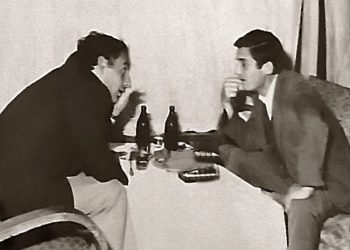
I was dissolved in a state of relaxation, almost to the point of unraveling. I was de-contracted and completely uninhibited from the very first meeting with him. It had been years – if it had ever happened at all – since I felt this way. He had the ability to win you over, to make you feel free. But also because all of this seemed beyond the real, beyond the dreamed. I was drinking with the Prime Minister’s son, while back where I came from, every bow-legged mining brigadier could scream at me and tell me whenever his f***ing heart desired: “I will rot you alive in the mine, Sadik Bejko!”
This boy with a pair of leek-colored corduroy pants, with a pair of shoes like those the needy wore: rubber tires on the bottom, thick leather with “ears” on top, like those from rural craftsmanship…! Oh God, and so relaxed. The conversation, as I said, bonded us as if we had met just yesterday. A slender boy, elastic body, thin facial skin, slightly olive and so fresh, with a sweating of the mustache and beard, as if black rye and unripened grains had been gently let down upon his tender marrow-filled cheeks.
So moist, so soft, and that youthful smile. This was him? Truly, this was the son of those who brought the storms and the sunshine to Albania? Above all, I was meeting a man who was confident and happy. A rare thing. And how beautiful. A happy man.
A former friend of mine, S.M., who had apparently been watching us, pulled me aside and said: “Look, you’ve become all mushy and muddy. Not like this, you who come from the working class, from the great fronts of socialism. Even if you are sentenced, you belong to the fronts of the working class. It doesn’t suit you to be so friendly and sycophantic with those at the top.” I was surprised. But what was he doing there? As if he had been following me, watching what I was doing and where I was going. He hadn’t spoken to me other times. I ignored him. Who had time for him and the things he said?
This boy “from above” was truly a marvel. As if fallen from the sky, one might say. I hadn’t thought I would even see him, let alone meet him and drink with him, let alone have him cast a spell on me so that I even grew fond of him. He told me he loved a girl. She lived in his house. She was his bride. His mother took her to high school by car. I remember it clearly; in the photograph, she had a beautiful chest. The photo was in color, like those in movies. And this stunned me. In Albania then, photographs were only taken in black and white.
But as if grasping my thought, he showed me an entire color film strip. And I saw, in beautiful sportswear, a well-formed adolescent girl, bold in her gaze and in her youth, in her health like a girl who came from the people. And especially her eye didn’t flinch at all; she didn’t care. She was there; she existed like onions under the soil, like fruit on a branch, like the solar disk, like the rounded mass of a wave crashing on the shore.
Energy, beauty, warmth. And she knew she had them. She gifted these in the ferocity and spontaneity of a girl who is liked: softness, warmth, fullness, a wonderful human and girlish shaping. Nothing more. She only felt them as she unfolded them. Here I am. A pure culmination, unafraid and unconditioned by anything except those ties and threads that created her, filled her, and wove her beautiful and complete. And only as such. Without asking about anything else.
This boy would come to meet me the day before I left. He came to the bar of the “Arbëria” hotel, so fresh, so clean. It was a beautiful early summer day, flooded with sunlight. His body, his physiognomy, naturally tender, seemed to have taken on a dimension of translucency. Shower droplets still hung on his face, on his forehead. His hair was like a wet mass, human flesh and hair together. He told me that you should come out of the bath without drying off with a towel. He had a book in his hand. He was facing his end-of-year university exams.
I remember he had suffered over Holland’s loss in the Football World Cup. He had worn orange clothes and followed it with sadness. It was as if the heat had lashed his passion, as if sickness had extinguished his footballing passion. The loss of the great, of the beautiful. Of Cruyff’s Holland team. He had submitted to the loss as if to an illness, willingly. Pain, come and take me instead, rather than have my heart’s team lose. And yet, they had lost.
“But Ginsberg, have you read him?” he asked. I hadn’t even heard of Ginsberg. Bashkim had told me a day earlier that, being up there, people avoided him; they didn’t offer friendship. He needed friends. Ah, where were we? At Ginsberg – your mother-profile, your Spain-profile. This tender boy was truly driving me crazy. Your Balkan-profile, your tragic profile, your Iberian profile, I added to myself. Images that remained firmly embedded in my brain for a long time. I don’t know how many of them are in Ginsberg.
The next morning he came again. “Do you have anything to read where you are?” he had asked. Eh, I do and I don’t, I had told him. He brought me two books: “Prometheus Bound” and “The Lady with the Dog.” I was surprised that he brought me two books I had read and re-read. But this boy was not just straightforward. We had spoken about literature. About Pushkin’s story “The Queen of Spades.” His tastes were entirely different from those propagated then.
We had spoken about Kafka, about Kadare. He smiled with pleasure when he mentioned Kadare. He is my friend, he told me. Yet he had something beyond what he showed. A day earlier he had spoken at length about a film that stuck in my mind as: “The Madhouse.” Even today, knowing that film well [One Flew Over the Cuckoo’s Nest], that’s how I remember the name. A film with the actor Jack Nicholson. And he told me there was an American Indian there who didn’t speak. He didn’t want to speak.
For no reason at all, out of a gesture, out of unnaturalness toward him, that Indian acted mute, voiceless. He listened and refused to speak. The reality of the madhouse is that of denaturing, of the deformation of human personality. And then the revolt of this virgin man, of this Indian, as a way out of the madhouse – as a sign of respect for one who knows how to live the madhouse, knows how to submit to the madhouse, and knows how to be different, untouched by it.
I was amazed by the information. This boy “from those up there” spoke of regimes that drove man mad. How was it possible that the dictatorship birthed the anti-dictatorship right at its core? I didn’t say this to him. It happens everywhere, it happens like this, he told me. The madhouse is a ubiquitous reality.
And the books he brought me that morning were very instructive. Not the books themselves, but what their translators had written in the dedications on the inside covers. There were very flattering dedications to the Prime Minister, to whom they had been gifted. He told me that many successful Albanian writers at that time made such dedications. They did this and who knows what else. But what took you beyond the limits of bewilderment was the implication that Albania is a madhouse. The whole world is a madhouse. Do you know how to live the madhouse, our world, or do you not? Not to live it without being conscious that it is such.
5.
I left with a heavy intellectual and sensory burden from the meeting with Bashkim Shehu. I was heavily loaded with food that would take me a long time to digest. My two friends had directed me to him so I could persuade him to influence his father to save me from the mine. Of course, I didn’t bother him with how I was or how bad I felt. A man in a mine knows what he is. I avoided whining. I only said this: it’s just like being in a mine.
But I had received the indirect message. Sometimes we live in a madhouse. Injustice exists. Here in Albania, those there in the USA, etc. Everywhere – here and there – as long as there is segregation, apartheid, it is the same. Everywhere you will live under a state, under a law over your head. Totalitarianism is a law unto itself. Human naturalness is a separate law on the other side. These two do not coincide. As long as there are different cultures that do not accept each other, deformations exist. As do constraints.
How much should the state adapt to the naturalness of man, and how much should man adapt to the totality of the law? Who can find the answer to this? Go ahead and find it perfectly even today! It is the clash between nature and culture. When our nature does not adapt, then man is isolated, imprisoned, and sent to the psychiatric hospital. He suffers the “education” and the medicines of the madhouse. “Re-education in the ranks of the working class.”
The point is to know that the dictatorship is a madhouse and, if you can, to defeat the madhouse within it, not to let the madhouse defeat you. These things I have said so far about the “madhouse” were only implied. They were not spoken. Leaving Tirana with such thoughts in my head was a lot for me then. But, as I said, I was still under the weight of the impressions. There would be time to think and overthink for a long time the direct and hidden messages I received from this meeting.
6.
The most important of the impressions was that I had met a beautiful man, a happy man. Not the Prime Minister’s son. And I felt no envy or resentment, or even a slight negative feeling toward him. On the contrary, I took a liking to him. For everything he radiated and that he so generously and sincerely displayed to me. He neither doubted nor thought much about these things. About how he had received his share of good things and happiness. He enjoyed them, he manifested them. And to meet a happy person is something that evokes positive emotions. It lights you up inside. Especially when he is also a wise man.
I remembered a conversation with a friend of mine, the writer S.S. When he was seeing me off from Tirana, he had told me: “Sadik, you fell into the mine, but don’t think that happiness and beauty no longer exist in the world. Poetry. Open your eyes to see them. They are right before your eyes.”
The mine and the peak of Albanian happiness had met. But also youth and experience. The un-met had met. And here, the black pitch, the mine, meets and adores the happy one. It cannot happen otherwise. Everyone dreams of happiness. Even when you cannot touch it yourself because they have forbidden you to touch it. Because that’s how things are in this world. Things are divided. You in the darkness, the other in Olympus. Then why not enjoy the moment when you see up close, almost touch, that fortunate one you have dreamed of?
To ask “how” and “why like this” is futile. To seek to change things, the order of how they are, is also futile. They have no reason why they are this way and not another. Sometimes they just are – they are and nothing more. They have no foundation. They are a caprice of Fate. Which says it shall be this way and not otherwise? We were children of fatality.
Of that: this way and not otherwise. Before it, envies and resentments fall silent. My desires and what my fate wants and endures fall silent. That I am this way, as I am, and he as he is. And then, and then, what can you say if Fate tomorrow changes its mind and says: neither this way nor that? Remaining in the iron circle of fatality each had to be satisfied with the place assigned to him.
And if hell freezes and rejoices in that which is its opposite, what else can it do? You don’t wish hell upon yourself, why wish it upon another? And then, let us be beyond ourselves. Especially when he who is above us reasons. He tells you, or lets you think, that this happens by itself. Not only today, but also tomorrow: it happens that you are young, beautiful, and rich. It happens that you are old, sick, poor, ignored.
That your lover abandons you, your wealth is lost, and your children die. You grow old and die alone with no one watching. Misfortune is more frequent than happiness. We don’t see it, how frequent it is around us. Because we don’t want to. Because we imagine ourselves above it. Because we have accepted that it exists, but for others, not for ourselves. We see that it is everywhere only when we fall into its hell.
7.
And then… those were such harsh, such perverse years. The most uncertain for happiness and beauty. In those times a heavy stone slab, a catastrophic slab swirled very low in the air. It swirled and swirled over everyone’s heads. It could fall on anyone’s head at any moment, even in the middle of a good turn. No matter how much you lowered your head, it would find you. And after that, there was no remedy. No other medicine. You would go wherever you went, and you would seek a cure only from the Party. The Party would heal your head or crush your head.
Of course, in exchange for a reward from your side, a service for the Party. But the slab still turned and swirled in the air. Time could not breathe without that slab of sudden misfortune over someone’s head. Woe to him whose turn it was for it to fall on his head. Woe to him who didn’t know how to strike a deal with the Party after the brick hit his head. And misery and lamentation for those from whom the Party no longer asked for a deal or a reward. It asked, like a butcher, only for the head. The removal of the head from the shoulders.
After 1970, the system suddenly went mad. Not one or two, but dozens and hundreds of heavy bricks swirled in the air. And they were falling on the heads of those who were closest to the regime, the system, more and more often. And much happiness and beauty were destroyed. In this country where beauties and happinesses were rationed. Indeed, the intentional misfortune of the country was the law.
8.
I was a teacher in Libohovë when Mehmet Shehu and his family suffered their ruin and disaster. Even though, from so far away, my punishment and downfall were linked to his name, I felt pity for that man. For his family. For Bashkim Shehu in particular. Why? Because I had met Bashkim Shehu. Because I knew his tastes and ideas. Because he had understood me and indirectly advised me for the best. I suffered this tragedy that was happening to them. I don’t know – even today I don’t know why I suffered for it as if for one of my own.
9.
And then his stories had that thread of taking reality and casting it into the magical. Both of these, real and imaginary, have a pair of gates attached tightly, back-to-back. Through these gates, you can change reality easily. You can cross the threshold of the real and find yourself in a soft or black fantasy, just as you can descend from the fantastic straight into the harshness and emptiness of the real.
To know where these gates are, to know where they hide the keys, to open them so you can stay as an ordinary and very welcome guest in both rooms beyond the gates – on the wrong side and the right side of them – this is a matter of the craft of writing. This is a skill of a writer, but also of having had a human fate fatally lived and heavily tossed about like that of Bashkim Shehu. This book of short stories bears witness to this. A book perhaps consciously conceived this way, almost in a mono-theme./Memorie.al