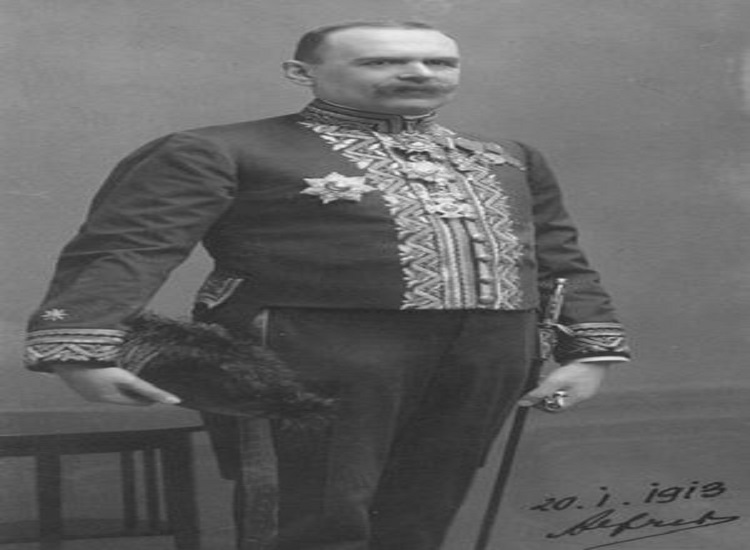
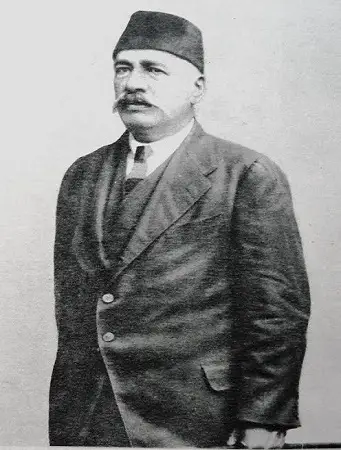
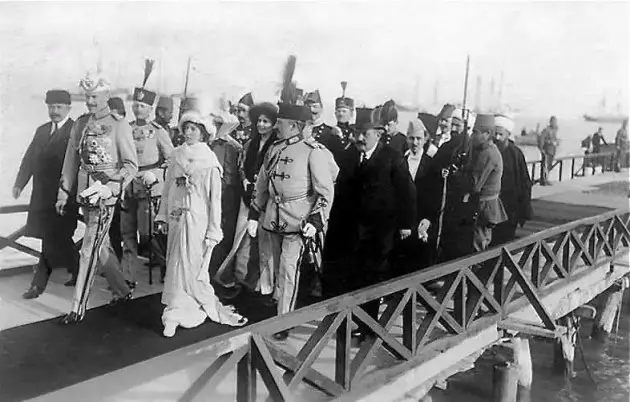
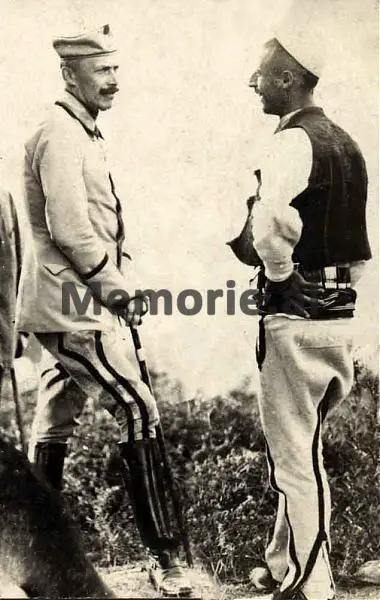
Memorie.al / A description of the figure of Bajram Curri by the Austrian consul August Kral, in a letter sent to the consul general Alfred Rappaport. The document is found in the political archive of the Austrian State Archive and is evidence that shows how detailed the Austrian diplomats knew the Albanian politicians of that time.
LETTER OF THE AUSTRIAN CONSUL IN SHKODËR, AUGUST KRAL, SENT TO THE CONSUL GENERAL RAPPAPORT, SHKODËR 11.1.1918
My dear friend!
I apologize that due to a series of circumstances I was delayed in responding to your letter of November 9 of last year (1917), regarding Bajram Curri. I am hurrying to do this and allow me to inform you that based on my experiences and my opinion, in any case I cannot agree with the absolutely negative judgment made of Bajram Curri by the military side, especially from Cetinje.
To understand him, his political past must also be taken into account. He does not descend from a family of beys, but took the title bey only later through military rank, which Sultan Abdulhamid had given him.
His area of influence was the Highlands of Gjakova, especially the Krasniqi and Gashi tribes, partially also in Has, where he is in sharp rivalry with Riza Bey Gjakova and his two sons, who recruit their main supporters there.
The enmity between these nobles for years dominated public life in the district of Gjakova and caused several times fierce wars between the supporters of both sides.
At the time of the wars related to the Constitution in Turkey (1908) Bajram Curri was found among those Albanians, who were gathered in large numbers in Ferizaj, to influence the proclamation of the Constitution and they aimed to achieve this by maintaining a threatening stance and through dispatches sent to the High Porte.
Since then, at least as far as we have seen from the outside, he has stayed away from the various uprisings of the Kosovars against the Turks, with the exception of the last uprising (1912), in the course of which he entered Skopje with about 10 thousand Albanians.
During the Balkan war he with his supporters fought against the Serbs and Montenegrins and in the end withdrew to Selitë, where he stayed until the fall of Shkodër (April 1913). Then he stayed long here and in 1914 together with Prenk Pasha participated in the failed expedition against the insurgents in Ishëm.
As an Albanian patriot he fully took the side of Prince von Wied, for his protection he went to Durrës with about 800 armed men and abandoned his duty there together with Isa Boletini only after the departure of Prince von Wied (at the beginning of September 1914), earlier he had shown himself ready towards us to fight the Serbs and Montenegrins and for this purpose had received from me a certain amount of money.
He had succeeded, together with Isa Boletini, to take with him from Durrës two cannons suitable for war in mountainous terrains and the corresponding ammunition. The whole expedition went by boat to Medua (Shëngjin) and then a part through Shkodër, the other part through Kallmet reached the border zone. Then under his leadership attacks were constantly carried out against the Montenegrins and Serbs.
That these actions did not have the proper success from the military aspect was a consequence of the lack of unity of the Albanians, the rivalry between Bajram Curri, Riza Bey Gjakova and Hasan Bey Prishtina, but in the large part also because of the mistakes and omissions from our side. As you know we could not give the Albanian fighters neither money, nor food, nor leaders, nor weapons and ammunition in a somewhat proper measure, therefore these miserable people depended only on their sacrifice, on themselves.
Besides this Bajram Curri was betrayed by the sons of Riza Bey Gjakova, therefore he was forced to flee. He came to Shkodër, stayed here until the entry of the Montenegrins and at the end of June 1915 went to Mirditë, where he awaited the advancement of our troops, where he participated actively and successfully together with his cousin Hysni Curri.
I consider Bajram Curri in any case an Albanian patriot and loyal to our policy. All his past and especially his behavior during the time of Wied and during the World War show by evidence that a steady character cannot be denied to him.
The accusation made against him by our military – based on the suspicious news of Czech and Serbian espionage officers – that he himself had given the Montenegrins one of his cannons and that he had made a pact with them, seems to me that it is based on faulty preconditions and impressions.
As far as I know and despite the assumption of our military he has never negotiated with the Bulgarians. That the Bulgarian side has enticed him and has exploited the misunderstanding that exists between our military authorities and him (Bajram Curri) is self-evident.
When Basri wanted to establish in Dibra his famous government of independent Albania (February, March 1916), he had offered Bajram Curri the post of Minister of War. This speaks a lot for the latter (Bajram Curri), who, leaving aside all vain Albanian motives, did not respond to the offer and stood loyal to us.
It is not known to me that he may be compromised by the Serbian secret files like Prenku, Marka Gjoni, Primo Doçi and others. The dark side in the character of Bajram Curri is the truly terrible personal interest, the greed for money.
But here it should be emphasized that he is not rich and that he always needs a lot of money to maintain influence among the highlanders, which has as a consequence that he is usually found in financial difficulties.
To ask from him support with weapons or any other patriotic activity, which is linked with great expenses, is possible only if the necessary means are put at his disposal.
In the commands of the Austro-Hungarian Empire in Gjakova and Zhur he has been held much at fault that last year from time to time he allowed irregularities during the collection of the tithe of agricultural products in Has, but on that occasion he did not take into account that his undoubtedly existing fault was based on old customs or abuses.
Every bey in Ottoman times has thought to profit during the sale of the tithe of agricultural products. It is clear that we are fighting these abuses, which is being done with success; at the same time because of such events we should not judge politically the respective people.
Not only for society, but also for the individual it is not an easy job that the traditional medieval mentality that is based on brigandry be replaced with new, moral concepts and to act according to them, despite the necessity to ensure personal existence. Bajram Curri is the son of a certain Shakir Aga Curri from Krasniqja.
Two of his three brothers have died; one is said to be deaf-mute. The well-known Hysni Curri, the son of Ibrahim Aga, a brother of Shakir Aga, is his cousin. The latter I think towards us is absolutely loyal in the political sense.
By character and private life, personal interest, he from beginning to end resembles his cousin. Where it is a matter of personal interest, an altruistic stance should not be expected neither from Bajrami, nor from Hysni.
Since under our administration the power of the beys is no longer based on oppression and exploitation of the farmers, but on personal merits and personal zeal, Bajrami and Hysni have lost a lot of authority among the population, although it cannot be denied that they have a certain influence.
Accept, dear friend, my hearty greetings. / Memorie.al
Kral
Source: State Archive of Austria
Translated: Enver Robelli