

Part Two
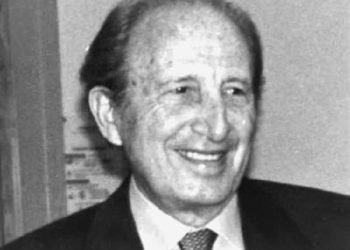
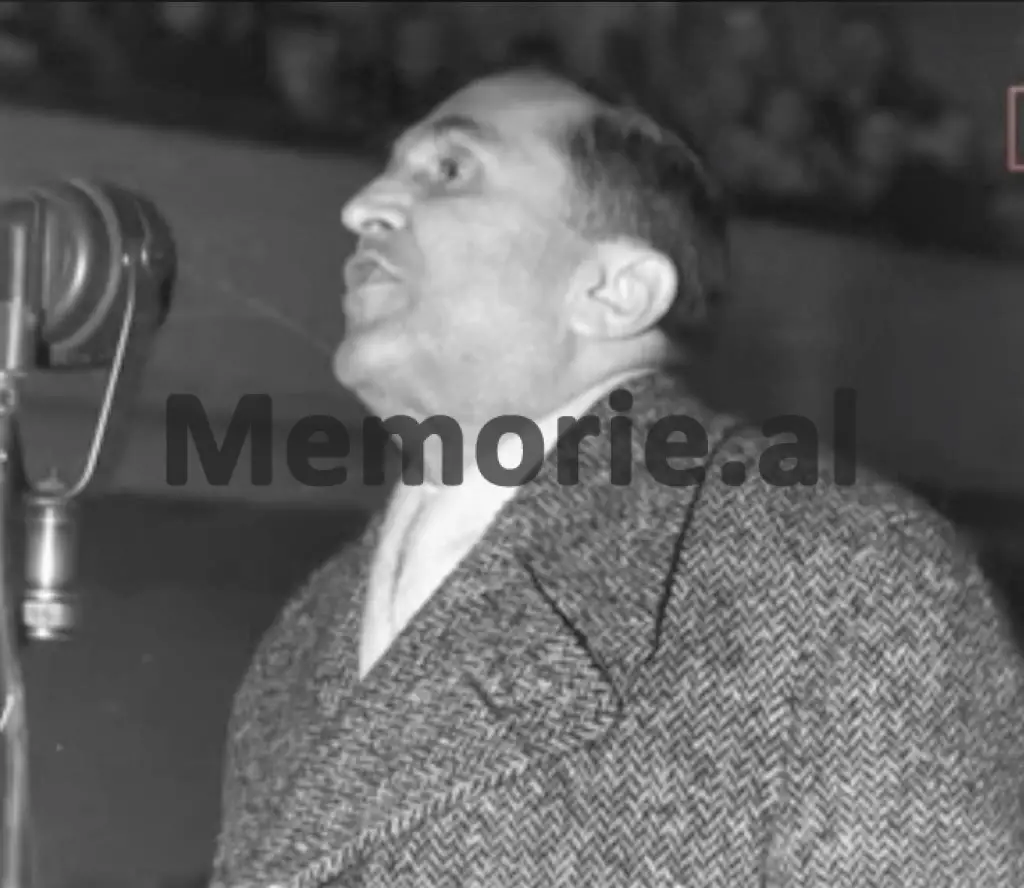
Memorie.al / Kostaq Kota, or Koço, as he liked to be called, was born on March 14, 1888, in Korçë – an Albanian city distinguished for its great patriotic movements for the freedom of the motherland, and for culture and education in the Albanian language. Historically, the Kota family was intensely involved in and contributed to these processes. Their origins trace back to the Castle of the city of Berat. Koço was the second son of Nuçi, who also had two other sons, Kristaq and Ilia, and a daughter, Leonora. His father was a very practical man, a merchant who traded in hides. Koço was born, raised, and formed in a family environment closely linked to the fates of the fatherland and the nation, to whose interests they were unceasingly committed.
Continued from the previous issue
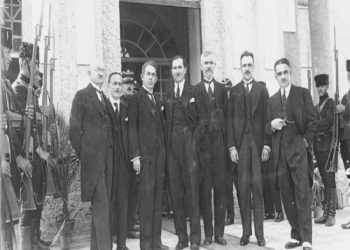
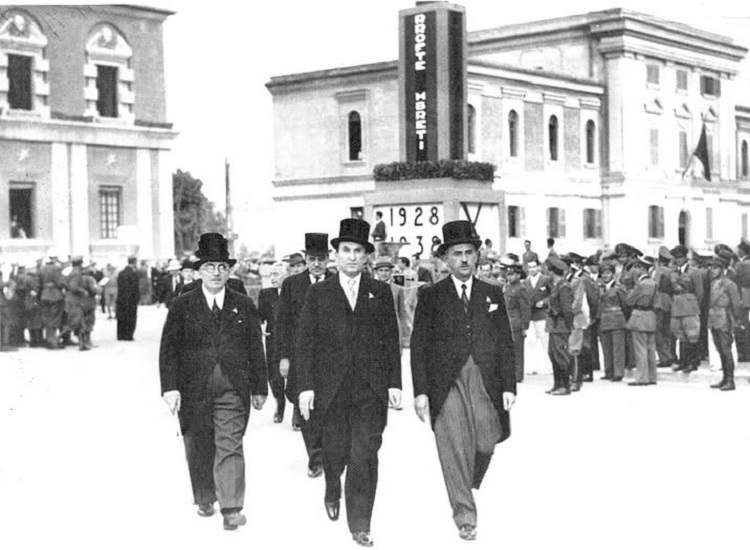
On September 5, 1928, Dr. Koço Kotta was elected Prime Minister and Minister of Internal Affairs. King Zog, newly crowned, encouraged legislative reforms in civil, commercial, and agrarian relations. The Prime Minister was fully committed to the separation of religion from the state, educational reform, the creation of a national and secular school system, and for the first time, a five-year development program was projected.
During his mandate, the ministries, the grand boulevard, several hospitals, the Burrel prison, and several other prisons were built. On March 4, 1930, Prime Minister Kotta, unwilling to take steps backward, resigned. In a letter addressed to King Zog, Prime Minister Kotta emphasized that the reason for his resignation “was the lack of harmony between the government and the Parliament, which hindered the development of important works.”
In 1930, Koço Kotta was elected as a deputy for Korçë in the Albanian parliament, which in its first session elected Dr. Koço Kotta as Speaker of the Parliament. During his mandate, he reviewed two laws in parliamentary session: on April 13, 1930, the Law “On Agrarian Reform,” which was approved that same day, and the law on “Legislative Reform and the Civil Code.”
In 1932, Dr. Koço Kotta was again mandated as a deputy for Korçë, where he was re-elected Speaker of Parliament. Discussions in the parliamentary legislatures focused on problems of education and the fight against phenomena that did not belong to the culture and traditions of the Albanian people. Three laws were decreed: the modification of laws 197, 206, and 207 for the nationalization of schools; “On the Prohibition of Face Veils and Head Coverings for Women; and On the Prohibition of the Marriage of Officials with Foreign Women.”
On November 9, 1936, King Zog decreed Dr. Koço Kotta as Prime Minister and Minister of Public Works and National Economy (Agriculture), to keep him in control and closely follow investments in the industrial and agricultural sectors. On January 31, 1937, Parliament gave a vote of confidence to Koço Kotta’s government.
In his role as Prime Minister, Koço Kotta oversaw the organization of the gendarmerie, taking drastic measures to establish order in Albania and to strike against any ideology or stance against the Monarchy. The administration of religious communities was also carried out according to the law drafted by Koço Kotta and decreed by King Zog I on July 16, 1929. According to this law, clerics had no right to vote and could hold no public office. Communities were not to receive any aid or subsidies from abroad. Their duty was to maintain a patriotic stance.
The battle for the Albanian church, initiated by the great patriot and revivalist Fan S. Noli as early as 1909 – who founded the Albanian Autocephalous Church in America – was completed in April 1937 by Ahmet Zogu and Koço Kotta.
On April 23, 1937, the government announced a decree-law regarding crimes against social and economic order, which prohibited the formation of associations aimed at “establishing the dictatorship of one class over another,” the forceful overthrow of the existing socio-economic order, and the spread of communist ideas.
On May 15, 1937, an anti-government movement organized by Et’hem Toto, former Minister of Internal Affairs in the government led by Mehdi Frashëri, erupted in Delvinë, but it was easily suppressed. To reduce political tensions with the diaspora, Ahmet Zogu sent Koço Kotta to Paris to negotiate with them, seek compromises, and convince them to return to Albania, but the mission failed. After the Yugoslav government cut off financial aid, the anti-Zogist emigrants, after many dilemmas, decided to return to Albania.
In August 1938, Koço Kotta went to Paris for medical treatment. To realize their goal, members of the steering committee took advantage of the Prime Minister’s arrival, met with him, and presented their request to return to Albania. The King listened carefully to the Prime Minister and told him: “It is already too late for my opponents.”
On September 1, 1938, the tenth anniversary of the Albanian Monarchy was celebrated with great pomposity. In September 1938, Koço Kotta, in constant contact with Mustafa Kruja, was informed of an “Italian movement” to aid Albanian patriotism by removing Zog, on the condition that in his place “Albanians accept an Italian prince.”
In September 1938, Koço Kotta, Mustafa Kruja, Qazim Koculi, Angjelin Suma, Kol Tromara, Rexhep Mitrovica, and Sejfi Vllamasi signed an agreement regarding the approval of the “Italian movement,” on the condition of refusing an Italian prince for Albania. The “Paris Agreement” was to be considered nullified in the event of an Italian invasion of Albania and its placement under the Imperial Crown of Savoy.
On January 11, 1939, the Italian Consulate in Tirana notified the Italian Legation of the preparation of a “movement to remove Koço Kotta from the Government.” On April 7, 1939, the Italian fascist military aggression began on the Albanian shores. As soon as the King crossed Kapshtica, he dissolved the government and went into exile as a fugitive Sovereign. Albania was left without an anti-fascist government in exile. On April 7, 1939, Koço Kotta, stripped of his function as Prime Minister, broke away from the Royal Court and settled in Thessaloniki.
In the period from April 7, 1939, until December 1944, former Prime Minister Koço Kotta, unwavering in his patriotic stance, did not participate in any Quisling Government formed during the Italian occupation of Albania, nor in any of the Regency Governments established by the German Army.
In the spring of 1944, to stop the Slavic-communist march in the Balkans, Mit’hat Frashëri devised a document regarding an alliance of Greek and Albanian right-wing forces and the creation of a dualist Greek-Albanian state – a federation or confederacy. According to Mit’hat Frashëri, the Albanian right-wing delegation would consist of Dhimitër Fallo – representing the National Front (Balli Kombëtar) – and Koço Kotta – representing Legality (Legaliteti). The Albanian project accepted the 1939 borders as the southern limits of Albania, while seeking Greek support for the inclusion of Kosovo and Albanian lands in the Dibra region into the post-war Albanian state.
The Greek side’s condition that the Albanian side accepts the surrender of Northern Epirus (Vorio-Epiri) was tolerated by Balli but deemed unacceptable by Legaliteti. Dr. Koço Kotta requested that Mr. Dhimitër Fallo add an amendment to the material devised by Mr. Frashëri, as follows: “The Albanian representation also recalled that both states are under the same occupation and for the union to succeed, they must undertake joint actions against the Germans.”
The final project-idea presented by Fallo-Kotta – a Greek-Albanian-Turkish front against the Nazis and the Slavic-communist threat – was completely unacceptable to the Albanian and Greek quisling governments. Mit’hat Frashëri’s diplomatic and simultaneously political operation failed in the months of April-May 1944.
After the Establishment of the Communist Regime in Albania
A street in the capital of Albania, Tirana, which in the 1930s had been named “Koço Kotta Street,” had its name removed by the Italians after the fascist invasion and was renamed “Galeazzo Ciano Street.” After the establishment of the communist regime, the same street was renamed “Qemal Stafa Street.”
In 1945, Koço Kotta was kidnapped in Thessaloniki by a Soviet intelligence officer, along with the Albanian officer Andon Sheti, aided by the Greek EAM, and brought to Albania. In the Special Trial, Koçi Xoxe accused Koço Kotta, among other things, of two issues.
Regarding the failure to organize resistance against the fascist invasion of April 7, 1939, Koço Kotta stated: “On April 7, 1939, our government was not only not afraid, but it also organized armed resistance…! I suggested this resistance to King Zog…! I did my part as a government. If there was any negligence, it belongs to the Armed Forces.”
Regarding the Greek-Albanian agreement for the creation of a dualist Greek-Albanian state, Koço Kotta declared: “I was not the head of the Albanian delegation, I did not represent the Legality Party, but I participated in the talks as a private individual.” Despite his lack of involvement in the organizations of the communist regime’s opponents, Dr. Koço Kotta was judged by a farcical trial, led by the servant of the Serbs, Koçi Xoxe.
Former Prime Minister Koço Kotta was sentenced to life imprisonment by the Albanian communist Special Trial and died in 1949 in Burrel prison. With the death of Koço Kotta, Slavic-communist segments achieved the physical and moral elimination of one of their most determined opponents – an indomitable and uncompromising patriot who dedicated his life solely to the fatherland and the Albanian nation.
After the Establishment of the Pluralist Democratic System
On November 24, 2014, Dr. Koço Kotta was posthumously decorated by the President of the Republic of Albania, Mr. Bujar Nishani, with the “Honor of the Nation” medal, with the citation: “For his precious patriotic activity and indomitable dedication in service and support of the national cause, many of whom were martyred by the inhuman communist dictatorship.”
The history of the life and national political activity of the patriot Koço Kotta, and his devoted contributions in the interest of the fatherland and the nation, were not forgotten by the Albanian people but were recorded in the annals and national historical memory as part of its conscience, placing his figure in the pantheon of Albanian patriotism. The people do not forget their sons and daughters who served them with national ideals, with Albanianism, and who with dedication did and gave everything they could for the interests of the people, the Fatherland, and the Nation, as Dr. Koço Kotta did. / Memorie.al