Memorie.al / Today, we may be in good relations and we hope these are maintained in the future, but we must remind children in schools, or today’s youth, of the painful history. This history is not made, as is claimed today in the globalized world, by erasing texts in schools, but by honestly writing the things that have happened and that still hang unresolved among us today. Perhaps this is what made the Serbs, a few years ago, pour out so much hatred in the stadium against a country that is not even on their border or what makes the Greeks, to this day, and not recognize the Cham reality. There are a series of platforms, ideas, and memorandums that over decades have been produced by high-ranking Serbian, Montenegrin, and Greek officials, through their kings, military leaders, prime ministers, and ministers, seeking to completely exterminate Albania. When you consider that among the well-known names are prominent families of Balkan dynasties, but also Nobel Prize-winning writers, then you shudder.
They are ideators of their own nations, but while thinking of the extermination of our nation, which they commonly called unnecessary, or that in the future they could even carry out biological expansion in the peninsula, as they commonly refer to Albanians. Today, history has turned upside down, but fortunately for the better, since the Kosovars, the most martyred people of the Peninsula, have their own state and even a mother state on the border, while the Greeks, not far in time, will face the Chameria problem realistically.
Whereas the Serbs have shrunk to absurdity. Justice may be delayed but it can never forget. Time has proven this and Albania is not only a factor in the Balkans, but also one of the most important elements of the tranquility and existence of this peninsula. We are unfolding some of these moments, when Albanians were seen as elements worthy of being driven from their homes, simply for the pure hegemonic interests of Greeks, Serbs, Montenegrins, etc.
“Načertanije” of Ilija Garašanin – Minister and Ideology
Ilija Garašanin received the proposal for this platform from the Czech Pan-Slavist, František A. Zach (1807-1892), from Moravia, at that time part of the Austrian Empire. Zach represented the organization of Polish emigrants, founded by Prince Adam Czartoryski. The goal is clear: Zach, who knows Belgrade well, suggests to the Serbian authorities to stay away from Russian influence. Ilija Garašanin was an official of the Internal Structures of Serbia.
A 19th-century figure (1812-1874), he became a key figure of the constitutional regime, as well as the ideator of the proponents of the expansion of the Serbian state. He is considered the founder of the foundations of Greater Serbian unification policy. Garašanin presented his synthesized platform in the secret document he called “Načertanije” (1844), which translates as “Draft”, i.e., “Plan”. In fact, it is believed that the basic project was entirely Zach’s memorandum, which envisioned the new Serbia as the successor to the medieval empire of Stefan Dušan (1308-1355).
Garašanin was the right person and he immediately argued why Serbia “must embrace all the Serbian peoples that surround it.” Zach thought that the Serbs should be the ideators and leaders of a formation of South Slavs, “it is not limited to its current borders, but aims to embrace all the Serbian peoples that surround it.”
According to Garašanin’s “Načertanije”, Northern Albania would also be part of the great Serbian state. For his program, Garašanin foresaw the organization of a secret service and a developed propaganda system. The “Načertanije” platform, with its expansionist aims in the Balkans, also implied expansion into Albanian territories.
Since then, for the Slavs, the Serbian people have been a divine and historical people. According to him:
– Bosniaks are Serbs of the Islamic faith, i.e., Muslimized Serbs; the language they speak is Serbian;
– Montenegrins are Serbs, both in language and religion;
– Macedonia is Southern Serbia;
– Croats, meanwhile, are Serbs of the Catholic faith and the language they speak is Serbian.
– Albanians are considered a Turkish remnant in the Balkans.
“Načertanije” was realized to a considerable extent during the First Balkan War (1912) when Serbia, based on the decisions of the London Conference of Ambassadors (1912-13), annexed Kosovo and other eastern regions of Albania with a policy of denationalization.
Vaso Čubrilović: “The Expulsion of the Albanians” (1937)
The one who continued the policy of “Načertanije” was Vasa Čubrilović (1897-1990). In his memorandum “Iseljavanje Arnauta” (The Expulsion of the Albanians), which he drafted for the government of Stojadinović (Milan Stojadinović (Čačak, Serbia 1888 – Buenos Aires, 1961); lawyer and economist, Prime Minister of the Kingdom of Yugoslavia from 1935-1939), he proposed methods and ways to solve the “Albanian problem”. Vaso or Vasa was an academic in the field of History and in his youth was one of the organizers of the assassination in Sarajevo of the heir to the Austro-Hungarian throne, Franz Ferdinand.
His memorandum speaks in detail about the Serbianization of Kosovo and also speaks mercilessly about his own government, which could not colonize this area after World War I. The memorandum was handed over on March 7, 1937, to the government of Milan Stojadinović and calls for the physical expulsion of Albanians from Kosovo to Turkey and Albania. It is the first detailed ethnic cleansing by the Serbs. For this, he cites another nationalist, Jovan Cvijić, who said that; “Albanians are the most expansive race in the Balkans” – former rector of the University of Belgrade and president of the Royal Serbian Academy of Sciences.
Here is what is stated in the memorandum’s preamble: “The problem of the Albanians in our national and state life was not born yesterday. It played a major role in our life during the medieval period, but it has occupied an extremely important place since the end of the 17th century, when the Serbian population, from lands that were once battlefields, migrated northwards and in their place came the Albanian highlanders. Slowly, from their hills they settled in the fertile valleys of Metohija and Kosovo and penetrating northwards, spread towards the western and southern Morava; through the Shar Mountains they fell into Polog and from there towards the Vardar.
By the 19th century, the Albanian triangle was created in this way, a wedge which, thanks to the ethnic support of the Dobar-Rogozna line, has driven deep into our lands and has reached as far as Niš, dividing our ancient lands of Raška from Macedonia and the Vardar valley…! Serbia began to trim this Albanian wedge from the first uprising, expelling the Albanian population from the northernmost areas, from Jagodina”!
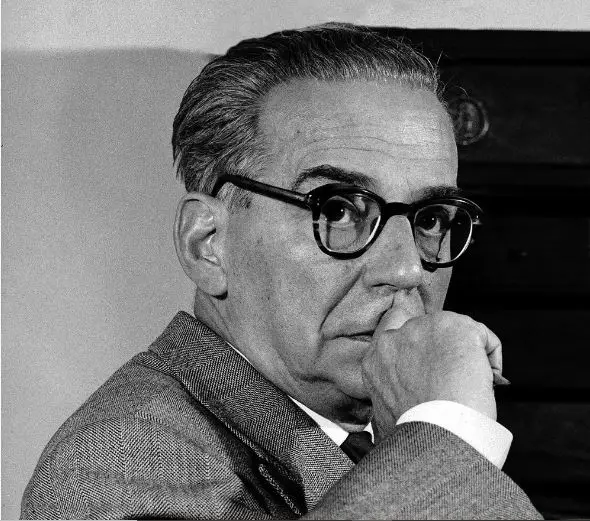
Ivo Andrić: The Purge of Albanians
Nobel literature laureate and well-known diplomat Ivo Andrić prepared a document that he published in Belgrade on January 30, 1939.
“The Partition of Albania”
“On the occasion of assessing this whole matter, we must bear in mind that we must in every way look to avoid any conflict, whether secret or open, with Italy. We must also avoid the occupation of all of Albania by Italy, because in this way it would endanger us in the most sensitive places – in the Bay of Kotor and in Kosovo. Taking into account all the above, the partition of Albania could be considered by us only as a necessary and unavoidable evil, which we could not resist, and as a great damage from which we must extract as much benefit as possible, meaning that we must choose the lesser of two evils.
Our compensations
These compensations are found in the material processed 20 years ago, when the issue of partitioning Albania was raised. The maximum we sought at that time was the border that would extend to the edge of the Mat and Black Drin rivers and that would give us the strategic security of Montenegro and Kosovo. Also, we must secure the valleys and lakes of Ohrid and Prespa, including Pogradec and the Slavic villages of Mali i Thatë (Dry Mountain), as well as those between Prespa and Korça. The taking of Shkodra, in this case, would have great moral and economic importance. This would enable us to develop major hydro-technical works and benefit from fertile land for the nourishment of Montenegro.
Northern Albania, within the framework of Yugoslavia, would enable the creation of new communication links between Northern and Southern Serbia with the Adriatic. With the partition of Albania, the center of attraction for the Albanian minority in Kosovo would disappear, which, in a new situation, would be more easily assimilated. We would eventually also have 200,000 to 300,000 more Albanians, but these are, for the most part, Catholics, whose relations with Muslim Albanians have never been good. The expulsion of Albanians to Turkey would also take place under new circumstances, because there would be no stronger action to prevent it.” (Part taken from the book by Hivzi Sulejmani)
Dobrica Ćosić: Albanians, a Burden for the Balkans
The well-known Serbian writer Dobrica Ćosić passed away only a few years ago. He is considered the “father of the Serbian people” and although he was also a dissident against Tito, when it came to Albanians, he is considered one of the supporters of the policy of Ranković, the infamous former Interior Minister in Tito’s time. As an academic and writer, he was one of those who often formulated national ideas and had polemics with many people.
Ćosić called Albanians a “barbaric burden of the Balkans”, while it is said that he agreed with the ideas for a Greater Serbia and spoke about how parts of Croatia and Bosnia should be returned to Serbia. However, a few years ago, at the age of 93, he confessed to the magazine “Nedeljnik” that Kosovo was lost and appealed to the new generations not to waste energy, because history has resolved this issue against their ideas.
Slobodan Milošević: The Final Purge
The movement for Kosovo’s independence gained momentum in the mid-80s, but the Serbs were against autonomy and in 1987 Slobodan Milošević, who was then climbing the Serbian power hierarchy, was elected leader of the Serbian Communist Party, with the promise of restoring Serbian rule in Kosovo. In 1989, Milošević became President of Serbia and immediately intervened in Kosovo, completely reducing its autonomy in 1990, by sending military troops that overthrew the Kosovar government.
But the calculations were wrong, as this policy led the Yugoslav Federation towards disintegration in 1991, and in 1992, while Kosovo a few years later would declare its own state. The epilogue was that Milošević, who thought he would put an end to the Albanian problem, ended up in The Hague Tribunal and died before the trial for crimes against humanity weighing on his shoulders was concluded. He carried out a nearly biblical expulsion of Albanians in the late 1990s, one of the most infamous of the last century.
Greece
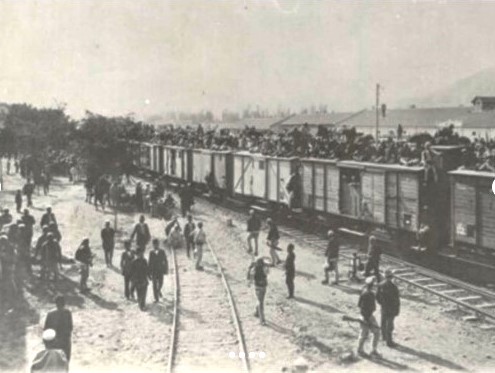
From 1913-1922, a time when Albania experienced many vicissitudes, Greece continued to systematically ethnically cleanse Albanians. Greece expelled over 80,000 Albanians from Albanian lands, sending some to Turkey and scattering others on the islands of death.
“Protocol of Corfu”
It is a document that defines the borders of Northern Epirus, where the concept of Northern Epirus extended as far as Durrës, since ancient Epidamnus was a Greek colony! Others extended this border to the Shkumbin River. The “Protocol” defined as Northern Epirus the regions of Korça, Gjirokastra, Saranda, and Himara.
“Law of War”
The history of the “Law of War” begins on November 10, 1940, when the Greek royal decree, law 2636, was declared on the state of war between Greece and Italy and Albania. After the occupation by Germany, the quisling government of Greece under Prime Minister Jorgos Tsolakoglou repealed the Law of War. But after the end of the war, the newly formed government in 1945 reinstated it, re-declaring war on Albania again, with a new decree number 13. On August 28, 1987, the government of Andreas Papandreou, with Karolos Papoulias present, repealed the law that provoked war between Greece and Albania.
The Massacre of Zervas, the Greek general, against the Chams
The collaborationist general Napoleon Zervas, on his deathbed, said: “I die calmly because I did what I wanted. I left behind rivers of blood, smoke, soot, ruins; the howls of children, naked brides and women, who threw themselves into lit ovens so that Albanians would no longer wake up… men hanged, pierced with bayonets, the Albanian language will no longer be spoken on Hellenic soil. This satisfies me, just as it satisfies all Hellenic souls.” In 1944, Zervas and other generals had received orders to completely destroy the Cham population of 30-35,000 inhabitants.
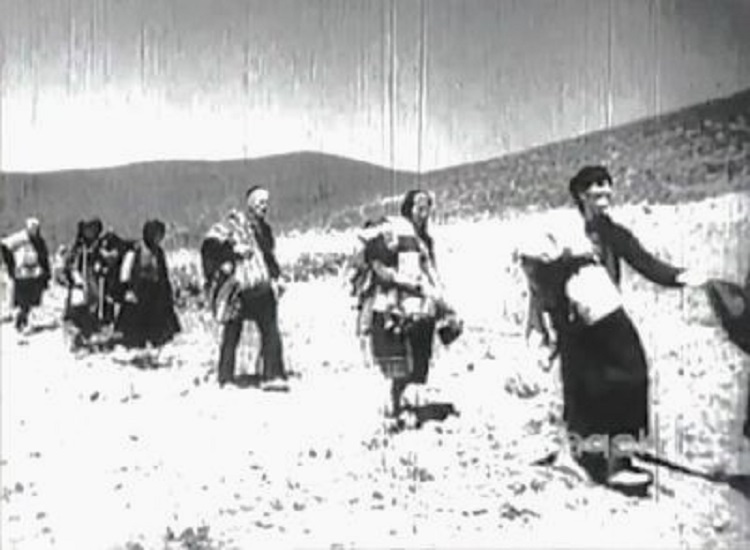
The paradox was that the Allies closed their eyes, or as Colonel Chris Woodhouse, head of the Allied military mission, declared: “With the encouragement of the Allied military mission that I led, Zervas expelled the Chams from their homes”! The genocide began on June 27, 1944. Zervas’s soldiers destroyed everything in front of them and razed over 5,800 houses in 68 villages and hundreds of thousands of Chams were killed and the owners completely looted…
The Peace Conference (1946)
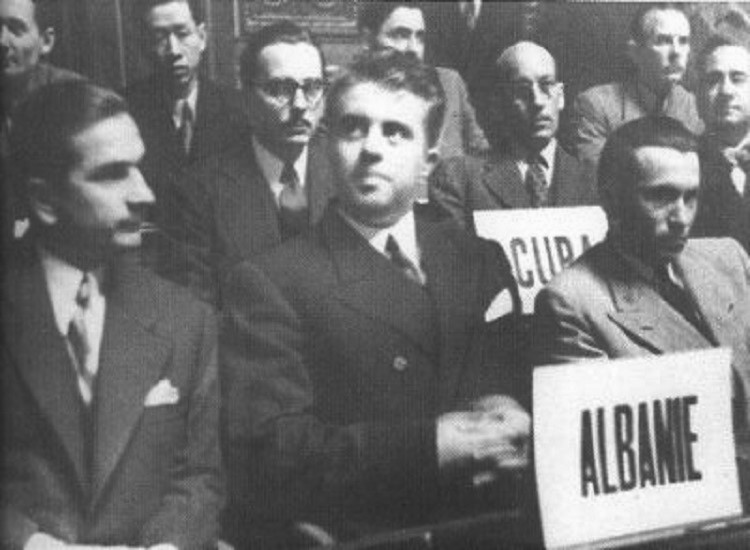
At the Paris Peace Conference in 1946, Greece requested the change of the border with Albania, demanding southern Albania. In 1949, the Greek army brought its forces to the border to enter Albania. In 1968, relations between Tirana and Athens reached the point of open war, after Greek claims to annex southern Albania.
The Greek aggression of August 2, 1949, in the South
On August 2, 1949, the southern Albanian territory in the southeast, based on the Korça region, but also as far as Konispol in Saranda, at Likojan, was the target of a military attack by Greece. It was not a provocation as characterized by the Albanian state in 1949, but a Greek military attack against our country. Hundreds of Albanian families were displaced to escape this unprecedented aggression.
Greece hurled over 70,000 armed forces against Albania, over 50 aircraft, 80 tanks, and an artillery echelon with nearly 400 launchers, mostly cannons; the Albanian state mobilized and put into the defensive war 10,000 soldiers, while keeping another 30,000 troops on alert near the attacked zone.
Italy – The Annexation of Albania
On April 7, 1939, Italy invaded Albania, and the country fell completely under the Italian empire. The most important person in the country was the Lieutenant General of His Majesty the King Emperor in Albania (Luogotenente Generale di S.M. il Re Imperatore in Albania), attached to the government in Tirana. This post was given to the former envoy Francesco Jacomoni of San Marino, to whom a staff of 120-140 persons reported. Albanian authorities were not allowed to issue legal acts or take important decisions without his approval.
The Albanian press was controlled by Piero Parini, who enjoyed a special status within the structures of the ruling apparatus. During the years 1940-1942, they numbered 100,000 – 150,000 people. Until November 1949, they were under the command of the Commander-in-Chief of the Armed Forces in Albania, General Sebastiano Visconti Prasca. The military mission of General Manlio Gabrieli was also temporarily stationed there. Later, the command of the forces that invaded Greece was stationed in Albania. The collaborationist government in Tirana was led by Shefqet bej Vërlaci, a feudal lord and large landowner, who had been Zog’s rival for many years. / Memorie.al