By AGRON ARANITASI
Part Twelve
– THE TRUTHS I BELIEVE: THE FRENCH AGENT –
Introduction
Memorie.al / When I began writing the book “The Truths I Believe” (published by “PAPIRUS”), I had not intended to write about myself. The initial impulse arose when I encountered the State Security (Sigurimi) files regarding the surveillance of Citizen Agron Hajdar Aranitasi. Those files serve as further evidence of how someone could be persecuted if, at a certain moment, they were placed in the ranks of the “enemies of the people’s power.” Nothing was taken into account- not how they had worked, how they had behaved, or how they had lived. Not even the standing of their parents, brothers, or numerous cousins was considered; they were all automatically subjected to brutal strikes and suffered consequences despite being entirely blameless.
Continued from the previous issue
1982: West Germans and Japanese Land in Tirana!
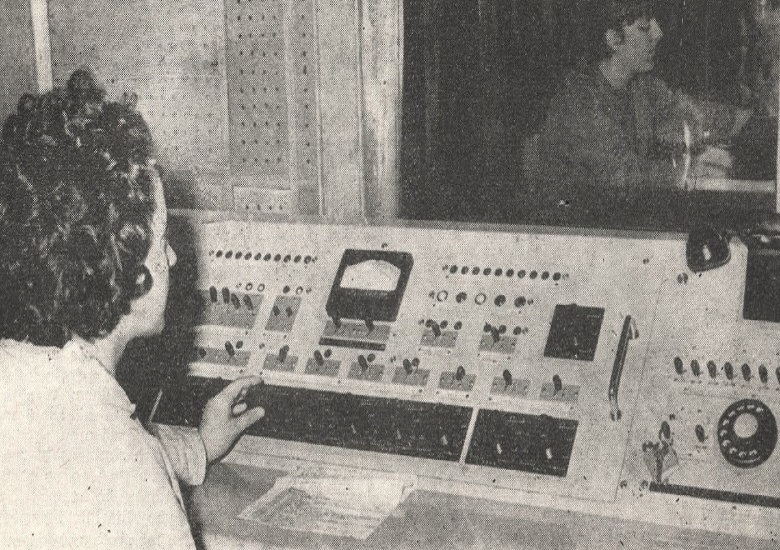
Color transmissions on RTSH had begun as early as 1976. The “Ampex” magnetic tape recorders (VTRs) were capable of recording color signals. However, problems arose during program playback because the recorders were not equipped with color signal processing options for reproduction. Due to financial reasons, and the fact that we were broadcasting in black and white, those options were not ordered. There was another reason: the television standard to be used had not yet been decided. In 1973, the Albanian government had expressed support for the French standard, “SECAM,” primarily for political reasons.
Thus, at that time, we broadcasted color films or programs purchased from abroad. I recall the film “Cousin Bette” or an Austrian-produced concert featuring Tyrolean songs and dances. These programs could be seen in color by very few people – only those who owned color television sets. In 1979, as I wrote above, three “Ampex” AVR-2 recorders were purchased along with the necessary options for color signal playback.
By this time, all of Western Europe, with the exception of Greece, had adopted the German standard, PAL. The Balkan countries had followed suit. We purchased the recorders in the PAL standard, but this was a secret kept hidden until late 1981, when the purchase of equipment for broadcasting the proceedings of the 8th Congress of the PPSH (Labor Party of Albania) began.
Technical work was progressing well; technical ideas had matured. The leaders of RTSH, Çajup Rusmajli and Marash Hajati, were in full sync with the technical specialists of TVSH. This was significant because they had connections with high-ranking party and state officials. The project calculations required large amounts of “hard currency” – meaning US dollars. This was an issue that the Government would not pass easily.
The first opposition came from Mehmet Shehu. He made a strange proposal: that TVSH be given one million dollars to buy ten cameras like the ones used during the 8th Congress. His proposal was conveyed to us by Manush Myftiu, who was then the Deputy Prime Minister overseeing RTSH.
His assistant, Jorgo Melica, informed us of a meeting. Çajup Rusmajli and I were to attend. Çajupi called me to his office and told me we were going to Manush to discuss the project for the transition to color broadcasting. “Be careful how you speak,” he said, “because once you start, you don’t know what you’re saying or when to stop. Manush is very harsh; if he takes a dislike to you, you’ll have nowhere to hide!”
I laughed and told him not to worry. “If I see you making a mistake, I’ll give you a sign,” he continued. We arrived at Manush’s office, and he began presenting the government’s (meaning Mehmet Shehu’s) view. When he mentioned the sum of one million dollars, I laughed. “We can’t do anything with that amount,” I said. Manush looked at me and blinked – a nervous tic everyone recognized.
This often signaled the onset of his dissatisfaction with the interlocutor. Çajupi gave me the sign; he stepped on my foot. I continued to explain to Manush what the TVSH project aimed for. He kept demanding clarifications, trying to convince us to lower our demands. I continued explaining; telling him that covering the country with a television signal also required additional funds. We went on like this for a long time.
Çajupi stepped on my foot again. I laughed and told Manush that the General Director was stepping on my foot. Manush turned to Çajupi: “Why, Çajup, must you always lie to me?” Çajupi replied: “Agron is a good and capable lad, but he doesn’t understand the Government’s troubles.” “That’s not it,” the Deputy Prime Minister spoke, “He knows our troubles as well as you do, but he has been favored all his life; his father and mother turned his path into a boulevard.”
He then continued: “Go and prepare the requests as you see fit; include the transmission equipment as well. Present the requests in writing and let the Government decide on everything.”
On the way back, Çajupi said: “We got off lucky; Manush was in a good mood because…” I then revealed my family’s connections to him. I informed him that I had also spoken with Kadri Hazbiu regarding the meeting with Manush, who advised me to speak openly because Enver Hoxha himself was interested in the RTSH project.
In fact, in 1982, we were the only country in the Balkans still broadcasting in black and white. The next day, the General Directorate met, and the order was given to draft precise technical requirements accompanied by the necessary financial value. The meeting discussed the television standard.
Engineers Tomço and Shpuza, recently returned from specialization in France, spoke in favor of the French standard. Marash Hajati agreed, citing the 1973 government decision. Vullnet Musaraj and I was for the West German standard, PAL, which had been adopted by most Balkan and European countries. Even Yugoslavia (and thus Kosovo) operated on the PAL standard. This was a further reason to select it. It was decided that I would sign the material for the government. This was contrary to the practices of the time – it was impermissible for the institution’s seal to be placed next to the name of someone who was not the head of the institution.
I mentioned this to Çajup Rusmajli and Marash Hajati. They insisted that I sign the cover document for the RTSH pre-project. I understood – the echoes of the “Ampex” affair were still lingering! In fact, Çajupi and Marashi were right to be concerned. No one knew what the government would decide. They feared Mehmet Shehu’s stance. The material was sent to the government and the Central Committee.
We requested eleven million dollars, presenting the option of dividing the project into two phases. The first phase required seven million dollars – five for TVSH and two for RTSH’s television transmitters. The requested funds were a heavy burden for the government. Its hard currency reserves at the time did not exceed thirteen million dollars.
Approval was granted very quickly, and by early December, “Makina-import” selected two companies producing color equipment. The Prime Minister’s office had pre-emptively banned contacts with the “Ampex” company. The Japanese company “Ikegami,” from which we had bought cameras a year earlier, and the West German company “Bosch,” known for the quality of its products, were proposed.
The latter emerged as the winner, both because it produced the entire range of equipment necessary for a television center and for its prices. The West German company offered a thirty-five percent discount (!) on all equipment in the contract, which caused confusion in the Ministry of Trade. The Minister, Nedin Hoxha, shouted at the leaders of Makina-import: “You barely manage a five percent discount. Use your heads!”
Another problem arose with the minister. Before the contract was signed, I asked the Bosch representative, Mr. Stromenger, to include the specialization of twelve TVSH technicians at their expense. Mr. Maksim Mema, the Makina-import employee overseeing RTSH issues, supported me. He was an electronic engineer and understood the importance of specializing technical personnel.
Mr. Stromenger agreed, but when Minister Nedin Hoxha found out, he ordered the specialization canceled and its value deducted from the contract. Nedin called Çajupi. Çajupi called me into his office and phoned Nedin, telling him that the chief specialist of TVSH was against this action. “We decide here,” the minister said and hung up.
I told the director I would resolve this. I headed to Durrës. I met Adil Çarçani. Adil, a calm and kind-hearted man, called the minister and ordered him not to make any changes to the RTSH contract. I proposed the names of twelve people for specialization. In the future, they would handle the maintenance of the apparatus. Their names, as per the rules, were reviewed by the basic party organization.
The secretary of the TVSH basic organization, Andon Rudha, called me and asked me to make a correction. To remove one name – whomever I wanted – and add another. “The name of Natasha Shpuza must be added,” he said. Natasha was the wife of Ramiz Alia’s nephew. I refused. I told him that the people being specialized would maintain the equipment. What did Natasha have to do with it? Andon pointed out that the names of specialists were approved by the party organization.
“That is so,” I replied, “but I am the one who designates those who go. If you wish, I can propose twice the number of names and you can choose those you think best.” With that, I ended it with Andon. He went and complained to Marash Hajati, the secretary of the RTSH coordinating bureau. Marash refused to intervene. Nor did Çajupi support the basic organization secretary. What could they do? They found a solution! They sent Ylli Pepo, who at that time (after the departure of Agron Çobani) was proposed for appointment as the director of TVSH.
“Agron, understand us,” Ylli told me, “it’s not about her; it’s about the one at the top. Even the RTSH leaders share this view, regardless of whether they tell you.” I got along well with Ylli. I agreed. The party organization removed two names because a woman could not go abroad alone. Such was the rule! Another was added, Lejla Bedo, a good and capable girl. She was the chief shift technician at TVSH.
Pre-emptively, the name of Mark Shoshi, one of the best technicians at RTSH, had been removed. They removed him because his father “turned out to be a Vatican agent!” I fought hard to send Mark abroad, but I was unsuccessful. Such an accusation could only be removed by Enver Hoxha and no one else. Mark was only cleared of “being an agent” when Ramiz Alia took Enver’s seat!
For the purchase of transmitters and radio relays, the French company “Thomson CSF” was chosen which had previously supplied RTSH with such equipment. The French transmitters were also among the best in Europe. RTSH and Makina-import requested a joint group of specialists to inspect the equipment before the contract was signed.
I proposed visiting several European broadcasters (a French one, an Austrian one, and a West German one). But the suicide of Prime Minister Mehmet Shehu occurred, and the situation became complicated. For nearly two months, we were not told what would happen next.
I saw Vullnet less and less. After the meeting with Ramiz Alia (I spoke of it in his chapter), he was sidelined under the pretext that he was in his party candidate probationary period. Most of the project’s technical problems were solved by Bosch specialists. They also designed the final project and performed the equipment installations in the TVSH premises. I signed the contracts as the technical specialist; on behalf of Makina-import, Mr. Maksim Mema signed.
I had no problems with him. Even when I was interned, he did not say a single word against me. He didn’t speak even when two investigators came to Fushë-Arrëz to question me about the purchase of seven air-conditioned “Benz” off-road vehicles. They were intended for the film crews. The investigators insisted that these cars had been bought without Prime Ministerial approval, as was the rule at the time.
They claimed I had bypassed the rule by hiding behind the fact that “Benz” vehicles were used by the country’s high leadership. In fact, they were wrong. Their purchase had been approved by the same Deputy Prime Minister who, a year later, would sign the document for my internment. During the month of August, the first pieces of equipment began to arrive. These were the Bosch VTRs, which were used until 1995. The “Ampexes” went out of use, both because they were aged and because their operation was too costly. Not even two months would pass before I was removed from the television station.
After my internment, they did not return Vullnet Musaraj there either, as was the rule for party candidates when they finished their probation. In my place, Vladimir Shpuza, the nephew of Ramiz Alia, was “catapulted.” Later, it would be claimed everywhere that he was the one who selected and contracted the color equipment for TVSH. Together with his wife, they would “reign” for nearly ten years at RTSH, even though the laws of the time prohibited a husband and wife from working in the same institution.
It was a mournful irony that my name was only mentioned by the drivers and film crews of TVSH. They thanked me for the purchase of the “Benz” off-roaders. One of them was later taken by a secretary of the Central Committee of the PPSH. But life went on, now under different conditions…! / Memorie.al
Continued in the next issue…