

By Visar Zhiti
Part Two
-When he would have been 90 years old-
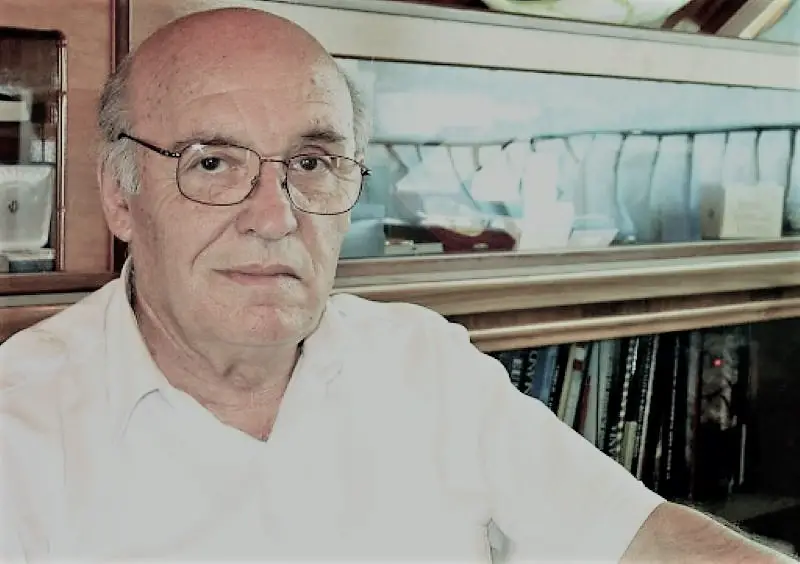
Memorie.al / It would have been greatly desirable, and joyfully normal, for Pjetër Arbnori’s family and friends, as well as Albania today, to have brought his birthday cake with 90 candles indicating his age, and for him to blow them out amidst joy and cheers, raising a glass of wine as a husband, parent, and grandfather, but also as a prominent fellow-sufferer in the severe prisons of a barbaric dictatorship, as a dignified deputy and chief parliamentarian later on, and as a unique writer. But he departed peacefully and with a mysterious silence 19 years ago, leaving everything behind, perhaps so as not to cause worry, but reconciled with himself and the world…!
Continued from the previous issue
I had seen Pjetri in difficult meetings too. I remember the one with a large group of Greek parliamentarians, over 20 people, who requested that the meeting be only with him. His advisors and collaborators left; I did not, perhaps I went unnoticed among the Greeks.
He successfully confronted them alone, demonstrating that he knew their history just as well, if not better than they did. And he convincingly defended the difficult situation in the South and promised a solution. I had been with Arbnori, the Speaker of Parliament, on official visits to Macedonia and Romania. With his Romanian counterpart, an authoritative figure with great influence, Arbnori was perfect.
I found opportunities to tell him not to forget the ‘Prison Diary’, that it absolutely had to be published, not just his novels, novellas, and letters. The gravity is there, in the diary…!
– “Eh,” – he would tell me, – “I don’t have time now, when I retire.”
– “Then give it to others, at least to be typed.”
– “It’s in an alphabet I invented myself,” – he explained, – “so that the prison police wouldn’t understand it, and now I’ve forgotten it; I can’t read it either.”
When he prepared the lyrical novella “The Beauty and the Shadow” for publication, I told him the story was strange, how he had written it in the cell, on the white margins of newspapers. He had been punished for leaving his torn slippers crookedly at the end of his bed. Although burdened with a lot of work, he wrote the introduction I requested during the night.
“Here,” he said. “I attached it to the novella as an introduction, as absurd and sad as it is.” The poet Teodor Keko, a deputy opposing Arbnori, wrote an appreciative critique of the book, struck precisely by that introduction, so beautiful, so rare, he told me. Under the care of the writer Novruz Shehu, my friend, all of Arbnori’s prison letters were published in the large volume “E dashtun Nanë” (Dear Mother).
Later, in Italy, I would also wait for Arbnori; I was working at the embassy as minister counselor for culture. Unlike any other high-ranking personality, he had gifts for all the staff, from the ambassador to the cleaner. He gave my youngest son a big teddy bear. The driver there told us it was the first time he had received a gift from a high official. Pjetër Arbnori, as a writer who came from the prisons, held a lecture at the “La Sapienza” University in Rome, in the large, packed auditorium.
There I met the daughter of the writer Ernest Koliqi, founder of Albanology at that University. He had fled the regime, which had sentenced him to death as a collaborator…! And in New York, colleagues told me, Arbnori had appeared similarly, dignified and modest, but also as a statesman, and likewise in Washington.
THE MISSING PRESIDENT
After the crazy year of 1997, when the Democratic Party and Arbnori fell into opposition, it was expected, not only by his admirers, that he would be the President of the Republic through consensus. “As Speaker of Parliament, now that he was no longer there, it was understood that he had no equal, rare, excellent,” – they said.
But as President? It would be even better! A challenger! He came from prison, and the judges who had sentenced him were still judges, some even promoted. Ah, this was something the fellow-sufferers, the majority, would not forgive. Meanwhile, would the leaders up high, both position and opposition, tolerate the President of the Republic being a former political prisoner, when they themselves had been raised by that regime, perhaps even with privileges?! What should be done? Well, just like with the statue later, better a statue than a president. His symbol had to be faded. The symbol of all those like him.
Perhaps this was the only issue where the ruling party and the opposition agreed. Pjetri knew how to be one of sacrifice as well. For the sake of free speech, he went on a difficult hunger strike, accustomed to them from his past. Yet, even afterward, he kept that smile and Shkodran humor among friends. And his friends remained unchanged, the same ones he had in his prison cell and after prison, when he worked as a carpenter. Likewise, the silence and that mysterious sadness remained.
When the Democrats returned to power, it was rumored that he might go as Ambassador to the Holy See in the Vatican. He was looking forward to it; “but they haven’t told me anything,” – he wisely told me one afternoon during a cocktail party. Meanwhile, I asked him for help for my son; he was starting school, the first grade. He took care of it, went to our Bishop Rrok Mirdita, and my son was registered at the Catholic school “Ylber” (Rainbow) in Tirana, where his children were, and he befriended them. We met cordially at book inaugurations. Rarely. Both seemingly unemployed. It looked as if oblivion was marching victoriously. Had Arbnori’s mission ended?
PYRAMID AND BRONZE
He left for Naples alone, so as not to worry his family, to undergo a surgical intervention, which was not at all difficult, but the unexpected happened; he suddenly died in the hospital. His wife, Suzana, requested that the funeral ceremony not be official. Many citizens gathered at the Cathedral in Shkodra. Meanwhile, the Pyramid of the dictator Hoxha, stripped and broken into pieces, but transformed into the International Cultural Center, was named “Pjetër Arbnori”- the one who had first taken over Enver’s office.
Now the pyramid too? But if it were demolished, as was discussed and protested, it would lose its new name as well. But no one would be to blame. When I was working in the Ministry of Culture, appointed as its director, one day the phone rang in my office. It was the writer Stefan Çapaliku. He told me that the sculptor Sadik Spahija had created a bust of Arbnori and that “it is an honor for everyone that this sculpture be placed somewhere in Tirana, in the Parliament, anywhere, absolutely.” I was struck by his insistence. As if he sought to shake off the dust of oblivion.
And I started to inquire higher up. I knew the power of that sculptor; I had seen it in the sculpture group of the poets of Librazhd, how moving! I looked for a place where it could be placed. “But the bust isn’t well executed,” I received an answer from one office. And a little higher up they told me to leave this matter for later!
“What do they have to do with the artistic side of the work,” – Çapaliku rightly flared up, – “their duty is to determine the place where it can be put, because artists are responsible for the artistic side, the competition, the commission that approved it. And when is later?”
I felt emptiness in the places where Pjetër Arbnori’s sculpture could be placed. All the pedestals seemed to be occupied. The emptiness spread within me too. A kind of abandonment and cold anxiety…! Better late than never. With irony or without irony? After waiting for about 10 years, Pjetri’s statue was brought out to be placed in the flowerbed in front of the building where he worked as Speaker of Parliament. And it was brought by his opponents.
Not only his family and permanent friends gathered at the inauguration, but also Speaker Ruçi, who was directly accused of the massacre of April 2nd in Shkodra, where Pjetër Arbnori was among the protesters; President of the Republic Meta, maligned for rampant corruption, arrested the previous year; while from the opposition, there was Chairman Basha and Mrs. Topalli, the other democratic former Speaker of Parliament, the first woman.
The two would not speak to each other, and many other adventures unfolded. Berisha also came – the founder of the official opposition, President and Prime Minister for his party, the historical leader. With whom Arbnori collaborated with dedication and loyalty. It seemed to me as if Arbnori’s statue, at any moment, would hand out rolled cigarettes, from his prison tobacco.
He, wisely, nonetheless created a small earthquake against harmful forgetfulness. His bust carried a silent rebuke to everyone. And just as rebuke is not always liked, even his bronze appearance caused dissatisfaction, and the cause is no longer Pjetri, but his symbol. I feel the pain there calling me. Pjetri’s statue holds the enigma of the sublime anger of a great prisoner, the disappointment, and the killed dream. Even if we didn’t spot it in the original. And the book pages by his side. Written and unwritten. Because we have plenty to say, even after death.
I wrote an article on the occasion of the placement of Pjetër Arbnori’s bust; the article appeared in several media outlets, including abroad. That’s all. And his bronze would also be forgotten to avoid as much as possible that dream and that spirit that comes from the martyrs, the killed, and the imprisoned and interned, from the revolts of students and citizens, so necessary for freedom and the rights of the individual, the people, and the fatherland. It must restart from the opposition. Awaiting a new vision of leadership.
What is important is the return of that spirit. Since Arbnori’s bust was brought by his opponents, let us view it, I thought at the time, as an attempt to collectively reconcile with history, a mutual understanding and extension of a hand, an unventured apology, and thus Pjetër Arbnori’s bust becomes more unshakable and doubly valuable. It resembles a biblical command that “we should make enemies into brothers,” and Pjetër Arbnori, as hard as it was, succeeded. Even now, with the sad loneliness of a statue.
Or was it deception, another voice tells me. Nevertheless, the statue is there… that for you, while we get the wealth of Albania, even the gold of Pjetri’s family, which they confiscated when he was arrested and he never recovered, even though he won the right in court. Pjetri himself told me: “I know I won’t get it, but I won morally,” – he concluded.
SMALL EPILOGUE, NOT ONLY FOR ME!
It often happens that we talk with friends, mostly about the past, where the present is like a bad extension of it, but for the better, – we say, not in one voice. They are the same people, or their children, who created the dictatorship, who want to create democracy too, but they are dominating it…!
“Of course, Pjetër Arbnori is remembered, with respect for his dignity, for his calmness in Parliament,” – says another, – “his balance, his suffering, his non-retaliation,” – they add, – “he should have done more for his own stratum,” – continues someone who considers himself from a different stratum, “he should have even resigned,” jumps in another, who himself has never dared to do anything, “they deceived you, the persecuted ones…!”
“Why? Not you?”… “Well, it’s still us…” – they tell me with a kind of dark humor, but also with cunning pleasure. Even though they live in the USA, free, they have become very rich, but the nostalgia for their time doesn’t leave them; Enverism aches in their bones like rheumatism when the weather gets cloudy, when Moscow shows its teeth, or China becomes a superpower, according to them, globalism intoxicates them…!
My fellow-sufferers are rightly desperate, “we are still not well,” – they say, – “there is also trampling, deliberate forgetfulness, that government compensation seemed like harmful reward,” I wrote once. But I have found my answer, my consolation, the key, nonetheless. I say:
– “We won, our cause won, we did not become communists, nor did Pjetër Arbnori and his comrades, but they became what we wanted, capitalists, regardless…! Are we building the capitalist system, the market economy,” – I continue to say, – “with human rights first, freedoms, and faith? They, they came onto our path…” Who won?” Memorie.al