
By Ahmet Xhavit Delvina
Part One
Memorie.al / Since the beginning of the 20th century, there were many high-quality intellectuals who embraced leftist ideas, such as Fan Noli, Tajar Zavalani, etc. However, the triumph of the October Revolution of 1917 in Russia and the subsequent criminal events caused the leftist sympathies of this category of intellectuals to fade, so much so that they later became enemies of Bolshevism. The triumph of this Revolution was accompanied by unparalleled terror and the most absurd anti-democratic reforms. Consequently, this caliber of people definitively severed their ties and sympathies for this revolution and ideology. From later social and private conversations among friends and the writings of the time, they felt regret and a lingering sense of “what if” – questioning why this revolution did not occur in developed countries like England, Germany, or France, but instead took place in the Asiatic Russia of the muzhiks.
But even after the departure of this prestigious and unique element, leftist sympathies continued to exist later on, held by various people of intellectual value, or young Albanians studying in universities abroad – sons of the wealthy or even sons of Great Families, down to the middle and working classes. In the following years, these activists of leftist ideas endured various calvaries and tribulations, ranging from the mildest to the most tragic, until communism fell as a system.
There were several communist groups in Albania, but they had no connection with one another. If one looked at the composition of these groups, they were characterized by regional and religious sectarianism, etc. For instance, the “Communist Group of Korça” consisted only of Orthodox members, or as they were called then, “kaur,” and their pathological sympathies for the Greeks were well-known; only the Mihals, Stefas, Koços, Pilos, etc., “militated” in this group, and you would hardly find any Muslims.
Meanwhile, in the “Shkodra Group,” the majority was Catholics with a special sympathy for the Slavs, and the other communist groups had similar compositions. This state of affairs, lacking “unity of action and thought” or rather the chaotic nature of the Albanian communist groups, did not escape the “masters” who were eager to spread communism worldwide. Therefore, it was deemed necessary that these groups be given a push toward unification into a single Communist Party.
Unfortunately for this “great goal” of making the entire world communist in perspective, the leadership of the World Revolution was taken – as mentioned above – by poor, Christian, and entirely backward Russia. Its propaganda policy utilized agreeable and tempting theses for the peoples of the world, and Bolshevik tall tales were represented on the basis of internationalist thought that would unite all the peoples of the world into one “homeland,” where there would be no distinction of race, nor rich or poor, but only social equality.
Thus, this leftist policy, filled with such nonsense, was never realized despite the great work they thought they were doing through its global organisms like the COMINTERN, etc. In this way, Moscow’s recommendations reached us in Albania via the COMINTERN, which operated in Central Europe for the benefit of the “Revolution.” The first suggestions were to achieve a balance in the composition of the groups in fair proportions based on religion or region.
This measure was considered among the most essential to be prioritized, because to the “godless” communists’ misfortune, the majority of the population in Albania was of the Muslim faith – a fact that stood out blatantly, as at that time, religion stood above everything else for the people. Once these problems were solved, we would receive “aid” to organize and realize the unification of the groups, starting with that of Korça – which was actually the largest group – and then moving on to the “Shkodra Group,” the “Youth Group,” etc. Said and done. Thus, the “militancy” of Muslims within the groups began immediately.
To the misfortune of their own heads and all of Albania, Koço Tashko along with Ymer Dishnica – who were cadres of the COMINTERN and the French Communist Party – convinced Enver Hoxha to join the “Korça Group.” They felt secure with him because they had known him since the Lyceum of Korça, and even in France, as a man with a good physical presence who “didn’t stir things up.” They had even shared intimacy and knew his vices to their depths; they knew him as a perfect “gigolo” and also knew that he “admired” perversity. Thus, he would be a puppet in their hands and simultaneously, to some extent, fix the religious “kaur-Muslim” ratio in the group.
Shortly thereafter, a strict order arrived from Moscow to organize a Conference to unify the communist groups and form the Albanian Communist Party as quickly as possible. Accompanying this order was a suggestion – surpassing the order itself – that since we Albanians lacked experience in undertaking actions of such great caliber, the Serbian Communist Party was tasked with organizing this extremely important action. Consequently, the Yugoslavs assigned two members of the Central Committee as their official specialists to carry out this super-task.
They were Miladin Popović and Dušan Mugoša – one a Montenegrin and the other a Serb. But simultaneously, they suggested that since Miladin was imprisoned in the Italian camp of Peqin, the Albanians must free him at all costs, even though a combat action if necessary. But it did not happen that way because his release went very “smoothly” and without any problems. For this so-called “action,” Mustafa Gjinishi – a communist recently returned from exile in Yugoslavia – and my uncle, Esat Dishnica – a wealthy man but with “fixed” leftist sympathies, and at the same time a friend to all communists, old and very old – were appointed.
This micro-team – which I do not believe has been written about in the History of the Party, but that is how it is – did not face many problems in freeing Miladin, because Esat possessed the most powerful weapon: “Money,” which went a long way here in Albania for compromising people. At the same time, in the Peqin-Elbasan district, he had credit and respect as the nephew of Aqif Pasha Elbasani, and similarly, Mustafa belonged to an honored and respected family in Peqin. Apparently, the Russo-Serbian superiors had thought this through well.
Upon his release, Miladin immediately began his duties for the formation of the Party, while Dušan worked on creating the first small partisan combat units and later on organizing the large formations of the Albanian-Serbian “National Liberation” Army. Thus, these two Serbian spies set to work with great zeal, finding massive support from negative elements within the country. Consequently, the Communist Movement saw great and immediate development, as entire masses of people joined them, forming a massive anti-fascist grouping.
Unfortunately, those with republican leanings – i.e., anti-monarchists – also joined, only realizing much later that their “republicanism” at those delicate moments caused maximum damage to the national interest. Thus, they found conditions that I can call special for fighting Albanian nationalism, which was a historical obstacle to the swallowing or partitioning of Albanian territories, certainly in favor of the Great Serbs or even the Greeks. The unification of Albania with Yugoslavia as its 7th republic was not even debated by the Yugoslav side, as they had received confirmation from the Soviet side, which stood at the head of the world communist movement, and the Russians would only recognize us through the Federal People’s Republic of Yugoslavia.
But is there a greater shame for these Albanian individuals, for what I described above and will continue to describe – perhaps with some repetition, for which I ask your forgiveness due to the nature of the profession – but rest assured that these descriptions are more than accurate. They are fragments gathered over a long time within the family environments where I was allowed to stay because I had blood ties, especially at the house of my uncle, Esat Dishnica, where high-ranking communist cadres, the oldest ones, used to come and go. They were “once” at the head of the movement and then, after certain periods, their Party had “centrifuged” them out of its ranks – interning, imprisoning them, etc., and some of them who presented a “danger” had even had their heads removed.
Glory to the martyrs – “victims” executed by their own Party.
With irony or a joke, or in every possible form, they would let slip some conversation that I recorded in my memory. This form of conversation by these “brave and mature” men was done to avoid any “eventual” danger; these unfortunate souls were, for example: Ymer Dishnica, Spiro Moisiu, Kadri Hoxha, Sejfulla Malëshova, down to Mane Nishova, Petro Marko, Skënder Luarasi, Qamil Çela, etc. Communist ideology for that “cursed” period became like opium for the youth; youthful enthusiasm naturally began to shine in the revolutionary work being done, and various individuals distinguished themselves for bravery, intelligence, leadership skills in revolutionary affairs, oratory, etc.
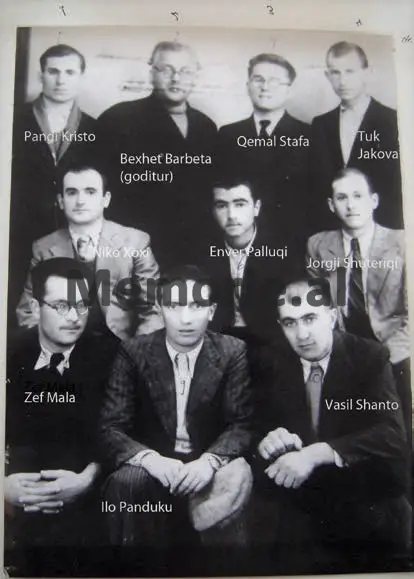
These distinguished ones began to discuss more than was their place; they even began to express the need for improvements in their communist philosophy. However, it was well known that this “liberalism” was harmful and the mouths of “these immature ones” had to be curbed and shut. Therefore, the Party had to act for the sake of the future, and thus the Russian law was authorized to be used here in Albania as well. Periodic liquidation within the family – and one of the first to suffer it was Qemal Stafa, a member of the Central Committee.
Communist hypocrisy reached the point where the tip-off given to the Italians regarding Qemal’s location, where he was “liquidated,” happened precisely on this day, which they later called the Martyrs of the Fatherland Day on May 5, 1942, and today it is celebrated with grandeur throughout the country as a day of remembrance. “What Hypocrisy!” Many at the time suspected this killing because it smelled of betrayal, and it was followed later by many, many others, but these matters were never concluded or clarified; they were always discussed in low voices, for “the devil would take you,” and this situation continued until the Party died out.
In the killing of Qemal, one thing was glaringly obvious – it was a great absurdity that on that same day, in that same fascist action, all the members of that base survived beautifully, specifically: Kristo Themelko, Flora Sata (Dishnica), Ana Jakova, as well as Qemal’s fiancée, Drita Kosturi. Kristo Themelko left for “work” before the fascists arrived, while during the siege, the three heroines – initially friends – fled like great ladies “climbing over the walls.”
When Flora was once asked during the years of “democracy” after 1991 what she thought about the sudden siege of that new base by the fascists – a base or house (it had just been rented by the Minxhozi family from Mati) – she replied: “The three of us women are still alive today; let Beqir Minxhozi also come – the one who was tasked by the Party, or rather directly by Comrade Enver, to bring a car for Çemali (Qemal) to travel to Vlora on party service – and let’s have a ‘Marie-Octobre’ type meeting. There, after memories, debates, and various discussions, let’s see if we can clarify how it happened that instead of Beqir coming with the car, the Italians came without Beqir – and when he saw and was sure the house was surrounded, he left immediately, without a thorn in his foot, just like Kristo Themelko, or ‘Shulia’ as they called him then.” (Flora, due to her dialect, pronounced the name Qemal as “Çemal”).
From the conversations gathered over the years from the communist “comrades” later “centrifuged” by the Party, it emerges that when Drita Kosturi told Qemal – before she made her escape – that “look over there, the fascists are coming in combat formation toward our house, and here they are,” Qemal was very shaken and turned around, but he saw no one – everyone had fled. To his misfortune, his thick myopic glasses fell off and he bent down to find them, but he did not find them and was wounded by a bullet that hit him below the neck and in the right shoulder. He fell to the ground there, suffered massive hemorrhaging, was taken by the Italians, and sent to the hospital, but they could not save him.
So, as you can see, his death was truly “heroic” – “he fought with a handgun until his soul departed!” However, much is said about the tip-off regarding the base where Qemal was located and mortally wounded, but one thing is certain: Qemal had to be killed because he, as a member of the “Shkodra Group,” supported Zef Mala for the head of the Party; in fact, it was said that Justina Sata (Dishnica) was also involved in this entanglement. This was also the desire of the Yugoslavs.
I also recall a very interesting case with my mother regarding this problem of Qemal Stafa and the name of Beqir Minxhozi, which sheds further light on uncovering this mystery or “communist-style” betrayal. It was the year 1954; I happened to come home late at night for service reasons from Burrel, where I was performing my military service. When I entered the only room we had, I did not see my mother sleeping in her usual place on the floor, and I asked my father where mother was at that late hour. But he also turned to me with surprise, as he did not understand this movement of mother’s – was it in the name of work or duty?!
Startled, he said to me: “I don’t know, son; they came and took her by car to go on a ‘delegation’ to Peshkopi, along with some employees of their enterprise and the director, Beqir Minxhozi. What can I tell you that are all I know – it is a time of great wonders!” I pleaded with him: “Please tell me the truth, is she perhaps sick and you are hiding it from me?” – “No, I am not joking; they took her in the late hours of the night, ‘Parole d’honneur’ – and do you know why? – Shame on those who want to rely on the great experience she has in trade, so that she can transmit this experience to the trade workers there, so they can become like Asime – shame on them!”
Then, after I calmed down, I spoke to him again but jokingly: “Well father, let us not be surprised, for they must have noticed some special positive quality in her, your wife, and it must certainly be so.” He became nervous and immediately reacted loudly: “Go on, go to sleep, for you surely have to get up early tomorrow.” But his order was an order and so it was done. Luckily for me, due to service reasons, my stay was extended by 2-3 extra days, and to my luck and hers, she arrived a day before I was to leave for Burrel.
Her account of the service she had just completed, explained with her characteristic humor while pretending to speak seriously, allowed her to extend the conversation full of jokes as much as she wanted. While we children were enjoying ourselves and laughing, father became nervous, especially when she acted like a teacher whose help was considered highly effective, receiving much praise from the trade workers of Dibra. Father meanwhile endured as much as he could and shouted with declamation: “Enough, enough with these idiocies and nonsense of the time.” So she immediately stopped the conversation and was heard no more, because the order was an order and he had unquestionable authority in the family.
However, my curiosity drove me to ask her again when father left the house, and I addressed her with the question: “What was this incomprehensible state ‘adventure’ really about?” – and she answered me: “This visit we made was in the Party program, within the framework of the campaign for the exchange of experience among distinguished workers of the trade system throughout the country. But from what I gathered – despite the fact that I was an old worker of the trade system and our director was Beqir Minxhozi – he had found out those days that I was the sister of Esat Dishnica and Meli Dishnica, and he immediately gave the order for me to join that propaganda team.
During our free time, he told me he had found out who I was and gave me much conversation; I was interested in being on good terms with the director, because work today – she said, poor thing – means bread for you and father. But leaning in, he told me that not even… (I didn’t understand what his aim was)! He wanted to find out directly from me any opinion or thought that Esat’s family had about him, and whether I had accidentally heard him being spoken of in house, which, as we said above, was often visited by former communist cadres – Esat’s house, after all.
From what I gathered, the two of them – Esat and Beqir – had an old acquaintance, as Beqir belonged to the anti-fascist youth groups and had Qemal Stafa as his direct leader, who they said was elected Secretary for Youth on November 8, 1941. During all the time we were free, he would ask me questions and talk about the time of the underground, and I was surprised at how he knew that first period of the underground in such detail; he also told me about people and events, such as those of the ‘Flora’ cigarette factory where Enver Hoxha worked as a manager.” / Memorie.al
To be continued in the next issue