By Caf Jonuz Çulaj
Part fifteen
Memorie.al/ According to the court decision, political prisoners were sent to labor camps. For the state, this contingent of people was free, as political prisoners were assigned to hard labor, mining, or reclamation. The realization of the norm was obligatory and if it was realized, it was paid with 14 old lek. If it was not realized, the profits passed to the prison command.
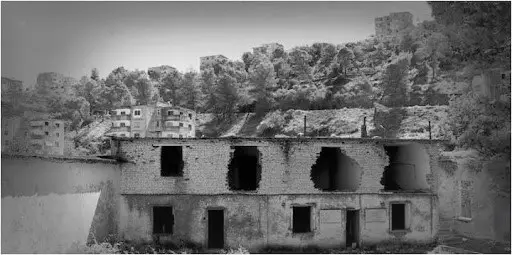
Many people worked there and few survived. Transfers to camps were common. In August 1971, I was transferred from the Vlora Saltworks to Spaç in Mirdita. What this prison personified was already known. Because of my age, I was not assigned to a mine, but to a camp for camp inmates. One day the engineer Frano Cara (prisoner), sent me to the mine, to get some beams for the palace we were building.
There we met the free technician Nikolle P. who was smoking at the door of gallery no. 3. The camp friends knew him all. We greeted each other as if we were free, because at that time social relations between prisoners and civilians were very limited.
Nikola, 30, from Mirdita, tried to help the prisoners who had to fulfill the norm. For this attitude, the prisoners honored him. He once encouraged us with the words: “Men, do not worry that all Albanians are prisoners, who in one way and who in another. Exclude the bulls of the breed.”
Nikola, was a miner boy and had practiced this profession himself. In this way, he had climbed the ladder of hierarchy from brigadier to instructor of the District Party Committee. After Enver Hoxha’s speech on February 6, 1967, Nikolla handed over the party card and went to the gallery as a technician. The cause was not known, but I would find out later.
In 1978, in the Ballsh camp, the bus from Tirana brought the new contingent. Among them, was Nikoll P. sentenced to 10 years of agitation and propaganda. According to prison custom we gave them first aid. We knew Nikolla better and stayed closer to her. He felt very good between us. In prison, you are imprisoned, he wants to confess to his friends in misery.
In these close conversations he seems to be grounded because he tells of arrest, torture, trial and punishment. Then the convict longs for the family. Someone remembered the mother, someone the father, someone the wife and someone the children. Nikolla and I became friends and played chess. One day he told me that he had been a communist (as far as I knew) and that he had left the ALP.
One day he told me: “In 1915, in Mirdita, a disease fell that devastated many houses. Only 7-year-old named Preng Bardhoku survived at home. Under the tutelage of John Markagjon, he continued his studies in Albania and Italy. In the latter he studied at the Military Academy, branch of finance.
At the time of the Kingdom, Prenga worked in Albania professionally. The year 1939 comes and as a sign of protest, Prenga resigns and works as a farmer. The end of the war is coming and Prenga gives his contribution to the eradication of illiteracy.
Understandably, the village loved him. In 1947 he was arrested as an anti-Yugoslav. In 1948, he was released but considered a kulak.
Kulak with 3 dynym of land?! He died in 1967. Before he died, the old man had left a message to the boy’s bride’s wife to bury him away from the graves of his ancestors.
The trust was the trust and had to be fulfilled. The deceased, dressed in the best clothes. The wife and daughter took over the funeral. The burial place was 10 km. away and seemed the very long way. The day before he died, Preng Bardhoku, attended a meeting where the Albanian “Zeus” himself had been. At that meeting it was declared that the class struggle should be intensified.
The next day, Nikolla and a friend of his left for the place where Prenga would be buried. On the way they saw the mother who was loaded with pickaxes and shovels and the daughter who was carrying the dead on her back. As usual, Nikola had a conversation with them while his friend did not speak. Nikola learned about the old man’s will there.
The bride carried the dead man on her back and tried to catch her breath. Nikola faced a great test. As a mirditor he knew the custom of the country, while as a party member, he had to know the law that Enver Hoxha had proclaimed. Being a real Mirditor and at the same time a communist was a job that did not work. At first, he thought, I am Mirditor. Nicholas entered the forest and cut down two tall trees where he placed the dead to bury. The next day he was summoned to the district Party Committee. When asked by the first secretary what the action of the previous day meant, he answered nothing more than a human action. To the other question that this is how the class war takes place, he answered that the class war is waged against the living and not against the dead.
He remembered the saying of a well-known Greek philosopher, “the culture of a nation is measured by the veneration of the dead.” Tue continued the retort with the 1st secretary, he ended by saying: “If my action is called inappropriate, then I am a foreigner to this party”. And immediately handed over the card. After this story I heard, Nikola felt relieved. I looked at him respectfully. I later learned that he was convicted of agitation and propaganda. After 20 years we reunited and hugged. Today he lives on the outskirts of Durrës. Memorie.al