
Part Twenty-Four
Memorie.al / Even though the CIA cooperated closely with King Ahmet Zogu, with the aim of overthrowing the communist regime in Albania, in several documents interesting details are given about his activity in emigration. There have been many accusations and statements against him, while according to a document declassified by the CIA, it is stated that Zogu had cooperation with Arab officials and representatives of Muslim movements and they helped him financially. On the other hand Mit’hat Frashëri is described as a man who had collaborated with the fascists initially and later with the Nazis. In other documents declassified by the CIA, the clashes of the Americans with the Albanians who escaped from the communist regime are shown.
Continues from the previous issue
12 August 1954
Consideration of the dissolution of the NCFA
A memorandum dated 1 July 1954, on the National Committee of “Free Albania”, has been sent to the Security Division as a matter of high interest. The CIA has requested to be notified of any development regarding this matter. After the request for the dismissal of four members of the 4,000-strong force of the NCFA (National Committee of “Free Albania”) in Germany, the group began investigations into whether political activity within the company was disturbing its effectiveness.
We were answered that in the absence of information on the request, it was recommended not only the suspension of the leaders, but also of possible replacement leaders. The proposal was discussed in the psychological warfare branch, but they did not agree with the recommendation for the reason that the Army had very little information and that the risk of propaganda was too great, to move prematurely. On 13 May 1954 the Department of the Army advised that one of the four individuals had withdrawn his opposition, therefore the dismissal of the three remaining was requested.
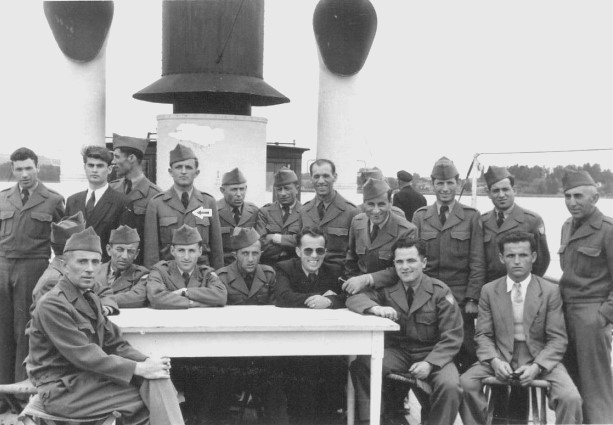
On 25 May, the results of the investigation were studied by CIA officers, who determined that there was no logical security basis to dismiss the three individuals. An Army note dated 17 March 1954, reflects that the National Committee of “Free Albania”, financed by the US and controlled by the US and Britain, has recruited according to the recommendation of the US about two hundred Albanian refugees, for the Labor Company in Germany.
The Department of the Army had no interest in this Company, among the officials of the NCFA they consider the Company as their personal army, with which one day they will liberate their country. After four and a half years that the NCFA is financed by the United States, the small pro-British grouping within it, the “National Agrarian Front”, is seeking that American funding for the committee be used to determine the “National Agrarian Front” as the future government of Albania.
The Meeting
In a meeting of the Department of the Army with the British authorities in October 1953, a reorganization of the NCFA was requested, to equalize British control and influence within the organization. The “National Agrarian Front” understood that they could no longer exploit the financial support of the US and withdrew from the Committee. Immediately after the withdrawal its leaders began an anti-NCFA and anti-US propaganda campaign, against the organization for which we have invested more than 1 million dollars.
Unfortunately, these leaders of the “National Agrarian Front” had about 80 followers in the Albanian Labor Company in Germany, who were also spreading anti-American propaganda among Albanians in emigration. In this way the United States was being made to look ridiculous by financing its enemies, who worked for the destruction of the group that the US supported financially and morally.
To this is added the fact that about 120 Albanians of the Labor Force in Germany who support parties friendly to the US, may be forced to leave the Company by their political leaders, if the United States does not take steps against those who sought to destroy it.
The ideal solution is certainly the dismissal of all 80 militants, but this action is not practical, for reasons of the difficulty of replacing them in the German Company. Therefore, in a discussion with Colonel Smith, it was decided that the best solution was the dismissal of four or five main leaders of the opposition. Their names were Çaush Basho, Rustem Kucka, Kasem Alimehmeti, Adnan Ypi.
Information on Zogu
In an information summary dated 17 May 1954, the following information on the Albanian Legalitet party was reflected; it results to be the political exponent of the former King Zog of Albania and consists mainly of former members of Zog’s Albanian army.
After Zogu’s departure from Albania, the party began to operate abroad headed by Abaz Kupi, former major of the army. Other members include General Pervizi, Xhemal Aranitasi and Avdul Sula. The Legalitet party had two main centers, one in Egypt, where the party received help from Arab leaders and other Muslim movements, and the other was located in Rome, at “Via Laverno” 42.
The latter was the technical and political center of the party led by Kupi. The group received financial support from an Italian group sympathetic to Albania during Zog’s regime.
Legaliteti was also in contact with British intelligence with whom they met on the Greek island of Crete, where counter-intelligence courses were also held for agents who would later be sent to Albania on behalf of the British. The grouping was part of the National Committee of “Free Albania” formed in the US, which also had centers in Rome.
The role of Mit’hat Frashri
The report of 5 May 1954 on Albanian political parties in emigration shows that the “National Front” was originally created in 1939 under the influence of Mit’hat Frashëri (formerly ambassador of Albania to Greece). After the capitulation of Italy, the “National Front” was split and was no longer organized. Most of the group at the end of 1944 moved to Italy together with the Italian troops, where they were initially held as prisoners of war.
Others joined the partisan resistance movement in Albania under the leadership of Enver Hoxha, or in Yugoslavia under the direction of Tito. Frashëri himself immigrated to the United States after the Second World War. He spent several years in other countries, trying to organize Albanian resistance groups, and on 26 August 1949 in Paris, he managed to create the National Committee of “Free Albania”, whose purpose was the organization of all Albanian groups against the communist regime.
Frashri was the leader of the “National Front” until his death on 4 October 1950, when he was replaced by Hasan Dosti, who lost his post recently, after the elections of 24 February 1954 in Naples. Currently the “National Front” is divided into two factions.
The first is the “Agrarian” one with headquarters in New York and led by Abaz Ermeni, which has branches in London, Paris and Athens. This faction wants the establishment of a democratic government in Albania and is also represented in the International Peasant Union, as well as in the NCFA.
9 October 1952
Memorandum of the conversation with King Zog of Albania
I visited King Zog at his villa in Alexandria on 8 September 1952, to receive a preliminary report from his emissaries in Yugoslavia, who had returned that morning to Egypt. The emissaries were Irfan bey Ohri and Colonel Derralla, who on their journey were accompanied by Lutfi Tozani, the Turk who functioned as Zog’s representative in the first contacts with Marshal Tito.
Zogu declared that the delegation had traveled from Turkey to Skopje through Greece and that Irfan Bey was his spokesman, while Tozani was accompanying the group, because he was skilled in organizing meetings with the Yugoslavs.
The group had been well received by the Yugoslavs and had been accompanied to a villa not far from Skopje, where they had stayed during the time of the talks that lasted two days. The Yugoslavs were called by the names; Colonel Branko and Cedo. After some conversations Irfan Bey determined their exact names as Branko Stankoviç and Osdomit Mijoviç.
The first seemed more important than the other, perhaps a representative of the secret services of the UDB, or the Ministry of Foreign Affairs, since he was more in the inner circle and spoke with authority on political issues. From the accent he seemed like a Croat, whiles the other spoke like a Montenegrin, and was perhaps a lower-level officer of Albanian affairs in the UDB, since he was more in the inner circle of Albanian issues and figures.
Details of the conversation with the Yugoslavs
Zogu said that at the meeting, after some conversations, Colonel Cedo told Irfan Bey, that the Yugoslavs understood that Zogu was interested in weapons and funds. Irfan Bey said that there was a misunderstanding in the King’s message conveyed by Tozani. The King was interested in creating a plan for the liberation of Albania, in cooperation with the Yugoslavs, and if the need arose for external support, the Yugoslavs would secure this from the United States. Key for Zog was the preservation of the integrity of Albania within its current borders.
Colonel Branko said with enthusiasm that the Yugoslavs were grateful to be speaking with serious people and not with adventurers. In another phase of the negotiations the Yugoslavs took Irfan Bey and Derralla separately, to ask them if Tozani could be eliminated from future discussions. Irfan Bey explained that neither he nor Daralla were political people and that the purpose of their visit was to convince the Yugoslavs to send a representative to speak directly with Zog.
Branko said that this could be done, while when Irfan Bey suggested starting the talks with the mediation of the ambassador in Cairo, Branko said that this could not be done. From the manner of refusing the proposal, Irfan Bey had the impression that the Yugoslavs did not have full trust in their ambassador in Cairo, or had other reasons that they thought made him unsuitable for negotiations with the King.
The pardon of some persons
Then, Colonel Cedo brought out a list of about 40 names and asked if the King would accept these people. When asked what he meant by “accept”, he answered if the King would pardon these people and allow them to kiss his hand. Irfan Bey was not allowed to keep the list, but he noticed that in it there were some people of the Second League of Prizren, sponsored by Yugoslavia, a number of personages in Albania including also six Titoist communists.
One of these latter Irfan Bey believed was a general. The list also had names of Albanians in emigration, such as Muharrem Bajraktari, Said Kryeziu, Abaz Kupi and Gjon Markagjoni. Irfan Bey said that he was sure that the King would pardon these persons and would work with all Albanians who seek the liberation of their country.
The Yugoslavs asked what the King would do regarding the organized groups of Albanians in emigration, such as the committee of “Free Albania” based in Rome. Irfan Bey answered that the King would act as with all other groups and would try to cooperate. When Colonel Cedo said that; the National Committee of “Free Albania” was financed by foreigners, Irfani asked; “Who finances the ‘Second League of Prizren’?”, which caused laughter and the discussions moved to the next point.
Colonel Branko asked why the King had done nothing until now, to incite revolution in his country. Irfan Bey answered that this depended on the mentality of Albania’s neighbors, since the King did not want to act until he had guarantees that the country would not be divided among them. Colonel Branko repeated that Yugoslavia was in favor of the integrity of Albania.
The Plan
Discussing the manner of starting the revolution, King Zog thought that the action could start 30-40 km. far from the Yugoslav border, while the Yugoslavs said that it would be better for Albania to be liberated by the Albanians, but if they did not have the ability to overthrow Hoxha’s power, the Yugoslavs would do it in their own way, since the current state of things in Albania is intolerable.
When asked for the latest recommendations, the Yugoslavs gave two: King Zog to maintain secrecy and to be as sincere as possible in relations with them, and the second, the King not to include any other power in these discussions, until a full agreement was reached with the Yugoslavs. Irfan Bey also commented on the contempt of the Yugoslavs, when they spoke about the Soviet Union.
Zogu said that the talks with the Yugoslavs were taking an interesting character, but he thought that they were simply trying to discover about his intentions and the ways in which they could use him for their interests. He considers essential the involvement of the United States in the overthrow of the current regime.
5 May 1949
Contacts with King Zog
The following information is obtained through unofficial channels; therefore care should be taken with the discussions of the branch regarding the matter. Our source is a Swiss merchant with interests in Egypt, and partner in the company of Vehbi Frashëri, member of Zog’s personal security service, and the son of Mehdi, former Prime Minister of Albania now in exile with King Zog in Alexandria, Egypt. Our source and Frashëri make frequent trips to Egypt for business.
During the period October-November 1948, he had several conversations with King Zog, in one of which Zog proposed to him cooperation with the United States for intelligence operations in Albania, with the implication that the US would use two or three agents chosen by him in operations. Zog claimed that he had contacts with army officials, or several ministries in Albania who were loyal to his cause, through whom he believes he can overthrow the regime and declare himself King within a few weeks.
But before starting this enterprise, he sought to have the moral or material support of the United States or England, as a kind of promise for the recognition of his future government. Zog made it clear to the source that he would negotiate only with a special representative of the American embassy. To prove his claims Zog gave the source a list of his contacts and agents in the Near and Middle East, or of other Albanians in Europe./ Memorie.al
Continues next issue