Part nine
Memorie.al / The CIA have released further details regarding the communist regime in our country. According to a document detailing developments in the United Nations Organization in 1960, Albania was the only state that defended China’s viewpoints. What the CIA emphasizes is that Enver Hoxha was absent from that meeting. On the other hand, the CIA had hoped that the Albanians would overthrow the regime, as it relied on the resistance offered to the Ottomans.
Continued from the previous issue
August 1956
Since 1946, the Soviet Union has provided approximately 5 billion dollars in economic and military aid to the countries of the Soviet Bloc, primarily to China (about 1.5 billion) and East Germany (1.4 billion), which have received roughly 58 percent of Soviet aid. Meanwhile, loans and credits to other countries are generally calculated at 2.1 billion for the purchase of Soviet economic goods, 1.2 billion in military equipment, 1.1 billion in economic development projects, and 550 million in imported goods.
The USSR has also provided grants totaling 360 million for North Korea and Vietnam. Until 1954, Soviet loans were mainly intended to alleviate the difficulties of transitioning through the hard post-war situation, while later credits focused on the purchase of joint-stock shares or military loans. At the 20th Congress of the Soviet Communist Party on February 14, 1956, Khrushchev stated that the USSR was helping build 391 production enterprises in the countries of the communist People’s Democracies.
He stated that the USSR had provided these countries with 21 billion rubles (about 5.2 billion dollars) in aid, a figure that also matches the calculations of intelligence agencies. The amount of aid provided so far to Albania cannot be calculated, but the first credit agreement was signed in February 1951. According to it, Albania would receive industrial equipment and technical assistance over the four years of the agreement, which would be repaid over the years.
Meanwhile, reports state that the country has received assistance in the construction of many industrial installations, such as hydroelectric power plants, oil refineries, textile combines, and various leather, wood, and food production factories. In 1954, communist leader Enver Hoxha announced that the USSR had granted Albania considerable credits and economic privileges for the development of the country.
November 1960
Differences between the countries of the Soviet Bloc
The emergence of the conflict between China and the Soviet Union over the application of Lenin’s teachings has brought various effects on the communist democracies of Eastern Europe. The geographical and economic realities of certain countries determine the degree of subordination of satellite countries to the Soviet Union.
The dependence of satellites on the USSR for raw materials gives the latter immense leverage over the Bloc, with the exception of Czechoslovakia, East Germany, and also Albania, which does not produce finished goods and can therefore utilize more distant and uncommitted resources. Even Albania’s needs for credits are relatively small.
Geographically as well, the closer a satellite country is located to the USSR, the smaller its independence. Bulgaria and Albania, which had been the most backward satellite countries, have made the greatest progress in terms of industrialization. The arena of Albanian politics is hermetically guarded and we know little about what happens there, but looking at their history as fighters, initially against the Turks and other foreign invaders, it was easy to think they would cast off communism as well.
However, it seems their spirit of freedom had not factored in internal oppression of the same kind, or perhaps Enver Hoxha’s unique ability to captivate his people with the fear of Yugoslav power in order to consolidate his personal rule. By now, Hoxha and Shehu seem to have firmly saddled the horse of power in Albania, the geography of which guarantees a certain freedom of action regarding the USSR, limited only by the difficulties of finding an alternative sponsor.
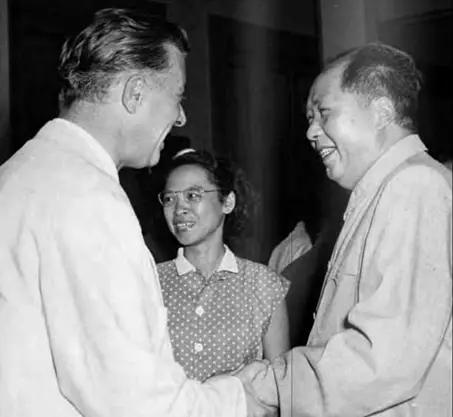
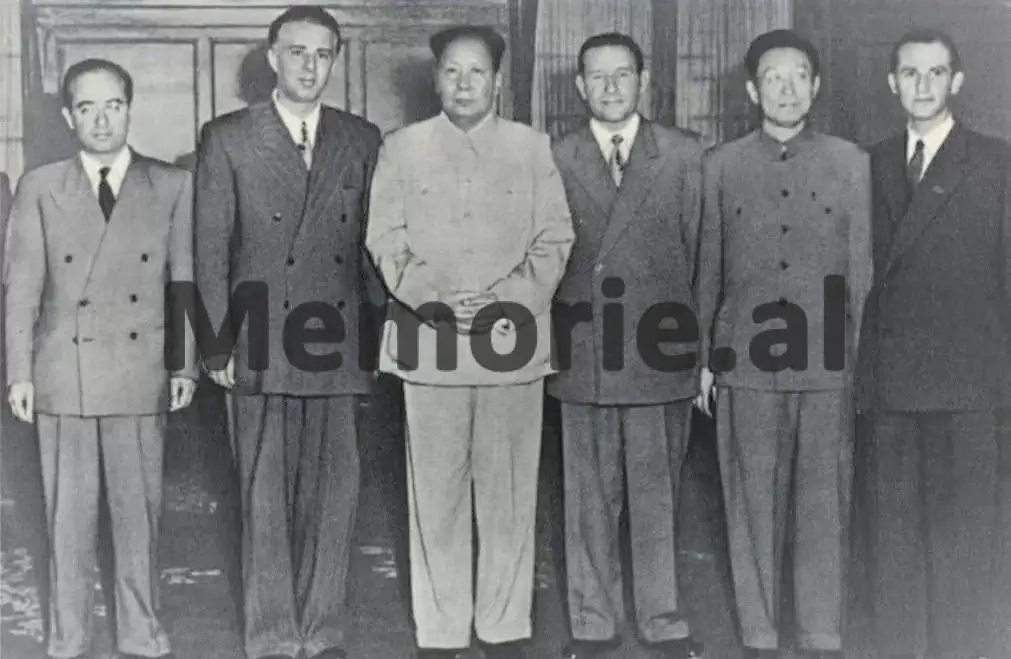
Differences among satellite countries appeared to have been smoothed over at the Bucharest conference, with the notable exception of Albania. The Albanian delegate was reported to be the only one who stood up in defense of China’s viewpoints, while Enver Hoxha was the only satellite head of state who did not participate in Khrushchev’s hearing at the UN in September. On the other hand, Albania was the only country present at the October 1960 celebrations in Beijing, represented by Deputy Prime Minister Abdyl Këllezi.
On October 4, 1960, he declared that China and leader Mao Zedong are the only ones correctly interpreting the Marxist-Leninist line. The Chinese, for their part, through Central Party Committee Secretary Chen Peixian, expressed the conviction that; “the heroic Albanian people do not fear threats of violence or difficulties, and have never had illusions about true friends and enemies. They have opposed imperialist policies and war, led by the USA.”
On the day of this speech, a shipment of grain arrived at the port of Durrës, which was so important that it was mentioned in a special announcement by Radio Tirana. The shipment came from distant China, at a time when Beijing itself was suffering from grain shortages. Much like other Balkan countries, the anomaly of Albania’s defiance of Moscow is coupled with the notion of its leaders’ personal rule.
Albania’s communist leaders truly came to power following Stalin’s break with Tito, and consequently following the break of the Albanian communist party with Yugoslavia, which halted the process of Albania’s absorption by its more powerful northern neighbor. As a result, Hoxha and Shehu rose in rank from leaders of a sub-Soviet satellite country (i.e., initially of Yugoslavia and then of the USSR), to that of a Soviet satellite country.
Therefore, we can safely say that they would not want a return to the previous inferior order, which might now seem like a real possibility following Khrushchev’s re-rallying of ties with Yugoslavia. Since Beijing’s behavior toward Yugoslavia has been uncompromising, it is natural for Albania to side with the distant communist power, whose moral and political support may suffice to disturb Moscow’s peace.
Practically now the Albanians are independent, and this increases the regime’s domestic prestige. It goes without saying that the Albanian claim to defend communist ideology and purity is ridiculous.
April 1969
Albania-Yugoslavia-Romania
Albania has made an unprecedented public statement saying that, together with Yugoslavia and Romania, they share common reasons to resist the Soviet threat. In an April 11 editorial, the party organ “Zëri i Popullit” maintained one of the most positive tones toward Belgrade in many years. At the time of the Warsaw Pact’s invasion of Czechoslovakia, Albania halted its controversies with its main enemy, Yugoslavia.
It resumed verbal attacks on the Yugoslav line in late October, but surprisingly halted them again before the 9th Congress of the Yugoslav Communist Party last month. Except for a single instance, the Albanian press did not comment at all on the Congress, which had previously been the primary target of attacks by “Zëri i Popullit.” Ever since distancing itself from the Warsaw Pact powers in the early 1960s, Tirana has maintained relatively good ties with Romania.
Although they have previously suggested they share a common cause with Bucharest, the “Zëri i Popullit” editorial is so far Tirana’s most open attempt to unite the two countries in opposition to Soviet policies. The new approach of Albanian communist party leader Hoxha toward his Balkan neighbors, but especially Yugoslavia, reflects Albania’s recognition that it benefits from the protection of Belgrade’s and Bucharest’s policies aimed at preserving independence. / Memorie.al
Continued in the next issue