Part Twenty-Five
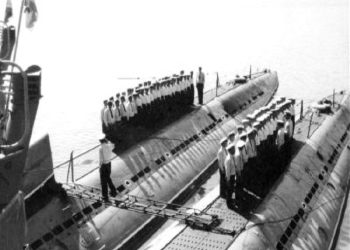
Memorie.al / The CIA have shown the great role that the Soviet Union played in communist Albania. In several “Top Secret” documents, but declassified for years, it is shown that the USSR built several important military bases, especially in the South of the country. There, the submarines that Moscow had on the island of Sazan and the Bay of Vlora are shown in detail, and likewise the air bases, such as that of Rinas, Kuçova, etc. Then a panorama of political developments is given, where the dismissal of Defense Minister Beqir Balluku in the summer of 1974, from all functions in the army and party, is mentioned. Likewise, a special place in the documents that the CIA has declassified are also those that speak of Albanian political emigrants in Yugoslavia, who are incorporated into the Committee of Prizren initially led by Apostol Tanefi and under the pressures of the UDB, which recruits them with coercive measures, such as return to Albania, etc.
Continuation from the previous issue
Relations with Yugoslavia and the satellites
New economic exchange agreements have been signed between Albania, Romania, and Bulgaria. Romania has undertaken to send factory technicians and train Albanian workers. It will send to Albania cement, glass, corn, clothing, and fishing equipment, in exchange for cotton, crude oil, olives, citrus fruits, and other fruits. Bulgaria will also supply construction materials and livestock.
In general, relations between the Soviet satellite countries are strengthening and Albania’s dependence on the Soviet Union is of a colonial type. Meanwhile, relations with Yugoslavia are becoming tense and the Albanian press does not miss an opportunity to attribute the current situation to what it calls Tito’s “betrayal.” Albanian newspapers describe daily the border provocations of the Serbs against Albania.
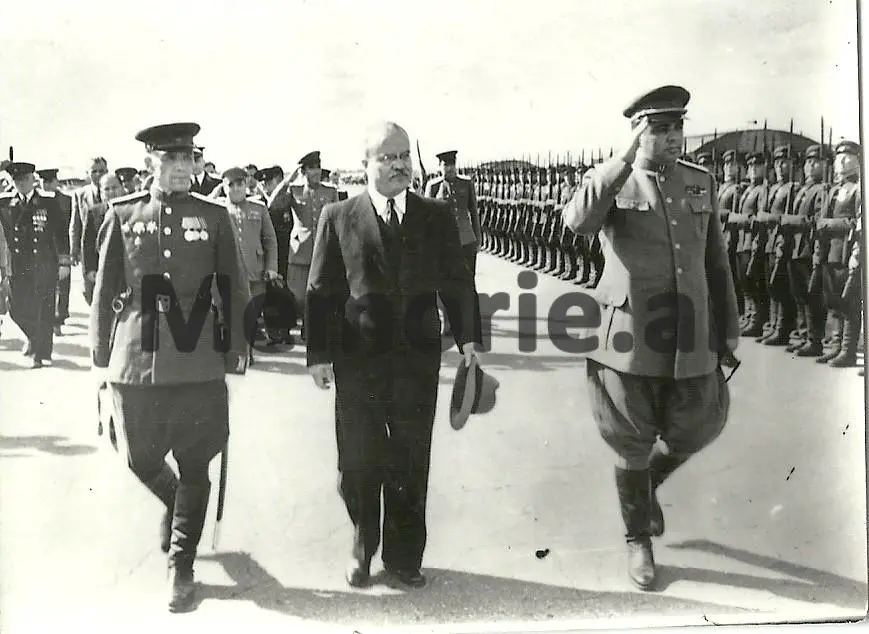
In the Kukës region, several border incidents were reported in June between Albanians and Yugoslavs. Clashes have also occurred between Albanian guerrilla groups coming from Yugoslavia and army units. The support from the USSR of Albanian propaganda and its version of the incidents is shown by the wide presence of military representatives of Czechoslovakia, Hungary, Romania, Poland, and the USSR at the celebration of the Albanian Army Day.
October 1947
Recruitment in Italy of Greek guerrillas
The recruitment of communists for the Greek guerrilla international brigades has continued in the northern areas of Italy under the care of Tito’s officials. After recruitment, they cross into Albania by means of fishing boats. However, the number of recruits has been small since Italians of fascist conviction prefer to fight those they call “Greek fascists” only verbally. Those registered receive a bonus of 100,000 lira.
They pass from Milan to Bari, to Albania, and then to Greece. It is reported that between June 20 and July 20, 1947, about 900 communists recruited by Tito’s officers have passed through the ports of Ancona and Trieste, but the information is not confirmed. One of the organizations working with recruitments is PARATO, which appears also involved in the arms trafficking of the guerrillas.
The weapons come clandestinely from the factories in Brescia and are sent to southern Italy and then to Albania, by the same routes used for personnel. The chief organizer in the province of Novara is Moscatelli, while the funds and a part of the weapons are all given by Russia. Moscatelli is reported to have met recently with Tito in Fiume. The information was reported by a resident of Fiume, who arrived recently. The recruitment propaganda spreads throughout Italy, while the main recruitment centers are in Turin, Milan, and Bologna.
In Milan, the center is directed by the communist Pietro Secchia. Moscatelli is the second commander of the communist brigades fighting in Greece, while the head is reported to be a Jewish Pole from Leningrad. One of the main recruitment centers is the café “Vittorio Emanuele” on Via Orefici in the center of Milan, which is always full of Albanians, Greeks, Yugoslavs, and Italians. They try to persuade people to go and fight for the “freedom of peoples” and do not care whether the recruits have been fascists in the past or not. In Milan, the well-known Greek communist Elia Liarutzos has also appeared.
September 1948
Greek guerrillas in Albania
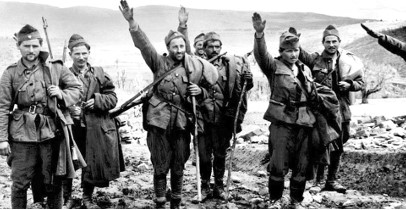
Although the Greek army has successfully managed to push about 1,400 guerrillas toward Albania from the Murgana area, south of Gramoz, the army has suffered defeat in the northern area of Vitsi, where counter-attacks from groups of communist guerrillas in large numbers have forced the army to withdraw while awaiting reinforcements. During the week, the numerical strength of the guerrillas has increased by 300 persons (to a total of approximately 21,000 people) and their activities have been of small scale but effective.
The guerrillas receive supplies from Albania, but a parachute drop has also been reported in the Peloponnese. Fire exchanges and cross-border crossings have been reported in all Greek border areas with the satellite countries. Even in cases of the withdrawal of guerrillas into Albania and Yugoslavia, they are rearmed and supplied to return to attack. In all likelihood, the Greek army will not manage to withstand the concentrated guerrilla attacks on its northern borders until the end of 1948.
April 1949
The temperament of Greece has been greatly irritated recently after it was understood that without Albania’s support, the Greek communist guerrillas would not have been able to launch their harsh attacks in the Gramoz area. Many right-wing newspapers in Athens have called for a retaliatory military expedition against Albania, while opinion in general has sought concrete intervention by the United Nations and not merely the publication of its reports on events in the Balkans.
Greek public feeling is quite inflamed at present and only an intervention against Albania would calm it. The issue will certainly serve for the revival of the political right in Greece that had been somewhat eclipsed by the current coalition government, but also distracts attention from the important tasks of the country’s economic recovery.
Although Albanian support for the Gramoz attacks does not represent changes in Soviet policies, each of Greece’s northern neighbors is expected to closely follow international reactions. If the issue is not given importance or is poorly managed by the UN or the four great powers, Albania and Bulgaria may feel free to continue supporting the Greek guerrilla movement.
January 1947
The reworked Constitution of the “National Front”
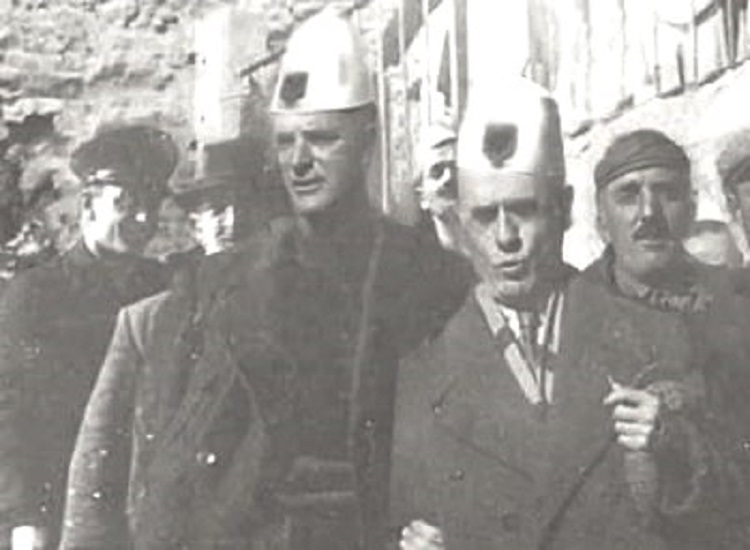
The leader of the “National Front,” Mit’hat Frashëri, is reported to have rewritten the Constitution of the Albanian political group in 1945. Below is a copy of the original draft:
Constitution of the “National Front”
“The National Front” is an Albanian democratic party cemented with the blood of thousands of national martyrs and is based on the unshakable faith of the soldiers of freedom and freedom-loving Albanians.
“The National Front” includes all classes of the people and will be organized according to the will of the people. The main parts of this organized body are the central units that form the core of the “National Front” and its intellectual, spiritual, and educational elite.
Its central organs are the Congress, the Central Council, and the Central Bureau. Its regional organs are the Regional Congress, the Regional Council, the Regional Bureau, the Council of prefectures and sub-prefectures.
“The National Front” has members and friends. All friends (Albanians) with good morals and good political credentials may be accepted as members, in case they have reached the age of eighteen, accept the principles of the organization, and take the oath on the flag to serve the homeland with discipline and self-sacrifice.
No member of the “National Front” is allowed to belong to groups that are not part of this organization. This constitution is provisional, until the creation of the organ accepted by the Congress.
Political principles
The National Front seeks to contribute to the security, order, freedom, well-being, and progress of Albania and Albanian society, through democratic organization and participation in government based on the will of the people and free elections.
“The National Front” wishes to cooperate with all parties and national groups that respect the freedom of the homeland and those who sincerely want security, well-being, development, and harmony.
“The National Front” opposes with all its power the parties, tendencies, or individuals that harm the interests of the country or use force, violence, or corruption to achieve power.
“The National Front” wishes that the provisional power in Albania be given to the High Council, which should allow the necessary time to prepare for a better form of government.
“The National Front” wishes that the elections be held one year after the party’s return to Albania, and that they be free, universal, direct, and secret elections. Then the assembly created by them shall decide on the final form of the constitution.
“The National Front” wishes that the administration of the country, the heads of communes, mayors, and economic councils be elected by the people so that the people are interested in the affairs of the state. “The Front” wishes special care for Albanians outside the homeland and their protection.
“The National Front” supports friendship and close cooperation with the Anglo-Americans, whom it considers as guarantors of freedom, defenders of Albania’s rights and of true democracy.
Regarding relations with neighboring countries, “The National Front” wishes sincere friendship and cooperation in economic and political spheres. “The Front” wishes the sacrifices that Albania has made to be taken into account. “The Front” wishes that with other states Albania have good diplomatic, economic, and cultural relations.
“The Front” does not wish any foreign power to have harmful influences on our national interests. “The National Front” wishes that Albania be represented in all international conferences, in the UN, are assigned responsibilities and privileges, as well as in any conference where Albania’s interests are involved.
“The National Front” seeks that Albania participate in international organizations that ensure peace, freedoms, national integrity and dignity, through fraternal economic and social cooperation.
June 30, 1949
Intelligence memorandum on policy for the future and independence of Albania
As far as I understand, our agent has returned with quite a lot of information on the situation in Albania, including the memoranda of conversations he has had with two officials in Italy (one from the British embassy there and the other Del Ponte). I also understand that the American military attaché in Rome is also very excited about the situation in Albania and has given signs that he might involve himself in this matter.
But he must be told not to interfere because with these activities he will only exceed his competences, confuse, or interfere in our work. I suppose G-2 will receive a cablegram with the appropriate instructions for the American attaché in Rome. If the proper cablegram with instructions for the conversation with Colonel Smith does not come, I believe we should draft a text.
Regarding the recent conversation between Lleuellyn Thompson and the former French minister in Albania, I understand that Mr. Thompson had quite interesting things to say. He was impressed by the statement that the Albanians themselves admitted that Albania had no future as a completely separate and independent country, and that for economic as well as political reasons, Albania and the Albanians would be much better off linked in one way or another with one of their neighbors, Greece or Yugoslavia.
Mr. Thompson did not make clear with which country the Albanians felt closer, or how widespread this feeling was among the Albanian people (If this information is true it is very valuable, it is because it conflicts with our previous information. According to our intelligence, the Albanians are terrified of annexation, especially by the Greeks, and believe that no liberation of the country would guarantee non-interference by the Greeks). This conversation had a number of interesting aspects; therefore I wanted a complete memorandum of what was reported by the French.
Mr. Thompson said he would try to draft a complete memorandum of the conversation but was pressed for time, so much so that he could not give the date of completion. I believe we should follow this path as much as we can get from Mr. Thompson, plus the other information we have at our disposal./ Memorie.al
Continuation in the next issue