By Ergys Alushi
Part One
Memorie.al / “The history of a city is not just two or three dates. The history of a city is every day, every hour, and every minute it lives; it is its people, because without people, there is neither city nor history!” These words conclude an article by Gëzim Zilja titled “In the Footsteps of Vlora’s Photography,” published 25 years ago. It remains one of the few writings dedicated to the history of photography in Vlora. And who better than photographers can capture the history of a city and its people? Truth be told, Vlora has an early tradition in the profession of photography. It could not have been otherwise for a city that descends from hills and mountains to be refreshed by the sea breeze. Nature had bestowed upon it all its beauties; thus, it is no coincidence that the people of Vlora are inherently photographers, painters, and admirers with high aesthetic standards.
A photograph taken in Vlora takes on different values – it is full of color. It is not by chance that the first cinema in Albania did not open in Vlora, nor that there exists what has been called the “Vlora School of Painting.”
The First Cinema in Albania Opens in Vlora
When discussing the history of cinema in Albania, it would be impossible and absurd not to mention the fact that the first cinema opened in Vlora, and the man credited with this achievement is Kojdhel Zilja. He is one of the early pioneers in the spread of cinema in Albania. In 1914, when the Italians occupied Vlora, they set up a wooden shack where various films were screened for the soldiers stationed in the city.
After the Italians left Vlora, Kojdhel Zilja began operating the cinema himself, naming it “Përparimi” (Progress), intending for its operation to contribute to the country’s advancement. He even brought an Italian to Vlora to work as a projectionist for about three months, but his tenure was cut short when he contracted malaria and never returned. The cinema remained open until 1923. Following its closure due to a lack of funds, Kojdhel was summoned to Tirana in 1925, where he opened the first public cinema named “Nacional.”
The Beginnings of Painting in Vlora
The first painter of Vlora was Vasil Talo. Before him, painting in Vlora was known through the works of David Selenica or in churches, where the Codices of Vlora are famous. That was all. Very few people were familiar with painting in Vlora – perhaps only those who had been able to enter the homes of Syrja Bej Vlora and Eqerem Bej Vlora, whose walls were covered with numerous paintings. Vasil Talo was the first to bring painting to the common people – art that was painted among the citizens and easily viewed by them.
There is still no exact date or period for Vasil Talo’s beginnings in the city. What is known for certain is that he was the inspiration and teacher for a talented generation of Vlora and Albanian painters who became representatives of the “Vlora School of Painting.” His most esteemed works are considered to be “Kavalona” and “The Little Fisherman,” the whereabouts of which are currently unknown. Other notable paintings include “The Fishing Boat,” “Coastal Village,” “Olive Trees,” and “Ships.” This lineage includes Petrit Ceno, Skënder Kamberi, Nestor Jonuzi, Rakip Shabani, Agron Dine, Hilmi Bani, Sabaudin Xhaferri, Lefter Shtëmbari, Agim Sulaj, and many others.
The Beginnings of Photography in Vlora
The beginnings of photography in Vlora coincide with the start of the 20th century. Evidence from those years shows that photographs were taken even during the Proclamation of Independence and the functioning of the Vlora government, but no one knows where they ended up or where they are located today. Even for the few photographs from that historical period, no one remembers to mention who the photographer was. Undoubtedly, they must have been from Vlora or at least a resident professional in the city. Just as Shkodra had the Marubi family, Vlora had its own “Marubis.” They are forgotten. No one speaks of them or evaluates their contribution.
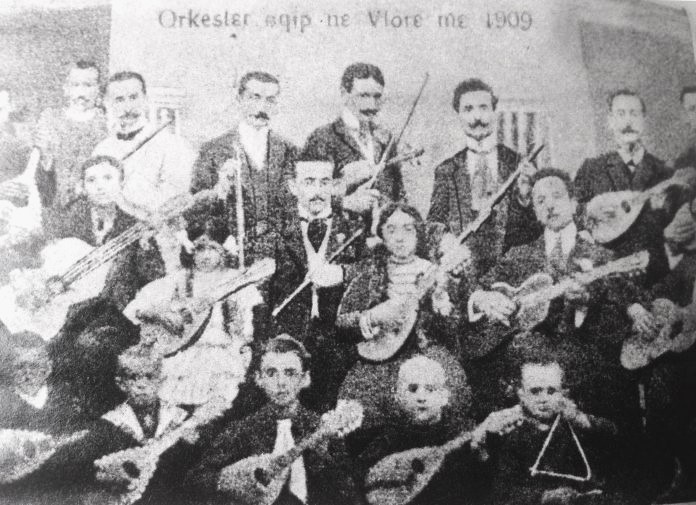
One of the first photographs dates back to 1909. It was posed in Vlora 110 years ago and printed in Sofia, Bulgaria, by the Albanian printing house “Kristo Luarasi.” The photo depicts the 20 members of the first Albanian orchestra of Vlora, also founded in 1909. The inscription reads: “ALBANIAN ORCHESTRA IN VLORA, 1909.” In the State Archives, as well as in the archives of historians and personal family collections, there are a significant number of old photographs taken in Vlora before and after 1909. While the inscriptions and locations identify them as being from Vlora, the authors remain unknown – whether they were locals or merely passing through.
Thoma Ninija
He is considered one of the first photographers in the city of Vlora. Hailing from a family of craftsmen living in the old “Varrosh” neighborhood, he met Gegë Marubi in 1915. He learned the trade from him, and together they opened a photography studio in the center of Vlora, which operated until 1960. He is credited with capturing the funeral of Ismail Bej Vlora in Kanina, the funeral of Avni Rustemi, views of the city over various years, and portraits of patriots and fighter units. Sources from the time indicate that King Zog chose him as a photography specialist during a multi-day visit to the south. He passed away on June 16, 1973, leaving the trade to his son, Stiljano Ninija, and subsequently to his grandson, Dhimitri.
Skënder Beqiri
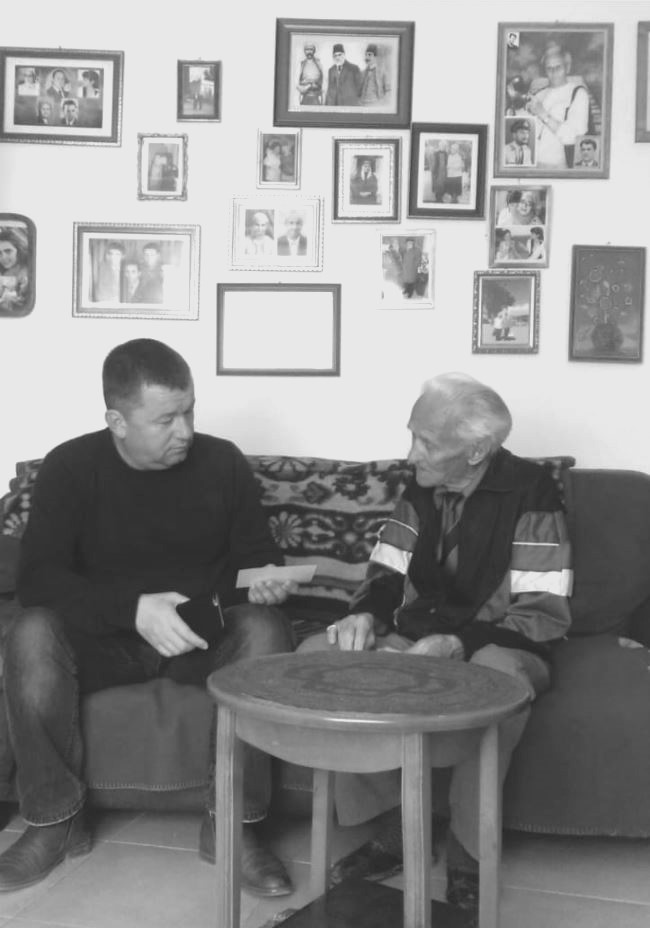
Now in his 90s, he proudly states that he is one of the students of Thoma Ninija, from whom he learned the trade and techniques of photography. He arrived from Chameria at the age of 15; having spent the next 85 years growing up and being educated in Vlora, he feels like a local. “I have worked hard for Vlora, and all of Vlora knows this. I owe Vlora the care and respect it has shown me. I am 93 years old, and as I approach the end of my life, I want to leave Vlora an exhibition of rare photos—ranging from the time before, during, and after Ismail Bej Vlora, the era of Fan Noli, the years of WWII, and the reconstruction of Vlora up to the years of democracy.”
“I was present when Enver Hoxha came for the 60th anniversary of the Proclamation of Independence at the Independence Monument. I was the only photographer authorized by the First Secretary of the Vlora district. The authorization was actually given by the Chairman of the Executive Committee, but the Secretary, to ensure I wouldn’t miss the ceremony or the official dinner, filled out an authorization himself. Enver Hoxha took the daughter of Isa Boletini – who was persecuted and working in the municipal services – by the arm and said: ‘Here we have our Isa.’”
Skënder Beqiri’s wife, also from Chameria and who passed away five years ago belonged to the prominent and patriotic Dine family. Because of this, her father was a political prisoner sentenced to 15 years. She was also a close cousin of Teme Sejko, but Skënder did not want her to associate with those cousins. He was the preferred photographer of the authorities in Vlora at the time, called upon to photograph even the most private meetings of party and government leaders. However, despite his wife’s “flaw” in her biography (political background), Skënder was never sidelined from his work, even though he was not a communist.
Photography: A Passion since Chameria
Skënder says his passion for photography began in Chameria. He had an Italian camera without a lens, just a small glass. Teachers would come from Corfu to his village, Vola, and he would photograph them. With that camera, Skënder remembers today, more than 70 years later, how he photographed the Chams at Qafa e Botës as they arrived in Albania with their belongings. When he came to Vlora in 1944, he photographed the Chams where they lived, in huts or old buildings. Even the locals were poor and devastated by the war.
“In 1945, alongside Chams and Vlora locals, we worked in the hills around the city picking olives. Instead of money, which didn’t exist, they gave us only bread to eat. Along with many other young men, we were taken under the patronage of Leka Shkurti, who had been active in the guerrilla units of Vlora. The Youth Committee was formed. In 1945-1946, we traveled to the villages of Vlora as a cultural brigade. A group of us even went to the North, as the Party intended to penetrate there since the post-war situation was difficult. We went house to house, meeting young people and talking to them about the party, the youth actions, and many other things, as per our instructions…” he recalls.
Why Did His Father Choose Him for the Youth Brigades?
Skënder had other brothers. He remembers that one day his father gathered them and said that one of his sons must engage in the youth actions. Skënder’s father had been wounded twice during the fighting in Janina and had been saved by the highlanders (labët), who found him wounded and did not let him die. For this, he felt indebted to them.
“The son my father chose was me. With the youth brigades, I went as far as Yugoslavia. In 1948, when relations with the Yugoslavs were severed, UDB (Yugoslav Secret Police) agents told us not to return to Albania, saying Tito was a great leader. None of us stayed; we returned to Albania. Until 1951, I continued without a single day’s break with the youth brigades. I rarely came home,” he recalled.
Starting Work as a Photographer in Vlora
“When the photography sector was created, I was appointed head of the photographers. I worked for 12 years as a photographer at ‘Flag Square’ (Sheshi i Flamurit). I worked with Vlora’s oldest photographer, Thoma Ninija. He was a rare man, tireless, who taught the trade to everyone. It is not right that he has been forgotten for the great contribution he made. Vlora and its old citizens were captured for years through his lens. The people of Vlora owe it to this great figure to remember and honor him.”
“I learned the trade very quickly and well. Because of this, I was authorized to photograph the meetings of the district party bureau and plenum, foreign delegations, Khrushchev’s visit to Vlora, and other party leaders. I have had a camera in my hand since 1946. Even today, whenever I go out, I take it with me, and if I see something that attracts me, I photograph it. Among the old photographers was also Janaq Derrolli,” Skënder remembers.
Skënder mentions several names of old photographers in Vlora, such as Stiljano (Noja) Ninija, Janaq and Vasil Derrolli, Veniamin Rrapi, Spiro Strati, Niko Papajorgji, Thoma Kotro, Hajri and Osman Hajrullau, and Vasil Kareco. The latter was Greek and was repatriated to Greece after WWII. Photographers were under surveillance due to the nature of their work. “When we went to the villages, we had to be equipped with police permits,” recalls Skënder Beqiri, who retired in 1990 as the manager of the “Vlora Today” exhibition, a role he held for 20 years.
From Head of Photographers to Chief of the Foreign Delegation Escort Group!
After many years as the head of the photography sector at “Flag Square,” he was appointed as the person in charge of escorting foreign delegations visiting Vlora. At the hotel known in Vlora as “Turizmi,” a photography sector was opened, and the photos he took were sent abroad for exhibitions showcasing the beauties of Albania. “I photographed all the foreigners who came to Vlora. Among them, there was more espionage than actual communists from Eastern countries or elsewhere.”
“One day, Petrit Hakani, the Chief of the Internal Affairs Branch (Dega e Brendshme) in Vlora, called me to a meeting. ‘I called you,’ he said, ‘not to make you a Sigurimi collaborator, nor to make you a communist. As a citizen of this country, you will work for this country. You have other duties, but what work you will do with my people in that sector, you shall tell no one. If a single word leaves your mouth, you face 25 years in prison, no questions asked. If the word you leak is even more serious, you face execution—so watch your head,’ he told me!”
“I accepted; I had no other choice. I was paid for that work. I had the job of escorting groups, but I also had to support the work of our Sigurimi, which acted to uncover foreign intelligence agencies. Today, it sounds like a fairy tale, but in those years, many masked agents came to Vlora and Albania – mostly Greeks and Yugoslavs. Twenty-two tourists would come, as that was the capacity we had at the hotel known as ‘Turizmi in Skelë.’ A Sigurimi officer was always stationed there, monitoring people’s movements, who they met, and what they discussed.”
“In those years, the Sigurimi knew everything and was very strong. Before a group of foreign tourists arrived in Vlora, the files of those who were foreign agents posing as tourists would arrive. They were kept under surveillance – where they went, who they might meet – and they were photographed, etc.” – recalls Skënder Beqiri.
How They Took a Letter from a Foreign Tourist’s Bag
Skënder recalls many episodes of State Sigurimi activity to maintain control over foreigners and uncover their motives for visiting the city. “I’ll tell you one case. There was a foreign woman who came as a tourist. She had a small bag that she never let out of her hand, wherever she went – even when she sat down to eat or went to the restroom. The information we had was that inside the bag was a letter she was supposed to deliver somewhere. The bag had to be taken at all costs to retrieve that letter.”
“The director of tourism at the time found a way. He called a waiter, a boy from Himara, and told him: ‘When you take the soup plate to that woman holding the bag, heat the soup well and spill it on her hand as if by accident so she drops the bag. You take the bag and go to the kitchen, as if to clean it, and take the letter.’ In the kitchen, the letter was photographed on both sides and placed back inside the bag. The moment the woman asked for her bag, the waiter was beside her with the cleaned bag and returned it immediately. She didn’t realize what had happened and continued eating calmly,” recalls Skënder regarding the Sigurimi’s operations in Vlora. / Memorie.al