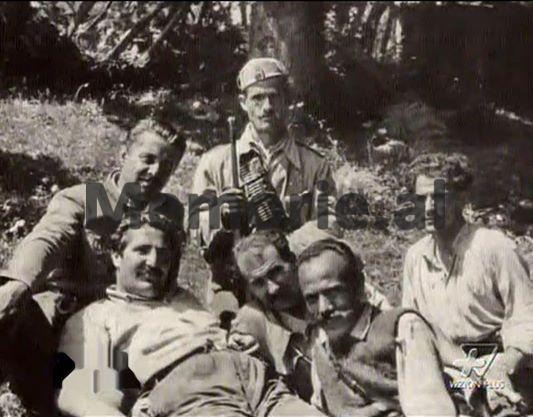
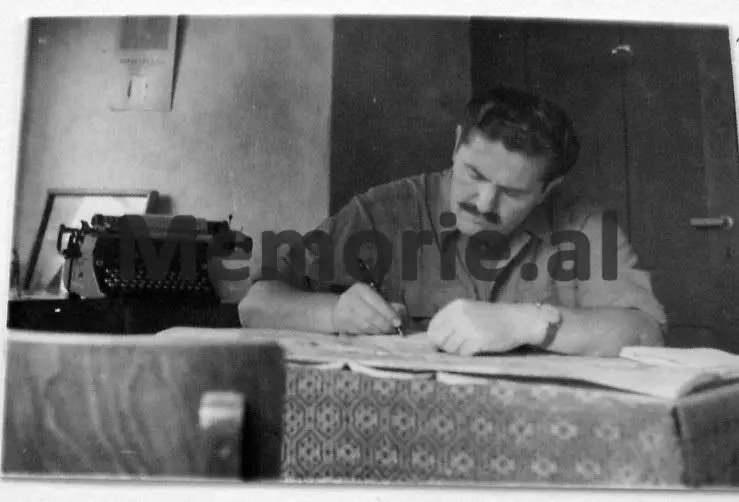
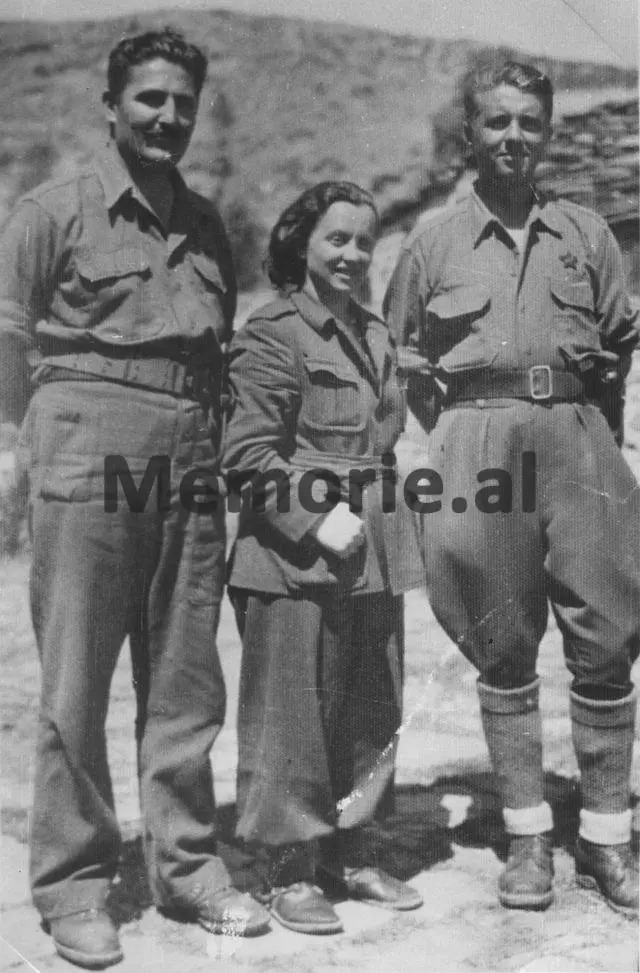

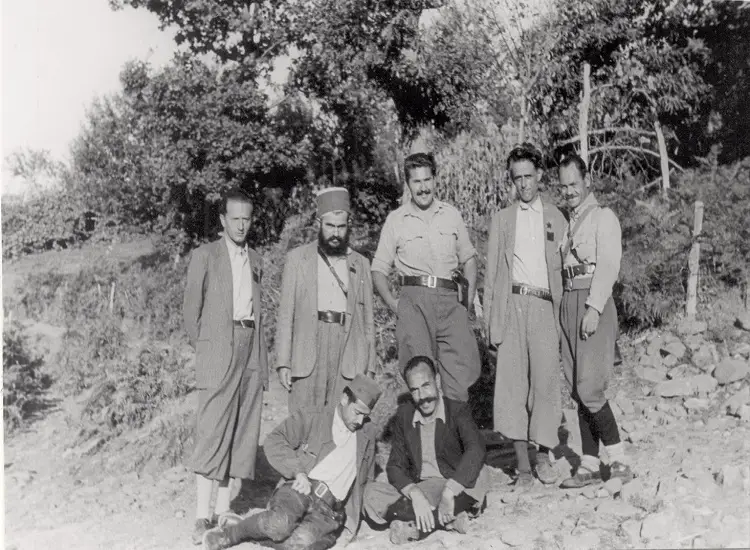
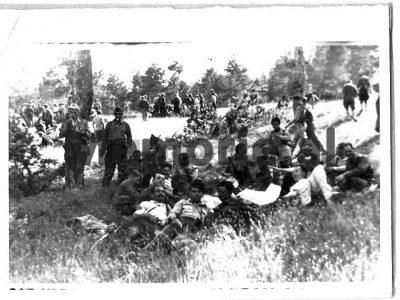
Memorie.al / An assassination in the center of Pristina. Then a suicide. Was the killing of Milladin Popović a nationalist act by Haki Taha, or elimination by the UDBA? What lies behind the murder of Enver Hoxha’s Montenegrin friend? Whether the five partisan guards protecting the commander of the Kosovo district, on March 15, 1945, were playing a real game of chess, or a forced move of pawns, remains an enigma in itself! But it is certain that their attention was slightly disturbed by the tall figure of a 28-year-old, who said nothing and directed his green eyes toward the entrance of the building of the Regional Committee of Kosovo.
A few minutes later, these same eyes, somewhat more blurred, turned toward the exit, again without attracting attention or disturbing the game of the Yugoslav partisans. The moment Milladin Popović was found executed with three bullets, two in the chest and one in the head, on his desk, according to a Balkan version of “Herostratus”, with the remaining cartridges from the 15-round magazine, Haki Taha from Gjakova would publicly kill himself in the center of Pristina.
What happened in mid-March 1945, a few months after Kosovo was “liberated”, is one of those rare stories that, even if there were another “version” of events, would still confer the same fate upon both victim and killer. Both would have died of tuberculosis.
But, while the Montenegrin Milladin Popović would naturally have lived a little longer, Haki Taha from Gjakova, in March 1945, was living his last days in this world. That a man condemned by nature to premature death should commit a murder is a historically acceptable fact. But this was never offered as an explanation for one of the most mysterious historical murders linking Albania and Kosovo.
No one could say that Haki Taha from Kosovo killed Milladin Popović, a figure of unusual stature for the time, merely out of despair at the death that awaited him. After that day, both became heroes of their own kind, for parties that would never have shared interests. Over the assassination, the two figures and their past, two of the greatest alibis of this event were erected, serving political purposes for a long time.
The few remaining witnesses say that Haki, the nationalist, killed the communist who had closely cooperated with Enver Hoxha because he had sold Kosovo and was one of the main causes of the final separation of two territories of the same ethnicity. While, for more than 40 years, Enver Hoxha said, convinced, that at the end of his life Taha was used as the best kamikaze of the UDBA, to eliminate one of the most pro-Albanian Yugoslavs.
TITO’S MILLADIN OR ENVER’S “ALI”?
The first to sense the bad end of his Montenegrin collaborator was Enver Hoxha. Three months before Albania was liberated, in August 1944, Marshal Tito sent the order that Milladin Popović must return urgently to Yugoslavia. Tito’s messengers rejected Hoxha’s request that Milladin stay with him for a few more months, saying that “Popović was being sent for another task and had to report on the situation in Albania”. Enver Hoxha allowed himself only one question: “Which route would Milladin take to Yugoslavia?” – “Over the mountains,” they replied, “we are still at war.”
This alternative seemed dangerous to the future Albanian dictator. For a man who had stayed close to him for four war years with a loyalty strange for his kind, Hoxha also intervened with the allies. He asked the officers of the British mission in Albania to take Milladin along on their ships or planes going to Italy.
Six months before he was killed, Milladin Popović arrived in Bari under the Albanian name “Ali Gostivari”. But why should Enver fear for Milladin’s life? The most recent Yugoslavs who had arrived on “cooperation” missions with the Albanian communists had not found many common points with the Montenegrin Milladin Popović, whom Enver Hoxha had turned into “Ali Gostivari”. But this was not the first time that the Albanisation, or rather Enverisation, of Milladin irritated Tito’s men.
Popović had arrived in Albania in the summer of 1941. Arrested by the fascists in Mitrovica, he was sent to a concentration camp. His release from prison was the first action undertaken together, before the founding of the Communist Party of Albania, by the three Albanian communist groups, and perhaps the first favour that Milladin owed, or “held in honour” for Enver Hoxha.
From this time on, Popović was present in almost all the movements of the head of the Albanian communists, and the only Yugoslav who supported his ideas even when the “centre” was against them. His influence on Enver was declared. But present at the founding meeting of the CPA, Milladin Popović, together with Dušan Mugoša, became the heart of a conflict that would continue for a long time among the border communists.
“The Yugoslavs put forward the claim that two Yugoslav communists, meaning Milladin and Dušan, created the Yugoslav Communist Party,” said Enver Hoxha, stating with conviction that “Milladin never attributed to himself merits that are not his… on the contrary, he rejected any insinuation that Tito’s envoys tried to make to attribute to him a role that is not his.”
But Milladin became the “internationalist Yugoslav” who, although formally never called Tito’s envoy, was the linchpin of Albanian-Yugoslav relations during the war years.
Enver’s supporter from the opposition to the creation of an inter-Balkan headquarters, the breaking of the Mukje Agreement, the results of the Bujan Conference, Milladin became the only Yugoslav that the Albanian communist leader trusted. At the first signs of “Yugoslav betrayal”, Enver simply wanted to save the life of his trusted Montenegrin.
ASSASSIN BETWEEN NATIONALISM AND THE UDBA
“Haki Taha, as a nationalist, killed Milladin Popović because he had torn up the text of the Mukje Agreement and together with Enver had left Kosovo outside Albania’s borders for the second time.” This is the version of all those who knew Haki Taha from Gjakova and are still alive.
“Haki Taha belonged to that category of Kosovars who, knowing both sides of Albanian reality, expected that the post-war period would also bring the unification of Albania with Kosovo,” says Sadik Bekteshi, one of the assassin’s comrades at the boarding school “Malet Tona”, when Haki was attending high school in Shkodër before the war.
“He was a nationalist in school and often insisted in our conversations that we should find the moment to unite,” says Sadik. After high school in Shkodër, Haki Taha, at the age of 23, continued at the “Normal” school in Elbasan, while the beginning of the war brought him back to Kosovo.
One of the enigmas surrounding the unnamed act of Milladin’s assassin is his last visit to Albania. Haki Taha was in Shkodër in the summer of 1944, during the same period when Milladin Popović had received Tito’s order to leave for Yugoslavia and was expected to cross the border from Shkodër.
The only one who raises the suspicion that Haki Taha had prepared the assassination of Popović in advance, before March 1945, is the nationalist Zija Muka. / Memorie.al