Memorie.al / After the invasion of Albania, on April 7, 1939, fascist Italy began its preparations for declaring war and invading two other Balkan countries neighboring Albania: Greece and Yugoslavia. Their invasion would be carried out through occupied Albanian lands, since Italy, after the invasion, considered Albania as its own territory. To justify the invasion of the two Balkan countries, the Italian fascists told the Albanians that they were waging this war to return the regions of Chameria and Kosovo, which had been unjustly separated from the motherland in 1913.
In October 1940, Italy militarily attacked Greece and, after six months, in April 1941, Italy attacked southern Yugoslavia, which was occupied within a week without any particular resistance, because most of it had been occupied by German Nazi forces.
The exact opposite was happening on the Greek-Italian front. The Greek state and its army opposed the Italian army with strong resistance, and fascist Italy did not manage to achieve its goal of quickly conquering Greece and defeating it within a short period of time. The Italian army was not only not advancing, but it suffered numerous losses and successive defeats on Hellenic soil.
To follow and see the fighting on the Italo-Greek front up close during February-March 1941, these areas were also visited by the Prime Minister of the fascist government, Benito Mussolini, known as the Duce. Mussolini, before the war, had always been engaged in the campaign against Greece.
The purpose of his visit to the Italo-Greek front was to give courage to the Italian soldiers, as he hoped that the Italian troops would make a final breakthrough against the Greek troops, leading to a sure and final victory in the invasion of Greece by fascist Italy. But the war front had been a true catastrophe for the Italians, and the Duce saw this catastrophe with his own eyes.
After leaving the Italo-Greek war front, Mussolini visited Albania from March 2 to March 21, 1941. His visit was dedicated to the review of the Italian occupying troops in this country. Throughout the period when Mussolini was in Albania, he dedicated himself to numerous visits to the military units present on Albanian soil. He hoped that by giving courage to his soldiers involved in the war, he would spur them on to fight strongly against Greece.
But events on the Italo-Greek front had proven that the advance of the Italian army had not only not progressed, but, on the contrary, the Italian soldiers were followed step by step by the Greek army all the way into Albanian territory. Mussolini, upon returning to Italy, having seen the lack of advance of the Italian army in Greece, had asked the Germans for help to repair the great damage of his army, which was not able to successfully end the war on Hellenic soil.
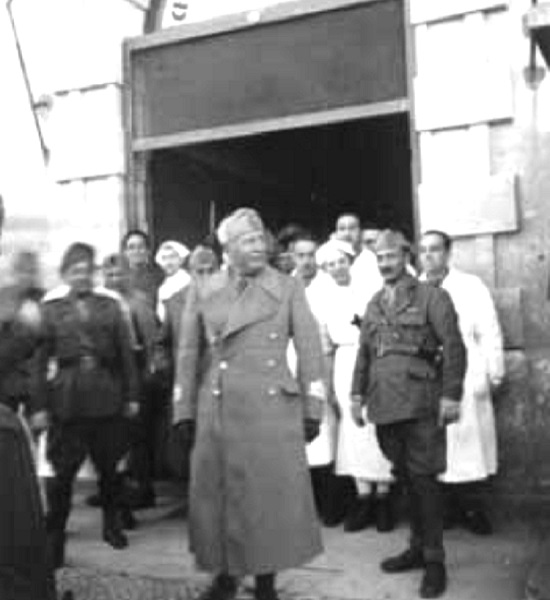
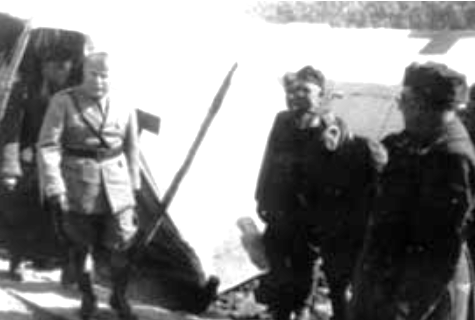
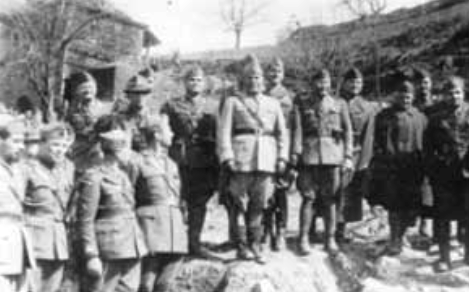
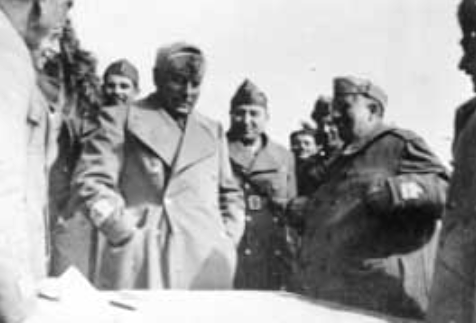
Towards the end of his stay in Albania, the Duce made a short stop in the city of Elbasan, to visit the wounded soldiers of the Italo-Greek war who were at the Krasta Military Hospital Center. This visit of the Italian fascist leader is also evidenced by a group of photographs collected by Dr. Pierluigi Zamperin, who was a doctor at this Military Hospital Center in Elbasan. We are publishing these photos for the first time, making them known to the Albanian public and reader.
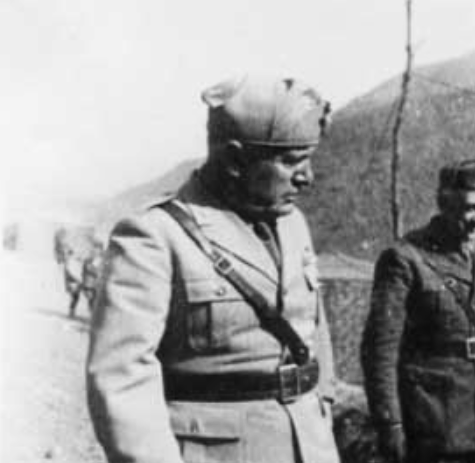
There are a total of 7 photographs, all of which have the Duce at their center. In these photos, he is accompanied by the highest military officials of the Italian army present in Albania, as well as by his iron guard (Photo PLZ 121). At first glance, the Duce appears calm and smiling in his meetings with the military (Photo PLZ 117) and the medical staff of the Krasta Hospital Center (Photo PLZ 118).
He appears the same in photos PLZ 115 and PLZ 120, as well as in a meeting with the soldiers and officers of this medical facility (Photo PLZ 120). But the far from optimistic situation on the Greek front, as well as the successive defeats suffered by his army on this front, could not be hidden behind these enigmatic smiles.
The gloominess and the forced smile of the Duce to appear calm cannot go unnoticed in almost all the photographs of Dr. Pierluigi Zamperin’s collection, such as in photos PLZ 115, PLZ 116, PLZ 117, PLZ 118, PLZ 119, PLZ 120, and PLZ 121.
In Dr. P. Zamperini’s collection there is also a particular (apparently) photo, which shows a war cemetery with graves of Italian soldiers, which, according to Dr. Zamperini’s notes, is located in Krasta, Elbasan (Photo PLZ-024). We do not know if the Duce visited these graves to see where his follies had led, to start a vain and absurd war to the detriment of the Balkan peoples, of Italy itself, and of its sons.
On March 21, 1941, at 07:45, Mussolini left Albania by plane, escorted by 12 fighter planes. He made a short stop in the city of Bari and at 10:30 landed in Centocelle, Rome. / Memorie.al