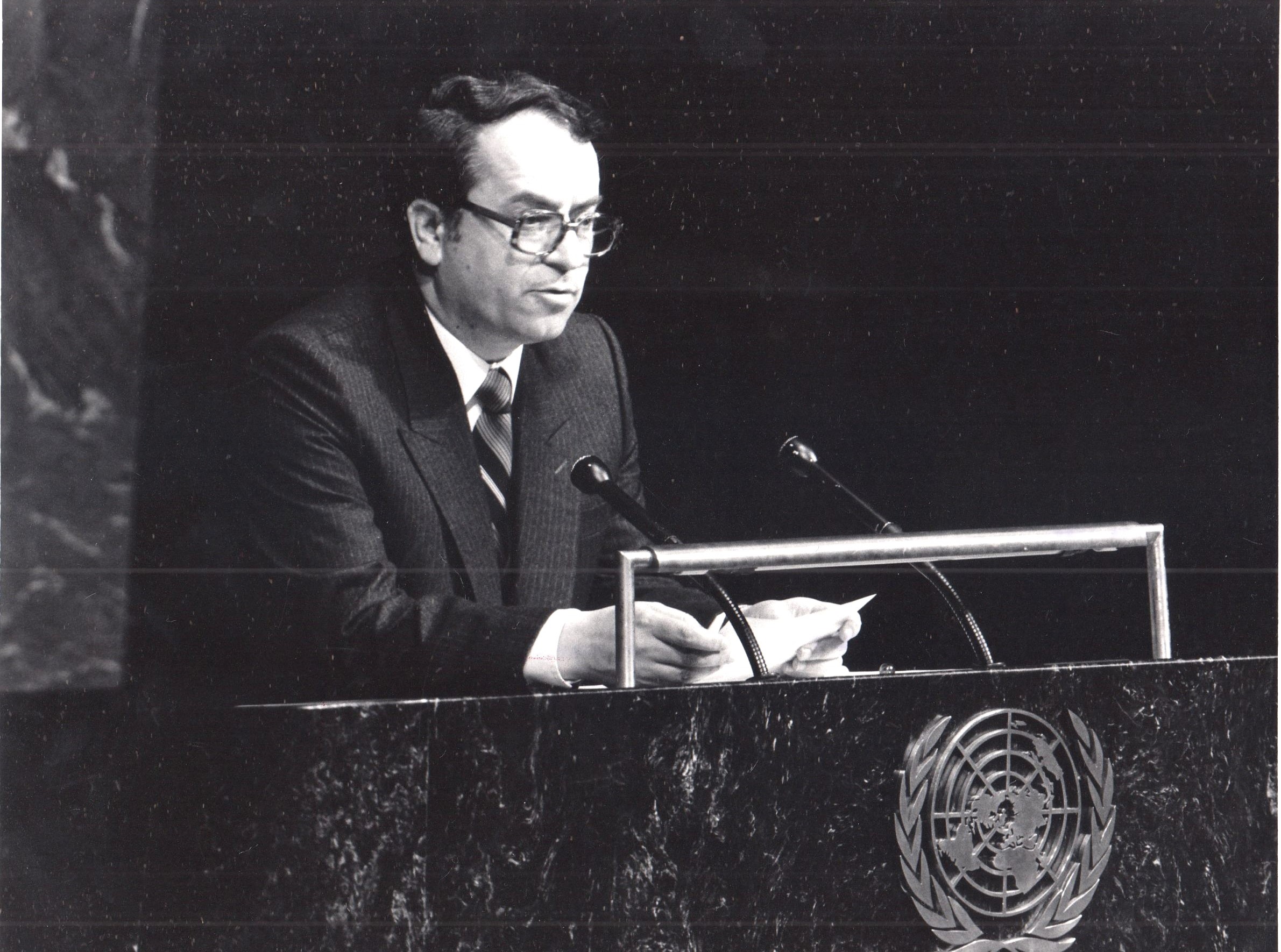
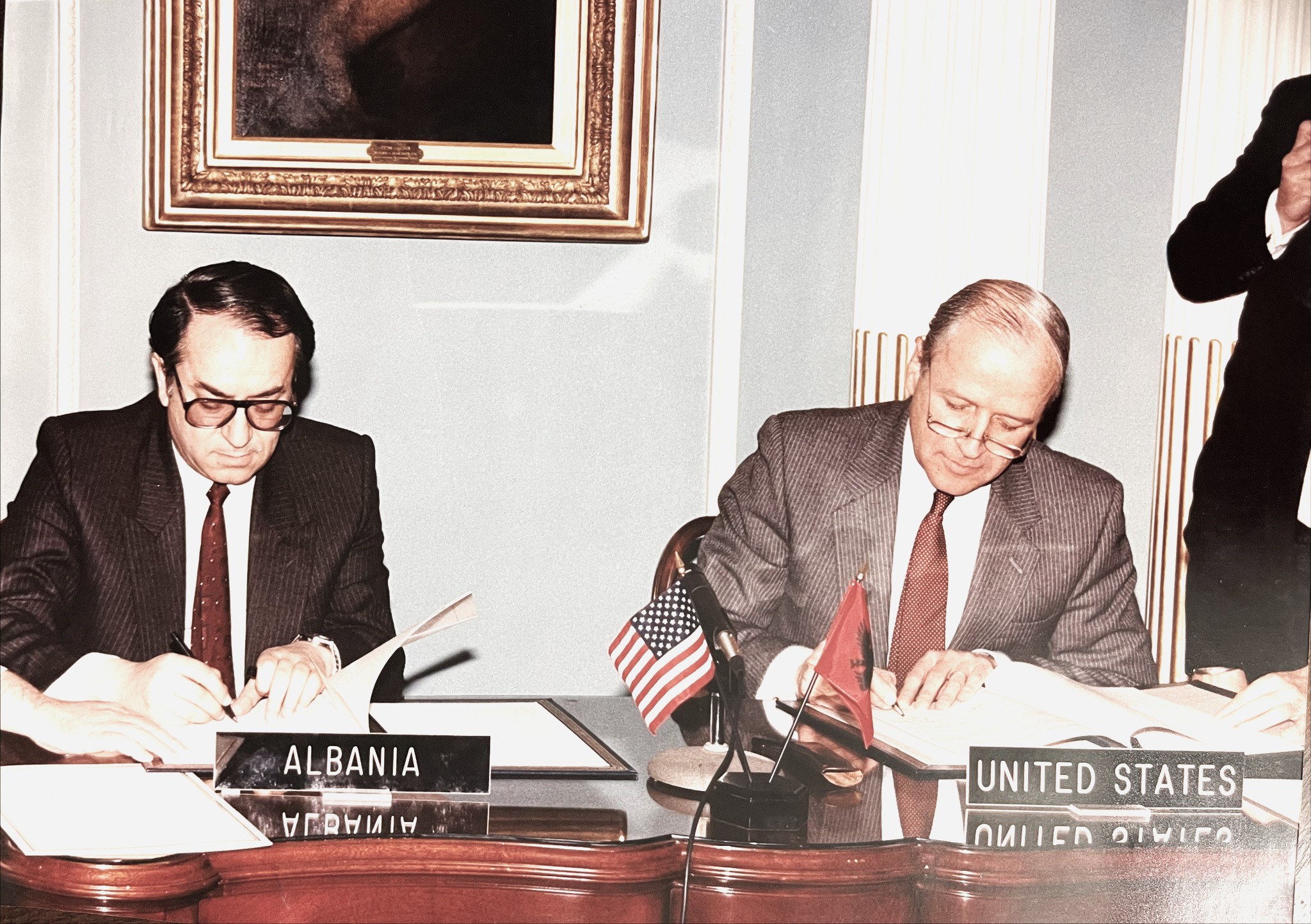

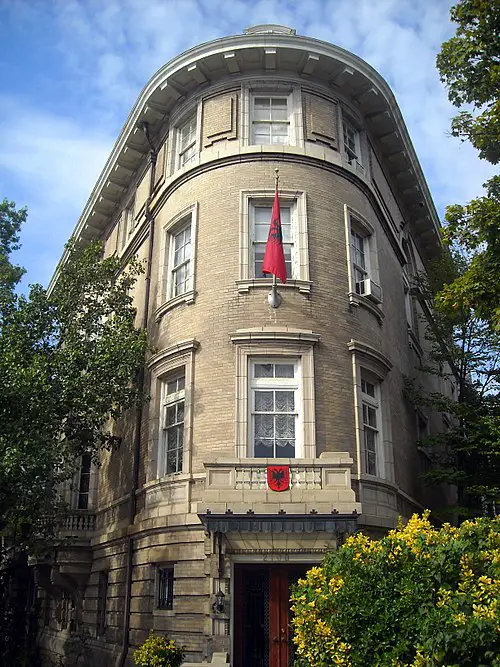
Memorie.al / “The United States of America will resume full diplomatic relations with Albania, effective Friday, ending a 52-year break,” – American and Albanian officials announced today. Administration officials said that Albanian Foreign Minister Muhamet Kapllani will fly to Washington, where he will take part in the signing of the formal act of diplomatic recognition with Assistant Secretary of State Raymond G. H. Seitz.
An administration official said that “it will be months before the United States ambassador to Tirana is named, and even longer before the American embassy in the Albanian capital is established and becomes operational.”
But the Bush administration has concluded that it is appropriate to act now because, “we wish to engage in the democratic process in Albania,” – officials said – and because “the communist government of President Ramiz Alia is making efforts at recent reforms.”
Greater engagement demanded
On March 31, 1991, Albania will hold its first multi-party elections since communist power was established at the end of 1944. American administration officials said the State Department will send a small group of American diplomats to Tirana to familiarize themselves with the situation before the elections.
Since the beginning of December, Albania, a country of 3.5 million inhabitants, has been gripped by a wave of discontent that has manifested itself through popular protests against the communist system. Richard A. Boucher, a State Department spokesman, said the moves are seen as a greater engagement – but not sufficient – by the United States of America.
Albania-US relations
The United States and Albania had close ties before World War II. Americans of Albanian origin returned to the Balkans in 1912 to help create the first Albanian government.
President Wilson is credited with having been the most powerful supporter of Albania’s territorial integrity in international councils immediately after World War I, when Italy, Yugoslavia, and Greece squabbled over who would take a bite of the country. Likewise, an American college in Albania bore his name.
Albania insults the US: “the devil superpower”
Diplomatic ties between Washington and Albania functioned until June 1939, immediately after the Italian invasion of Albania. An informal American observation mission was sent to Tirana in 1945 to examine the possibility of restoring relations.
The communist government refused to respect post-war agreements and so harassed members of the mission that they withdrew in November 1946.
The Albanian government restored diplomatic relations with the Soviet Union last year, after a 29-year break. Likewise, Albania and China have agreed to increase economic and trade cooperation as part of Albania’s efforts to improve its international ties.
Albania has secured observer status in the Helsinki talks in Europe, which have drawn attention to respect for human rights. From then until a year ago, the communist government regularly insulted the United States of America, branding it as “the devil superpower” that wanted to subdue small countries like Albania.
In fact, before the 1950s, the United States was actively engaged in a plot to overthrow Albanian communists with paramilitary forces.
Negotiations for restoring relations
Negotiations for restoring relations began last summer and were almost completed in September. But State Department officials objected to moving forward because of human rights abuses that continued in Albania, which caused the project to be delayed.
The New York Times brings opinions of Albanians who immigrated to America. Community leaders speak. The movements that the political subjects of the diaspora made!
For Albania to break from its Stalinist past is as far away as the sound of footsteps heard in the neighborhoods of New York. “It’s like a dream,” says Dr. Sami Repishti, when his telephone rang from the distant island one morning, after 23 years during which Albanian authorities had outlawed religious belief and the use of private vehicles, and had cut citizens’ communication with the outside world.
“I couldn’t believe it, from the moment I heard my brother’s voice. I hope that one day Albania will be democratic.”
Albania, through hearsay
From the Belmont section of the Bronx, the social clubs of Albanians and the murky restaurants of Manhattan fill with partisans and former conspirators of King Zog, where noisily, men smoke cigarettes and drink raki and talk about strange things – about protests and political privileges in their homeland, about unwashed dishes on ships carrying Albanians off the Italian coast, and even about the toppling of the monument of former leader Enver Hoxha.
The conversations are easily forgotten. Not infrequently, after coming to America, the names of immigrants, such as Gjergj, usually become George. When he got a job at an Italian restaurant in Manhattan, an Albanian of Muslim faith introduced himself to the owner as Sergio, even though his name was Sejdi.
But as one looks externally at the Albanians of New York, one often sees the reflection of a small, isolated Balkan country, and sometimes violent images: the dreamy riots have opened a window into a community of extraordinary power and success.
And immigrants use their origin in discussions held here as a kind of sliding game, although the rule of the Albanian Party of Labor is shaking like one of the last dominoes of Communist Europe, which has also revived old pride.
“People will say: Are you Albanian? Does that mean you’re from Albany? Are you an Albino?” – says Father Artur Liolin, Chancellor of the Albanian Orthodox Church of America. “Now people know who you are.”
How the resumption of diplomatic ties was received
On Friday, after more than half a century of mutual antagonism and non-recognition between Albania and the USA, full diplomatic relations was restored. American officials argued for this move, saying they wish to support the new pluralism in the future, as well as the multi-party elections to be held on March 31.
But unfortunately, the promise of close ties with their homeland after four decades that seem like lost time has not elated all Albanian-Americans.
“We are waiting for the big change, for the country to be free,” says Imam Isa Hoxha, the spiritual leader of thousands of Albanian Muslims in New York, based in Brooklyn. Still, there is a spirit of energy and activism among Albanian-Americans.
Outside the Albanian Roman Catholic Church in the Bronx, for a while, the streets of Park Avenue looked filled every Sunday with more cars like Toyotas and Volvos. In recent weeks, the Albanian Orthodox Church has gathered hundreds of packages of food, clothing, and other items to be sent to Albania.
Albanian political games even in the USA
Even known Zogists, as well as monarchists, have called for new recruits, while their old rivals, the powerful members of the ‘Balli Kombëtar’ or the ‘National Front’, say they have an ever-growing audience for their show on the ethnic radio station WKDM-FM.
But some mysterious Albanians in New York still remain incomprehensible. Not everyone knows exactly that many Albanians living in this area come from the southern Yugoslav province of Kosovo, which was separated from Albania in 1913. According to estimates by community and church leaders, the number of Albanians may be between 75,000 and 150,000, but others say the figures may be much lower. Memorie.al