

Interview with Mr. Darling Vlora regarding Ismail Qemali, the founder of the Albanian state
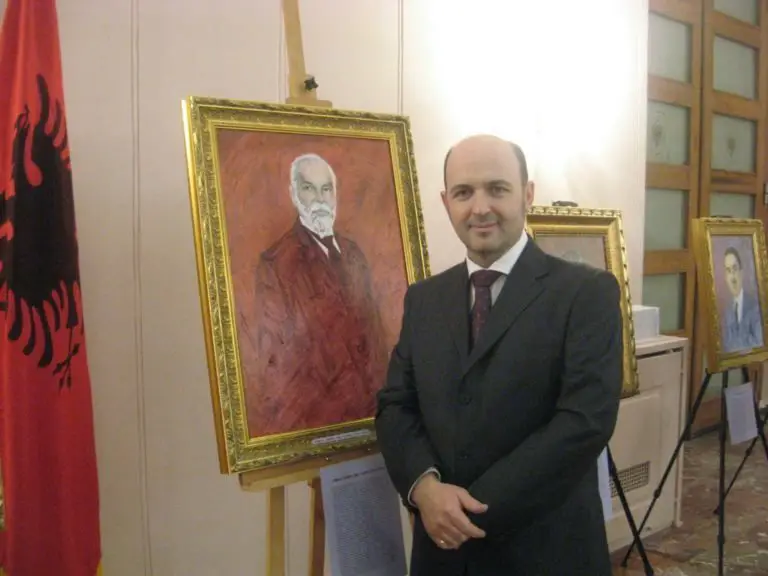
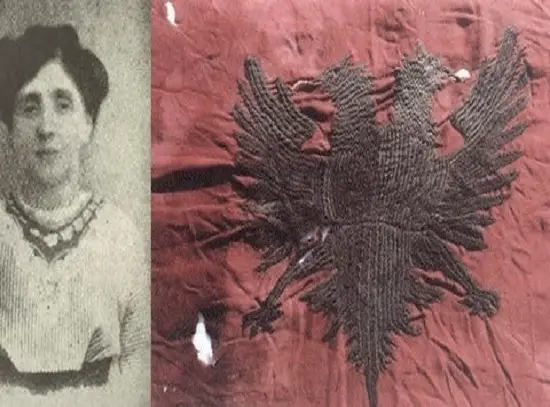
Memorie.al / January 24th mark the 167th anniversary of the birth of Ismail Qemali, which also coincides with the 92nd anniversary of his death. To commemorate the figure who led the National Awakening in the proclamation of Albania’s Independence and his invaluable contribution to the Albanian nation, we interviewed Darling Vlora, one of his great-grandsons. Darling Vlora lives in Italy and has organized two photographic exhibitions for Ismail Qemali: the first in 2009 at his home on the occasion of Qemali’s 165th birth anniversary, and the second in Parma in November 2010, in collaboration with the “Scanderbeg” Association.
Who is Ismail Qemali to Darling Vlora?
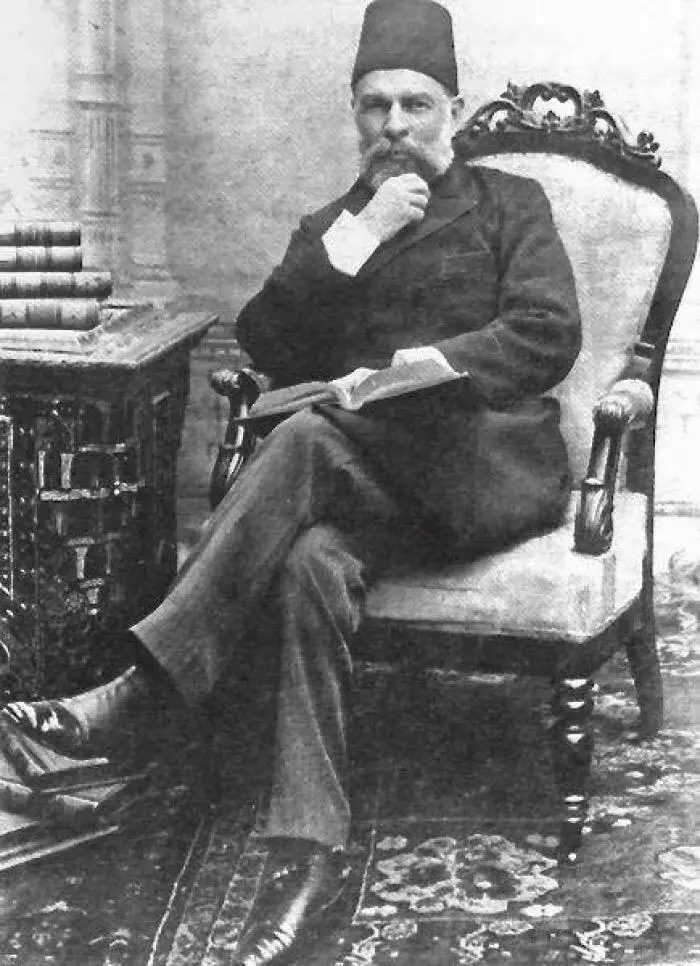
Ismail Qemali – full name Ismail Qemal bey Vlora – is my ancestor. My grandfather, Qamil bey Vlora (my father’s father), was one of Ismail Qemali’s sons. Therefore, in the male line, I am his great-grandson.
What role does Ismail Qemali play in the history of the Albanian state?
In this case, a quote by Roberto Cotroneo regarding the great Genoese artist Fabrizio De André comes to mind: “L’architetto De André si serviva degli ingegneri perché i conti tornassero, ma il disegno era suo” (Architect De André used engineers to make the accounts work, but the design was his). Ismail Qemali is the architect of Albanian Independence; he is the Father of the Nation and the Founder of the Albanian state. This is not just my opinion; it is the opinion of the people themselves, the opinion of those who knew him, and the opinion of the Albanian patriots who answered his call by supporting him in the great national cause.
Dhimitër Zografi, one of the delegates of the Assembly of Vlora who accompanied Ismail Qemali from Trieste to Vlora and, along with other delegates, signed the Act of the Proclamation of Independence, wrote: “What Ismail Qemali has done for Albania, what honor he deserves, and how high his name should be raised, can only be judged by someone who knows and has seen his works.”
Qazim Kokoshi, another signatory of the Act of Independence, on February 12, 1919, standing before the lifeless body of Ismail Qemali – the Father of the Nation, as he called him – addressed the gathered crowd: “You who were there in 1912, oh dear patriots, you are here today as well; on the 28th of the third autumn of that year, you saw, you acted, and you rejoiced; you saw the Balkan war as a danger to you, you made efforts to save your land, and you rejoiced in the victory and the fulfillment of the ideal. You, therefore, are a living history of the new Albania, but the creator and the first hero of this history is Ismail Qemali.”
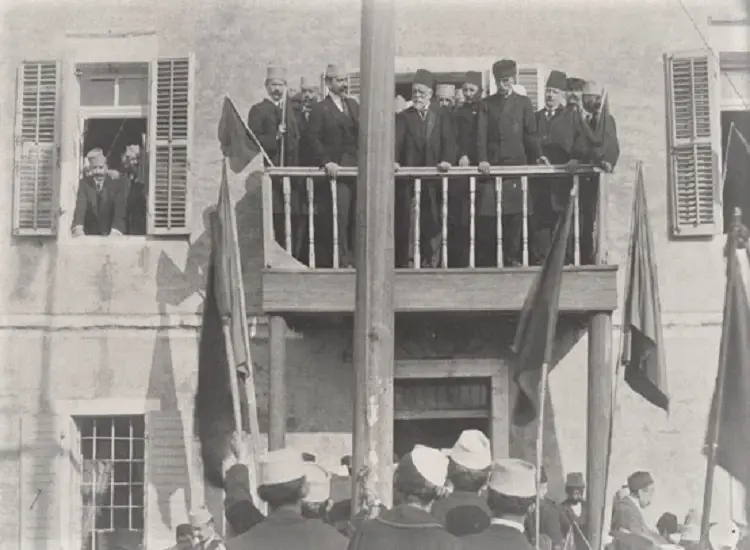
Ferit Vokopola, another signatory, wrote on the 100th anniversary of Ismail Qemali’s birth: “Ismail Qemali, as the unique son of Albania, seized the Flag, stepped onto the balcony, and raised it with his own hand, addressing the people with great patriotic words, through which he informed Albania and the entire World that at this decisive moment, a new state was being added to the ranks of Great and small Kingdoms, and that its people were among the oldest heirs of the Balkans. I knew him and saw him in these decisive moments, much changed from other times… He was previously a Star and now a Sun of the Albanian world; he was previously a Freedom Fighter, a faithful servant of the Nation, and now a savior of the People.” This is Ismail Qemali through the thoughts of just three signatories of the Act of Independence, not to dwell long on the quotes of other signers like Mustafa Kruja, Luigj Gurakuqi, Rexhep Mitrovica, etc. All those who were there, all those who signed the Act of Albanian Independence, recognized and called him the Father of the Nation.
Ismail Qemali served the Ottoman Empire for 50 years. He was also among the first Ottoman liberals and, in 1909, the founder and Chairman of the Liberal Party. His engagement with the reformist forces of the Empire predates his role in the National Awakening. What drove Ismail Qemali to be a liberal: greater autonomy for the Albanian vilayets or his conscience as an Ottoman statesman?
Recently, I have encountered a form of criticism regarding the fact that Ismail Qemali served the Ottoman Empire. This perspective, not only in my view, is entirely mistaken. His service in the Ottoman Empire coincided precisely with a time when Albania was part of the Empire; thus, he did not serve the Empire, but his country. Throughout his activity in the state administration, Ismail Qemali stood out as a man of liberal and reformist ideas. He entered the administration at age 16, when it was led by distinguished and progressive men like Midhat Pasha, Fuad Pasha, and Ali Pasha. However, his activity must always be seen in parallel and closely linked with his efforts for the benefit of Albania. As early as 1864, we find him in meetings organized in Istanbul to form a national cultural society for opening Albanian schools and developing Albanian literature.
As a visionary, Ismail Qemali – as he always declared – was convinced that by strengthening the Empire, he served his own country. He collaborated with Midhat Pasha in drafting the first Ottoman Constitution, proclaimed in 1876. Its 108th article accepted that “the administration of the provinces would be based on the principle of decentralization.” One of Midhat Pasha’s ideas, certainly at Ismail Qemali’s suggestion, was the creation of an Albanian Vilayet. As we can see, this was two years before the League of Prizren and nearly 40 years before Independence. Unfortunately, Midhat Pasha was arrested; the Constitution remained unimplemented until 1908, and Ismail Qemali himself was exiled. After being allowed to return to Istanbul and seeing the Sultan’s unchanged stance, Ismail Qemali decided to leave Turkey for good in 1900, subsequently dedicating himself entirely to the Albanian national cause. In the letter he addressed to the Sultan from the board of the English ship that would take him to Europe, he wrote: “My crime against the fatherland is my love for it.”
Sami Frashëri (Şemseddin Sami) is considered by both Albanian and Turkish historiographies as one of the founders of the nationalisms of these two nations. How is Ismail Qemali viewed by Turkish historiography?
As your question suggests, the majority (if not almost all) of our “Rilindas” (National Awakening figures), some more and some less, served in the Turkish state administration but never forgot their birthplace. Just like Sami Frashëri, who through his work served the knowledge and culture of all nationalities living in the Ottoman Empire, Ismail Qemali, wherever he served, was distinguished as a supporter of knowledge and progress. Even today, in the places where he held the post of governor, he is remembered with respect for his works in opening schools, opposing racial and religious discrimination, etc. He is also remembered as a liberal figure, among the first liberals of the Empire. Recently, his “Memoirs” have been published in Turkish, in addition to a work containing some of his parliamentary speeches published many years ago.
In contrast to other figures, it seems as if Ismail Qemali became very active in the National Awakening specifically in the years preceding the Young Turk Revolution. How can this “delay” be explained?
That is a fair observation. It seems he was more active in the national movement on the eve of the Revolution, but that is not the case. Ismail Qemali’s entire activity is closely linked to his origins, his patriotism, and the history of his country and family. These factors, combined with his rare intelligence and preparation, created the liberal statesman who sought to serve all nationalities within the Empire – including Albania – by strengthening the Empire itself; thus, he transcended national boundaries.
However, if there is a “delay” in his role in the Albanian national movement before 1900, we must not forget that he was exiled for 7 consecutive years (1877–1884) and later, as historians like Luarasi, Xoxi, and Naska have noted, he was intentionally kept away from Istanbul by the Sultan specifically to keep him away from national activities.
In the last exhibition you organized in Parma, a 1908 photo caught my attention: Qemali returns to Albania and is elected a deputy in the Ottoman Parliament. His carriage is carried by the people of Vlora on their shoulders from the pier to the city center. Was he loved that much in Vlora?
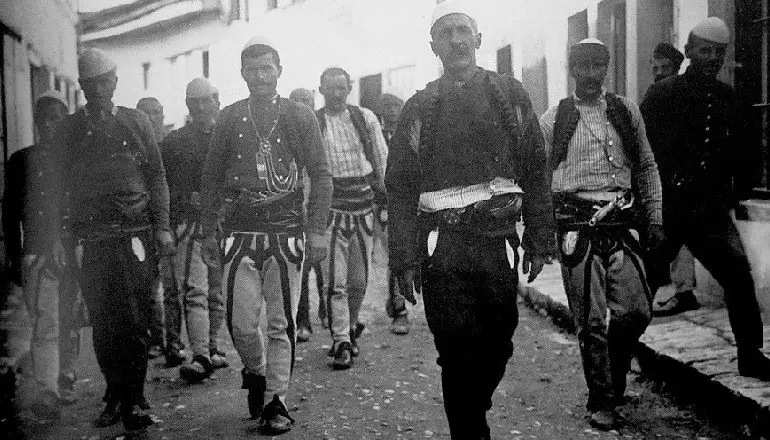
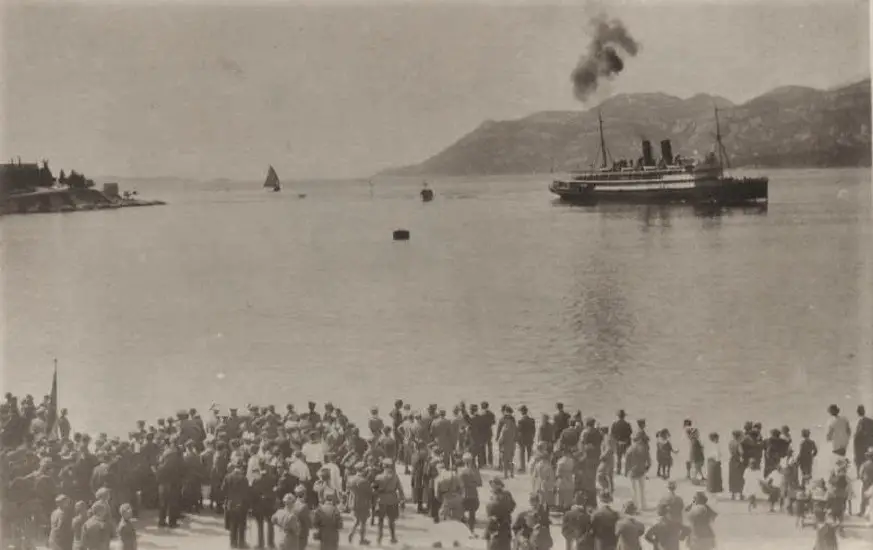
Ismail Qemali was born in Vlora, where his family had governed the Sanjak of Vlora since 1480. Although he left Vlora young, he never broke ties with his birthplace. All Albanians who went to Istanbul always found his support. He was considered the most prominent representative of the Vlora family. Immediately after the proclamation of the constitution, the people of Vlora, via telegram, pleaded for him to return. His arrival turned into a massive public manifestation. A delegation of 39 people went to meet him in Corfu. At the pier, the entire population of Vlora had come out to welcome him. Various patriotic speeches were held; cannons were fired at both the pier and the city. To express the great love and respect the people felt for their son, they unhitched the horses from Ismail Qemali’s carriage and carried it on their shoulders for the entire 2 km distance to the city center.
In the memory of the Vlora family, did Albanians “win” their independence, or was it the result of 19th-century politics based on the balance of great powers and the compensation of winners?
In my opinion, based also on the “Memoirs” of Ismail Qemali and other members of the Vlora family, Albanians fully won and earned their Independence. November 28, 1912, was the culmination of our people’s centuries-long struggles. Those who occasionally present Independence as a “gift” of European politics or a mere diplomatic solution do nothing but denigrate the work and sacrifices of our patriots. Certainly, during the First Balkan War, there were contradictions among the Great Powers which, to maintain their balance, decided not to create, but to support Albania’s Independence. There is a huge difference there.
Ismail Qemali, during his travels to European capitals (October–November 1912) in defense of the national cause, managed to convince the Great Powers to support the Albanian action. The advantage he gained from the contradictions and interests of the Powers must undoubtedly be considered a stroke of genius. Is that not a victory in itself?
Undoubtedly, Albanian independence was also in Europe’s own interest. On April 2, 1913, in a long front-page article in the prestigious “Il Giornale d’Italia”, the Italian journalist Benedetti wrote: “The cause of peace owes much to this man who had the most difficult historical task in the diplomatic battles he had to face. It would have been easier for him to undo Europe.”
Ismail Qemali traveled frequently to Italy. Since the early 1900s, several Italian dailies dedicated their front pages to him. What were his connections with Italy?
Ismail Qemali traveled often to Italy, frequently staying for long periods in cities like Rome, Milan, Naples, San Remo, etc. He had established personal ties with many Italian personalities of the time, including Marquis San Giuliano, who later became Italy’s Foreign Minister. Ismail Qemali’s ideas regarding the future of Albania and Italo-Albanian relations are clear in various interviews published in the Italian press. Despite his strongest ties being with English statesmen, he sought his primary support from Italy regarding Albania’s future. Until the end of his life, he hoped for sincere Italian aid and did his utmost to attract the attention of both the government and Italian industrialists to cooperate with Albania.
What did Italian newspapers write about Ismail Qemali?
There are numerous articles over the years. For example, immediately after Albania’s independence, the daily “La Stampa” wrote on page two:
“While awaiting the events that will inevitably follow the proclamation of Albanian independence, curiosity focuses on the man at the head of the movement that achieved its goal, the Chairman of the Provisional Government, Ismail Qemali. Ismail Qemali is not unknown in Europe and especially in Italy. He paid for the love of his birthplace with persecutions by Abdul Hamid and later with exile. The Young Turk Revolution brought him out of his residence in Paris. He believed in transforming Turkey into a Confederation of nationalities with equal rights like Switzerland or Austria. The history of the last three years proved him right. But, before the dissolution of Turkey was noticed, predicting the endangered fate of his country, he rushed to Rome and Vienna in defense of Albanian rights, and then went to Durrës and Vlora, where the Assembly of Albanians elected him Chairman of the Provisional Government. Ismail Qemali is a charming old man, tall, ruddy-faced, with bright and lively eyes and a white beard. A distinguished figure, he dresses in European style, mainly in an impeccable ‘redingote.’ A brilliant mind, he speaks 5 languages fluently; he understands Italian but speaks it with some difficulty. He is informed on international affairs and personally knows the main European politicians.”
Italy is the country where Ismail Qemali died on January 24, 1919, under what are called “unclear circumstances.” Why was he in Italy at that time and could there have been a plot against him?
Exactly, Ismail Qemali arrived in Italy from Genoa on December 9, 1918, and ended his life in the city of Perugia on January 24, 1919. At the end of World War I, the issue of Albania’s borders was certainly going to be reviewed again. Italy’s interests were still significant regarding the Albanian issue; therefore, to coordinate actions, the Italian government invited Ismail Qemali to Rome. At that time, he was in Spain and had been elected by Albanians in America as their representative in Europe to defend the national cause.
On January 23, 1919, while waiting in Perugia, Ismail Qemali suffered a cerebral hemorrhage and, despite all possible medical care, died on January 24. There have been various theories about his death, which coincided with a very delicate moment for the national cause when the help expected from him was vital. Certainly, as a representative of the national cause, he had enemies – sworn enemies of Albania – so the possibility of a plot by anti-national circles exists.
Another striking fact is the destruction of the Vlora family cemetery by the communist regime. In what year did this happen and why?
Since 1500, when Sinan Pasha – former Grand Vizier of the Ottoman Empire and founder of the Vlora Family – was buried near the Kanina Castle, other family members were always buried there, gradually turning it into a grand family cemetery. In it, among many distinguished relatives, was the grave of another Grand Vizier, Ferid Pasha Vlora. The communists’ hatred toward the great families knew no bounds; to erase any possible trace, they destroyed the Vlora cemeteries in the early years after the “liberation.” Around 1980, they even opened Ferid Pasha’s coffin and threw his embalmed body – nearly 70 years after his death – into the brambles of the village cemetery. Today, except for Sinan Pasha’s burial site, nothing remains, and that grandeur exists only in photos to testify to the communist crime and destruction.
You were perhaps the first to hold a photographic exhibition for Ismail Qemali both in Albania and abroad. You even held the first one at your home in Sirtori. It seems as if the historical memory of a statesman like Ismail Qemali is considered a “family matter” in Albania. Is that so?
It is true that I was the first to dedicate a photographic exhibition entirely to Ismail Qemali. The first time, I organized it in the house where I live. It was more of a private reception, attended by the Consul General of Albania in Milan, Spartak Topollaj. Later, with the support of the “Scanderbeg” association in Parma, we organized another exhibition presenting photos and articles from the Italian press. I do not believe that the “historical memory” of a statesman – especially Ismail Qemali – should remain or become a family matter. From time to time, there are anti-national moments, denigration, or indifference, but these are always fleeting. In the national memory, the name and figure of Ismail Qemali are deeply embedded because his name is eternally linked to the great national Work: the Proclamation of Independence. Thus, the people – who are the ones who immortalize you – composed the legendary verses: “I am Ismail Qemali / History follows behind me.”
Undoubtedly, it is the duty of historians to write the history of the country and national figures, and in this case, the duty of family members to assist them. But when historians play politics, write history to serve it, or remain silent (and this phenomenon unfortunately has happened, happens, and will happen), then it is the duty of the descendants to tell the story of their ancestors. In this regard, I have given my contribution as much as I could. Regardless of my lineage, of which I am certainly proud, I no longer view Ismail Qemali’s figure as tied solely to the family aspect. The family connection is simply an extra motivation to shed more light on his work, but I now see him entirely as a historical figure that current and future generations must know as a point of reference.
What is your next objective in your commitment to “restore” the historical memory of Ismail Qemali?
After my visit to Kosovo last October, in collaboration with Prof. Dr. Eqrem Zenelaj – an Albanian from Kosovo, who, after researching Austrian archives, has found many interesting and important documents, mostly unknown, about the Vlora family – we have a project for a work on the genealogy and history of the Vlora Family. It will be a work that sheds light not only on Ismail Qemali’s deeds but also on many other personalities of this family who brought honor and glory to our nation – a history that has been left entirely in oblivion until today./Memorie.al