
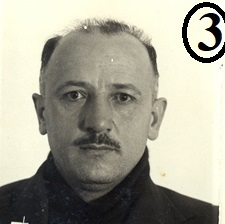
By Ali Buzra
Part Thirteen
LIFE UNDER PRESSURE AND SUFFERING
(EVALUATIONS, COMMENTS, NARRATIVES)
Memorie.al / At the request and desire of the author, Ali Buzra, as his editor and first reader, I will briefly share with you what I experienced during my encounter with this book. This is his second book (following “Gizaveshi through the Years”) and naturally continues his writing style. The sincerity and candidness of the narrative, the simple and unembellished language, the precision of the episodes, and the lack of – or refusal to use – any intentional later imaginative processing, have, I believe, served the author well. He comes to the reader in his original form, inviting us at the very least to recognize unknown human fates and pain, whether by chance or not, leaving us to reflect as a beginning of awareness toward a catharsis so necessary for the Albanian conscience.
Bedri Kaza
Continued from the previous issue
He entered Albania several times with diversionist groups, aiming to participate in organizing anti-communist activities, but as is known, this yielded no results. Pajazit also paratrooped with Hamit Matjani, escaping by a hair’s breadth from the Sigurimi (Secret Police) forces, while the latter was captured and sentenced to hanging by the communist court. Thus, after the failure of the attempts to overthrow the regime, like many others, he was forced to remain abroad. Under these circumstances, immediately after Pajazit’s escape, his family was interned.
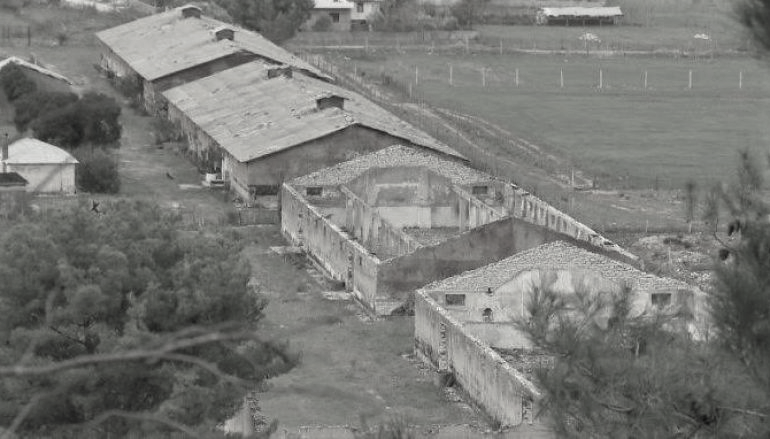
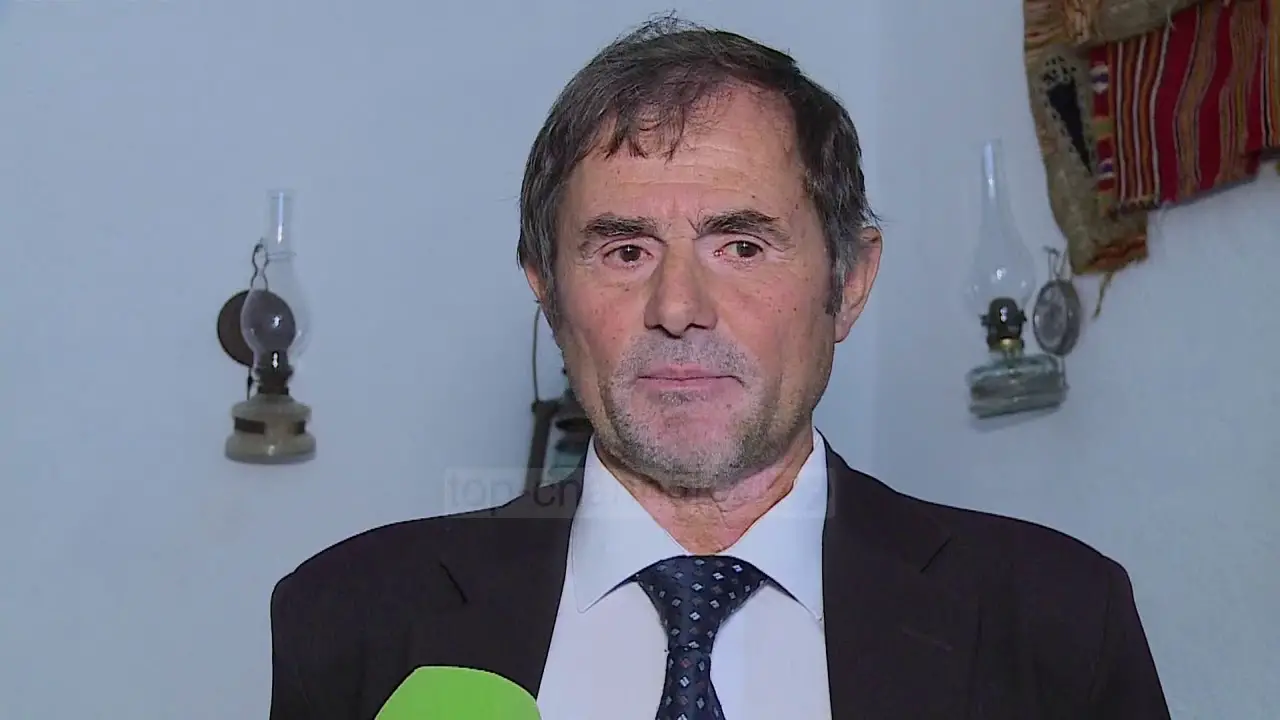
It was his wife, Shazja, their four daughters – the youngest being only three months old – and Xhevdet, who was 11. “Initially,” Xhevdet narrates, “they sent us to Valias,” where they placed them in barracks-prisons from which German prisoners of war had recently been removed. The barracks were surrounded by barbed wire, housing hundreds of persecuted families, lined up one after another on two-tier wooden planks. Women and grown children were sent to various labor tasks. After a few months, they were sent to Tepelena.
“Tepelena,” he says, “is indescribable! They cooked water with bulgur where you could clearly see the worms floating.” What is chilling in Xhevdet’s account leaves one speechless: “Everyone was starving, but we children experienced horror. We would cry and beg our mothers for bread. My mother tried to soothe me with words, saying she would give me some, but where was the poor woman to find it? We would fall asleep in her lap and wake up crying.
Often, we would approach the door of the camp command officers’ mess hall. During mealtime, some of them would throw meat bones, bread crusts, or a watermelon rind on the ground, and we would rush, lunging over each other to grab them. Such a scenario could only happen with dogs – and not even house dogs, but stray ones!”
“In another instance,” Xhevdet relates, “they kept a woman’s body for three days after she died without reporting it, solely to collect her bread ration.” In 1954, along with many others, they were moved from there to Savër, housing four families in a single shack. Later, the Mileci family was transferred to Plug, where they remained until 1990.
“In the camp,” he recounted, “we worked and were paid, meaning we fed ourselves, while for housing, they moved us from one shack to another.” Their mother died and was buried there. Xhevdet completed primary school in Ersekë, while he finished the 7-year and secondary school in Tepelena and Lushnjë. In the camp was Mustafa Kruja’s nephew, who had a textbook for the Italian language. With him, Xhevdet learned Italian, which he still speaks fluently today.
There he met the sons of Abaz Kupi, Hamit Matjani, the sons and daughters of Gjon Marka Gjoni, Hysni Dema, Vera Dema, and Ali Dema, and the sons of Mustafa Kruja, one of whom was an engineer who had studied in Italy. “We read hundreds of novels,” he recalls. “The cream of Albania’s intellectuals was there.” After 1990, Xhevdet left Lushnja and now lives in Elbasan.
Tahir Biçaku grows old in the prisons of the dictatorship and in internment!
While the family of Azis Biçaku spent nearly 45 years in the dictatorship’s camps, the sons of Tefik Biçaku (Azis’s nephew), Tahir and Shebrit, stayed in the village. Left as orphans after their father passed away at a young age, they were raised by Azis, who took great care of them. During the war, Tahir, the eldest, was not mobilized with the ‘Balli Kombëtar’, as Azis wanted the boys to live in peace regardless of the outcome.
Once, he was sent to guide the partisans of the First Brigade, along with his son Isuf. It is said that at the end of 1944, Tahir collected bread and food for the partisans near the village. At the war’s end, since they lived in the same building, their house was burned down. They were left under the open sky with their mother on the brink of winter, while their goods and livestock were confiscated. They were initially sheltered by the family of Azis Lala and later Ramadan Dobra in the village of Letëm. Their mother, Bejazja, a brave and capable woman, was the paternal aunt of Sali Burufi.
The latter, a former officer of the Albanian Kingdom who had not taken sides during the war, was taken by the partisan command and sent to Elbasan prison. There, Sali Burufi was tortured and vanished treacherously. Around 1949, the brothers Tahir and Shebrit Biçaku, along with their mother, worked and built a new two-story house. They married two sisters from the Hasa tribe in the village of Qarrishtë. Until 1962, they were not harassed. Tahir was even elected secretary of the People’s Council in the village.
But this “calm” would not last. In June 1962, Tahir was arrested on the charge of the time: “agitation and propaganda.” He was then 41, a father of six. In the interrogation cells, he resisted the pressure and the violence used against him. In a scuffle while handcuffed, he bit off the finger of one of the abusive policemen. Based on false witnesses and without concrete evidence, he was sentenced to 25 years in prison. His brother Shebrit, a hardworking and loving man, raised and married off Tahir’s minor children.
I will personally share a memory of meeting Shebrit, whom I first met by chance around 1972. I had started working as a teacher in Prevall. I went with my uncle to a wedding in Letëm, at the house of our family friend, Haki Kullafi. Around midnight, my uncle said we would go to rest at a nearby house.
A man in his forties was waiting for us. It was Shebrit Biçaku. Simply but elegantly dressed, he wore the traditional snow-white qeleshe (felt cap). With large eyes and a gentle but attentive gaze, he looked at me with curiosity. He led us to his house about 300 meters away. We entered the guest room, a large room without furniture but shining with cleanliness.
In those villages, many houses were then unplastered and lacked ceilings. His guest room was plastered and had a ceiling. One could conclude we were dealing with a noble and hardworking family. He made coffee over the fireplace embers and asked about my family and work. He and my uncle began talking about the past. He spoke calmly, thoughtfully, and beautifully. During the conversation, my uncle spoke openly, attacking the communist state, while Shebrit was more restrained, occasionally changing the subject. It was clear he did not want to involve me in the dissatisfaction against the regime he hated so much, fearing perhaps the ever-present surveillance of the State Sigurimi.
After an hour, he told his wife to prepare a place for me to sleep on a cotton mattress and quilt. He and my uncle did not sleep; they stayed up all night talking. In the morning, despite our insistence, Shebrit would not let us leave without breakfast. He escorted us to a small hill. “A good friend escorts you with his eyes too,” my uncle told me. “He is the son of Azis Biçaku’s nephew. He carries a heavy burden, living with the family of his brother, Tahir, who has been in prison for 10 years.”
I learned from my father and others the history of Azis Biçaku’s noble family. As a teacher in Prevall and Kostenjë, I often traveled through Letëm and met Shebrit. He worked in the construction brigade of the cooperative. Later, I heard they removed him from there because he had married his daughter into the Bajraktari tribe in Shkodër. He was summoned to the Executive Committee and told: “Shebrit, you are a master builder, but you married your daughter to a kulak (class enemy)!” He replied: “Yes, I married her there because you wouldn’t take my daughter, so what should I do, leave her unmarried?” He worked the hardest jobs until 1990 under constant surveillance.
His brother, Tahir, served his sentence in Prison 313 in Tirana, the Elbasan cement factory, the Laç superphosphate plant, the Vlorë salt pans, and the Ballsh oil refinery. Tahir escaped Spaç prison only because he was an invalid; he had broken his leg in his youth.
Despite his physical disability, he worked to commute five years of his sentence. He was released in 1982 after 19 years and 10 months, aged 61. Exhausted and barely able to walk, he was summoned by the cooperative offices just days after his release and told to work. “I am incapable,” he said. “We’ll give you light work,” they replied. “Stacking haystacks.” “Stacking hay with a broken leg?” he answered, “Nonetheless, I will come.”
He worked for about two years, surveyed by the Sigurimi. On November 14, 1984, his house was surrounded by police. His youngest son, Destani, describes that day. Destani was working with a silage machine when a villager told him to go home. He found two policemen and two Sigurimi officers shouting at his father to get ready. Tahir asked why he was being removed. “The Party knows!” they barked. His mother was groaning; she had been out of the hospital only two days following surgery.
Both husband and wife were to be interned. When they began taking the mother out, Shebrit’s daughters, Fetia and Sadete, grabbed her, telling the police: “Even if you kill us, we won’t let her go. She is sick!” One of the officers kicked one of the girls to move her.
Tahir intervened: “You dogs of hell don’t hit the children!” They were loaded onto the back of a commercial truck. Destani went with them. They took a mattress, a quilt, and a few kitchen utensils. It began to rain heavily. At Librazhd, a doctor was forced to sign a paper saying the post-operative mother was “fit to travel.” They reached Babje, where the road became too muddy for the truck.
The driver, Xhevahir Koka, recounted: “I had orders to take the truck to the Sigurimi. It was an open-bed ‘IFA’. We went to Letëm. I tried to make a makeshift cover for them, but it was useless. Tahir told the police, ‘You will pay for my wife.’ I left them at Babje because the truck was spinning its wheels.”
The destination was the village of Gurshpatë in Polis. The police refused to let them shelter in a local shack for the night. They ordered pack animals. Two men arrived with mules. The sick mother was placed on a mule, while the police, wearing leather boots and rain capes, took the others.
Tahir went on foot. Destani walked beside the mule, holding his mother. One of the muleteers, Sami Tanushi, seeing the family’s torture, whispered to Destani: “Don’t fall into the wolf’s mouth, for they are treacherous.” But Destani, not knowing the man, replied: “Mind your own business!” Memorie.al